BGR Analyzes Impact of ‘Fair Share’ Deal for New Orleans Infrastructure

• Bureau of Governmental Research


This report analyzes the impact of the 2019 “Fair Share” deal to direct new tourism dollars to maintain streets, drainage and other infrastructure in New Orleans. BGR finds that the deal is delivering on its promise, with opportunities for improvement.
 

This report, How Has “Fair Share” Fared?, analyzes the impact of the 2019 “Fair Share” deal to direct new tourism dollars to maintain streets, drainage and other infrastructure in New Orleans. BGR finds that the deal between the City of New Orleans and State of Louisiana is delivering on its promise to provide significant recurring revenue for essential infrastructure improvements – all at little or no cost to local taxpayers and ratepayers. BGR also identified ways to improve the deal, including providing greater transparency and accountability for the use of the funds.

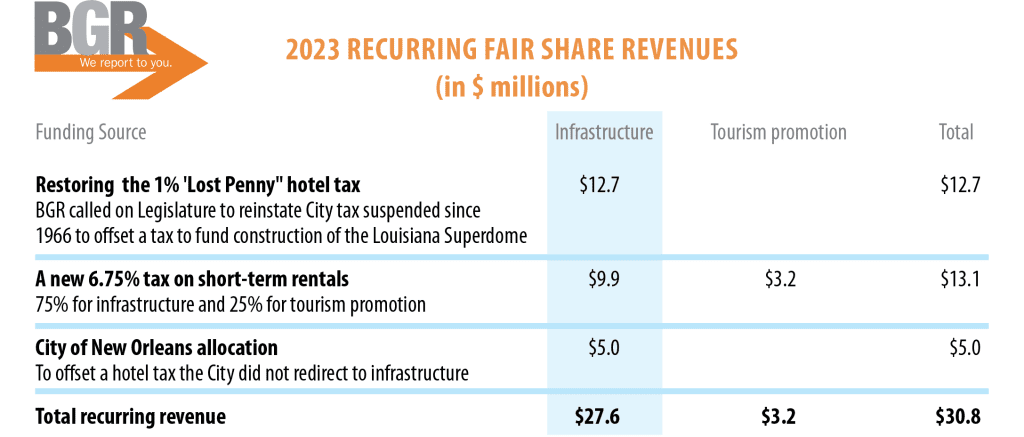
The revenue comes primarily from taxes on hotels and short-term rentals, with additional contributions from the City. All told, 2023 recurring revenue reached $30.8 million. This included $27.6 million for infrastructure that was divided between the Sewerage & Water Board ($21.9 million) and the City’s Department of Public Works ($5.7 million). The remaining $3.2 million was for tourism promotion and went to New Orleans & Company, a private nonprofit organization.

Table of 2023 recurring Fair Share revenue

KEY FINDINGS

  • The Sewerage & Water Board is using its Fair Share revenues to help fund critical upgrades to its electrical power, water meters, water treatment and other systems. It has so far committed $84 million of its Fair Share funding to these projects through 2025.
  • However, BGR found that a March 2024 ordinance adopted by the New Orleans City Council to solidify the City’s recurring allocation could be interpreted as limiting the utility’s future funding to drainage projects and reducing the overall amount. The ordinance’s author told BGR he plans to work with the City administration on an amendment clarifying that this was not the intent.
  • The Infrastructure Advisory Board – comprised of citizens appointed by the mayor and governor – provides effective oversight of the Sewerage & Water Board’s Fair Share expenditures. The advisory board’s role could expand to help the utility build public trust by reviewing its spending of any new funding it obtains from New Orleans residents and businesses for its vast infrastructure needs.
  • Public Works has used its Fair Share revenue to double annual funding for street maintenance to about $15 million. Still, this is less than a third of the $50 million the City estimates it needs to adequately maintain streets.
  • There are no public reporting requirements for the City’s use of Fair Share revenue by Public Works. Also, the City’s operating budget does not clearly track Fair Share spending. BGR had to conduct its own analysis to determine where the money went.
  • New Orleans & Company’s annual reports to the City on its use of short-term rental tax revenue lack sufficient detail on where the money went and the unspent balance.
  • The transfer of the “minor” drainage system to the Sewerage & Water Board from Public Works, planned for 2025, warrants a reassessment of the current 75%-25% split of Fair Share tax revenue split between the two entities.
  • Both the City and Sewerage & Water Board have substantial infrastructure maintenance needs that Fair Share cannot meet. These needs include adequately funding street and subsurface drainage maintenance, as well as fixing water pipe leaks and deferred maintenance on major drainage works.
  • Besides recurring revenue, the Fair Share deal provided $57 million in one-time funding from the New Orleans Ernest N. Morial Convention Center ($28 million), the State ($24 million) and the Downtown Development District ($5 million). The Convention Center and State funding went to the Sewerage & Water Board to help with emergency repairs and cash-flow problems in 2019. The DDD’s contribution will pay for drainage improvements in downtown New Orleans after Mardi Gras 2025.

SUMMARY OF BGR’S RECOMMENDATIONS

BGR concludes that there is a significant opportunity to enhance the impact of Fair Share and improve public transparency and accountability. BGR makes a series of recommendations in the report, which are summarized here:

  • The City Council should amend its March 2024 ordinance to clarify that it does not restrict all of the Sewerage & Water Board’s Fair Share funding to drainage projects, and that it should receive the full amount of the City’s annual allocation.
  • The Sewerage & Water Board and the City should review whether the current 75%-25% split of Fair Share tax revenues between the utility and the Department of Public Works is optimal given the utility’s new responsibility for the entire drainage system.
  • If the City redirects some or all of its Fair Share revenue to the Sewerage & Water Board, it should allocate a commensurate amount of additional General Fund revenues to Public Works to sustain the street maintenance gains it has made.
  • If Public Works retains its Fair Share revenues, the mayor and City Council should subject it to the same transparency and accountability measures that the Sewerage & Water Board faces.
  • New Orleans & Company should expand its annual reports to the City to fully account for its use of short-term rental taxes.
  • As the Sewerage & Water Board and City seek additional funding from New Orleans residents for unmet infrastructure needs, they should consider using the Infrastructure Advisory Board to provide oversight of those funds.
  • Future mayors should continue the executive order establishing the Infrastructure Advisory Board as long as it provides effective oversight of Fair Share dollars.
Previous Next