
BGR examines New Orleans’ drainage funding challenges and outlines what any future stormwater proposal must deliver to earn public trust.
OVERVIEW
 New Orleans faces significant and growing drainage challenges that existing funding sources cannot adequately address. The city relies primarily on property taxes to pay for drainage infrastructure, but those taxes have not kept pace with maintenance, repair, and capital needs. Decades of deferred investment have weakened the system at a time when storms are becoming more intense and frequent.
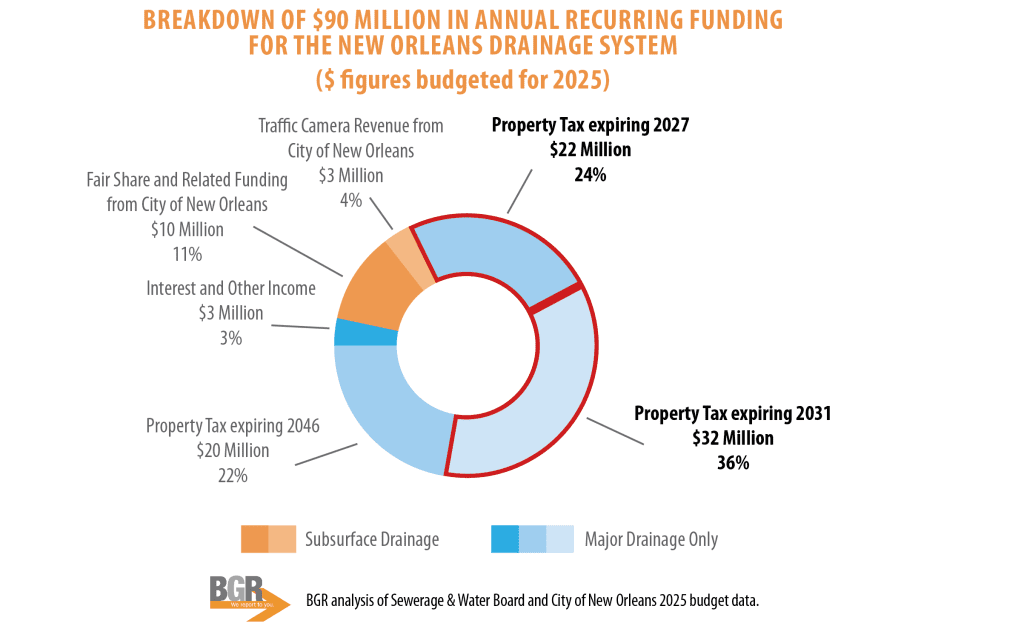
Compounding the challenge, about $54 million a year, or roughly 60% of the $90 million in current drainage revenue, is set to expire by 2031 unless voters renew two existing taxes. One tax worth approximately $22 million expires in 2027, and another worth about $32 million expires in 2031. Without action, loss of this revenue would undermine the city’s ability to manage stormwater and reduce flood risk.
In response, the Sewerage and Water Board of New Orleans is developing a proposal for voters, as soon as 2026, to approve a stormwater fee, along with a long-term extension of some or all existing drainage taxes. Because the utility has not released a formal proposal, BGR does not take a position in this report. Rather, BGR offers independent guidance on how the utility can craft fair, transparent and accountable stormwater funding for New Orleans’ drainage needs. Citizens and community groups can use this report to assess the future proposal.
A well-designed stormwater fee could provide a more stable and equitable funding source by making tax-exempt properties help support the drainage system and incentivizing property owners to control their runoff. However, the scale of New Orleans’ drainage needs, affordability concerns, and low public trust in the utility make careful design and oversight essential.
KEY FINDINGS
- Current drainage funding is insufficient and at risk. Preliminary estimates indicate that traditional drainage needs, from catch basins to pumping stations, could require $35 million to $60 million a year in new local funding, on top of the roughly $90 million currently budgeted. The Sewerage & Water Board has less than $7 million a year available to finance approximately $800 million in major drainage capital needs. And the 2025 transfer of the City of New Orleans’ subsurface drainage to the Sewerage & Water Board came with decades of deferred maintenance and little new funding. Further, long-term funding needs are not fully quantified for green infrastructure (rainfall retention projects designed to lighten the burden on pipes and pumps) or the City’s remaining street drainage functions.
- A stormwater fee could spread costs more fairly – but only if designed carefully. Unlike property taxes, a stormwater fee would broaden the base of payers. In 2025, 37% of New Orleans’ assessed property value is exempt from property taxes, even though those properties benefit from the drainage system. A fee based on impervious surface area, which means hard surfaces such as roofs and pavement, would better align charges with system use. A stormwater fee would represent a new cost for many property owners already strained by housing, insurance, and utility expenses. The Sewerage & Water Board has suggested a tiered structure for single-family homes, as well as a credit against property taxes paid, to improve affordability. But details remain limited. The utility continues to study how to avoid shifting drainage cost burdens in unintended ways, such as from high-value buildings to lower-value properties with little green space. Any tax-and-fee proposal will require clear justification, careful legal analysis, and strong public explanation.
- Louisiana law offers little guidance on fee transparency and accountability. Residents expect clear plans for fee credits, billing and collection, management and distribution of fee revenue, customer service and appeals. They also expect public reporting on both financial management and drainage system performance. Voters and City Council members have indicated they would consider a fee only if there is a clear plan for managing revenue, measuring results, and ensuring oversight.
DEVELOPING A STRONG PROPOSAL
New Orleans’ drainage system is fundamental to public safety, economic stability, and quality of life. BGR’s analysis shows that new local revenue will be necessary to address long-standing funding gaps and reduce flood risk. A stormwater fee offers a promising tool, but only if it is crafted with care. Before the Sewerage & Water Board issues a drainage funding proposal for public consideration, BGR recommends several steps, described more fully in the report, that the Sewerage & Water Board should take in coordination with the City:
- Develop an accurate, comprehensive and public spending plan. A spending plan for new drainage system revenue should identify system needs and set funding priorities for both the Sewerage & Water Board and the City, including gray and green infrastructure.
- Set up effective and transparent management of stormwater fee revenue. The strategy should cover how the Sewerage & Water Board and the City will lead planning for stormwater management and provide the public with an easy dashboard to track financial and system performance.
- Clearly justify any tax-and-fee combination. The utility should explain why retaining some property taxes is necessary to meet New Orleans’ drainage challenges, how its proposed approach meets legal standards, and how it compares with alternatives.
- Consider increasing the number of tiers in the stormwater fee structure to enhance fairness and affordability for homeowners. The use of tiers in a stormwater fee structure can deliver greater equity and affordability compared to a single flat rate.
- Enhance City Council and citizen oversight of drainage system revenue. The council should have a clear process for reviewing tax and fee funding requests and monitoring drainage system performance. A citizen-led stormwater advisory committee can support the council’s oversight.
By addressing these issues upfront, local leaders can offer voters a fair way to fill New Orleans’ extensive drainage funding gaps, while ensuring public dollars are used effectively and responsibly.