
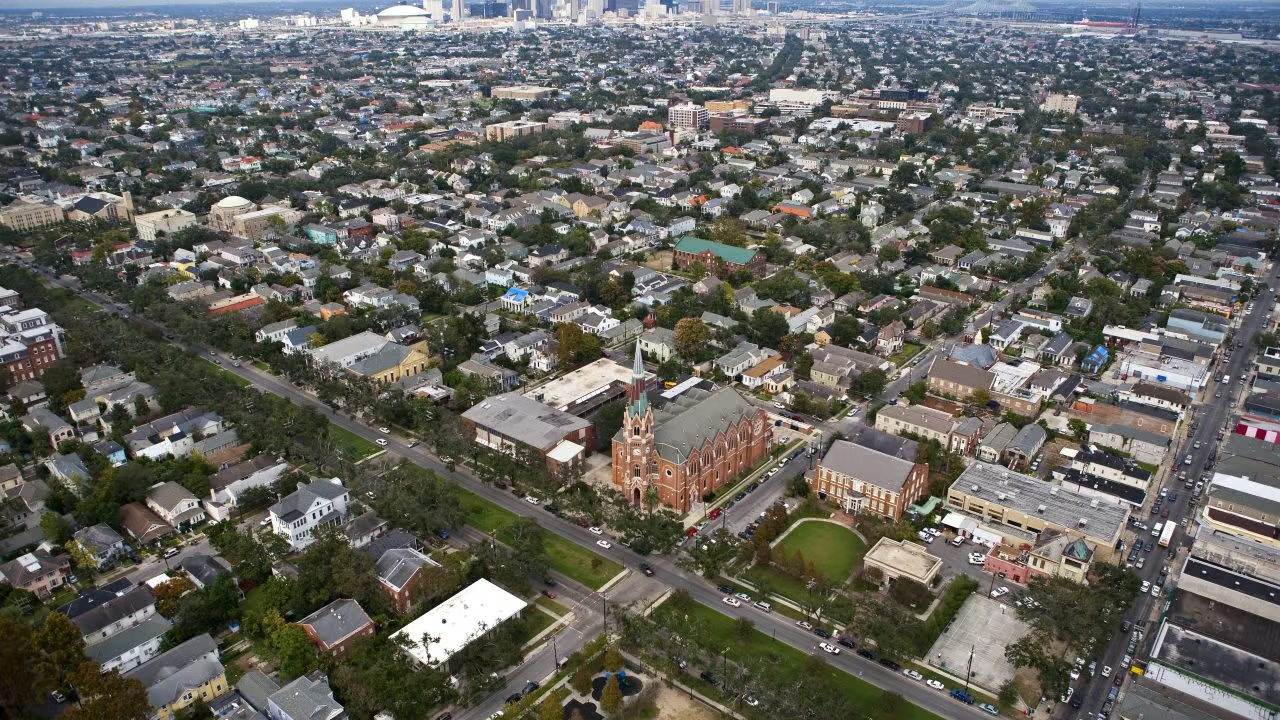
In 2025, $2.74 billion, or 37%, of New Orleans’ real estate assessed value was exempt from property taxes, a share that is probably among the largest nationally. BGR’s new report finds that exemptions remain a major structural constraint on the property tax base, which provides about half of all local tax dollars in New Orleans.
Read the Off the Rolls summary (PDF) | Read the full Off the Rolls report (PDF)
What Is Tax-Exempt Property?
Louisiana’s constitution exempts some property from property taxes, either entirely or in part. In New Orleans, that includes property owned by government, such as public schools, City Hall and federal buildings; property owned by nonprofits, such as universities, hospitals and churches; the first $75,000 of a home’s value for homeowners who live there, known as the homestead exemption; and some private developments that get tax breaks to encourage investment.
Many exemptions support important public goals. But when some property doesn’t pay, local governments have less money for services and infrastructure, and more of the cost shifts to the residents and businesses that do pay. Renters feel it too, because landlords pass much of their property tax costs on through rent.
This report is not a call to tax all exempt property. The central question is whether exemptions are producing benefits that justify their costs.
Key Dates for Exemptions and Infrastructure Funding
- 2027: A key property tax that pays for drainage expires unless voters renew it.
- Spring 2027: The legislative session is Louisiana’s next opportunity to consider tax exemptions.
- 2031: Another drainage property tax is set to expire. If both expire, 60% of the drainage system’s existing revenue is at risk.
What BGR Recommends
Because exemptions are written into Louisiana’s constitution, changing them takes a two-thirds vote of the Legislature and approval from voters. That makes practical action more important.
BGR’s top priority is a fee for infrastructure. City leaders should develop a fair, transparent and accountable fee proposal by 2027 for defined and prioritized infrastructure needs, such as drainage. Unlike a property tax, a fee can apply to all property owners, so owners of tax-exempt property could contribute to the infrastructure they rely on.
BGR also recommends:
- Statewide reporting. The Legislature should require assessors to report the value, type and ownership of exempt property.
- Regular review. The Legislature should require a review of the benefits and costs of property tax exemptions at least once a decade.
- A higher bar for new exemptions. The Legislature and local officials should not create or expand exemptions without analyzing the benefits and costs, including who would pay more as a result. Voters should reject proposals that do not provide clear analysis and justification.
- Consistent valuations. Parish assessors should work together on developing standard guidance for valuing exempt property, other than homesteads, and reporting it to the public.
- Stronger incentive policies. Local governments that grant development tax breaks should adopt written policies requiring a finding that each incentive is strategic, necessary, efficient, effective and fair.
- Better use of City property. The City of New Orleans should identify vacant or underused property it owns that could be put to more productive use.
Key Findings on Tax-Exempt Property in New Orleans
The exempt share is still large. It has fallen from 65% in 1996, when BGR first studied the issue, but 37% is probably among the largest shares nationally. Growth in taxable property value since Hurricane Katrina, along with post-Katrina reforms and anti-blight efforts, has flipped the shares of exempt and taxable real estate. Because New Orleans can’t expand its borders to add new taxable land, the fiscal pressure is greater.
The stakes are substantial. If all exempt real estate were taxable at 2025 rates, local governments in New Orleans could receive about $316 million more annually. If revenue stayed constant, the overall millage rate could have been about 32% lower. BGR presents these preliminary estimates only as an illustration of impacts that must be managed, not as a suggestion that every exempt property should be taxed. The community benefits of exempt property, such as reducing burdens on government or improving quality of life, should be weighed carefully in any policy decisions.
Exempt value is concentrated among major institutions. Much of the exempt value is held by large public and nonprofit owners, with public property accounting for 55%.
Public information is incomplete. Louisiana lacks a statewide exempt-property database, an essential tool for encouraging public transparency and accountability. The Orleans Parish Assessor corrected two errors BGR identified that inflated the value of tax-exempt real estate by $721 million.
The issue is not limited to New Orleans. Across the entire tax base, 33% of New Orleans’ assessed value is exempt, the second-highest share among six large Southeast Louisiana parishes, after Ascension Parish.
Frequently Asked Questions
How much property in New Orleans is tax exempt?
In 2025, 37% of New Orleans’ real estate assessed value, about $2.74 billion, was exempt from property taxes. That share is probably among the largest nationally.
What is the homestead exemption?
The homestead exemption covers the first $75,000 of a home’s value for homeowners who live there. It is one of several property tax exemptions in Louisiana’s constitution.
Who pays when property is tax exempt?
When some property doesn’t pay, local governments have less money for services and infrastructure, and more of the cost shifts to the residents and businesses that do pay. Renters feel it too, because landlords pass much of their property tax costs on through rent.
Should tax-exempt property be taxed?
BGR’s report is not a call to tax all exempt property. Many exemptions support important public goals. The central question is whether exemptions are producing benefits that justify their costs.
How has tax-exempt property in New Orleans changed since 1996?
In 1996, BGR found that 65% of New Orleans’ real estate assessed value was off the tax rolls. Growth in taxable property value since Hurricane Katrina, along with post-Katrina reforms and anti-blight efforts, has flipped the shares of exempt and taxable real estate.
What does BGR recommend?
BGR’s top priority is for City leaders to develop a fair, transparent and accountable fee proposal by 2027 for defined and prioritized infrastructure needs, such as drainage. BGR also recommends steps for the Legislature, parish assessors and local governments to strengthen reporting and accountability for exemptions.
Read the Report
Get the key takeaways in the Off the Rolls InBrief, or explore the details in the full report.
Read the Off the Rolls summary (PDF) | Read the full Off the Rolls report (PDF)