
In this On the Ballot report, BGR informs New Orleans voters about the May 3, 2025 property tax renewal proposed by the Orleans Parish Sheriff.
In this On the Ballot report, BGR informs New Orleans voters about the May 3, 2025 property tax renewal proposed by the Orleans Parish Sheriff.
On May 3, New Orleans voters will decide whether to renew a property tax for the Orleans Parish Sheriff’s Office at its current rate of 2.46 mills. The tax supplements funding from the City of New Orleans (City) for the operations, maintenance and upkeep of the Orleans Parish jail. If renewed, the tax will extend for 10 years from 2026 to 2035. Otherwise, the tax will expire this year. The tax would generate an estimated $12.7 million in 2026.
BGR prepared this report to provide voters with an independent, nonpartisan analysis to help them make an informed decision on the tax renewal. The report’s analysis poses three key questions: (1) Has the Sheriff’s Office carefully planned how it will spend the tax revenue and provide financial stewardship and accountability for public dollars? (2) Is the tax renewal an acceptable way to fund the purposes in light of alternative funding options? (3) Is there evidence that the tax renewal would result in effective outcomes for the public?
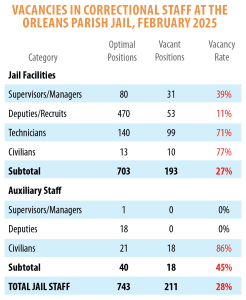
FOR. This 2.46-mill property tax provides a stable source of funding for the Orleans Parish jail, which has a long road ahead to reform. Renewing the tax would help the Orleans Parish Sheriff’s Office maintain current staffing levels as it seeks ways to address high turnover and vacancy rates. The tax would also continue facility maintenance and programs to assist people in custody with rehabilitation. These investments can help improve conditions and safety at the jail, achieve cost savings for the public, and support broader public safety gains. These efforts are also important to comply with federal court-ordered reforms. While compliance regressed during and since the pandemic, the Sheriff’s Office has put in place a strategic plan and related initiatives to reverse that trend. The tax could help sustain these efforts and avoid saddling the City with a substantial new budget obligation on top of other competing needs. BGR notes the taxing authority, called the Orleans Parish Law Enforcement District, suffers from a basic lack of transparency and accountability due to its sole control by the Sheriff. The Sheriff’s Office must take steps to offset those flaws. It should regularly report on tax expenditures, as it plans to do, and its progress toward improving jail compliance, performance and outcomes. It should also use its regular meetings with the City Council to present that information to the public. These steps would enhance the reporting already available to the public on the Sheriff’s Office website and support the effective use of taxpayer dollars.
If voters renew the tax, it will keep the jail operating at its current level, but it is not a long-term fix for the jail’s existing and future funding challenges. These include pay increases to stabilize jail staffing and operating costs for the new Phase III mental health and medical services facility. As BGR has recommended, the Sheriff, the mayor and the City Council must reach an agreement for long-range planning and budgeting processes to support stable and adequate jail funding. This is essential to regain and sustain momentum on the reforms.
This report is part of BGR’s On the Ballot series, which provides voters with independent, nonpartisan analysis of significant ballot propositions in the New Orleans metropolitan area. In producing these reports, BGR recommends positions consistent with its mission of promoting informed public policy making and the effective use of public resources to improve local government. On the Ballot reports highlight the strengths and weaknesses of ballot propositions and assess the potential for government expenditures or actions to efficiently achieve beneficial outcomes for citizens.
BGR’s updated dashboards explain how local property tax rates are changing as homeowners review their tax bills. 2026 Property Tax Dashboard As homeowners across the region review their property tax bills, new data from BGR’s Property Tax Dashboards provides an updated picture of local property tax rates in St. Tammany, Orleans, and Jefferson parishes. The […]
BGR examines New Orleans’ drainage funding challenges and outlines what any future stormwater proposal must deliver to earn public trust. OVERVIEW New Orleans faces significant and growing drainage challenges that existing funding sources cannot adequately address. The city relies primarily on property taxes to pay for drainage infrastructure, but those taxes have not kept pace […]
In this report, BGR examines three separate propositions on the November 15, 2025, ballot that would authorize the City of New Orleans to borrow a total of $510 million for capital improvements.
This Beyond the Ballot report enhances public transparency and accountability for the 2019 New Orleans bond authorization and helps residents understand its uses and impacts.
The reform and modernization of local government is a lasting legacy of Hurricane Katrina. By envisioning positive change and reforming local government, residents, advocates and policymakers created a better future for Greater New Orleans. BGR is proud to have been a leader in these efforts with our independent, nonpartisan research and monitoring. On the 20th […]
BGR’s Candidate Q&A reports ask the candidates for mayor, City Council and sheriff in the October 11, 2025 primary election to explain how they will address important public policy issues if elected. BGR developed the questions based on our body of research. Many of these issues have close ties to concerns that voters themselves have […]
Public outrage over the brazen escape of 10 men from the Orleans Parish jail is a clear call for the Orleans Parish Sheriff’s Office and the City of New Orleans to squarely face chronic problems plaguing the jail. While seven escapees remain at large as of midday May 19, BGR strongly urges public officials to […]
In this On the Ballot report, BGR informs New Orleans voters about the May 3, 2025 property tax renewal proposed by the Orleans Parish Sheriff.
The Bureau of Governmental Research (BGR) has updated its interactive Property Tax Dashboards with the latest rates for Jefferson, Orleans and St. Tammany parishes. First launched at the beginning of 2024, the dashboards help residents, business owners and policymakers navigate the complexities of property tax rates, taxing bodies and dedicated purposes across the three parishes. […]
This report analyzes the impact of the 2019 “Fair Share” deal to direct new tourism dollars to maintain streets, drainage and other infrastructure in New Orleans. BGR finds that the deal is delivering on its promise, with opportunities for improvement.
Property taxes are a basic means of financing local government, but the public faces a confusing array of tax rates, taxing bodies and dedicated purposes across the New Orleans region. To help explain these taxes, the Bureau of Governmental Research (BGR) today launched an interactive, online tool. BGR’s property tax dashboards for Jefferson, Orleans, and St. Tammany […]
In a November 28 letter to the City Council, BGR recommends that the council create a formal process to objectively evaluate S&WB funding proposals for the city’s water, sewer and drainage systems. BGR also recommends that the council develop a stronger framework for oversight that relies more on regular accountability, instead of the council’s control […]
This BGR NOW report urges the City of New Orleans and the Orleans Parish Sheriff to resolve a long-running disagreement over funding the jail. The dispute flared anew last fall when the City Council denied the Sheriff’s request for a $12.4 million funding increase. Voters subsequently rejected a Sheriff’s Office proposal to increase its property […]
OVERVIEW These On the Ballot reports inform New Orleans voters about three propositions on the October 14, 2023 ballot: the renewal of a property tax for public school facilities and charter amendments on code enforcement and the City budget process. The Orleans Parish School Board is seeking to renew a property tax of up to 4.97 […]
OVERVIEW This BGR NOW report discusses concerns that the Orleans Parish Sheriff’s Office and New Orleans City Council have raised about the planned Phase III facility to provide mental health care and medical services at the Orleans Parish jail. Their issues include design elements that may not be suitable for incarcerated persons with mental illnesses […]
OVERVIEW This On the Ballot report studies the Orleans Parish Sheriff’s proposed property tax increase that New Orleans voters will decide on April 29, 2023.
OVERVIEW BGR’s report highlights how a more cooperative relationship between the Orleans Parish Sheriff and the City of New Orleans is essential to end more than 50 years of federal oversight of the jail and sustain recent performance gains.
OVERVIEW This report is intended to help New Orleans voters make an informed decision on whether to approve a new 5-mill, 20-year property tax dedicated to programs and capital investments that provide childcare and educational opportunities for children who have not yet entered kindergarten.
OVERVIEW This On the Ballot report provides St. Tammany voters with background and analysis of an April 30, 2022, proposition to authorize the District Attorney to levy a 0.14% sales tax to fund the office’s criminal prosecutions in the parish. If approved, the tax would begin July 1 and run for 10 years.
OVERVIEW On the Ballot: New Orleans Library and Housing Taxes, December 11, 2021 provides New Orleans voters with independent analysis of the library and housing property tax propositions on the December 11 ballot citywide. Both taxes would take effect in 2022 and run for 20 years. Each would replace an existing property tax that expires […]
OVERVIEW On the Ballot: St. Tammany Parish Sales Tax Proposition, November 13, 2021, provides St. Tammany Parish voters with an independent analysis of a proposed 0.4% sales tax to provide funding for the state-mandated responsibilities of parish government. These obligations include providing the parish jail and courthouse, as well as financial and operational support to […]
OVERVIEW In August, the New Orleans City Council excluded hotel room rentals from a new sales tax for enhanced public safety in the French Quarter despite questions about whether the exclusion is permissible under state law. While BGR has not taken a position on the legal issues, this BGR NOW report identifies several compelling policy […]
OVERVIEW BGR’s report, On the Ballot: French Quarter Sales Tax, April 24, 2021, is intended to help French Quarter voters make an informed decision on a proposition for a 0.245% sales tax to pay for supplemental police patrols and other public safety services. The tax would take effect July 1 and remain in place for […]
OVERVIEW On the Ballot: French Quarter Sales Tax Renewal, December 5, 2020 is intended to help French Quarter voters make an informed decision on a proposition to renew a 0.2495% sales tax to pay for supplemental public safety services. The proposition would extend the tax – set to expire at the end of 2020 – for […]
OVERVIEW On the Ballot: New Orleans Property Tax Propositions, December 5, 2020 analyzes three propositions to replace several City of New Orleans property taxes that expire at the end of 2021. The replacement taxes would have the same combined rate of 5.82 mills as the existing taxes. However, the propositions would change the tax dedications. […]
OVERVIEW With the public getting its first look at this year’s property tax assessment rolls beginning July 15, 2020, this edition of PolicyWatch re-urges BGR’s recommendations on property valuation practices in New Orleans. It also revisits an unusual funding formula that generates large surpluses for the Orleans Parish Assessor’s office at the expense of other […]
OVERVIEW Welcome to the inaugural edition of PolicyWatch, a periodic newsletter that draws on BGR’s body of independent, nonpartisan research to address current public policy issues. This edition focuses on the City of New Orleans’ finances as it faces a pandemic-induced budget deficit. It discusses the City’s proposal to borrow up to $100 million as […]
OVERVIEW Assessing the Assessor: Progress on Property Assessment Reform in New Orleans evaluates whether and to what extent New Orleans’ property assessment system has improved under the single parish assessor since he replaced the seven-assessor system in 2011.
OVERVIEW As the City Council reviews the proposed $722 million 2020 operating budget, BGR Now: A Framework for Assessing New Orleans’ Proposed 2020 Budget outlines key findings of BGR’s recent City budget study to help inform citizens and policymakers. BGR’s study, A Look Back to Plan Ahead, analyzes growth in revenues and changes in expenditures […]
Overview On the Ballot: New Orleans Bond and Tax Propositions, November 16, 2019 studies three propositions to let the City issue bonds for capital improvements, levy a new tax for maintenance, and levy a new tax on short-term rentals. If voters approve, the City of New Orleans would be able to: Issue up to $500 […]
Overview A Look Back to Plan Ahead: Analyzing Past New Orleans Budgets to Guide Funding Priorities reviews a decade of City General Fund budgets. It also lays a foundation for examining potential opportunities to reallocate revenue to critical needs.
Overview On the Ballot: Housing Tax Exemptions in New Orleans, October 12, 2019 reviews Constitutional Amendment No. 4, which would allow the City of New Orleans to exempt from taxation properties with up to 15 residential units located within Orleans Parish to promote affordable housing. This report is the latest in BGR’s On the Ballot series, […]
In this letter to the Mayor and City Council, BGR suggests the City of New Orleans develop a strategy to requalify for tax-exempt status for future bond issues. This would save interest costs for taxpayers financing infrastructure and other capital projects. Discovering the Issue While conducting research for a report on the City’s budget, BGR […]
Overview The $1 Billion Question Revisited: Updating BGR’s 2015 Analysis of Orleans Parish Tax Revenues breaks down 2019 projected local tax revenue by recipient and by purpose to help assess current funding priorities and identify options to redirect tax revenues to needs.
Overview The report analyzes a May 4, 2019 tax proposition in New Orleans to replace three existing taxes for parks and recreation totaling 6.31 mills with a single tax at the same rate. Voter approval would not result in a tax increase. The three existing taxes fund the Audubon Zoo (0.32 mills), the Audubon Aquarium […]
Overview On March 30, 2019, New Orleans voters will decide whether to approve a new property tax for elderly services, programs and other assistance. If approved, the tax will be levied citywide at a rate of 2 mills for five years, beginning in 2020. The tax would generate $6.6 million in the first year. BGR’s […]
Overview In this report, BGR compares Orleans Parish hotel taxes to best practices for taxation as well as state and national norms, focusing primarily on the share of revenue available for general municipal purposes.
OVERVIEW Today BGR releases three reports on Jefferson Parish tax renewals for drainage works, juvenile services, and animal shelter and health services that voters will consider on November 6, 2018. If approved, each tax would be renewed for 10 years, from 2021 to 2030. On the Ballot: Jefferson Drainage Property Tax Renewal Voters in Jefferson […]
OVERVIEW This On the Ballot report reviews a constitutional amendment on the November 6, 2018 ballot that would allow eligible homeowners to phase in an increase in property taxes resulting from a reappraisal. The four-year phase-in process would apply only to residential properties subject to the homestead exemption that increase in assessed value by more […]
OVERVIEW This report is the latest installment in BGR’s Candidate Q&A Election Series. The new report consolidates and reissues the responses of the newly elected City of New Orleans mayor and councilmembers who completed BGR’s surveys last fall on important issues facing City government. We encourage citizens to revisit the issues by reviewing the BGR […]
OVERVIEW BGR examines the March 24, 2018 propositions asking St. Tammany voters to decide whether to renew two separate parishwide sales taxes for the parish courthouse (the Justice Center) and the parish jail, which is operated by the St. Tammany Parish Sheriff.
Overview BGR’s On the Ballot report analyzes the proposed 10-year renewals of three existing property taxes for New Orleans public schools that voters will decide on October 14, 2017.
Overview For the October 14, 2017 primary elections in New Orleans, BGR provided voters with its 2017 Candidate Q&A Election Series. BGR submitted questions to all mayoral and City Council candidates on public safety, infrastructure and other important public policy issues facing the City of New Orleans government. BGR compiled the answers of the candidates who […]
Overview Paying for Streets: Options for Funding Road Maintenance in New Orleans explores ways to fund the routine maintenance necessary to safeguard the City’s $2 billion, once-in-a-lifetime capital investment in the street network.
Overview Beneath the Surface: A Primer on Stormwater Fees in New Orleans explores a funding mechanism for drainage that is expanding in usage nationwide as an alternative to ad valorem property taxes.
Overview BGR reviews two property tax propositions on the ballot in New Orleans on December 10, 2016: a tax increase for fire protection services for the City of New Orleans and a tax renewal for the Sewerage & Water Board’s drainage system.
Overview In Convention Center Bill Highlights Need to Rethink Local Taxation, BGR addresses a bill that would grant taxing authority to the New Orleans Ernest N. Morial Convention Center’s economic development district. The release calls for a comprehensive re-evaluation of Orleans Parish taxes, with an eye toward aligning tax revenues with the city’s most pressing needs.
Overview BGR explains and analyzes two tax propositions in New Orleans on April 9, 2016: one for street work and other improvements, and a second for the police and fire departments.
Overview In The $1 Billion Question: Do the Tax Dedications in New Orleans Make Sense? BGR presents a comprehensive picture of where local tax dollars are going in Orleans Parish. The report provides breakdowns of tax dedications by entity and by purpose, and gives examples of problems that can arise when tax dedications are established […]
Overview BGR analyzes two property tax propositions meant to sustain west bank flood protection systems and three proposed St. Tammany charter amendments before voters on November 21, 2015. The tax propositions include a new tax for the West Jefferson Levee District and a tax renewal for the Algiers Levee District in New Orleans. Both levee […]
Overview This On the Ballot report informs voters in the October 24, 2015 election about a proposed quarter-cent sales tax for public safety in New Orleans’ French Quarter and a constitutional amendment allowing the State of Louisiana to invest in an infrastructure bank.
Overview BGR analyzes proposed property taxes for the Orleans Parish Sheriff’s Law Enforcement District, the New Orleans Public Library system and the Lake Borgne Basin Levee District in St. Bernard Parish. Voters in New Orleans and St. Bernard Parish will decide the propositions on May 2, 2015. The Lake Borgne Basin Levee District is governed […]
Overview This release discusses the Louisiana Supreme Court’s refusal to hear BGR’s lawsuit seeking public access to the records and meetings of a committee charged with re-assessing the number of judges needed at each of the state’s courts. The release follows up on BGR’s 2013 report, Benchmarking the Bench, which reviewed civil, criminal and other courts […]
Overview BGR reviews a proposed property tax for the upkeep of public school facilities in New Orleans and 11 propositions to amend the Jefferson Parish charter that voters will decide on December 6, 2014. The charter propositions relate to: Modifying the Jefferson Parish Council’s authority to investigate parish affairs Limiting the outside employment of the […]
Overview BGR examines two proposed amendments to the Home Rule Charter of the City of New Orleans, one Orleans Parish property tax proposition and two constitutional amendments on the ballot for November 4, 2014. One City charter amendment would incorporate certain professional services contracting reforms made in 2010. The other charter amendment would move the […]
On July 22, 2014, hundreds of citizens and a number of government officials turned up at a citywide meeting hosted by the Fix My Streets campaign and the Lakeview Civic Improvement Association to discuss options for addressing New Orleans’ bumpy street network. The dialogue centered on the need to determine the condition of city streets, […]
Overview In this release, BGR points out that the Supreme Court committee charged with re-assessing the number of judgeships at each of the state’s courts appears to be positioning itself to punt on the matter – at the public’s expense. The release follows up on BGR’s 2013 report, Benchmarking the Bench, which reviewed civil, criminal and […]
Overview In this release, BGR calls on the Supreme Court committee that is reviewing court efficiency to conduct its work in an open and transparent manner. It also urges the committee to act in a timely fashion. The release follows up on BGR’s 2013 report, Benchmarking the Bench, which reviewed civil, criminal and other courts in […]
Overview BGR presents data on the estimated need for judgeships in Orleans Parish and recommends steps for right-sizing the courts in Benchmarking the Bench: Are Public Dollars Being Wasted on Excess Judgeships in Orleans Parish? Courts discussed in the report include Civil District Court, Criminal District Court, Juvenile Court, Municipal Court, Traffic Court, and First and […]
Overview In this release, BGR examines a 2013 legislative proposal to authorize a hotel assessment in New Orleans. For hotel guests, the assessment would be the functional equivalent of a new hotel tax.
Overview In On the Ballot: November 6, 2012, BGR examines three proposed constitutional amendments, two propositions pertaining to multiple parishes in the New Orleans area, a proposed change to the City of New Orleans charter and two local tax propositions. The three constitutional amendments would strengthen gun rights, provide an additional homestead exemption to spouses […]
Overview BGR examines charter amendments, tax propositions and state constitutional amendments on the October and November 2011 ballots. The October 22 ballot includes a Jefferson Parish charter amendment to establish the Office of Inspector General and an Ethics and Compliance Commission, as well as a related property tax to fund both entities. It also includes […]
Overview On the Ballot: Jefferson Parish, April 30, 2011 examines four proposed tax renewals. One is a sales tax renewal for the Jefferson Parish Public School System. The other three are property tax renewals that support Jefferson Parish drainage, juvenile services, and a combination of the Parish’s animal shelters and public health facilities and the […]
Overview The Bureau of Governmental Research made presentations before the New Orleans Tax Fairness Commission on February 3, 2011 and February 23, 2011. The first presentation, Taxation in New Orleans, examines the City’s tax picture, with particular emphasis on property taxes. It provides an overview of the tax structure and discusses issues related to exemptions […]
Overview On November 24, BGR sent a letter to the Mayor and City Council on the proposed 2011 budget for the City of New Orleans. The letter contains suggestions that would free up millions of dollars.
Overview In Rolling Forward: The Complete Picture, BGR provides a composite picture of citywide property tax rates in New Orleans, the capacity of various taxing entities to increase those rates, and the potential cost to property owners. The report also explains the “roll forward” process following a property assessment.
BGR analyzes 10 State constitutional amendments on the ballot for November 2, 2010. The amendments concern a wide variety of issues, including: Salary increases for elected officials Allocation of State of Louisiana severance taxes Property tax exemption for disabled veterans Limiting tax increases for non-elected taxing authorities Extending the period following a disaster for retaining […]
Overview In The Price of Civilization: Addressing Infrastructure Needs in New Orleans, BGR provides information on New Orleans’ core infrastructure needs – including streets, the systems of the Sewerage & Water Board of New Orleans, schools and the Orleans Parish jail – and assesses the community’s capacity to fund those needs.
Overview In Forgotten Promises: The Lost Connection Between the Homestead Exemption and the Revenue Sharing Fund, BGR examines the decline of the State of Louisiana’s funding mechanism for compensating local taxing bodies for the costs of the homestead exemption. The report provides data on compensation for New Orleans, Jefferson Parish and St. Tammany Parish.
Overview As the campaign for the city’s soon-to-be consolidated assessor’s office begins, BGR releases In All Fairness: Building a Model Assessment System in New Orleans. The report explains what the new citywide assessor must do to create a fair, efficient and transparent property tax assessment system in Orleans Parish.
Overview Street Smarts: Maintaining and Managing New Orleans’ Road Network provides an overview of street management systems in general and examines the challenges New Orleans faces in maintaining its streets. It concludes with recommendations to improve street maintenance and management in New Orleans.
Overview In On the Ballot: New Orleans, October 2008, BGR provides analysis and takes positions on two ballot propositions: one to issue bonds through the Sheriff’s Law Enforcement District for Orleans Parish criminal justice facilities and another to protect the newly created Office of Inspector General in New Orleans.
Overview On the Ballot: Orleans Parish School Tax Renewals provides an overview of four New Orleans school property tax millages up for voter renewal on July 19, 2008. The taxes support basic operations and maintenance, among other needs.
Overview This On the Ballot report analyzes proposed constitutional amendments of particular significance to the New Orleans region. This issue covers amendments before voters on November 7, 2006. This report focuses on five amendments that address issues relevant to the New Orleans area. These amendments deal with property taxes, the juvenile court system, and assessors. […]
Overview BGR analyzes two of four state constitutional amendments that will appear on the November 2, 2004, ballot. The two amendments would modify the homestead exemption and the veterans’ preference to apply for civil service positions. In addition, BGR provides voters in New Orleans with information on a proposed $260 million bond issue and Jefferson […]
Overview On February 2, 2002, the voters of New Orleans will consider a proposition to authorize the extension of the property tax millage for the New Orleans Business and Industrial District. The district has since been renamed the New Orleans Regional Business Park.
Overview This report presents BGR’s analysis of the Downtown Development District’s tax and bond proposal on the ballot for April 7, 2001 in New Orleans.
Overview This report presents BGR’s analysis of ballot propositions to allow the issuance of general obligation bonds of $150 million by the City of New Orleans and $27 million by the Orleans Parish Law Enforcement District. Although the Criminal Sheriff governs the district, the bond proposal would raise funds for the sheriff, the district attorney […]
Overview This issue of the Outlook series examines the capital budget process of the City of New Orleans and critiques the implementation of the 1995 voter-approved building program.
Overview This report provides a short analysis of the potential creation of three separate neighborhood-based special tax districts in New Orleans and a recommendation on two proposed amendments to the Louisiana Constitution relative to the governance of higher education. The neighborhood districts will provide additional funding for enhanced security and in some cases, beautification and […]
Overview This report provides a short analysis of the proposal to levy a one-mill ad valorem property tax in New Orleans to fund the offices of the Orleans Parish Assessors.
Overview This report provides a synopsis and short analysis of all 18 proposed amendments to the Louisiana Constitution on the October 3, 1998, election ballot. The topics include assessment freezes for senior citizens and properties undergoing restoration, as well as parish severance tax allocations and remediation of blighted property: Establishes community college system Increases parish […]
Overview This report is the fourth in BGR’s program of governmental oversight and monitoring of Jefferson Parish governments. This report provides updated budgetary information on the Parish Council, District Attorney and Sheriff.
BGR has released an update to its 2026 Property Tax Dashboards, providing an up-to-date look at property tax rates in St. Tammany, Orleans, and Jefferson parishes. The latest data shows that property tax rates declined again in St. Tammany...
The Bureau of Governmental Research (BGR) released a new report today examining the Sewerage & Water Board’s effort to develop a drainage funding proposal that can keep up with New Orleans’ growing needs. At a time when storms are becoming more...
Today the Bureau of Governmental Research (BGR) released two reports providing independent, nonpartisan analysis to New Orleans voters on propositions in the November 15 election. Early voting begins Saturday, November 1. On the Ballot: $510 Million New Orleans Capital...
Today the Bureau of Governmental Research (BGR) released Beyond the Ballot: Analyzing Spending and Impacts of the 2019 New Orleans Bond Authorization. The report finds that the City of New Orleans raised a total of $589.6 million for capital improvements...
New Orleans is at an inflection point. The city is losing businesses and residents, with many saying they simply cannot afford to live here anymore. They point to a wide array of culprits: not enough good jobs, not enough...
Candidates for sheriff are laying out plans to take charge of the Orleans Parish jail, offering their visions for financial planning, staff recruitment and the care of, and programming for, incarcerated people. While the May 16 jailbreak has loomed...
Day 2 of the MLB draft wrapped up Monday, and now several Louisiana college ballplayers know where they’ll be continuing their careers. Nine LSU prospects were selected along with three from Tulane, and a handful more from Southern, Southeastern...
Voters will head to the polls in October to decide New Orleans’ municipal elections, with the seats of the Mayor, City Council and Orleans Parish Sheriff being the major positions up for grabs. In our quest to remain a...
Twenty years after Hurricane Katrina devastated New Orleans, BGR’s June 18 Breakfast Briefing discussed the disaster’s lasting impact on local government reform—and what lessons public officials and citizens can use to inspire future change. This event was free to...
The reform and modernization of local government is a lasting legacy of Hurricane Katrina. By envisioning positive change and reforming local government, residents, advocates and policymakers created a better future for Greater New Orleans. BGR is proud to have...
On May 16, ten inmates escaped from the Orleans Parish Prison through a hole cut in the wall. Even though they ran in front of a security camera, they were not immediately seen escaping because the deputy in charge...
NEW ORLEANS — The trial over millions of dollars the Orleans Parish School Board claims it is owed by the city of New Orleans has been delayed after a judge ruled that an essential party is missing from the...
* BGR released a report with recommendations on how to improve the New Orleans jail. Let’s break it down * Councilmember Joe Giarrusso on the big power outage Sunday and why Entergy was given barely...
It’s good that Orleans Parish Sheriff Susan Hutson is now taking “full accountability” for the mass breakout from the jail she runs, and calling it what it is: an epic failure that played out on her watch. You know...
NEW ORLEANS (WVUE) – Louisiana Attorney General Liz Murrill toured the Orleans Justice Center jail on Wednesday (May 21) and laid out the scale of the facility’s damaged or defective lock issues. “There’s probably 160 of them – doors...
Sheriff Susan Hutson, who oversees the New Orleans jail from which 10 inmates escaped last week, suspended her reelection campaign Tuesday, hours after she apologized to the City Council amid mounting calls for her resignation and questions about her...
NEW ORLEANS (WVUE) – Amid the search for the remaining New Orleans jail escapees, a government watchdog released a new report urging the sheriff and the city to work together to address the jail’s needs. The Bureau of Governmental...
Public outrage over the brazen escape of 10 men from the Orleans Parish jail is a clear call for the Orleans Parish Sheriff’s Office and the City of New Orleans to squarely face problems plaguing the jail. While seven...
The search for six escaped inmates in New Orleans has entered its fourth day after a total of 10 inmates escaped from the Orleans Parish Jail early Friday. Four of the 10 have been captured. The Orleans Parish Justice...
BATON ROUGE, La. (WVUE) – A proposal to increase Louisiana’s homestead exemption for the first time in more than four decades is gaining traction at the State Capitol. The measure, authored by Rep. Matt Willard (D-New Orleans), would allow...
With the outcome hinging on just two votes, on May 3, 2025, Orleans Parish voters narrowly approved the renewal of a critical 10-year property tax for the Sheriff’s Office. The final tally stood at 12,715 in favor and 12,713...
By an almost surreal, historically close margin, Orleans Parish voters appeared to hand Sheriff Susan Hutson a huge reprieve Saturday, approving what Hutson described for months as a critical renewal of a tax that funds around a fifth of...
Signs saying “No New Taxes” and calling for New Orleans residents to vote against a tax renewal have been popping up around the city…but they’re inaccurate. Tommy talks with Rebecca Mowbray and Nate Pabon-Trinidad from the Bureau of Government...
Voters in about half of Louisiana’s parishes will go to the polls Saturday to elect officials and decide on various ballot proposals. Several parishes will hold runoff elections from municipal or special primaries held in March. Others will vote...
Voters in Orleans and Jefferson parishes head to the polls Saturday to make selections on local races and determine how some property tax dollars get spent. Why it matters: Turnout is traditionally pretty low for these hyperlocal elections, so...
Mysterious campaign signs have cropped up around New Orleans that falsely attack a tax renewal from the Orleans Parish Sheriff’s Office, leaving Sheriff Susan Hutson scrambling to correct the record before the referendum goes to a vote next Saturday....
On May 3, New Orleans voters face a critical decision: Will we invest in making our city safer, more just, and more humane OR allow vital public safety systems to collapse under the weight of political theater? The ballot...
NEW ORLEANS (WVUE) – Orleans Parish Sheriff Susan Hutson held a press conference flanked by supporters to urge New Orleans voters to approve a proposed millage renewal, even as signs positioned around the city suggest opposition. No one has...
Voters in New Orleans are being asked on the May 3 ballot to extend a millage collected by the Orleans Parish Sheriff’s Office for 10 years. We recommend a “yes” vote. The millage is a renewal, so unlike the...
NEW ORLEANS — If you live or work in New Orleans, you’ve probably seen signs saying, “No New Taxes” and urging city voters to reject a property tax on May 3. Those signs and their message are a lie....
Orleans Parish Ballot MeasuresPW Law Enforcement District2.46 Mills Renewal – Sheriff – 10 Yrs. Shall the Sheriff of Orleans Parish, as the governing authority of the Law Enforcement District of the Parish of Orleans, State of Louisiana (the “District”),...
The name “Orleans Parish Prison” still stirs outrage in New Orleans, even after its rebranding as the Orleans Justice Center. From the abandonment of inmates during Hurricane Katrina to the federal consent decree still in place today, the jail...
NEW ORLEANS — The Orleans Parish Sheriff is urging voters to renew a current tax mileage on the May 3 ballot. Sheriff Huston says the money from the millage will go toward critical programs, maintenance and staffing. The law...
Orleans Parish Sheriff Susan Hutson is asking voters in the May municipal elections to renew a 10-year-old tax that provides a significant chunk of the budget for her overcrowded and understaffed jail. Hutson has been attempting to raise more...
Today, the Bureau of Governmental Research (BGR) released On the Ballot: Orleans Parish Sheriff’s Office Tax Renewal, May 3, 2025. The report provides an independent, nonpartisan analysis of a proposition to renew an existing 2.46-mill property tax for the...
Early 20th-century novelist Thomas Wolfe wrote, “You can’t go home again.” Dorothy Gale, in “The Wizard of Oz,” though, said, “There’s no place like home.” Wolfe was wrong and Dorothy was right. Forty years after starting as a sports...
NEW ORLEANS (press release) – The Bureau of Governmental Research (BGR) updated its interactive Property Tax Dashboards with the latest rates for Jefferson, Orleans and St. Tammany parishes. The update reveals most millage rates were lowered in Jefferson and...
The Bureau of Governmental Research (BGR) has updated its interactive Property Tax Dashboards with the latest rates for Jefferson, Orleans and St. Tammany parishes. First launched at the beginning of 2024, the dashboards help residents, business owners and policymakers...
Five years after New Orleans Mayor LaToya Cantrell struck a historic deal to direct tourism-related taxes to city infrastructure needs, a good government watchdog finds that her “fair share” arrangement has delivered needed recurring funding for critical infrastructure projects. The...
This article is no longer available online. Please review BGR’s report here: https://www.bgr.org/report-index/bgr-analyzes-impact-of-fair-share-deal-for-new-orleans-infrastructure/
NEW ORLEANS — This week, the Bureau of Governmental Research (BGR), a private, nonprofit, independent research organization dedicated to informed public policy making and the effective use of public resources, released a detailed report assessing the impact of the...
Today, the Bureau of Governmental Research released a report analyzing the impact of the 2019 “Fair Share” deal to direct new tourism dollars to maintain streets, drainage and other infrastructure in New Orleans. BGR finds that the deal between the City...
The Bureau of Governmental Research (BGR) won three awards from its peer organizations in the Governmental Research Association (GRA) at its national conference July 21-23 in Asheville, N.C. BGR’s 2023 report calling for governance reforms for the Sewerage and...
To help explain these taxes, the Bureau of Governmental Research (BGR) launched an interactive, online tool.
About an hour north of Jackson, Miss. the Justice Department is investigating a small town’s police force. The allegations? Unlawful stops, retaliation, racist roadblocks and excessive force. As the Gulf States Newsroom’s Kat Stromquist reports, residents still worry they...
BGR President and CEO Becky Mowbray discussed our new Property Tax Dashboards on WWL Radio with host Tommy Tucker. Although the audio clip is no longer available online, you can click here to explore the dashboards.
NEW ORLEANS — From the Bureau of Governmental Research: Property taxes are a basic means of financing local government, but the public faces a confusing array of tax rates, taxing bodies and dedicated purposes across the New Orleans region....
NEW ORLEANS (WGNO) — The Bureau of Governmental Research released a new online dashboard designed to help residents in Orleans, Jefferson and St. Tammany parishes better understand their property taxes. According to the BGR, the dashboard serves as an...
Property taxes are a basic means of financing local government, but the public faces a confusing array of tax rates, taxing bodies and dedicated purposes across the New Orleans region. To help explain these taxes, the Bureau of Governmental...
Since Jeff Landry won the Louisiana governor’s race, New Orleans political circles have been abuzz with the question of what the relationship might look like between the Democratic city and the Republican governor-elect. Eyebrows raised last month ago when...
NEW ORLEANS — From the Bureau of Governmental Research: At the end of this week, the New Orleans City Council will reset property tax rates based on the recent rise in property assessments. The Sewerage and Water Board (S&WB)...
In a November 28 letter to the New Orleans City Council, BGR expressed concern that the council does not have a formal process to evaluate funding requests from the Sewerage and Water Board of New Orleans (S&WB). The lack...
NEW ORLEANS — From the Bureau of Governmental Research: New Orleans voters will head to the polls on Saturday to vote in several prominent races, including one for Louisiana’s next governor. But they will also decide three important local...
Saturday’s elections for statewide and parish offices along with a number of other ballot initiatives will be the culmination of many months of hard work and millions of dollar spent by candidates, their supporters and public and quasi-public agencies...
Louisianans head to the polls Saturday to vote in the gubernatorial primary. Why it matters: Just about every statewide office is up for grabs, so voters will make a big impact on the state’s direction for the next several...
BGR President and CEO Rebecca Mowbray discussed BGR’s reports on the October 14, 2023, ballot propositions with WWL Radio host Tommy Tucker. Audio recording not available online.
New Orleans voters heading to the polls Oct. 14 will punch ballots for governor, the legislature and several other state and local elected positions. They’ll also see three citywide ballot measures, one aimed at renewing tax funding for school...
This year, Louisiana voters are once again being asked to weigh in on a number of policy issues. At the state level, lawmakers have proposed four amendments to the Louisiana constitution, while here in Orleans Parish voters will be...
Excerpt: PW HRC Amendment Prop. No. 1 of 2 – Art. VI, Sec. 6-102 & 6-104 – CCShall Article VI, Sections 6-102 and 6-104 of the Home Rule Charter of the City of New Orleans be amended to move...
NEW ORLEANS — The Bureau of Governmental Research has published a report calling on the City of New Orleans and the Orleans Parish Sheriff’s Office to resolve a long-running disagreement over funding for the parish jail. The dispute flared last fall...
NEW ORLEANS (WGNO) — As the New Orleans City Council prepares its 2024 budget, the Bureau of Governmental Research has released a report about a longstanding dispute over funding for the Orleans Parish Prison. According to the report, the...
The Bureau of Governmental Research (BGR) published a report today calling on the City of New Orleans and the Orleans Parish Sheriff’s Office to resolve a long-running disagreement over funding for the parish jail. The dispute flared anew last fall...
Today, the Bureau of Governmental Research (BGR) releases three On the Ballot reports for the October 14 election. The reports are intended to help New Orleans voters make informed decisions on three separate propositions: a property tax renewal for...
In the latest twist in the saga over who will represent St. Tammany Parish in a lawsuit over a controversial apartment complex planned on the outskirts of Covington, a judge ruled that the parish has, as of now, no...
Spanish Plaza, the public space at the foot of Canal Street that New Orleans officials have long worried was neglected and underused, would get a new event space for musicians and other improvements through a new, tax-funded plan working...
The Bureau of Governmental Research (BGR) won two awards from the Governmental Research Association (GRA) at its national conference July 24-26 in Worcester, Mass. BGR’s 2022 report calling for governance reforms for the Orleans Parish jail received the Most...
The New Orleans City Council on Thursday asked state authorities to review whether Assessor Erroll Williams’ office properly conducted a recent citywide reassessment, citing findings that the assessor used “sales chasing” during the last quadrennial assessment. Williams has long...
Orleans Tax Assessor Erroll Williams took part in a Q&A session with the New Orleans city council on property assessments. Williams said he disagrees with a Bureau of Governmental Research reports that said he assigns property values by chasing...
Following a 23 percent spike in citywide property values in a recent property tax reassessment, the New Orleans City Council — along with a few other local agencies that collect property taxes including the Orleans Parish Sheriff’s Office and...
The citywide assessment of New Orleans property values is set to give homeowners sticker shock this month as they receive letters from the Orleans Parish Assessor’s Office showing a potentially huge jump in property taxes. Assessor Erroll Williams said...
If you’ve opened your letter from the Orleans assessor’s office, you may have experienced a bit of sticker shock. Property values are reassessed every four years, and this time they have gone up for many homeowners. So, what you...
Rebecca Mowbray and Paul Rioux join Tommy Tucker to talk about the cost and design of a new jail in New Orleans. (Audio no longer available online.)
NEW ORLEANS — Following a series of stories by WWL-TV over the controversial design proposed for a new mental health wing for mentally ill inmates at the city’s jail, several groups have added their opposition to the so-called Phase...
NEW ORLEANS (WGNO) — The Bureau of Governmental Research released a report supporting a review of the design and cost concerns for a proposed jail facility in Orleans Parish. Dubbed “Phase III,” plans for the new facility were submitted...
A federal judge should order a fresh review of the proposed design and costs of the controversial expansion to the Orleans Parish jail, even if it’s too late to suspend construction on the estimated $109 million project, an independent...
NEW ORLEANS — From the Bureau of Governmental Research: On July 11, BGR published a report discussing concerns that the Orleans Parish Sheriff’s Office and New Orleans City Council have raised about the planned “Phase III” facility to provide...
Today, the Bureau of Governmental Research (BGR) issued a report discussing concerns that the Orleans Parish Sheriff’s Office and New Orleans City Council have raised about the planned Phase III facility to provide mental health care and medical services...
On April 29, New Orleans voters made a clear statement against paying more in taxes for the city jail. But a key question remains: Does the Orleans Parish Sheriff’s Office need additional funding — likely from another source, such as the City...
Orleans Parish Sheriff Susan Hutson’s proposal to double her office’s property tax millage didn’t just go down to defeat on April 29. Voters opposed her proposition by the largest margin in memory — 91% voted against it. That’s more...
New Orleanians of every stripe can all agree on maybe just a few things. Crawfish are good. Potholes are bad. The refs have it in for the Saints. Saturday’s election results may add another item to the list. More...
NEW ORLEANS (WVUE) – Voters in Orleans and St. Tammany parishes overwhelmingly rejected property tax hikes Saturday (April 29) that had been championed by Sheriff Susan Hutson and Coroner Dr. Charles Preston, respectively. A measure to nearly double the...
New Orleans on Saturday delivered a nearly unanimous rejection of a proposal from Orleans Parish Sheriff Susan Hutson to nearly double a tax her office collects, the latest in a series of setbacks for Hutson that comes almost a...
Voters are going to the polls across Southeast Louisiana today consider tax issues and a handful of races. Elections got underway this morning in Orleans, St. Tammany, Plaquemines, and St. John the Baptist parishes. New Orleans voters are deciding...
New Orleans voters will decide the fate Saturday of a tax proposition that would nearly double the tax collected by the Orleans Parish Sheriff’s Office. The tax call in New Orleans highlights an otherwise slim ballot across the metro...
Tomorrow is the first Saturday of Jazz Fest. It’s also Election Day in New Orleans — but we doubt very many voters will queue up to cast a ballot. That’s too bad, because Orleans Parish Sheriff Susan Hutson is...
PW Law Enforcement District5.5 Mills In-Lieu – Sheriff – 10 Yrs.Shall the Law Enforcement District of the Parish of Orleans, State of Louisiana (the “District”), levy a tax of 5.5 mills on all property subject to taxation in the...
On April 21, 2023, BGR President and CEO Rebecca Mowbray and Research Analyst Paul Rioux discussed BGR’s report, On the Ballot: Orleans Parish Sheriff’s Office Tax, April 29, 2023, with Dr. Torin Sanders on The Good Morning Show on...
The International Association of Chiefs of Police has been conducting meetings across New Orleans this week to receive public comment on what citizens want to see in their next police Chief. NOLA Messenger queried more than a dozen residents...
NEW ORLEANS — On April 29, property owners in Orleans Parish will have to decide on a millage that would increase property taxes to better staffing and conditions at the Orleans Parish jail. If approved, the millage would increase...
NEW ORLEANS (WGNO)— May 2 will mark one year since Orleans Parish Sheriff Susan Hutson took office and Thursday, she reflected on her first year. “In the first week, we had an officer-involved shooting. We had a fake escape,...
Newell speaks with Rebecca Mowbray and Paul Rioux of BGR about Sheriff Susan Hutson’s push for higher property taxes to increase her agency’s budget being too vague. Click this WWL Radio link to listen to the segment. Click here...
Independent watchdog group Bureau of Governmental Research says they are against the millage to increase property taxes to fund jail.
NEW ORLEANS — The Bureau of Governmental Research has issued a report that does not support the recent proposed tax increase from the Orleans Parish Sheriff. Voters will decide whether or not to nearly double a $2.8 million tax...
NEW ORLEANS — From the Bureau of Governmental Research: On April 19, BGR released a report intended to help Orleans Parish voters make an informed decision on whether to nearly double a 2.8-mill tax for the Orleans Parish Sheriff’s Office by...
Orleans Parish Sheriff Susan Hutson’s proposal to nearly double a tax her office collects is premature, skirts the practices of other large parishes and remains short on details just 10 days ahead of the April 29 referendum, an independent...
NEW ORLEANS (WVUE) – Sheriff Susan Hutson’s push for higher property taxes to increase her agency’s budget should be rejected by voters because her plans for spending the windfall are too vague, a non-partisan New Orleans policy research group...
ORLEANS PARISH, La. (WGNO) — “What is the timeline for all these investments? Why are they priorities? Which ones are the biggest priorities on here? I don’t really know,” questioned Becky Mowbray. She’s the president and CEO of the...
Today, the Bureau of Governmental Research (BGR) releases a new report, On the Ballot: Orleans Parish Sheriff’s Office Tax, April 29, 2023. The report is intended to help Orleans Parish voters make an informed decision on whether to nearly...
Just a few months after the New Orleans City Council rejected Orleans Parish Sheriff Susan Hutson’s request for a $13 million budget hike, Hutson is again seeking millions in new funding. This time, the proposal has flown below the...
Awards The Bureau of Governmental Research has received two research awards from the Governmental Research Association. BGR received a Certificate of Merit for Distinguished Research on a Local Government Issue for its method of analyzing local tax propositions in its “On...
NEW ORLEANS — From the Bureau of Governmental Research: BGR received two research awards from the Governmental Research Association at a national conference held last month in Philadelphia. In addition, BGR recently welcomed Melanie Bronfin as a new member of its...
The Bureau of Governmental Research (BGR) recently received two research awards from the Governmental Research Association (GRA) at its national conference held last month in Philadelphia. In addition, BGR recently welcomed Ms. Melanie Bronfin as a new member of...
Power struggles between the Orleans Parish Sheriff’s Office and the city have long stymied progress at the New Orleans jail that could have moved the facility closer to compliance with a federal consent decree and made it safer, according...
NEW ORLEANS — From the Bureau of Governmental Research: BGR has released a report that urges the Orleans Parish Sheriff and the City of New Orleans to forge a multi-year agreement to improve their collaboration, strategic planning, administration and...
A new report by the Bureau of Governmental Research has has a long list of recommendations to improve the Orleans Parish Prison. BGR’s CEO Rebecca Mowbray, along with Vice President and Research Director Stephen Stuart break down their recommendations...
NEW ORLEANS (WGNO)— A new report by The Bureau of Governmental Research is now out and it focuses on how the Orleans Parish Sheriff can better work with the City of New Orleans to forge improvements and strategic planning...
Today, the Bureau of Governmental Research (BGR) releases a report to assist local policymakers as they seek to end a 50-plus-year cycle of unconstitutional conditions at the New Orleans jail. The report finds that the chronic deficiencies are linked...
Tonight the St. Tammany Parish Council talks property taxes in a public hearing. There are some expenses stacking up that the parish needs to figure out how to pay. St. Tammany is coming up short on state-obligated funds for...
Voters in New Orleans on Saturday approved a property tax measure aimed at creating 1,000 or more early childhood seats for low-income children. Support for the 20-year, 5-mill tax ran at 61% to 39% with all 351 precincts reporting,...
North shore District Attorney Warren Montgomery failed to get a new revenue stream to support his office Saturday, as St. Tammany Parish voters shot down a proposed 10-year, 1/7th cent sales tax. Complete but unofficial returns showed 54% voted...
New Orleans voters will see just one item on Saturday’s ballot: a millage proposal to fund early childhood education. We break down what you need to know before you head to the polls. Dates, times and locations to knowElection...
New Orleans voters are being asked this month to approve a property tax to create 1,000 or more early childhood seats for low-income children under age 4. Supporters cast the April 30 ballot proposition as a transformational plan to...
Voters in three area parishes are being asked to enact new taxes on April 30; early voting begins Saturday. We understand that it might seem odd to ask voters to raise taxes in 2022, when governments are bulging with...
If they blink, St. Tammany voters might miss the vote for a new sales tax to fund criminal prosecutions. It’s the lone parishwide proposition on the April 30 ballot, and north shore District Attorney Warren Montgomery isn’t taking the...
NEW ORLEANS — From the Bureau of Governmental Research: BGR has released a new report intended to help New Orleans voters make an informed decision on whether to approve a new 5-mill, 20-year property tax dedicated to programs and capital investments...
Today, the Bureau of Governmental Research (BGR) releases a new report, On the Ballot: Early Childhood Education Property Tax, New Orleans, April 30, 2022. The report is intended to help New Orleans voters make an informed decision on whether...
ST. TAMMANY PARISH, La. (press release) — The Bureau of Governmental Research (BGR) released a new report that analyzes a 0.14% parishwide, 10-year sales tax proposed by the District Attorney for St. Tammany Parish to fund criminal prosecutions. On...
Today, the Bureau of Governmental Research (BGR) releases a new report, On the Ballot: District Attorney Sales Tax, St. Tammany Parish, April 30, 2022. The report is intended to help St. Tammany voters make an informed decision on whether...
A local property tax dedicated to affordable housing and blight reduction is set to expire at the end of the year, after a majority of New Orleans voters rejected a ballot proposition to renew it earlier this month. The...
When Marlin Gusman was elected to the New Orleans City Council more than two decades ago, Oliver Thomas was already there. Their paths would diverge, with Gusman moving up to run the city’s jail for 17 years as sheriff...
New Orleans voters approved a ballot measure to fund the Public Library system on Saturday, but a second tax proposition — to pay for an affordable housing and blight elimination fund — was narrowly defeated. Property owners have already...
New Orleans voters on Saturday narrowly rejected the renewal of a 0.91-mill property tax housing programs that had been in effect since 1991. The “no” vote prevailed with less than 51%, and the 940-vote difference amounted to 1.7% of...
New Orleans voters will head to the polls on Saturday with four City Council seats at stake along with a hotly contested race for Orleans Parish sheriff. Live election results: New Orleans sheriff, St. Tammany casino and more In...
Public library millage renewal: Yes In 2020, voters soundly rejected a complicated property tax swap that would have cut deeply into the New Orleans Public Library system’s bottom line. We too were skeptical that this vital institution could do...
New Orleans voters will decide Saturday whether to renew a tax that largely funds the city’s public library system, roughly a year after they rejected a tax plan that would have cut library funding. The 4-mill tax on Saturday’s...
New Orleans residents will head to the polls on Saturday to decide whether to renew two existing property taxes that expire at the end of the year — one that brings in roughly $10 million per year for the...
New Orleans voters will decide Saturday whether to continue paying a $4 million property tax for housing assistance. The 0.91-mill levy is relatively small compared to other citywide property taxes, but housing advocates say it provides important financing to...
New Orleans voters will consider two property tax proposals Saturday, one dedicated to the city’s library system and the other for a key housing fund. Both are intended to replace existing millages that expired at the end of the...
The Bureau of Governmental Research has published its report on two tax propositions under consideration in the New Orleans city elections taking place on December 11th. One proposition would help fund the New Orleans Library System, and the other...
Last year, New Orleans voters soundly rejected a complicated property tax swap that would have cut deeply into the New Orleans Public Library system’s bottom line. We too were skeptical that this vital institution could do more with less....
Early voting in the Dec. 11 runoff elections for New Orleans City Council, Sheriff and Clerk of Criminal Court begins Saturday, and voters will also weigh in on tax propositions for the New Orleans Public Library and housing. The...
Early voting for the Dec. 11 municipal runoff begins Nov. 27 in the (thankfully) final election of the year. Voter turnout tends to be pitifully low in December elections, even when the stakes are high. This year’s election will...
New Orleans voters will find themselves inside a voting booth for the second month in a row this December, with two millages and six runoff races to decide on. The quick turnaround from the Nov. 13 election coupled with...
A prominent government watchdog group is recommending New Orleans voters renew one expiring property tax on the Dec. 11 ballot but reject another. In a report published Monday, the Bureau of Government Research supports renewing a 4-mill tax for...
The nonpartisan think tank the Bureau of Governmental Research released a new report on Monday with a split decision on the two property tax renewals that New Orleans voters will decide on during the Dec. 11 election. BGR is...
A nonpartisan policy group is split on its opinion of two tax proposals New Orleans voters will consider Dec. 11. The Bureau of Governmental Research issued a report Monday in which it supports a 20-year property tax that benefits...
BGR has released a new report that analyzes proposed 20-year property taxes for public libraries and housing that New Orleans voters will decide in the Dec. 11 election. The report is intended to help voters in New Orleans make...
Today, the Bureau of Governmental Research (BGR) releases a new report that analyzes proposed 20-year property taxes for public libraries and housing that New Orleans voters will decide in the December 11 election. Each tax would replace an existing...
After years of doing taxes the same way, Louisiana voters beginning Saturday are being asked to decide if the state should head in a different direction. Forty-three parishes, like Orleans, are choosing local leadership or deciding propositions, like East...
For years, St. Tammany Parish voters have been hearing about the looming financial plight the parish will face if a new revenue source isn’t secured for the jail and courthouse. A pair of quarter-cent sales taxes that funded those...
NEW ORLEANS — From the Bureau of Governmental Research: BGR has released a new report titled “On the Ballot: St. Tammany Parish Sales Tax, Nov. 13, 2021.” The report is intended to help voters in St. Tammany make an...
The Bureau of Governmental Research has endorsed the proposed sales tax that St. Tammany Parish government will put before voters next month, according to a report released by the agency on Thursday. BGR, a New Orleans-based non-profit watchdog group,...
Today, the Bureau of Governmental Research releases a new report, On the Ballot: St. Tammany Parish Sales Tax, November 13, 2021. The report examines a proposition that asks St. Tammany Parish voters to authorize a new 0.4% sales tax...
A tax agreement signed Thursday with the French Quarter Management District marked the final step toward resuming enhanced police patrols in the Vieux Carré and seemingly ended a contentious process over the past 1½ years. But the agreement includes...
NEW ORLEANS – From the Bureau of Governmental Research: Today, the Bureau of Governmental Research (BGR) published a new report raising concerns about the New Orleans City Council’s recent decision to exclude hotel room rentals from the sales tax...
In August, the New Orleans City Council excluded hotel room rentals from a new sales tax for enhanced public safety in the French Quarter despite questions about whether the exclusion is permissible under state law. While BGR has not...
A special sales tax to fund supplemental police patrols in the French Quarter will be reinstated starting in October after expiring at the end of 2020. The tax was approved by voters in an April ballot measure and was...
Orleans Parish voters will decide in November whether to renew two property taxes that expire at the end of the year — one for the public library system and another for affordable housing and blight initiatives. It appears likely...
A quarter-cent sales tax in the French Quarter, approved by residents of the historic neighborhood earlier this year through a ballot measure, was meant to go into effect on July 1. But that date has come and gone. And...
NEW ORLEANS (WVUE) – In order to fund the “Blue Light Patrols” in the Quarter, the reinstatement of the quarter-cent sales tax is back on the ballot after the initial renewal failed in December. Because of pandemic losses, the...
NEW ORLEANS – The Bureau of Governmental Research is weighing in against a proposition for a 0.245% sales tax to pay for supplemental police patrols and other public safety services in the French Quarter. The measure will go before...
NEW ORLEANS (WGNO)– For our viewers heading to the polls this weekend, there’s a new report out that you should know about before casting your ballot. The French Quarter Sales Tax is on Saturday’s ballot and the report from the Bureau of Governmental...
Today the Bureau of Governmental Research (BGR) releases On the Ballot: French Quarter Sales Tax, April 24, 2021. The report is intended to help French Quarter voters make an informed decision on a proposition to authorize a new 0.2495% sales...
Earlier this week, Mayor Cantrell’s Director of Strategic Initiatives Joshua Cox had a press conference wherein he accused the French Quarter Management District of not being able to administer their task force program, and of mismanaging funds. Newell invited...
The battle over security patrols in the French Quarter continues, with Mayor Cantrell’s administration remaining at odds with the French Quarter Management District (FQMD) on how previously-collected tax monies should be spent. The FQMD is currently responsible for funding...
A New Orleans City Council committee was set to consider Mayor LaToya Cantrell’s most recent nominee for the New Orleans Public Library Board of Directors on Thursday, but after an outpouring of public criticism, the nomination was put on...
NEW ORLEANS — A member of the New Orleans Public Library Board of Directors blasted the city’s library director at a board meeting Tuesday, accusing him of “spreading misinformation … and basically lies” about Proposition 2, Mayor LaToya Cantrell’s...
We find ourselves in the uncomfortable, but necessarily so, position of having to start this week’s Commentary with an apology. In late November, Gambit endorsed Mayor LaToya Cantrell’s millage proposals, most notably her controversial library millage plan. This was...
The voters in Orleans Parish spoke quite clearly Saturday when they rejected three millage proposals that Mayor LaToya Cantrell strongly pushed. I suspect the mayor isn’t hearing what they’re saying, at least not yet. There were plenty of complaints...
In Orleans Parish, multiple property tax measures were on the Dec. 5 ballot. New Orleans overwhelmingly rejected Mayor LaToya Cantrell’s near-term fiscal strategy Saturday when they voted down three property tax dedication changes as well as a French Quarter...
New Orleans voters roundly defeated all three of Mayor LaToya Cantrell’s tax proposals just days after she had warned that their failure could lead to the city implementing layoffs instead of the proposed furloughs that already figure to dramatically...
New Orleans voters on Saturday rejected a package of ballot propositions put forward by Mayor LaToya Cantrell that would have changed how the city spent roughly $23 million a year in property taxes. The plan would have cut roughly...
NEW ORLEANS — City leaders in New Orleans are calling on residents to approve three propositions on Saturday, which all deal with taxes set to expire at the end of next year. The first deals with funding infrastructure and...
ORLEANS PARISH, LA. — Orleans Parish voters will have to decide on three millage propositions at the polls. These propositions focus on infrastructure, housing and economic development, and early childhood education. New Orleans Mayor LaToya Cantrell says voters need...
NEW ORLEANS — Facing significant opposition to her proposed cut to public libraries and to separate tax increases for infrastructure and economic development, Mayor LaToya Cantrell said Friday that if three propositions on Saturday’s ballot fail, she may have...
There are three parish-wide millage propositions on the ballot for Orleans Parish residents this weekend. One has to do with maintenance and infrastructure, another has to do with library funding and early childhood education. A third has to do...
New Orleans Mayor LaToya Cantrell threatened to lay off city employees unless voters extend three property taxes Saturday. If the millages are not renewed, she said during a virtual town hall meeting Thursday evening, City Hall would “immediately have...
NEW ORLEANS — Saturday’s tax proposition in the French Quarter just picked up a heavyweight endorsement from one of the neighborhood’s most well-known residents. New Orleans entrepreneur Sidney Torres is financing a last-minute media campaign in support of the...
In Orleans Parish, multiple property tax measures are on the Dec. 5 ballot. Proposition 1 funds infrastructure, including roadwork. A yes vote for Proposition 1 would replace two existing property taxes with a new special tax. The existing millage...
NEW ORLEANS (WVUE) – Mayor LaToya Cantrell says there is a lot riding on three millages this Saturday. Proposition One is a renewal of a infrastructure and maintenance fund tax. Proposition Two is a restructured library tax which would...
Dr. Gabriel Morley, the director of the New Orleans Public Library, said at a Wednesday morning press conference that he had seen no written plan for how the library would adjust to a 40 percent budget cut being proposed...
Today the Bureau of Governmental Research (BGR) releases On the Ballot: French Quarter Sales Tax Renewal, December 5, 2020. The report is intended to help French Quarter voters make an informed decision on a proposition to renew a 0.2495%...
NEW ORLEANS— In addition to deciding the next district attorney, voters in Orleans Parish will decide issues that affect their wallets. There are three propositions the city is asking voters to renew. In an exclusive interview with WGNO News,...
The future of New Orleans’ publicly funded childcare program is now tied to a controversial tax proposal that slashes the library’s budget by 40 percent. Proposition 2 reduces the existing property tax dedicated to the city’s public library system,...
Newell talks to Research Director Stephen Stuart about what voters will see on their ballots in the Dec 5 election. The discussion focuses on the New Orleans property tax propositions on the ballot.
In recent weeks, New Orleans Mayor LaToya Cantrell has ramped up her campaign to convince voters to approve a plan to reallocate millions of dollars in property taxes, which will appear as three separate ballot propositions on the Dec....
New Orleans voters will be asked to reconfigure five soon-to-expire taxes into four new ones on the Dec. 5 ballot, leaving the overall tax rate the same but altering how much funding various city services and functions receive. The...
Mayor LaToya Cantrell is asking New Orleans voters to approve three interrelated millages on Dec. 5 that wouldn’t increase residents’ total tax bills, but would reallocate the proceeds for 20 years. The first would increase a combined streets and...
The diverse group of parents, librarians and concerned citizens that make up the Save Our Libraries coalition got a boost this week when the Bureau of Governmental Research added their voice to those opposing Proposition 2 which is on...
NEW ORLEANS — Early voting begins Friday across Louisiana for the Dec. 5 election, which includes the runoff for Orleans Parish District Attorney, as well as several judicial runoffs and important tax issues across the metro New Orleans area....
NEW ORLEANS – In a new report, the Bureau of Governmental Research – a private, nonprofit government watchdog – analyzes three separate propositions to replace several property taxes that will expire at the end of 2021. BGR said the...
In a report released Monday, the Bureau of Governmental Research, a local nonpartisan think tank, came out against a package of proposed property tax changes backed by New Orleans Mayor LaToya Cantrell. Cantrell’s tax plan is being put to...
Today the Bureau of Governmental Research (BGR) releases On the Ballot: New Orleans Property Tax Propositions, December 5, 2020. The report is intended to help New Orleans voters make an informed decision on three separate propositions to replace several City...
The Ernest N. Morial New Orleans Convention Center has spent $49 million of its large cash reserves to cover deep budget shortfalls caused by the coronavirus pandemic, which has ground the convention industry to a near-complete halt and starved...
At the request of Mayor LaToya Cantrell, the New Orleans City Council on Thursday gave final approval to a long-anticipated 6.75 percent tax on short-term rental bookings. Thursday’s ordinance codifying the new tax into city law comes more than...
Members of the New Orleans City Council on Thursday initiated the process to renew a quarter percent sales tax in the French Quarter that has funded Louisiana State Police patrols in and around the French Quarter for the past...
Today, BGR published a new PolicyWatch newsletter, focusing on property assessment issues in New Orleans. Last year’s incomplete property reassessment in New Orleans led citizens and policymakers to question the progress made by the Orleans Parish Assessor on assessment system...
Today, BGR released the inaugural edition of PolicyWatch, a periodic newsletter that draws on BGR’s body of independent, nonpartisan research to address current public policy issues. This edition focuses on the City of New Orleans’ finances as it faces a...
A coalition of 21 local unions, advocacy organizations and other groups are calling on the Ernest N. Morial New Orleans Convention Center to release $100 million out of its unrestricted cash reserves to support hospitality industry workers who are...
The Ernest N. Morial Convention Center has presented a proposal to Mayor LaToya Cantrell to settle a yearlong dispute with the Regional Transit Authority over millions in tax dollars split between the two agencies and the New Orleans Tourism Marketing Corporation....
Having your car broken into via smashed windows has become the new normal in New Orleans. On Tuesday, Jan. 14, a group of neighborhood associations hosted a community meeting at the Jewish Community Center to “discuss the recent uptick...
Deputy clerks at Orleans Parish Criminal District Court can breathe a sigh of relief — at least for now. Clerk of Court Arthur Morrell said Monday that he has shelved his plan to furlough nearly all of his office’s...
Large portions of Convention Center Boulevard are closed for the entire month of December. It’s just the latest in a series of intermittent closures on the Central Business District thoroughfare as the street is permanently converted from four lanes...
Newell talks to BGR Vice President and Research Director Stephen Stuart and research analyst Jamie Parker about what’s changed since 2011, when New Orleans replaced the seven-assessor system with just one.
Property tax assessments in Orleans Parish have come a long way from the days when seven assessors with a mishmash of policies determined the value of properties across the city. And while Orleans Parish Assessor Erroll Williams has built...
The City Council has made a request to cut tax rates for property owners, and an agreement is under consideration. The plan is to move some individual millages around to prioritize infrastructure and public safety dollars over areas of...
Today, BGR releases Assessing the Assessor: Progress on Property Assessment Reform in New Orleans. The report evaluates whether and to what extent New Orleans’ property assessment system has improved under the single parish assessor since he replaced the seven-assessor...
Citizens in New Orleans who plan to vote in Saturday’s election can inform their decisions with BGR’s report, On the Ballot: New Orleans Bond and Tax Propositions, November 16, 2019. The report examines three separate propositions that would authorize...
On Friday, The New Orleans Tourism Marketing Corporation, a public municipal entity, provided some of the first details into what it will look like once the majority of its staff, mission and funding are absorbed by the private nonprofit...
Since taking office in May 2018, New Orleans Mayor LaToya Cantrell has searched far and wide for more money to fund the city’s pressing infrastructure needs, winning a big victory this spring when state officials and the tourism industry...
The topic of the Sewerage & Water Board of New Orleans is a contentious one. In the past two years, people have lost their homes and their vehicles due to the flooding of portions of the town. Yet, when...
As the New Orleans City Council reviews the proposed 2020 budget for the City of New Orleans, BGR presents here a collection of resources to help citizens understand the proposal in the context of recent City budget trends and...
November 16th, New Orleans residents will vote on three different propositions, all that would allow the city to use those dollars to improve local infrastructure. “This touches basic civics services, and if we want a better quality of life...
Today, BGR releases BGR Now: A Framework for Assessing New Orleans’ Proposed 2020 Budget, which outlines key findings of BGR’s recent City budget study and connects them to the current 2020 budget process to help inform citizens and policymakers....
In a report released Tuesday, the non-partisan Bureau for Governmental Research (BGR) has endorsed three ballot propositions that would collectively generate millions of dollars in both annual and one-time funding, most of which would be spent on infrastructure projects....
Mayor LaToya Cantrell’s top public works aides offered a roadmap Tuesday for the hundreds of millions of dollars they plan to spend on streets, drainage, parks and other infrastructure in coming years, even as they cautioned that much of...
In 2-1/2 weeks New Orleans voters will be asked to consider three new tax measures that city officials say, would generate more than $520 million a year for capital improvements and infrastructure needs. The Bureau of Governmental Research came...
The Bureau of Governmental Research is backing three ballot initiatives aimed at increasing city funding for infrastructure that Mayor LaToya Cantrell’s administration is putting before the voters on Nov. 16. Cantrell is asking voters to impose a new sales...
Today BGR releases On the Ballot: New Orleans Bond and Tax Propositions, November 16, 2019. The report analyzes three separate propositions that would authorize the City of New Orleans (City) to: Issue up to $500 million in bonds for...
One of the reasons you love Think504 is that we keep you informed about important political and civic decisions you have to make. So when you go into the voting booth (Early voting Nov 2-9 Election Day Nov 16) to elect...
Today, BGR releases A Look Back to Plan Ahead: Analyzing Past New Orleans Budgets to Guide Funding Priorities. The report reviews the City’s General Fund budgets from 2010 to 2019, focusing on growth in revenues and changes in expenditures. As...
Today, BGR releases On the Ballot: Housing Tax Exemptions in New Orleans, October 12, 2019. The report analyzes Constitutional Amendment No. 4, which voters will consider on October 12. It would allow the City of New Orleans to exempt from...
New Orleans will receive tens of millions of dollars to replace antiquated sewage pipes, fix faulty drainage pumps and mend pothole-filled roads, mostly by levying higher taxes on visitors, after the state Senate on Sunday gave final approval to...
For generations, the mayor of New Orleans was supposed to be a native, a smooth political operator and, it almost goes without saying, a man. In her history-making 2017 campaign, Mayor LaToya Cantrell bet that New Orleans was ready...
The city of New Orleans’ crumbling infrastructure will receive an infusion of tens of millions of dollars under a deal announced Monday by Gov. John Bel Edwards and Mayor LaToya Cantrell after weeks of hard-fought negotiations between their aides...
NEW ORLEANS (WVUE) – New Orleans voters approved a measure to consolidate taxes for the parish’s Parks and Recreation services Saturday (May 4). With 91 percent of precincts reported around 10:30 p.m., 76 percent voted to create the 20-year...
New Orleans voters approved a consolidation of soon-to-expire taxes for New Orleans parks and recreation organizations Saturday (May 4). The 20-year property tax will be split four ways among two city agencies and two park operations, including the first-ever local tax...
New Orleans voters on Saturday roundly endorsed a new financial plan for parks and recreation in the city that will boost services but not taxes. The overwhelming approval — about 76 percent — means the property taxes that benefit...
Voters in much of the New Orleans area will head to the polls Saturday to consider mainly requests involving taxes, as a parks and recreation tax in Orleans Parish, a teacher pay tax in Jefferson Parish and a school...
A measure to replace and redistribute expiring taxes for New Orleans parks and recreation organizations will be put to voters Saturday (May 4). If approved, the proposed 20-year property tax would be split four waysamong two city agencies and two park operations....
The closing of a deal to secure millions of dollars in immediate and continuing money for the city’s drainage infrastructure and the Sewerage & Water Board appears imminent for Mayor LaToya Cantrell. The negotiations in some respects could put more money in the hands of the...
Some very critical tax measures go before the voters on Saturday. Teacher pay raises and commitments to public greenspace and facilities in both Jefferson and Orleans. Even on the second Saturday of Jazz Fest, these millages are worthy of...
America faces a crisis at home more urgent than any before — other than Pearl Harbor and 9/11. That crisis is our crumbling and badly managed infrastructure. Some may call me an alarmist, but I don’t expect many New Orleanians...
Four years after calling for a comprehensive review of New Orleans’ tangle of tax dedications, the watchdog Bureau of Governmental Research has a new report that points out officials have done little to fix the problem. The nonprofit published...
The Bureau of Governmental Research is once again calling for changes in the way taxes are distributed in New Orleans, issuing a new report just as Mayor LaToya Cantrell and representatives of the tourism and hospitality industry are battling...
NEW ORLEANS (WVUE) – The Bureau of Governmental Research has released a report with updated estimates of how much money the City of New Orleans will generate from tax revenue this year. BGR released the report Thursday morning detailing...
Today, BGR releases The $1 Billion Question Revisited: Updating BGR’s 2015 Analysis of Orleans Parish Tax Revenues. With New Orleans facing billions of dollars in costs to improve infrastructure and public services, this report updates key figures from a 2015...
In a hardball move against the hospitality industry, New Orleans Mayor LaToya Cantrell took her fight for tourism tax dollars to the Louisiana Legislature Monday, with members of her administration testifying in favor of a series of bills to...
The Times-Picayune Editorial Board makes the following recommendation for the May 4 ballot. ORLEANS PARISH PARKS AND RECREATION TAX PROPOSITION To replace three existing property taxes for parks and recreation totaling 6.31 mills with a single tax at the...
Five years ago, with his request for a tax hike decisively rejected by voters, Ron Forman stood in an Audubon Commission conference room and promised to someday make taxpayer funding of “world-class attractions” like the Audubon Zoo easier for...
While it involves no new taxes, a proposition on the May 4 ballot will renew some existing property millages totaling 6.31 mills for parks and recreation in New Orleans. The three existing taxes will be renewed but distributed differently...
VOTERS IN NEW ORLEANS AND JEFFERSON PARISH WILL GO TO THE POLLS ON MAY 4 — during Jazz Fest — to consider several important property tax millages. In New Orleans, the sole item on the ballot is the proposed renewal...
The sole item on the May 4 ballot in New Orleans is a citywide referendum often referred to as “Parks and Rec.” The ballot proposition could just as easily be cast as a vote on the future of New...
On April 9, 2019, the independent Bureau of Governmental Research (BGR) released a report on the May 4 tax proposal that would replace three existing property taxes for parks and recreation with a single property tax at the same rate....
A nonpartisan research group is urging New Orleans and Jefferson Parish voters to support two tax measures that will be on the May 4 ballot. The private Bureau of Governmental Research announced Tuesday that it has endorsed a measure...
An independent New Orleans research group is backing the proposal to replace three existing property taxes into one millage for citywide parks and recreation. But there’s a caveat: If passed, the city is urged to monitor the park agencies’...
The Bureau of Governmental Research gave its blessing Tuesday (April 9) for a ballot proposal in New Orleans aimed at maintaining the current amount of property taxes charged for local parks and recreation services and a new split of...
Today, BGR releases On the Ballot: New Orleans Parks and Recreation Tax Proposal, May 4, 2019. The report analyzes a May 4 tax proposition in New Orleans to replace three existing taxes for parks and recreation totaling 6.31 mills with...
Hear WWL Radio’s Tommy Tucker talk with Amy Glovinsky, President/CEO BGR (Bureau of Governmental Research), about the City’s efforts to get a greater share of the tax revenue from the tourism industry. Click here to read BGR’s report on...
NEW ORLEANS (WVUE) – A last-ditch effort at the polls for a property tax to benefit elderly services fell flat Saturday (March 30). City Councilman Jason Williams sponsored the measure and posted on his Facebook page in the days...
New Orleans voters overwhelmingly rejected a new tax to pay for services for senior citizens Saturday in an election that doubled as a test of political might between Mayor LaToya Cantrell and the City Council. The more than 2-1...
New Orleans voters rejected a new property tax Saturday (March 30) to support elderly services, money the Council on Aging intended to use to shorten waitlists for its Meals on Wheels and housekeeping services programs. Unofficial results showed 12,335...
A property tax proposal on Saturday’s (March 30) ballot to support elderly services in New Orleans has given Mayor LaToya Cantrell a platform to call for more accountability and transparency from agencies not under City Hall control. Yet the...
In a video posted to Facebook earlier this week, Mayor LaToya Cantrell continued to urge New Orleans residents to vote “NO” on a new property tax. The proposed tax increase would be sent to the Council on Aging, a...
The Times-Picayune Editorial Board makes the following recommendation for Saturday’s election (March 30). ORLEANS PARISH Elderly Services Tax Proposition To levy a 2-mill property tax for five years for services for senior citizens No It’s clear that New Orleans...
NEW ORLEANS — Suppose we had an election and almost no one showed up? That could happen this Saturday in New Orleans — and it could raise your taxes. That’s the topic of this week’s commentary by Eyewitness News Political...
VOTE YES in the upcoming 2 Mills, Senior Services Property Tax Special Election on March 30. Funding for senior services has collapsed in Orleans Parish post-Katrina, and the dollars allocated out of the General Fund proved pretty anemic prior to...
It’s 2019, but looking at some of the city’s old and antiquated infrastructure, it doesn’t feel like it. We have a pumping system that includes parts that are over a hundred years old, and a water and sewer system...
Before the fish plates were served Friday at the senior center on the edge of Pontchartrain Park, Joyce Rawlins and Rose George were on opposite sides of a debate. Rawlins, 73, supported giving the organization that manages the center...
We don’t want to disrespect our elders, but a proposal to levy a new 2-mill property tax in New Orleans for elderly services is not the show of respect that our seniors deserve. The proposition is the only item...
NEW ORLEANS (WVUE) – On March 30th voters in New Orleans will decide whether to pass a property tax to benefit senior services — a measure that has not been as well-received as some had hoped. According to the...
Less than a month away from the start of the 2019 legislative session, Mayor LaToya Cantrell’s legislative agenda is being shaped by her push to divert millions of tax dollars from state-sponsored tourism and sports agencies to helping meet New...
The Great Hall of the New Orleans Ernest N. Morial Convention Center was a bustle of activity the day before 18,000 cardiologists from all over the world were set to arrive for their annual gathering. Electricians tinkered with video...
Two groups — one created by the mayor and the governor, the other consisting of tourism and business leaders working behind the scenes — are zeroing in on sources of money that could help address the New Orleans Sewerage & Water...
The political appeal of a tax for services to the elderly is obvious. For one thing, members of the New Orleans City Council can tell you, the elderly vote in larger numbers. But the Bureau of Governmental Research has...
There are relatively few items on ballots in the New Orleans area for the March 30 election, as statewide races and several legislative seats won’t be decided until this fall. But for those who can’t make it to the...
NEW ORLEANS MAYOR LATOYA CANTRELL HAS DRAWN HER FIRST ELECTORAL BATTLE LINES since taking office last year. She opposes a new 2-mill property tax for senior services while she leads the effort to renew an existing 6.31-mill levy for parks...
The Bureau of Governmental Research is urging New Orleans voters to reject a proposed property tax hike to fund services for senior citizens, saying that city officials have not properly detailed how the money would be used. In a...
New Orleans voters should reject a new tax later this month dedicated to senior services because it gives city officials spending authority that is too broad and poorly planned, according to a Bureau of Governmental Research report. The report,...
A new report by the Bureau of Governmental Research urges New Orleans residents to vote against a new property tax that would raise money for services and programs for the elderly. While the report, released Tuesday, agrees that there is a...
Today, BGR releases On the Ballot: New Orleans Elderly Services Tax Proposal, March 30, 2019. The report analyzes a March 30 tax proposition in New Orleans to fund elderly services, programs and other assistance. If approved, the property tax will...
Community activism is alive and well in New Orleans at the grassroot level. One group, The New Orleans Peoples’ Assembly (NOPA), is in the vanguard of addressing social injustice and human rights violations by people with both political and...
With the Louisiana Legislature convening in exactly one month, the first proposals focused on raising more money for New Orleans road and Sewerage & Water Board repairs have begun to take shape. The chances for major success, though, appear slim at this point,...
This year agencies in New Orleans charged with overseeing the Mercedes-Benz Superdome, running the Ernest N. Morial Convention Center and promoting tourism in the city will do so with the help of more than $160 million in tax dollars....
New Orleans Mayor LaToya Cantrell has signaled she wants $75 million for city infrastructure repairs straight from the Ernest N. Morial Convention Center’s reserve account, tapping money from hotel tax revenues that Gov. John Bel Edwards, key state lawmakers and tourism industry leaders have said should be...
What was originally meant to be a temporary move to ease the construction of the Superdome may still be costing the city an estimated $12 million dollars in 2019, according to a recent report. A recent report from the...
NEW ORLEANS (WVUE) – Mayor LaToya Cantrell wants millions of dollars from the Convention Center and said the city is not getting its fair share of hotel tax money, when compared with other major cities. “I have recommended a...
The old idiom that nothing is certain but death and taxes remains true, with the possible addition of Roger Goodell’s loathing of the Saints to round out the list. The certainty surrounding taxes, however, is in the paying of...
Amy Glovinsky and Paul Rioux of the Bureau of Governmental Research joined Newell to talk about the tourism dollar to the state budget.
Mayor LaToya Cantrell on Thursday gave the clearest outline yet of her vision for plugging budget holes at the cash-strapped Sewerage & Water Board, a plan that banks heavily on the city’s tourism and sports industries providing an upfront...
New Orleans City Councilwoman Kristin Gisleson Palmer is calling for an end to a longtime arrangement that diverts about half of the Regional Transit Authority’s hotel tax revenues to the tourism industry. A one-percent sales tax — approved in...
NEW ORLEANS (WVUE) -The City of New Orleans wants to spread the wealth from hotel tax funding. The Bureau of Governmental Research will share its findings Tuesday on how the tax money could be used to improve city services....
Mayor LaToya Cantrell’s effort to get more of New Orleans’ hotel-motel taxes into the city’s general fund got a boost when the Bureau of Governmental Research (BGR), a nonpartisan good government group, made the case that the city should increase hotel-motel...
The Bureau of Governmental Research has waded into the big-dollar tax dispute between Mayor LaToya Cantrell and the tourism industry with a recommendation that would deliver more dollars to the city of New Orleans – as Cantrell is seeking....
NEW ORLEANS The New Orleans government’s share of taxes from hotel rooms in the tourism-dependent city should increase by more than $12 million a year, an independent research group said in a report released Wednesday. Reviving a debate involving city...
Restoring a 1 percent sales tax on New Orleans hotels would be a step too much for the city’s tourism industry to bear, leading industry representatives said Wednesday (Jan. 30), responding to a new watchdog report that called for the extra...
A new report by a nonprofit group says the city of New Orleans should get to keep more tax dollars then it’s currently getting. That report came from the Bureau of Governmental Research. View video here.
NEW ORLEANS (WVUE) – A leading local research group published a comprehensive report on New Orleans hotel-motel taxes, which shows the city lagging far behind when it comes to using hotel tax revenues to help fund city services. Since...
A new report from the Bureau of Governmental Research released on Wednesday found a lack of accountability and transparency when it comes to New Orleans hotel tax revenue, and recommended that the city get at least $12 million more per year,...
A one-percent tax on New Orleans hotel sales should return to city coffers, as it was decades ago before that local tax was halted to let the state collect its own tax revenue to build the Superdome, says a new report...
Lt. Gov. Billy Nungesser doesn’t think New Orleans hotel tax revenue should be redirected from state marketing, tourism and sports-related organizations to deal with the city’s drainage issues. His perspective, which he shared with the Baton Rouge Press Club on Monday...
In her push to find money to improve New Orleans’ decrepit infrastructure, Mayor LaToya Cantrell is targeting a share of the $160 million in sales and hotel taxes that are collected each year to promote the tourism industry. The...
New Orleans Councilwoman Kristin Gisleson Palmer warned this week that she would not support any new fee levied on residents and businesses to raise money for the city’s drainage system unless it’s paid fairly by everyone in the city and nixes exemptions...
The Louisiana Stadium and Exposition District, the state entity with oversight of Mercedes-Benz Superdome and Smoothie King Center, raked in an additional $2.6 million in hotel taxes in 2017, pushing its revenue from tourist-related taxes to a record high,...
Facing political pressure to share some of their hotel tax revenue with city agencies, New Orleans tourism leaders on Thursday proposed an alternative: a new hotel tax that would generate $6.7 million a year for municipal infrastructure projects. But...
New Orleans hospitality industry and business representatives are pitching a plan to raise $81 million in one-time money to plan and undertake fixes to drainage and other city infrastructure. Mayor LaToya Cantrell panned the proposal shortly after it was made public...
Gov. John Bel Edwards on Monday said definitively that he will not support a plan by Mayor LaToya Cantrell to move some of the city’s hotel tax to the Sewerage & Water Board’s drainage system, which agency leaders recently...
Governor John Bel Edwards presented at a BGR Breakfast Briefing on State of Louisiana priorities of local importance. BGR expresses its appreciation to Governor Edwards and to our attendees for their presence and participation in the Q&A that followed...
A plan by New Orleans Mayor LaToya Cantrell to ask state lawmakers to shift some hotel taxes from tourism to the ailing infrastructure of the Sewerage & Water Board was dealt a major, and likely fatal, blow on Tuesday...
There will be several proposed changes to the state constitution on the ballot next Tuesday. One of them, Amendment 6, is meant to ease the blow of a sudden increase in property taxes. That’s something experienced by many people...
Jefferson Parish voters will take up three parishwide tax renewals when they go to the polls Nov. 6, while voters in Grand Isle and parts of the west bank also will vote on taxes for their local fire departments....
Today the Bureau of Governmental Research (BGR) releases reports to inform voters on proposed Constitutional Amendment No. 6 and three proposed Jefferson Parish property tax renewals. Tax Phase-In Constitutional Amendment On November 6, 2018, voters statewide will decide whether...
Let New Orleans drown in water and red ink or stop giving special interests money to finance their real-life Monopoly game? It should be a no-brainer for Louisiana lawmakers. Earlier this month, Mayor LaToya Cantrell executed a campaign promise...
New Orleans Mayor LaToya Cantrell built her political career by being a disruptor, and she won election with 60 percent of the vote, so clearly that’s a quality her constituents wanted in their new leader. Her disruptive side was...
New Orleans Mayor LaToya Cantrell is poised to meet with hotel and tourism industry leaders this week to broach potential tweaks to the existing occupancy tax dedication structure amid a funding shortfall for city drainage infrastructure improvements. Tens of millions of dollars flow to a handful of tourism,...
Louisiana state Senate President John Alario on Friday threw cold water on Mayor LaToya Cantrell’s tentative plan to try to shift tax revenue away from local tourism agencies to help pay for improving New Orleans’ antiquated drainage, water and sewerage systems....
Four years after New Orleans voters overwhelmingly rejected a 4.2-mill property tax for the Audubon Nature Institute that would have lasted a whopping 50 years, Audubon President and CEO Ron Forman is trying to craft a more palatable proposal...
Mayor LaToya Cantrell outlined tentative plans Thursday to shift some tax revenue away from various local tourism, sports and marketing agencies to improve New Orleans’ crippled drainage and water systems. Cantrell said she would ask state lawmakers, presumably during...
The Bureau of Governmental Research (BGR) won two awards from the Governmental Research Association (GRA) at its national conference July 30 to August 1 in Detroit. BGR received the Outstanding Policy Achievement award for the 2016 report Reducing the...
To provide New Orleans police officers with a pay raise starting in 2018, former Mayor Mitch Landrieu tapped into an initial lease payment to the city from the team redeveloping the former World Trade Center. Over the next two years, the...
Update: A clarification was added to this story to indicate that municipal taxes were not factored in the Louisiana Tax Commission’s rankings. Three parishes in metro New Orleans were in the Top 10 with the highest property tax rates among...
The start of hurricane season always raises our collective anxiety level a bit. South Louisianians have to be on guard between June 1 and Nov. 30 — it’s a fact of life this close to the Gulf of Mexico....
New Orleans Mayor LaToya Cantrell held a news conference on Tuesday (May 22) to level with the public about the city’s flood risk and to outline how her administration is trying to “unclog” funding sources to mitigate risk. Cantrell said she...
Three prominent business groups are backing a pair of proposed sales tax renewals for the St. Tammany Parish courthouse and jail, both of which voters have rejected twice before. The St. Tammany West Chamber of Commerce and the Northshore...
The St. Tammany West Chamber of Commerce has announced its support of March 24 ballot proposals to renew sales taxes to fund the parish jail and courthouse. The organization is the second business group in recent days to publicly endorse the...
For the third time in two years, St. Tammany Parish voters are being asked this month to approve a pair of sales tax renewals: one for the 1,100-bed parish jail and the other for the St. Tammany Justice Center,...
Today the Bureau of Governmental Research (BGR) releases On the Ballot: St. Tammany Parish Tax Renewals. On March 24, 2018, St. Tammany Parish voters will decide whether to renew two separate parishwide sales taxes. Proposition No. 1 would renew the sales...
The Bureau of Governmental Research is backing a St. Tammany Parish sales tax renewal for the operation and maintenance of the parish jail but is against a similar tax renewal for the parish courthouse. BGR, a non-profit watchdog group, issued its recommendations Friday (March...
The Bureau of Governmental Research has come out against a one-fifth cent sales tax for the St. Tammany Justice Center but is supporting another fifth of a penny sales tax for the parish jail, both of which will go...
On some days, you need nerves of steel to drive down Louisiana Avenue during rush hour. It’s one of several arteries torn up under a $2 billion effort to improve drainage in Orleans and Jefferson parishes under the Southeast...
The Sewerage & Water Board will open the new year facing both a federal audit of its post-Hurricane Katrina spending and a $56.6 million deficit in its funding for drainage projects. Though unrelated, the two new revelations show continuing...
NEW ORLEANS, LA (WVUE) – The unexpected July and August outraged many people in the city and revealed deficiencies in the drainage system. Come 2018, either Latoya Cantrell or Desiree Charbonnet will have a lot of say at the...
New Orleans voters opted to renew three property taxes that fund public school employee salaries, supplies and disciplinary programs. The three 10-year millages, which will continue at their current rates through 2028, were on the path to resounding approval...
On Saturday at the polls, voters will decide whether to renew three millages, or local taxes, that support the public school system. Voters have approved the millages each time they’ve appeared on the ballot since 1988. If voters approve...
NEW ORLEANS — The city’s traffic cameras became a hot-button issue after their numbers nearly doubled over the past year. The big question for mayoral candidates during WWL-TV’s televised debate on Oct. 11 was if the revenue justified the...
WDSU-TV’s New Orleans mayoral debate on Tuesday (Oct. 3) was a careful, plodding affair with almost no friction between the candidates, and a list of boilerplate questions that did little to differentiate the candidates from one another. Anchorman Scott Walker, the...
The Times-Picayune editorial board makes the following recommendations for the Oct. 14 ballot. Early voting is open through Saturday, Oct. 7. ORLEANS PARISH SCHOOL BOARD PROPOSITION A To renew a 1.55 mill property tax for textbooks for 10 years Yes...
Six leading New Orleans mayoral candidates vowed this week to keep the troubled Sewerage & Water Board under city management, but said they would appoint expert overseers or modernize the agency so that crises like this week’s 24-hour boil-water...
In the midst of new concerns about the reliability of the Sewerage & Water Board’s drainage system and longstanding complaints about broken streets and other infrastructure, City Councilwoman LaToya Cantrell is proposing to direct $84 million a year toward...
Mayor Mitch Landrieu is in the early stages of a plan to put a stormwater management fee proposal before the New Orleans City Council to help pay for improvements to the city’s troubled drainage system. Similar fees are in place in 39...
New Orleans’ ambitious plan to pour billions of dollars into fixing its crumbling streets is already behind schedule before it has really gotten started. The city had expected to accept bids by the end of July on the first 30...
A new report from the Bureau of Government Research says New Orleans isn’t using ANY traffic camera money to fix the streets. Our guest, Amy Glovinsky, President of the Bureau of Governmental Research says, “on the issue of traffic...
This week on All Things New Orleans, we chat with Stand with Dignity’s lead organizer, Toya Lewis, about a series of song story workshops. Then, we’ll discuss a report on street maintenance and how to pay for it with...
NEW ORLEANS — According to a new report, the City of New Orleans is only spending $3.8 million on street maintenance and none of that is coming from traffic camera fines. Ask any New Orleans driver, our city streets...
NEW ORLEANS – BGR released “Paying for Streets: Options for Funding Road Maintenance in New Orleans,” yesterday, Tuesday, May 9. With the city embarking on a $2 billion program for capital repairs to its street network, the report explores...
The city of New Orleans only spends an average of $3.8 million annually on street maintenance tasks like pothole repairs — a fraction of the $30 million to $35 million officials say they need to cover the costs of maintaining...
New Orleans property owners are venting their frustration after finding a second property tax bill for 2017 in their mailboxes this week. The reason: Voters on Dec. 10 approved a new property tax millage for fire protection and renewed a tax...
A state representative is proposing to redirect about $16 million a year in taxes from the Ernest N. Morial Convention Center to an independent board that would spend the money on fixing streets in New Orleans. The proposal, by...
A larger share taxes generated by short-term rentals on platforms such as Airbnb would go to New Orleans rather than entities like the Ernest N. Morial Convention Center or Convention and Visitor’s Bureau under a bill filed for the...
This week on All Things New Orleans, we spoke with representatives of the Global Livingston Institute about their annual iKnow Concert Series in Uganda. Dr. Andrew Ward and Tom Larson, Chairman and Musical Director, both urge New Orleans artists...
The New Orleans Sewerage & Water Board should consider levying usage fees to pay for the upkeep of its drainage system rather than relying on the property taxes that now fund the system, according to a new report from...
The $40 million public safety plan proposed recently by Mayor Mitch Landrieu and being considered by other New Orleans officials depends on having the bulk of its upfront costs covered by the Ernest N. Morial Convention Center. The $23...
Tuesday (Jan. 31) was the deadline for New Orleans property owners to pay their 2017 taxes, but they can expect another bill in the coming months. The reason: Voters on Dec. 10 approved a new property tax millage for...
A massive expansion of the New Orleans Police Department’s surveillance capabilities, in both the French Quarter and 20 “hot spots” around the city, was unveiled Monday afternoon. The 20 “hot spots” for more cameras include Hollygrove, Mid-City, Hoffman Triangle,...
BGR won two awards from the Governmental Research Association (GRA) at its national conference in Pittsburgh, Pa., on Tuesday, July 26, 2016. BGR won the award for Outstanding Policy Achievement for the report The Accidental Steward: The Orleans Parish School...