

A year after a cash crisis forced New Orleans to borrow $125 million to make payroll, City leaders have navigated the crisis and are rebuilding basic budget stability. But BGR’s new report finds one-time money kept the 2026 budget afloat, and the City has not achieved long-term structural balance.
Read the Balancing Act summary (PDF) | Read the full Balancing Act report (PDF)
Where New Orleans’ Budget Stands
The City’s General Fund pays for the services residents use every day, including police, fire, trash pickup, streets and parks. From 2023 to 2025, City spending grew while recurring revenue stayed flat, and the City covered the difference by drawing down reserves and federal relief dollars. By 2025, reserves were depleted and the City borrowed $125 million to meet payroll. All three major credit rating agencies downgraded the City, and it faced the threat of a State takeover of its finances.
In 2026, the City faced about $975 million in cash needs, including repaying the $125 million loan and nearly $50 million in previously unbudgeted costs. To cover them, it pulled together $223 million in one-time money, three times what it planned. Much of that money won’t be there in future years.
Now the City Council is weighing the mayor’s proposed $763 million budget for 2027, which includes $77 million in spending cuts and accounts for previously unbudgeted costs, including employee health care and payouts for unused leave. BGR finds the proposal achieves basic budget stability by minimizing one-time funding and avoiding the use of reserves or borrowing for operating costs. To avoid some of those cuts, the City is working to increase recurring revenue, which could include the administration’s proposal to raise certain property taxes. These decisions will shape City services, and what residents pay, for years to come.
2027 Budget Timeline: Council Hearings and Vote
- November 5, 2026: City Council public hearing on “rolling forward” property taxes, which would raise some City tax rates up to the maximum allowed and could bring in up to $42 million a year
- November 19, 2026:The council plans to adopt the 2027 budget
- December 1, 2026: Deadline for the council to adopt the budget
What New Orleans Needs for a Sustainable Budget
The City has begun work on both of BGR’s key recommendations. BGR urges the City to:
- Adopt a rolling, five-year financial plan, reviewed with the City Council every year, that sets spending priorities and identifies sustainable ways to pay for them, with measurable milestones and public reporting.
- Finalize a formal reserve policy that sets a higher level of emergency savings suited to a disaster-prone city, with guardrails for using and replenishing reserves.
Key Findings on New Orleans’ 2026 Finances
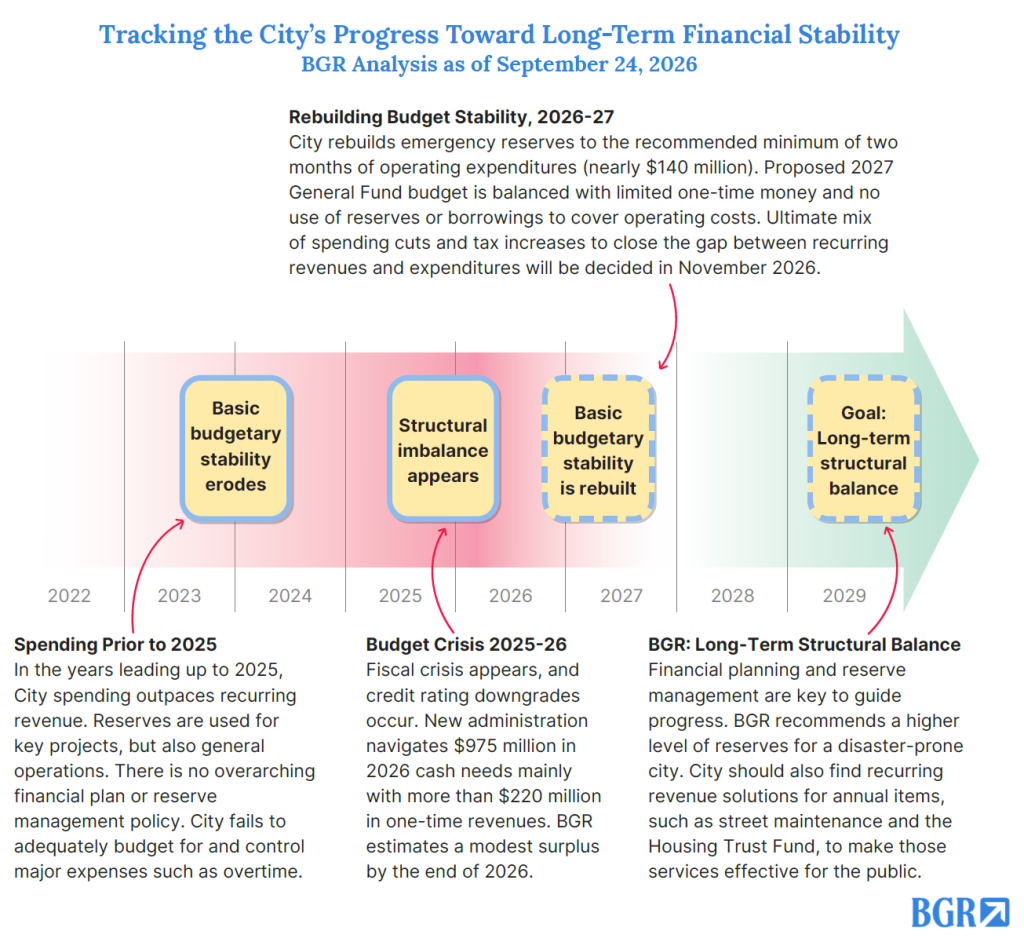
Source: BGR analysis as of September 24, 2026.
- The City is managing its money better. Through June 2026, revenue collections were about 9% above budget, and spending was about 12% under. Through September 2026, overtime spending, a major driver of the 2025 crisis, was down nearly 50% from the same period in 2025. New online dashboards also let the public track City spending and overtime in real time.
- Emergency savings have been rebuilt. Selling future rent from the Caesars casino lease, combined with the City’s Savings Fund, brought reserves to nearly $140 million, about the generally recommended minimum of two months of operating costs. BGR encourages a reserve target above the current minimum level, given New Orleans’ vulnerability to tropical storms.
- One-time money kept 2026 afloat. The City has assembled $223 million in one-time money this year, triple what it planned. Along with spending controls and better collections, that money puts the City on track to end 2026 with a modest surplus, by BGR’s estimate.
- The 2027 budget reaches basic budget stability. The mayor’s proposal balances the budget with $15 million in one-time money and no use of savings or borrowing for operating costs. It also accounts for previously unbudgeted costs, including employee health care and payouts for unused leave.
- Still, the City has not reached long-term structural balance. That’s when recurring revenue covers the full cost of providing adequate services and infrastructure, without relying on reserves or one-time money. More than $82 million a year in ongoing costs still lacks steady funding, including $36 million more for street maintenance, $20 million or more for the firefighters’ pension fund, about $16 million for the Housing Trust Fund and $10 million requested by the Sheriff’s Office for the jail’s new medical and mental health wing.
- The City is using bond money for recurring costs. Bond proceeds are paying for Public Works staff and the Housing Trust Fund dedication. Government finance experts warn against this because it consumes money voters approved for capital projects, while taxpayers carry the interest costs.
Frequently Asked Questions
Is New Orleans still in a budget crisis?
The City has navigated its 2026 cash crisis with help from more than $220 million in one-time money. The proposed 2027 budget reaches basic budget stability, but long-term structural balance, where recurring revenue covers the full cost of adequate City services and infrastructure without reserves or one-time money, will take several years.
Why did New Orleans run out of money in 2025?
From 2023 to 2025, City spending grew while recurring revenue stayed flat. The City covered the gap with reserves and federal relief funds, without a long-term plan or policy for replenishing and protecting reserves. Unbudgeted overtime also played a major role: the City budgeted $57,500 for overtime in 2025 and spent $50.1 million.
Will New Orleans raise property taxes in 2027?
The City is working to increase recurring revenue to avoid some budget cuts. This could include the administration’s proposal to roll forward some property tax rates, which could bring in up to $42 million a year. The City Council will hold a public hearing on this tax increase on November 5, 2026. Residents can see how the roll-forwards would affect their property tax bills using the City’s calculator.
When will the 2027 New Orleans budget be approved?
The City Council plans to adopt the 2027 budget November 19, 2026, and must do so by December 1, 2026.
What does BGR recommend?
BGR recommends that the City adopt a rolling, five-year financial plan and a formal reserve policy that sets a higher level of emergency savings. The City has begun work on both.
Read the Report
Get the key takeaways in the Balancing Act summary, or explore the details in the full report.
Read the Balancing Act summary (PDF) | Read the full Balancing Act report (PDF)
Want more on the City budget? Read More Cash for Trash, our analysis of the City’s new cost-based sanitation fee.