
This BGR NOW report re-emphasizes key recommendations to help preserve and strengthen the City of New Orleans’s financial health.
This BGR NOW report re-emphasizes key recommendations to help preserve and strengthen the City of New Orleans’s financial health.
The City of New Orleans is at a tipping point. As the races for mayor and City Council heat up, frustrated residents are demanding better City services and infrastructure. Meanwhile, the City’s improved post-pandemic financial position is at serious risk as the 2025 budget is on pace for a $102.5 million shortfall, with new costs looming in 2026 and beyond.
Against this backdrop, this BGR report that provides recommendations for the current mayor and council to improve the City’s financial management practices as they prepare and adopt the 2026 budget. They should hand their successors a more financially secure City government to better address residents’ needs and deal responsibly with any fiscal crises.
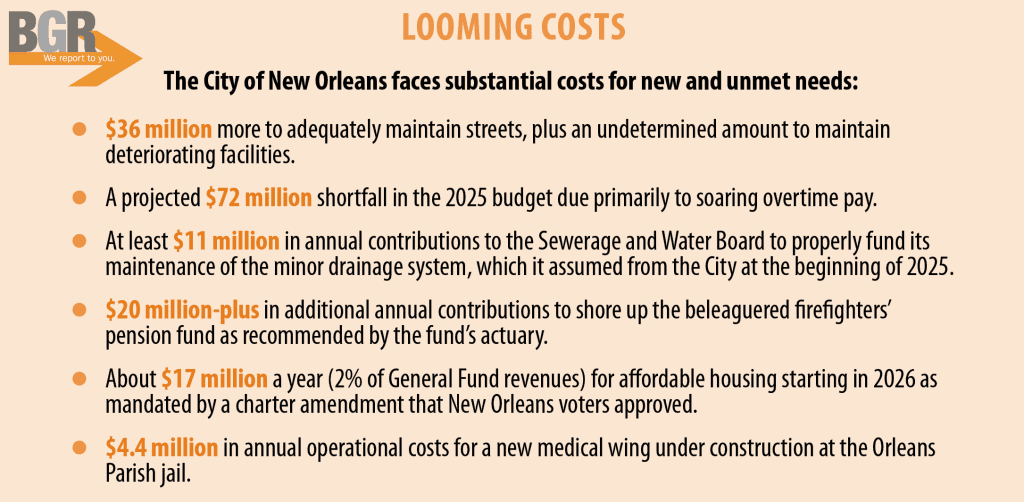
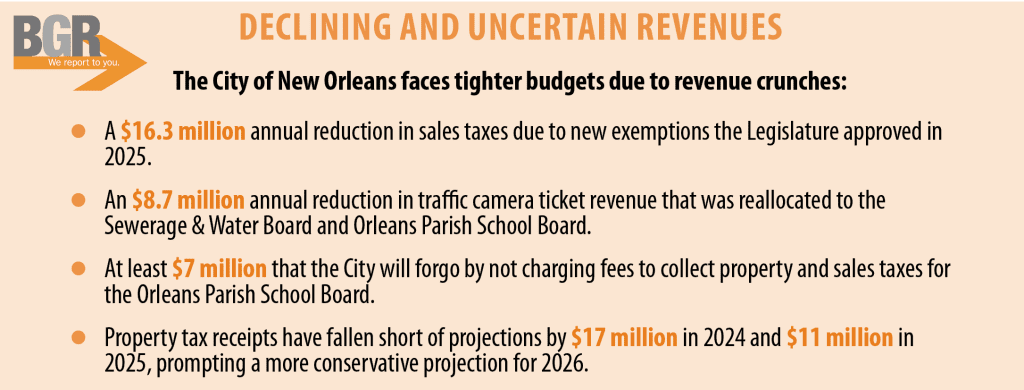
The report follows BGR’s April report entitled After the Windfall which found the City has a limited window to safeguard financial gains it made during the pandemic thanks to nearly $400 million in federal funding. Just five months later, that window has narrowed even further. The $102.5 million projected deficit is due to a $30.5 million reduction in estimated revenues and personnel costs that are running $72 million over budget, primarily from soaring overtime. The City also faces tens of millions of dollars in looming costs – such as deferred maintenance of infrastructure and facilities – that aren’t part of the deficit but will put additional pressure on the City’s budget.
To deal with these challenges, BGR urges the City administration and council to improve their financial management practices by (1) working to achieve a structurally balanced budget that covers the full costs of responsibly running City government, (2) developing a five-year financial plan to get there, and (3) adopting a policy to manage and safeguard the City’s financial reserves or “rainy day” fund. These findings are summarized below; read more by clicking the button above or clicking here to download the full report.
The City’s charter requires it to have a balanced budget with projected revenues that equal or exceed planned expenditures. However, this is a relatively low hurdle that does not ensure the budget is financially sustainable. It allows the City to achieve balance with one-time revenue, such as reserves, that it cannot count on for future budgets. Also, the budget does not have to provide sufficient funding for certain City responsibilities, such as maintaining infrastructure and facilities at acceptable levels. This pushes those costs onto future budgets and future taxpayers. The City has had problems in both these areas. It relies on reserves to balance the budget and chronically underfunds preventive maintenance.
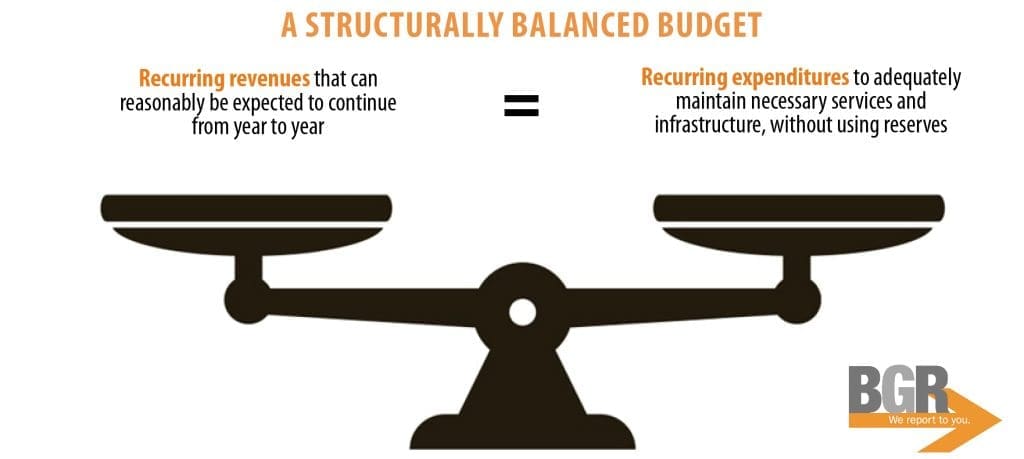
To confront these shortcomings and improve the City’s financial stability, the report calls on the mayor and council to strive for a structurally balanced budget. This is when annually recurring revenues equal or exceed the recurring expenditures needed to adequately maintain services and infrastructure, without using reserves. A structurally balanced budget is a relatively simple yet powerful concept that can help ensure the budget meets the true costs of City government and is sustainable year after year.
Attaining a structurally balanced budget might take several years or longer and will require careful planning. BGR’s report urges the City to begin developing a five-year financial plan that accounts for significant anticipated changes in revenue and spending. The plan should identify funding strategies to meet looming costs and high-priority needs. This will help ground the 2026 budget deliberations in a better understanding of the City’s finances and needs, even if a more comprehensive five-year plan cannot be completed until the next administration and council take office.
A key to achieving a sustainable budget is to maintain adequate reserves to help avoid cuts to essential services and increases in taxes or fees during financial emergencies. Government finance experts recommend that municipalities maintain at least two months of expenses in reserve, or about 17% of their general fund operating budgets. Experts say disaster-prone cities such as New Orleans should consider a higher level. As shown in this report, the City’s reserves skyrocketed from just $13 million before the pandemic to a high of $344 million in 2022. But three years of spending from the reserves could reduce them below the minimum recommended level of $133 million by the end of this year.
Part of the problem is the City lacks a policy to manage its reserves and limit spending to ensure an adequate financial cushion. Both BGR and the City’s financial consultants have called for the City to develop and adopt such a policy this year. Establishing a policy on reserves now is important to support continuity in managing fiscal issues into the next mayoral and council terms.
The City of New Orleans is at a critical juncture in its fiscal history. While it emerged from the pandemic in a better financial position, those gains are at risk due to looming costs and declining revenues. The City administration and council have a choice. They can stick with their current financial management practices and risk sliding back to a more tenuous position. Or they can work to improve those practices, including a five-year financial plan and a policy for managing its rainy day fund. Doing so would achieve a more sustainable budget to better address residents’ immediate and long-term needs and deal with any fiscal emergencies.
In this report, BGR examines three separate propositions on the November 15, 2025, ballot that would authorize the City of New Orleans to borrow a total of $510 million for capital improvements.
This Beyond the Ballot report enhances public transparency and accountability for the 2019 New Orleans bond authorization and helps residents understand its uses and impacts.
This BGR NOW report re-emphasizes key recommendations to help preserve and strengthen the City of New Orleans’s financial health.
The reform and modernization of local government is a lasting legacy of Hurricane Katrina. By envisioning positive change and reforming local government, residents, advocates and policymakers created a better future for Greater New Orleans. BGR is proud to have been a leader in these efforts with our independent, nonpartisan research and monitoring. On the 20th […]
BGR’s Candidate Q&A reports ask the candidates for mayor, City Council and sheriff in the October 11, 2025 primary election to explain how they will address important public policy issues if elected. BGR developed the questions based on our body of research. Many of these issues have close ties to concerns that voters themselves have […]
This report discusses City of New Orleans financial practices that are out of step with recommendations by government finance experts and calls for improvements.
This letter to New Orleans’ mayor and City Council highlights ways to strengthen the future use of Housing Trust Fund money. In November 2024, New Orleans voters amended the City charter to dedicate annual funding to the trust fund. This amount will equal at least 2% of the City of New Orleans General Fund budget […]
This On the Ballot report informs New Orleans voters in the November 5, 2024, election about a proposal to amend the City charter to require an annual budget appropriation for the City’s Housing Trust Fund.
This report analyzes the impact of the 2019 “Fair Share” deal to direct new tourism dollars to maintain streets, drainage and other infrastructure in New Orleans. BGR finds that the deal is delivering on its promise, with opportunities for improvement.
This BGR NOW report urges the City of New Orleans and the Orleans Parish Sheriff to resolve a long-running disagreement over funding the jail. The dispute flared anew last fall when the City Council denied the Sheriff’s request for a $12.4 million funding increase. Voters subsequently rejected a Sheriff’s Office proposal to increase its property […]
OVERVIEW These On the Ballot reports inform New Orleans voters about three propositions on the October 14, 2023 ballot: the renewal of a property tax for public school facilities and charter amendments on code enforcement and the City budget process. The Orleans Parish School Board is seeking to renew a property tax of up to 4.97 […]
Today, BGR sent a letter to the mayor and the New Orleans City Council urging greater planning and public reporting for the City of New Orleans’ use of its primary financial reserve. The City Council’s budget committee is meeting tomorrow, May 23, to consider more than $73 million in appropriations from this reserve, called the […]
OVERVIEW In this letter to the Jefferson Parish Council, BGR recommends ways in which the council can improve planning and public reporting for one-time spending made possible by the receipt of federal pandemic relief funds through the American Rescue Plan Act (ARPA). In June 2022, the council allocated the Parish’s $84 million of ARPA funds […]
OVERVIEW In this report, BGR explores how the City of New Orleans has deployed pandemic relief funds it received through the federal American Rescue Plan Act, and what impacts this unprecedented one-time money had on City finances and budget priorities.
OVERVIEW In this release, Handle with Care: Public Planning and Accountability Must Guide Spending of Federal Relief Funds, BGR offers guidance to government entities on harnessing the opportunities presented by unprecedented federal funding to spur recovery from the pandemic’s economic, fiscal and health impacts.
OVERVIEW Welcome to the inaugural edition of PolicyWatch, a periodic newsletter that draws on BGR’s body of independent, nonpartisan research to address current public policy issues. This edition focuses on the City of New Orleans’ finances as it faces a pandemic-induced budget deficit. It discusses the City’s proposal to borrow up to $100 million as […]
OVERVIEW As the City Council reviews the proposed $722 million 2020 operating budget, BGR Now: A Framework for Assessing New Orleans’ Proposed 2020 Budget outlines key findings of BGR’s recent City budget study to help inform citizens and policymakers. BGR’s study, A Look Back to Plan Ahead, analyzes growth in revenues and changes in expenditures […]
Overview On the Ballot: New Orleans Bond and Tax Propositions, November 16, 2019 studies three propositions to let the City issue bonds for capital improvements, levy a new tax for maintenance, and levy a new tax on short-term rentals. If voters approve, the City of New Orleans would be able to: Issue up to $500 […]
Overview A Look Back to Plan Ahead: Analyzing Past New Orleans Budgets to Guide Funding Priorities reviews a decade of City General Fund budgets. It also lays a foundation for examining potential opportunities to reallocate revenue to critical needs.
Questions for a New Parish Council is the second in a two-part 2019 Candidate Q&A Election Series providing the views of candidates for Jefferson Parish government on important public policy issues, such as tax dedications and contracting. Questions for a New Parish Council provides voters with the candidates’ answers to 16 questions developed from BGR’s […]
Questions for a New Parish President is the first in a two-part 2019 Candidate Q&A Election Series providing the views of candidates for Jefferson Parish president on important public policy issues affecting Parish government. Questions for a New Parish President provides voters with the candidates’ answers to 16 questions developed from BGR’s body of research. […]
In this letter to the Mayor and City Council, BGR suggests the City of New Orleans develop a strategy to requalify for tax-exempt status for future bond issues. This would save interest costs for taxpayers financing infrastructure and other capital projects. Discovering the Issue While conducting research for a report on the City’s budget, BGR […]
Overview BGR’s On the Ballot report examines the proposed amendment on the November 18, 2017, ballot to establish the Savings Fund of the City of New Orleans in the City’s home rule charter.
Overview On November 24, BGR sent a letter to the Mayor and City Council on the proposed 2011 budget for the City of New Orleans. The letter contains suggestions that would free up millions of dollars.
Overview In The Price of Civilization: Addressing Infrastructure Needs in New Orleans, BGR provides information on New Orleans’ core infrastructure needs – including streets, the systems of the Sewerage & Water Board of New Orleans, schools and the Orleans Parish jail – and assesses the community’s capacity to fund those needs.
Overview With the primary on the way, BGR submitted questions to all mayoral candidates on topics in four areas: the city’s budget, city services, infrastructure and blight. Four candidates – Rob Couhig, John Georges, Mitch Landrieu and James Perry – responded. BGR is presenting the Q&A to the public in a web-only, four-part series, Questions […]
Overview This release calls on the City of New Orleans to conform to charter requirements in producing its capital budget, which is developed by the mayor and reviewed by the New Orleans City Planning Commission and City Council.
Overview This release raises concerns about proposed budget approvals for the New Orleans Office of Recovery Management’s plans in advance of a public vetting of those plans. New Orleans recovery planning process following Hurricane Katrina requires transparency and public input.
Overview In Budgeting in a Time of Crisis: A Review of the City of New Orleans’ 2007 Budgets, BGR examines the City’s operating and capital budgets for 2007, the second fiscal year following Hurricane Katrina in 2005.
Overview On September 30, Louisiana voters were asked to approve 13 constitutional amendments. This report focuses on those that are amendments relevant to Greater New Orleans in four arenas: coastal restoration and flood protection, expropriation, the homestead exemption, and unfunded state mandates. In addition, BGR provides an expanded discussion of the proposed amendment on expropriation, […]
Overview BGR and the Public Affairs Research Council of Louisiana, Inc. (PAR) have issued a joint report calling for a full appraisal of financial options for local governments in fiscal crisis, including municipal bankruptcy.
Overview In this report, BGR predicts tight financial times ahead for Jefferson Parish Government. What can the Parish Council and Parish President do about it? This report offers an array of options for keeping the parish coffers filled.
Overview This report examines the history and current state of the operating budget and compares revenues and expenditures, including salaries, for the City of Harahan, a municipality in Jefferson Parish. The report includes information on comparable Louisiana cities.
Overview This edition of BGR’s Outlook series discusses the financial challenges facing the Jefferson Parish Public School System and the current academic performance of its schools.
Overview In this report, BGR reviews the four proposed changes in the Louisiana constitution that voters will decide on November 7, 2000. The amendments would: (1) authorize the state to establish a corporation to be the state’s principal economic development organization (Louisiana Inc.) and to exempt it from civil service; (2) change state individual income […]
Overview This issue of the Outlook series examines the capital budget process of the City of New Orleans and critiques the implementation of the 1995 voter-approved building program.
Overview This issue of Outlook updates the financial status of the Jefferson Parish Public Schools with a focus on the revised fiscal year 1999 and the adopted fiscal year 2000 operating budgets.
Overview This edition of Outlook provides an overview of Jefferson Parish Government and the Parish’s fiscal outlook, including final general government revenues and expenditures between 1988 and 1997, and an examination of the 1999 Jefferson Parish adopted budget.
Overview This is the first report in BGR’s Outlook series on the Orleans Parish School Board. The purpose of this report is to provide an overview of the Board’s fiscal outlook with a focus on the FY 1999 (July 1, 1998 through June 30, 1999) operating budget.
Overview In this issue of Outlook, BGR focuses on one specific area of Jefferson Parish Government—the public works function, which manages streets, water, sewer, drainage and other infrastructure. The purpose of this report is to provide a brief overview of how this department is organized, where it receives its funding and how it spends its […]
Overview This report reviews the City of New Orleans’ property service charge proposal on the ballot for December 5, 1998. The primary intended uses of the new revenues include pay raises for most City employees and for all Orleans Parish public school employees.
Overview This report provides a short analysis of the potential creation of three separate neighborhood-based special tax districts in New Orleans and a recommendation on two proposed amendments to the Louisiana Constitution relative to the governance of higher education. The neighborhood districts will provide additional funding for enhanced security and in some cases, beautification and […]
Overview This report provides a synopsis and short analysis of all 18 proposed amendments to the Louisiana Constitution on the October 3, 1998, election ballot. The topics include assessment freezes for senior citizens and properties undergoing restoration, as well as parish severance tax allocations and remediation of blighted property: Establishes community college system Increases parish […]
Overview This issue of the BGR Outlook on Jefferson examines the Jefferson Parish School Board’s finances. The 16-page report analyzes the factors leading to recent operating budget deficits and discusses potential solutions.
Overview This report is the fourth in BGR’s program of governmental oversight and monitoring of Jefferson Parish governments. This report provides updated budgetary information on the Parish Council, District Attorney and Sheriff.
Overview This is the first in a new series of reports highlighting the finances of Jefferson Parish local government. It provides an overview of parish general-purpose government revenues and expenditures over the past ten years and comparison of current-year operating budget.
The Bureau of Governmental Research (BGR) released a new report today examining the Sewerage & Water Board’s effort to develop a drainage funding proposal that can keep up with New Orleans’ growing needs. At a time when storms are becoming more...
Today the Bureau of Governmental Research (BGR) released two reports providing independent, nonpartisan analysis to New Orleans voters on propositions in the November 15 election. Early voting begins Saturday, November 1. On the Ballot: $510 Million New Orleans Capital...
Today the Bureau of Governmental Research (BGR) released Beyond the Ballot: Analyzing Spending and Impacts of the 2019 New Orleans Bond Authorization. The report finds that the City of New Orleans raised a total of $589.6 million for capital improvements...
That’s the name of the new report just released by independent local research organization Bureau of Governmental Research (BGR). President and CEO Rebecca Mowbray shares the shocking things not required to be included in the budget, why we need to...
The New Orleans City Council is planning to ask the state’s top auditor to examine the city’s finances and provide clarity on the size of its budget deficit after a city budget hearing this week left council members with...
As New Orleans Mayor LaToya Cantrell’s administration prepares measures to address the city’s budget deficit, there is confusion over what the shortfall actually is. Officials tossed around various numbers at a City Council budget committee meeting this week, without...
NEW ORLEANS (press release) – The Bureau of Governmental Research (BGR) issued a new report warning that New Orleans is facing a projected $102.5 million budget shortfall in 2025. BGR urges the mayor and City Council to adopt stronger financial management practices as...
This audio recording is no longer available. BGR President Rebecca Mowbray discussed a September 11 BGR NOW re-emphasizing key recommendations made this spring to help preserve and strengthen the City of New Orleans’s financial health.
NEW ORLEANS — A report released by a local government watchdog highlights the City of New Orleans’ growing budget deficit, which is on track to top $100 million by the end of the year. “There’s a concern about looming...
The City of New Orleans is at a tipping point. As the races for mayor and City Council heat up, frustrated residents are demanding better City services and infrastructure. Meanwhile, the City’s improved post-pandemic financial position is at serious...
NEW ORLEANS (press release) – The Bureau of Governmental Research (BGR) won three awards at the national Governmental Research Association conference July 13-16 in Providence, R.I. BGR was honored for Outstanding Policy Achievement for its efforts to encourage the City of New Orleans to meet...
Voters will head to the polls in October to decide New Orleans’ municipal elections, with the seats of the Mayor, City Council and Orleans Parish Sheriff being the major positions up for grabs. In our quest to remain a...
Twenty years after Hurricane Katrina devastated New Orleans, BGR’s June 18 Breakfast Briefing discussed the disaster’s lasting impact on local government reform—and what lessons public officials and citizens can use to inspire future change. This event was free to...
The reform and modernization of local government is a lasting legacy of Hurricane Katrina. By envisioning positive change and reforming local government, residents, advocates and policymakers created a better future for Greater New Orleans. BGR is proud to have...
NEW ORLEANS — The trial over millions of dollars the Orleans Parish School Board claims it is owed by the city of New Orleans has been delayed after a judge ruled that an essential party is missing from the...
When Congress passed the $1.9 trillion American Rescue Plan Act (ARPA) in March 2021, it allocated $350 billion in assistance to state and local governments – providing the largest infusion of cash to local governments since the start of...
As New Orleans officials grapple with an April 17 meeting where they literally will argue about whether or not the city faces a budget crisis, they should welcome some new recommendations from the Bureau of Governmental Research, even if...
NEW ORLEANS – The Bureau of Governmental Research (BGR), a private, nonprofit, and independent research organization based in New Orleans, released the report “Improving Financial Management Practices for the City of New Orleans” on April 7, highlighting concerns about...
Former New York Mayor Michael Bloomberg, who built a multi-billion dollar business and led the nation’s largest city for three terms, has a motto: “If you can’t measure it, you can’t manage it.” The next mayor of New Orleans...
This recording is no longer available online. Read BGR’s report urging the City of New Orleans to improve its financial management practices.
Listen to Newell Normand’s commentary in response to BGR’s report urging the City of New Orleans to improve its financial management practices.
NEW ORLEANS — After months of unclear back-and-forth from city leaders regarding the city’s financial standing- sparked by the Mayor pulling out of a multimillion dollar settlement with the Orleans Parish School Board- a new report released by the...
New Orleans officials don’t have a long-term plan for the city’s finances or safeguards for the city’s reserves, leaving municipal budgets vulnerable at an “inflection point” in the city’s history, according to a new report from the Bureau of...
The recent dispute about a proposed $90 million legal settlement between the City of New Orleans and the Orleans Parish School Board has raised concerns about the City’s financial health. It also revealed troubling disagreements within the administration about...
A government watchdog group has issued guidance that it says City Hall and its partners must follow before dispersing millions of dollars in new, voter-approved funding for affordable housing programs. The Bureau of Governmental Research initially opposed the Housing...
Today, the Bureau of Governmental Research (BGR) sent a letter to New Orleans Mayor LaToya Cantrell and members of the City Council highlighting several ways to strengthen the future use of Housing Trust Fund money. In November, New Orleans...
NEW ORLEANS (Dec. 18, 2024) — Yesterday, the Bureau of Governmental Research (BGR) sent a five-page letter to Mayor LaToya Cantrell and the City Council, offering a series of recommendations aimed at strengthening the effectiveness of the newly approved...
New Orleans voters on Tuesday (Nov. 5) approved two new amendments to the city’s charter: one that will add a “workers’ bill of rights” and another that will require the city to set aside millions per year in a...
New Orleans is poised to see a massive influx of taxpayer funding for local affordable housing projects after voters approved a charter amendment during Tuesday’s election. Over 75 percent of the city voted “yes” on the amendment, handing supporters...
New Orleans voters on Tuesday overwhelmingly backed a city affordable housing fund and symbolic support for private sector workers, while Jefferson Parish voters agreed to allow city government to fire certain staffers at will. In an election that also...
As the City Council’s leading advocate on the quest for more affordable housing, District B Councilmember Lesli Harris has a lot at stake in the November 5 Election. Harris is heading up the effort to pass the New Orleans...
Other than the bitterly divisive presidential race, the Nov. 5 ballot features few contested elections in Orleans and Jefferson parishes. In fact, the hottest local item appears to be a proposed City Charter amendment to create permanent local funding...
NEW ORLEANS — City leaders in New Orleans want to allocate a chunk of money from the general fund for affordable housing needs. The proposal is on the ballot in November as Charter Amendment 1. The proposal is to...
NEW ORLEANS — As city and state leaders clash over homeless encampments in New Orleans, Lesli Harris and other city leaders are advocating for a long-term solution that’s already in the works. That solution, the Housing Trust Fund, is...
Proposition one on the ballot is asking New Orleans voters to approve two percent of the city’s general fund to pay for affordable housing. Click here to review BGR’s report on the ballot proposition.
The Bureau of Governmental Research discussed its report, On the Ballot: New Orleans Housing Trust Fund, November 5, 2024 Election, on The Good Morning Show on WBOK 1230 AM. Click here to watch the segment.
While the presidential race is still very much a toss-up, some winners are already certain when the votes are counted in New Orleans on Nov. 5: advocates of affordable housing and persons in need of housing assistance. The New...
I love New Orleans. I love the architecture, the arts, the culture, the food, the music, the people. I love our gumbo population, with its strong Black base. But there’s no denying that some of my city’s neighborhoods have...
It is no secret that New Orleans is facing a housing crisis. Like many other cities across the nation, New Orleans is contending with a decreasing supply of low-cost housing coupled with cost-of-living increases across the board. The city...
Voters in New Orleans will see two proposed city charter amendments on the Nov. 5 ballot, with early voting beginning Friday. Here are the Times-Picayune’s recommendations. Home Rule Charter Amendment No. 1: No The bad news is that New...
Members of the River District consortium and other New Orleans developers are the main financial backers of a November ballot initiative that would direct millions of city tax dollars annually to affordable housing projects. New Orleans developer Louis Lauricella,...
Tommy hears from BGR and from Councilmember Lesli Harris about affordable housing. Click here to listen. Click here to read BGR’s On the Ballot report.
NEW ORLEANS (Oct. 12, 2024) — The Bureau of Governmental Research (BGR) expressed concern this week regarding a proposed charter amendment in New Orleans that would mandate a minimum annual budget allocation of 2% of the City’s General Fund...
Affordable housing is getting harder to find in New Orleans, and city leaders want to put millions in taxpayer dollars toward solving the issue. Residents will see a question on their ballot on Election Day asking them to vote...
NEW ORLEANS (WGNO) — New Orleans voters will decide whether to dedicate millions of local tax dollars to affordable housing. The proposition will appear on the Nov. 5 ballot. According to a 2024 report from the National Low Income...
NEW ORLEANS (press release) — District ‘B’ Councilmember Lesli Harris, who chairs the Quality of Life Committee and has been an advocate for affordable housing, issued the following statement in response to BGR’s new report on the Housing Trust...
Construction is set to begin on a blighted, century-old firehouse on Louisiana Avenue that will become New Orleans’ first city-owned property to include both affordable housing units and an early childhood education center, city leaders said Wednesday. As part...
NEW ORLEANS (press release) — The Bureau of Governmental Research (BGR) has released an On the Ballot report analyzing a proposed charter amendment in the Nov. 5 New Orleans election. The proposition would require an annual budget appropriation for...
A good government group has come out in opposition to a plan that would dedicate millions in public funding to affordable housing programs each year if approved by New Orleans voters this November. According to a report released Wednesday...
Today, the Bureau of Governmental Research (BGR) releases an On the Ballot report analyzing a proposed charter amendment in the November 5 New Orleans election. The proposition would require an annual budget appropriation for the City’s Housing Trust Fund equal to at least...
It’s a problem New Orleanians know all too well: Housing costs in the city have skyrocketed in recent years, forcing long-time residents to cheaper suburbs and shrinking the city’s tax base. Past efforts to help people with their rent...
Today, the Bureau of Governmental Research released a report analyzing the impact of the 2019 “Fair Share” deal to direct new tourism dollars to maintain streets, drainage and other infrastructure in New Orleans. BGR finds that the deal between the City...
The Bureau of Governmental Research (BGR) won three awards from its peer organizations in the Governmental Research Association (GRA) at its national conference July 21-23 in Asheville, N.C. BGR’s 2023 report calling for governance reforms for the Sewerage and...
Renata Young blocks her front door with sandbags when it rains. During a recent downpour, the water near her home in Treme was pooled ankle-high above each of the block’s four overwhelmed catch basins. More than three years ago,...
New Orleans City Council members are pressing forward with plans to enshrine an unprecedented local investment in affordable housing into the City Charter, a move aimed at expanding programs to help first-time homebuyers, rehab rental units and provide financial...
The New Orleans City Council approved the city’s $1.57 billion budget on Friday, greenlighting most of the spending that Mayor LaToya Cantrell proposed for 2024. That budget, along with an additional $56 million in spending on a variety of...
The New Orleans City Council is set to approve most of Mayor LaToya Cantrell’s proposed $1.57 billion city budget on Friday, with pay raises on the way for New Orleans police, more money set aside in a “rainy day”...
Mayor LaToya Cantrell wants to tackle some of New Orleans’ most stubborn issues over the next year: public safety, infrastructure and improving residents’ quality of life. But anyone looking for major new initiatives from the mayor who has two...
NEW ORLEANS — From the Bureau of Governmental Research: New Orleans voters will head to the polls on Saturday to vote in several prominent races, including one for Louisiana’s next governor. But they will also decide three important local...
Saturday’s elections for statewide and parish offices along with a number of other ballot initiatives will be the culmination of many months of hard work and millions of dollar spent by candidates, their supporters and public and quasi-public agencies...
Louisianans head to the polls Saturday to vote in the gubernatorial primary. Why it matters: Just about every statewide office is up for grabs, so voters will make a big impact on the state’s direction for the next several...
BGR President and CEO Rebecca Mowbray discussed BGR’s renewed call for the City of New Orleans and the Orleans Parish Sheriff to develop a cooperative agreement to fund the Orleans Justice Center, the parish jail. Audio recording is not...
BGR President and CEO Rebecca Mowbray discussed BGR’s reports on the October 14, 2023, ballot propositions with WWL Radio host Tommy Tucker. Audio recording not available online.
New Orleans voters heading to the polls Oct. 14 will punch ballots for governor, the legislature and several other state and local elected positions. They’ll also see three citywide ballot measures, one aimed at renewing tax funding for school...
This year, Louisiana voters are once again being asked to weigh in on a number of policy issues. At the state level, lawmakers have proposed four amendments to the Louisiana constitution, while here in Orleans Parish voters will be...
Election day is almost here. And there is more on the ballot than candidates running for office. Voters in many municipalities are also being asked to consider ballot measures related to local governance. In the city of New Orleans,...
Excerpt: PW HRC Amendment Prop. No. 1 of 2 – Art. VI, Sec. 6-102 & 6-104 – CCShall Article VI, Sections 6-102 and 6-104 of the Home Rule Charter of the City of New Orleans be amended to move...
Orleans Parish School Board facilities millage renewal: Yes In the grueling recovery from Hurricane Katrina, the $1.8 billion lump sum settlement with FEMA to rebuild New Orleans schools was a high point. Saddled before the storm with facilities so...
NEW ORLEANS — The Bureau of Governmental Research has published a report calling on the City of New Orleans and the Orleans Parish Sheriff’s Office to resolve a long-running disagreement over funding for the parish jail. The dispute flared last fall...
NEW ORLEANS (WGNO) — As the New Orleans City Council prepares its 2024 budget, the Bureau of Governmental Research has released a report about a longstanding dispute over funding for the Orleans Parish Prison. According to the report, the...
The Bureau of Governmental Research (BGR) published a report today calling on the City of New Orleans and the Orleans Parish Sheriff’s Office to resolve a long-running disagreement over funding for the parish jail. The dispute flared anew last fall...
Click here to watch the video, and here to visit the BGR webpage for this report.
NEW ORLEANS — From the Bureau of Governmental Research: On Sept. 21, the Bureau of Governmental Research released three On the Ballot reports for the October 14 election. The reports are intended to help New Orleans voters make informed decisions...
Today, the Bureau of Governmental Research (BGR) releases three On the Ballot reports for the October 14 election. The reports are intended to help New Orleans voters make informed decisions on three separate propositions: a property tax renewal for...
The Bureau of Governmental Research (BGR) won two awards from the Governmental Research Association (GRA) at its national conference July 24-26 in Worcester, Mass. BGR’s 2022 report calling for governance reforms for the Orleans Parish jail received the Most...
The New Orleans City Council on Thursday approved $32 million for a new affordable housing fund, nearly doubling the financing assistance available to developers planning large multifamily projects across the city. City officials say the additional subsidies are needed...
Becky Mowbray and Stephen Stuart join Tommy to talk about how the city is spending the money from the General Fund Reserve. Click here to listen to the interview.
The New Orleans City Council on Thursday (May 25) approved a city spending plan for more than $120 million — almost all of which comes from federal COVID pandemic relief funds. The money is going to a wide range...
The New Orleans City Council is set to vote Thursday (May 25) on a plan to spend tens of millions in city surplus dollars on city vehicles, affordable housing and assorted other projects as well as the last $54...
Standing before a gymnasium full of angry residents at the Avondale Playground in October, Jefferson Parish Council member Byron Lee made a pledge. “If you need uniforms, call my office,” he said. “If you need playground equipment, call my...
NEW ORLEANS — From the Bureau of Governmental Research: In an April 28 letter to the Jefferson Parish Council, BGR recommends ways in which the council can improve planning and public reporting for one-time spending made possible by the receipt of...
In an April 28 letter to the Jefferson Parish Council, BGR recommends ways in which the council can improve planning and public reporting for one-time spending made possible by the receipt of federal pandemic relief funds through the American Rescue Plan...
NEW ORLEANS — New Orleans East is getting some much-needed funding for some big projects. Councilman Oliver Thomas announced on social media this weekend that extra cash from the American Rescue Plan Act will be heading to New Orleans...
NEW ORLEANS (WVUE) – As residents complained about garbage left to rot on the streets for weeks, the company contracted to collect that trash in several neighborhoods was pleading with the city of New Orleans to fully pay the...
When the New Orleans City Council passed a massive, $262 million amendment to the 2023 budget in the waning hours before a Dec. 1 deadline, local activists were surprised. There’d been no formal notice that Mayor LaToya Cantrell and...
NEW ORLEANS — From the Bureau of Governmental Research: On Dec. 13, BGR released a new report that shows how the City of New Orleans has used the first half ($194 million) of its federal relief funds to weather...
A new report from the local think tank the Bureau of Governmental Research analyzed how New Orleans has managed the $388 million in federal COVID relief funds it received through the America Rescue Plan Act, or ARPA. The central...
The Bureau of Governmental Research (BGR) highlighted a new report on the City of New Orleans’ uses of its federal American Rescue Plan Act funds in a webinar on December 14 on Zoom. The federal government has provided state...
A new report from the Bureau of Governmental Research (BGR) takes a closer look at the impacts of the City of New Orleans’ federal pandemic relief funds on its finances and budget priorities. Managing the Windfall: Tracking the City of...
Today, Governor John Bel Edwards joined the Bureau of Governmental Research (BGR) for a Virtual Breakfast Briefing to discuss his key priorities for 2022 and the potential impacts of new federal funding for Louisiana. Click here or on the...
The City of New Orleans has received its first portion of federal pandemic relief funds through the American Rescue Plan. This historic federal investment will influence the City’s budget for the next few years. BGR recently discussed the need...
NEW ORLEANS – The City of New Orleans has received its first portion of federal pandemic relief funds through the American Rescue Plan. This historic federal investment will influence the City’s budget for the next few years. BGR recently...
NEW ORLEANS – The Bureau of Governmental Research has released guidance for government entities planning how to spend federal pandemic relief funds. The nonprofit watchdog said governments have “substantial flexibility” in spending the federal dollars, which creates a “rare...
The Bureau of Governmental Research today releases Handle with Care: Public Planning and Accountability Must Guide Spending of Federal Relief Funds. This BGR NOW offers guidance to government entities on harnessing the opportunities presented by unprecedented federal funding to...
Today, the Bureau of Governmental Research (BGR) hosted a virtual Breakfast Briefing featuring Jefferson Parish President Cynthia Lee Sheng. She discussed “Leading Jefferson Parish Today and Tomorrow: Reflections on 2020, Managing the Pandemic, and Future Priorities.” Following her presentation,...
Today, BGR releases this BGR NOW supporting three policy changes up for consideration by the Orleans Parish School Board that would strengthen NOLA Public Schools’ financial accountability measures and support the district’s financial sustainability. The changes address financial oversight...
Today, the Bureau of Governmental Research (BGR) hosted a virtual Breakfast Briefing featuring New Orleans Mayor LaToya Cantrell. She discussed “Looking Ahead to 2021: New Orleans’ Budget, Infrastructure and Policy Priorities” and then answered questions from the audience. BGR...
Today, BGR released the inaugural edition of PolicyWatch, a periodic newsletter that draws on BGR’s body of independent, nonpartisan research to address current public policy issues. This edition focuses on the City of New Orleans’ finances as it faces a...
The coronavirus outbreak and the efforts to slow its spread are set to levy a massive toll on the New Orleans economy, with the hospitality sector already seeing a sharp downturn in business and officials warning about likely cuts...
BGR President and CEO Amy Glovinsky and Vice President & Research Director Stephen Stuart talked about the 2020 Excellence in Government Awards program and a variety of issues related to local government in a live interview with Oliver Thomas...
Deputy clerks at Orleans Parish Criminal District Court can breathe a sigh of relief — at least for now. Clerk of Court Arthur Morrell said Monday that he has shelved his plan to furlough nearly all of his office’s...
The City Council has made a request to cut tax rates for property owners, and an agreement is under consideration. The plan is to move some individual millages around to prioritize infrastructure and public safety dollars over areas of...
As the New Orleans City Council reviews the proposed 2020 budget for the City of New Orleans, BGR presents here a collection of resources to help citizens understand the proposal in the context of recent City budget trends and...
Today, BGR releases BGR Now: A Framework for Assessing New Orleans’ Proposed 2020 Budget, which outlines key findings of BGR’s recent City budget study and connects them to the current 2020 budget process to help inform citizens and policymakers....
Today BGR releases On the Ballot: New Orleans Bond and Tax Propositions, November 16, 2019. The report analyzes three separate propositions that would authorize the City of New Orleans (City) to: Issue up to $500 million in bonds for...
Citizens in Orleans and Jefferson parishes who plan to vote in tomorrow’s election can inform their decisions with three BGR reports: On the Ballot: Housing Tax Exemptions in New Orleans, October 12, 2019 examines Constitutional Amendment No. 4, which...
Today, BGR releases A Look Back to Plan Ahead: Analyzing Past New Orleans Budgets to Guide Funding Priorities. The report reviews the City’s General Fund budgets from 2010 to 2019, focusing on growth in revenues and changes in expenditures. As...
Today BGR releases Questions for a New Parish Council, the second in a two-part report series providing the views of candidates for Jefferson Parish government on important public policy issues. Yesterday, BGR released the responses of the candidates for...
Today BGR releases Questions for a New Parish President, the first in a two-part series of reports providing the views of candidates for Jefferson Parish government on important public policy issues. Tomorrow, BGR will release the responses of the...
There are several issues and races on the ballot throughout south Louisiana for today’s election, including a statewide contest to pick the next treasurer and a high-profile race for mayor in New Orleans. We urge everyone to go to...
New Orleans voters have agreed to create a safety net for the city’s finances, establishing a “rainy day” fund with a charter change that gained citywide approval Saturday (Nov. 18). The city will be required to set aside for emergencies...
In 7 1/2 years, together with the City Council and the people of New Orleans, we have righted the ship of government. Today, our financial house is stronger, going from a budget deficit to a budget surplus, and our...
When Mayor Mitch Landrieu and a new City Council took office in May 2010, New Orleans was broke. The mayor and council took drastic measures to put the city’s fiscal house in order, and those tough choices have, for...
BGR won two awards from the Governmental Research Association (GRA) at its national conference in Pittsburgh, Pa., on Tuesday, July 26, 2016. BGR won the award for Outstanding Policy Achievement for the report The Accidental Steward: The Orleans Parish School...