
BGR shows how the Convention Center can reduce public subsidies for its convention hotel. And it can do so with little or no impact on the hotel’s profits.
OVERVIEW
 In this report, Bureau of Governmental Research (BGR) presents several ways that the New Orleans Ernest N. Morial Convention Center can restructure the public subsidies for its convention headquarters hotel project to save substantial tax dollars. And it can do so without jeopardizing this long-sought project to boost convention business and the regional economy.
The Convention Center hopes to finalize a deal in March 2026 for Omni Hotels to build a $600 million, 1,005-room convention headquarters hotel. The Convention Center has pursued this project for more than a decade to attract new conventions, increase attendance and remain competitive with other cities, many of which have added such convention hotels. The new upscale hotel would be the fifth largest hotel in New Orleans, and the first one with at least 1,000 rooms to be built in the city in more than 40 years.
BGR acknowledges the hotel’s strategic importance and does not oppose the project. However, the report raises concerns about the structure and size of the public subsidies. It focuses primarily on an estimated $836.7 million that Omni would receive over 45 years from taxes paid by hotel guests. The report shows how these tax rebates could continue for decades after they are no longer needed for Omni to hit its profit target. BGR offers four options to reduce the public contributions by about half a billion dollars. These new options would save substantial public resources for other pressing needs while having little or no impact on Omni’s profits.
Fortunately, there is still time to adjust the public subsidies to align them with the demonstrated need. The hotel must obtain a flurry of approvals in the next few months to meet the Convention Center’s target date for finalizing the deal. The State of Louisiana and the Louisiana Stadium and Exposition District, which runs the Caesars Superdome and the Smoothie King Center, must agree to join the Convention Center in giving Omni tax revenues they would otherwise receive from the hotel. The City of New Orleans must also approve height and zoning variances, a property tax incentive, and the sale of part of a street to the Convention Center to expand the hotel site. All these steps create opportunities for reviewing the project to achieve more efficient public subsidies.
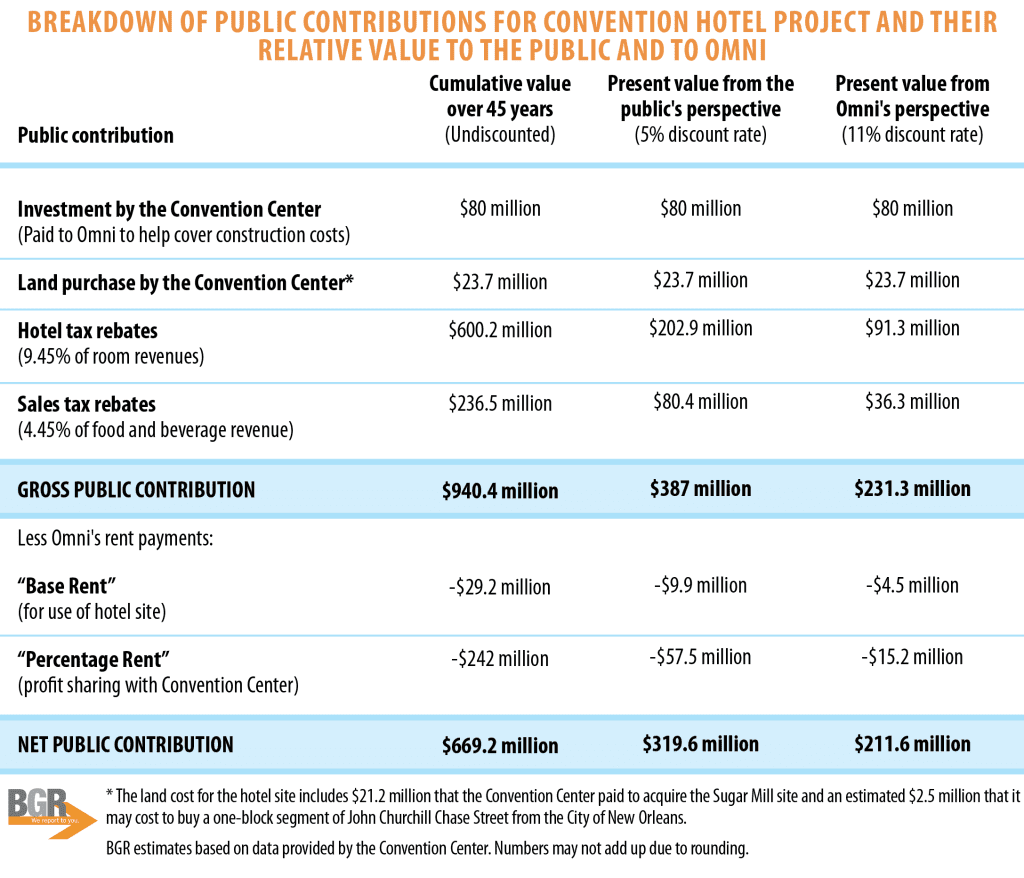
In addition to the $836.7 million in tax rebates, the Convention Center would pay an estimated $23.7 million for the hotel site and make an $80 million investment payable to Omni to help cover construction costs. The deal also calls for Omni to make a payment in lieu of property taxes (PILOT), but the value of this tax incentive is not yet known. Omni, an industry leader in convention hotels, would cover the remaining $520 million in construction costs and be liable for any cost overruns, limiting the public’s financial risk. Omni would also make rent and profit-sharing payments to the Convention Center, resulting in an estimated net public contribution of $669.2 million over 45 years.
KEY FINDINGS
- The tax rebates are not well aligned with the demonstrated need. Using the Convention Center’s own projections for the hotel’s performance, BGR shows that the tax rebates might no longer be necessary to meet Omni’s annual $57.2 million profit target after the 11th year of operation. In subsequent years, projected profits exceed the target by a growing margin each year, yet the rebates would continue for more than three decades. Recommended practices for economic development projects generally support a 20-year maximum term for public subsidies. Omni told BGR it typically receives 20 to 25 years of tax rebates for convention hotels and has never before received 45 years of rebates.
- Tax rebates in the later years have limited value to Omni but a high cost to the public. Because Omni applies an 11% corporate discount rate to future revenue streams, tax rebates received decades from now have a much lower present value to Omni than from the public’s perspective at a 5% discount rate. This lower rate is more in line with expected returns on public investments. In this case, the estimated $576.4 million in tax rebates in the last 25 years of the deal would have a present value of just $20.7 million to Omni. But from the public’s perspective, the present value would be $105.8 million, more than five times higher. This dynamic creates opportunities to shorten or restructure the rebates with little or no impact on Omni’s profitability, while generating large public savings.
PATHS TO A BETTER FINANCIAL STRUCTURE FOR THE PUBLIC
BGR identified four ways to reduce the public’s cumulative long-term costs by roughly half a billion dollars, while preserving the Convention Center’s ability to move forward with the hotel project. On a present value basis, BGR estimates the public could save $85.1 million to $117.6 million, while Omni would see relatively little or no lost revenue, as shown in the report.
BGR urges the Convention Center and other public entities to carefully review and reduce the size and duration of the planned tax rebates before granting final approvals. As discussed more fully in the report, BGR recommends:
- Reducing the duration of the tax rebates to better align them with the demonstrated need, with 20 years as a maximum term; or
- Replacing the long-term tax rebates with an equivalent lump-sum payment that preserves value for Omni while substantially reducing long-term public costs.
BGR also recommends that City officials evaluate the necessity of the payment in lieu of property taxes (PILOT) incentive and work with the Convention Center and Omni to limit any PILOT to a maximum of 20 years and gradually increase the payment amount to reach full taxation.
By recalibrating the public subsidies, BGR concludes that the Convention Center can still achieve its goal of building a headquarters hotel while preserving hundreds of millions of dollars in future tax revenue for other critical public needs and investments.