

The Louisiana Legislature is considering bills to consolidate Orleans Parish courts and reduce the number of judges. In a new report, BGR examines the proposals and finds that while the question of right-sizing the courts deserves consideration, the bills are moving faster than the evidence supports.

THE ISSUE
Two bills before the Legislature — House Bill 911 and Senate Bill 217 — would each eliminate nine judgeships in Orleans Parish. The proposals are based largely on a preliminary caseload formula developed by the Louisiana Supreme Court. But the Supreme Court’s own chief justice has said the formula is just a starting point. A final determination requires court visits, interviews with judges, and supplemental research that hasn’t been done.
BGR has long called attention to the potential for excess judgeships in Orleans Parish and urged careful review. The City’s ongoing financial crisis adds urgency to eliminating any unnecessary judgeships. But insufficient analysis raises serious concerns about the bills’ potential impacts on the justice system and public safety.
BGR’S RECOMMENDATION
The Legislature should not eliminate judgeships without a comprehensive Supreme Court analysis, including court visits and supplemental research, to determine the appropriate number of judges. The Supreme Court, which has delayed action on this question three times since Hurricane Katrina, should complete that analysis promptly, and the Legislature should wait for the results before making cuts that could take years to undo.
WHAT BGR FOUND
- The Louisiana Supreme Court’s new caseload formula suggests Orleans Parish may have up to 10 more judges than it needs. But the Court’s chief justice has said that formula is just a starting point.
- The proposed cuts don’t always match the formula’s own findings. In some cases, the bills would eliminate more judges than even the preliminary estimates support.
- Criminal District Court is the most complex case. Orleans Parish judges handled nearly 25% of all criminal jury trials in Louisiana last year. The volume of violent felonies, multi-defendant cases, and other complexities may justify a larger bench than the formula suggests.
-
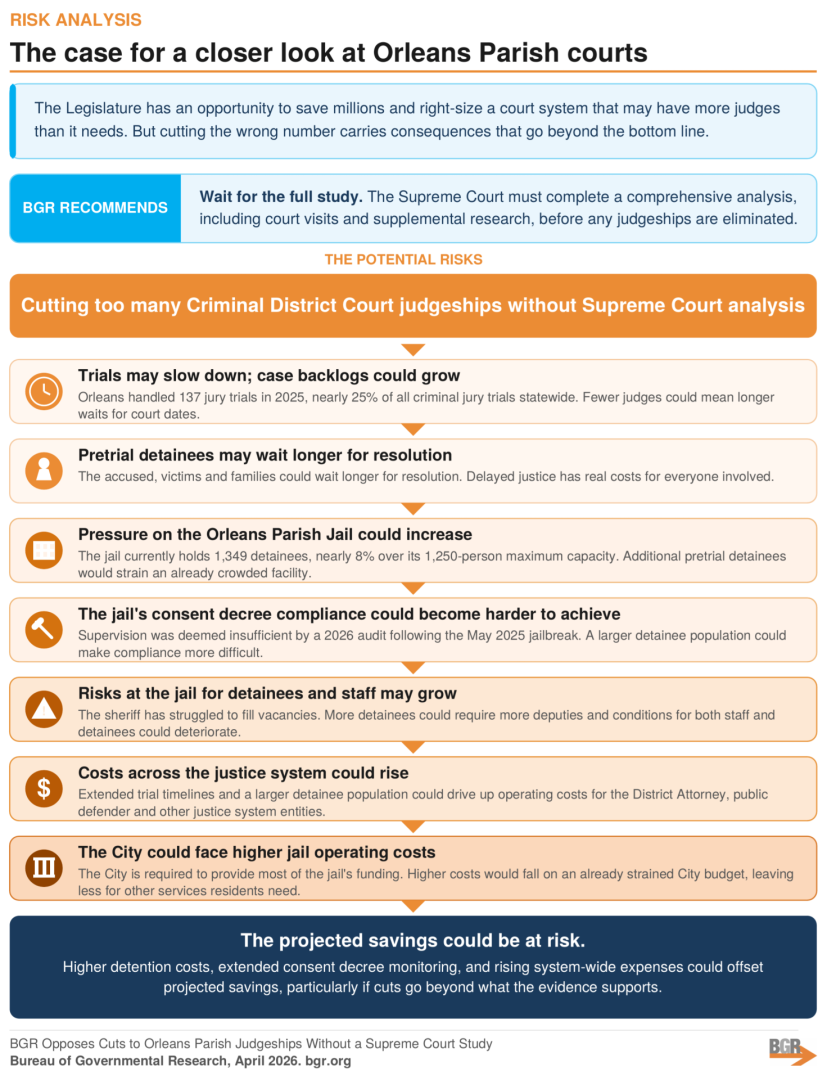
The projected savings could evaporate. Cutting too many judges could mean longer backlogs, more people waiting in jail before trial, and rising detention costs that offset whatever the city saves on judgeships.
- A political clock is ticking. If the Legislature doesn’t act before the November 2026 judicial elections, a constitutional prohibition against shortening a sitting judge’s six-year term would put reductions off the table until 2032. That’s a real constraint, but it’s not a reason to skip the analysis.
BGR’s risk analysis breaks down the potential consequences in detail
[READ THE FULL REPORT] | [READ THE INBRIEF] | [READ THE MEDIA RELEASE]