
This On the Ballot report examines the November 15, 2025, proposed charter amendment on New Orleans’ City Attorney.
This On the Ballot report examines the November 15, 2025, proposed charter amendment on New Orleans’ City Attorney.
On the Ballot: New Orleans City Attorney Charter Amendment analyzes a proposed City charter amendment to clarify that the City Attorney represents the entire City of New Orleans, and not just the mayor or the City Council. It also would allow the council to block the mayor’s firing of the City Attorney under certain circumstances. BGR’s report analyzes whether the proposal would effectively address a clear problem or need, and whether it is necessary or desirable to change the charter to improve public outcomes.
The council proposed the amendment to help ensure even-handedness in the City Attorney’s dealings with both branches. This followed legal disputes with the mayor in which the council questioned the City Attorney’s neutrality and independence. The mayor vetoed the proposed amendment, but the council unanimously overrode the veto to place it on the ballot.
If approved by voters, the charter amendment would take effect January 13, 2026. This is the first day in office for the next mayor and City Council.
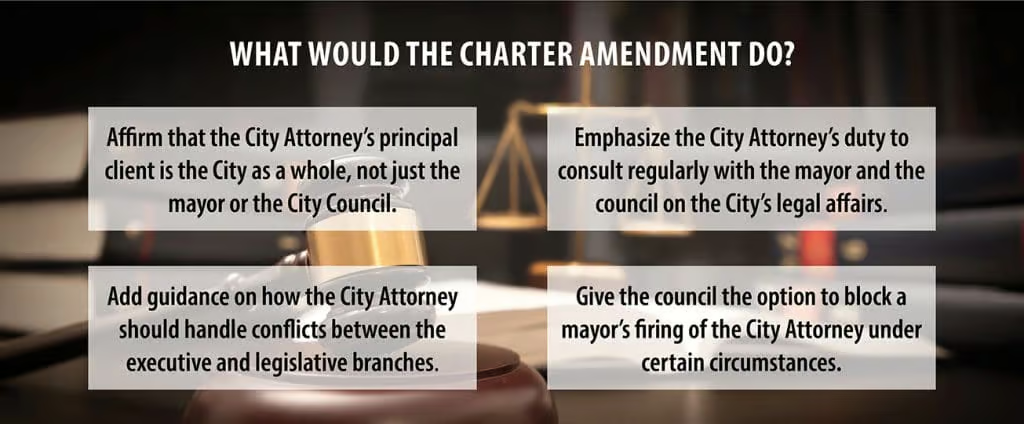
AGAINST. The proposed charter amendment is not necessary to achieve the desired goal of improving the working relationship between the City Attorney, the mayor and the City Council. It is clear from the current charter that the City Attorney and the Law Department represent the City as a whole, and not just the mayor or the council. The City Attorney also must advise both the mayor and the City Council and follow all other charter duties and ethical rules that the amendment seeks to affirm. From a practical standpoint, the amendment would provide greater cover for the City Attorney to give legal advice to both the executive and legislative branches of City government in a professional, neutral manner. But the same guiding principles for dealing with interbranch conflicts will apply even if they are not explicitly stated in the charter.
In addition, the council will be able to confirm the next mayor’s choice for City Attorney after a public hearing at which the council can vet potential appointees. It can evaluate their understanding of the City Attorney’s duties to the City, the mayor and the council under the current charter, as well as the ethical rules and how they would apply to the position. A successful candidate could be held accountable for a failure to act consistently with the answers given during the public confirmation process. This public vetting may be a more effective way of fostering the City Attorney’s positive working relationship with both branches than the proposed charter amendment’s process for allowing the council to block the mayor’s firing of a City Attorney. That process is not clearly defined in the amendment and could lead to more interbranch conflicts.
Click here to download the full report.
This report is part of BGR’s On the Ballot series, which provides voters with independent, nonpartisan analysis of significant ballot propositions in the New Orleans metropolitan area. In producing these reports, BGR recommends positions consistent with its mission of promoting informed public policy making and the effective use of public resources to improve local government. On the Ballot reports highlight the strengths and weaknesses of ballot propositions and assess the potential for government expenditures or actions to efficiently achieve beneficial outcomes for citizens.
This On the Ballot report examines the November 15, 2025, proposed charter amendment on New Orleans’ City Attorney.
The reform and modernization of local government is a lasting legacy of Hurricane Katrina. By envisioning positive change and reforming local government, residents, advocates and policymakers created a better future for Greater New Orleans. BGR is proud to have been a leader in these efforts with our independent, nonpartisan research and monitoring. On the 20th […]
BGR’s Candidate Q&A reports ask the candidates for mayor, City Council and sheriff in the October 11, 2025 primary election to explain how they will address important public policy issues if elected. BGR developed the questions based on our body of research. Many of these issues have close ties to concerns that voters themselves have […]
This letter to New Orleans’ mayor and City Council highlights ways to strengthen the future use of Housing Trust Fund money. In November 2024, New Orleans voters amended the City charter to dedicate annual funding to the trust fund. This amount will equal at least 2% of the City of New Orleans General Fund budget […]
This On the Ballot report informs New Orleans voters in the November 5, 2024, election about a proposal to amend the City charter to require an annual budget appropriation for the City’s Housing Trust Fund.
OVERVIEW These On the Ballot reports inform New Orleans voters about three propositions on the October 14, 2023 ballot: the renewal of a property tax for public school facilities and charter amendments on code enforcement and the City budget process. The Orleans Parish School Board is seeking to renew a property tax of up to 4.97 […]
OVERVIEW This page provides a brief online report and the video recording of BGR’s May 24, 2023 webinar, “Designing City Governments for Success.”
OVERVIEW In this report, BGR provides voters with nonpartisan analysis of a proposal to require New Orleans City Council confirmation of the mayor’s appointments of department heads and authorize the council to confirm certain other administrators.
OVERVIEW This On the Ballot report informs voters on a proposed City of New Orleans charter amendment to change the composition of the Sewerage & Water Board’s board of directors. On December 8, 2018, New Orleans voters will consider removing one citizen member and adding a City Council representative to the board, who may be […]
Overview BGR’s On the Ballot report examines the proposed amendment on the November 18, 2017, ballot to establish the Savings Fund of the City of New Orleans in the City’s home rule charter.
Overview BGR analyzes a November 8, 2016 proposition that would amend New Orleans’ charter to allow for the permanent separation of the Independent Police Monitor from the Office of Inspector General.
Overview In It’s the Law: Land Use Decision Making and the Master Plan, BGR provides clarity to recent public planning dialogue in New Orleans over the extent to which the Master Plan has the force of law.
Overview BGR examines two proposed amendments to the Home Rule Charter of the City of New Orleans, one Orleans Parish property tax proposition and two constitutional amendments on the ballot for November 4, 2014. One City charter amendment would incorporate certain professional services contracting reforms made in 2010. The other charter amendment would move the […]
Overview In On the Ballot: October 19, 2013, BGR explains, analyzes and takes positions on three tax propositions on the ballot in Jefferson Parish and two proposed charter amendments in New Orleans, one of which would reform the Sewerage & Water Board. The Jefferson tax propositions are renewals of property taxes for the Jefferson Parish […]
Overview In On the Ballot: November 6, 2012, BGR examines three proposed constitutional amendments, two propositions pertaining to multiple parishes in the New Orleans area, a proposed change to the City of New Orleans charter and two local tax propositions. The three constitutional amendments would strengthen gun rights, provide an additional homestead exemption to spouses […]
Overview BGR examines charter amendments, tax propositions and state constitutional amendments on the October and November 2011 ballots. The October 22 ballot includes a Jefferson Parish charter amendment to establish the Office of Inspector General and an Ethics and Compliance Commission, as well as a related property tax to fund both entities. It also includes […]
Overview BGR analyzes two Orleans Parish propositions and two State constitutional amendments on the ballot for October 2, 2010. The two Orleans Parish propositions would amend the Home Rule Charter of the City of New Orleans to reconfigure the governance of City recreation services and facilities, and adjust the City Council membership on the Sewerage […]
Overview This BGR release deals with proposed legislation that would require a referendum for approval of the city’s Master Plan. It focuses on three bills, all introduced by New Orleans legislators, that attempt to undermine a charter change approved by New Orleanians seven months ago that clarified and strengthened the planning process in New Orleans.
Overview BGR provides analysis of local propositions as well as amendments to the state constitution appearing on the ballot for November 4, 2008. A proposition in New Orleans would amend the city charter to make comprehensive changes to planning and land use decision making in the city. A proposition in Jefferson Parish would expand the permissible […]
Overview This release calls on the City of New Orleans to conform to charter requirements in producing its capital budget, which is developed by the mayor and reviewed by the New Orleans City Planning Commission and City Council.
Overview On March 2, 2002, Orleans Parish voters will be asked to decide whether the City Charter should be amended to require voter approval of decisions by the Sewerage & Water Board of New Orleans (S&WB) to enter into certain privatization contracts.
With this report BGR provides voters with an analysis of the arguments for and against the proposed charter amendment allowing a third consecutive term for the New Orleans Mayor and provides BGR’s position. The amendment would change the term limit provision of the City’s home rule charter.
Today the Bureau of Governmental Research (BGR) released two reports providing independent, nonpartisan analysis to New Orleans voters on propositions in the November 15 election. Early voting begins Saturday, November 1. On the Ballot: $510 Million New Orleans Capital...
Twenty years after Hurricane Katrina devastated New Orleans, BGR’s June 18 Breakfast Briefing discussed the disaster’s lasting impact on local government reform—and what lessons public officials and citizens can use to inspire future change. This event was free to...
The reform and modernization of local government is a lasting legacy of Hurricane Katrina. By envisioning positive change and reforming local government, residents, advocates and policymakers created a better future for Greater New Orleans. BGR is proud to have...
Today, the Bureau of Governmental Research (BGR) sent a letter to New Orleans Mayor LaToya Cantrell and members of the City Council highlighting several ways to strengthen the future use of Housing Trust Fund money. In November, New Orleans...
New Orleans voters on Tuesday (Nov. 5) approved two new amendments to the city’s charter: one that will add a “workers’ bill of rights” and another that will require the city to set aside millions per year in a...
New Orleans is poised to see a massive influx of taxpayer funding for local affordable housing projects after voters approved a charter amendment during Tuesday’s election. Over 75 percent of the city voted “yes” on the amendment, handing supporters...
New Orleans voters on Tuesday overwhelmingly backed a city affordable housing fund and symbolic support for private sector workers, while Jefferson Parish voters agreed to allow city government to fire certain staffers at will. In an election that also...
As the City Council’s leading advocate on the quest for more affordable housing, District B Councilmember Lesli Harris has a lot at stake in the November 5 Election. Harris is heading up the effort to pass the New Orleans...
Other than the bitterly divisive presidential race, the Nov. 5 ballot features few contested elections in Orleans and Jefferson parishes. In fact, the hottest local item appears to be a proposed City Charter amendment to create permanent local funding...
NEW ORLEANS — City leaders in New Orleans want to allocate a chunk of money from the general fund for affordable housing needs. The proposal is on the ballot in November as Charter Amendment 1. The proposal is to...
NEW ORLEANS — As city and state leaders clash over homeless encampments in New Orleans, Lesli Harris and other city leaders are advocating for a long-term solution that’s already in the works. That solution, the Housing Trust Fund, is...
Proposition one on the ballot is asking New Orleans voters to approve two percent of the city’s general fund to pay for affordable housing. Click here to review BGR’s report on the ballot proposition.
The Bureau of Governmental Research discussed its report, On the Ballot: New Orleans Housing Trust Fund, November 5, 2024 Election, on The Good Morning Show on WBOK 1230 AM. Click here to watch the segment.
While the presidential race is still very much a toss-up, some winners are already certain when the votes are counted in New Orleans on Nov. 5: advocates of affordable housing and persons in need of housing assistance. The New...
I love New Orleans. I love the architecture, the arts, the culture, the food, the music, the people. I love our gumbo population, with its strong Black base. But there’s no denying that some of my city’s neighborhoods have...
It is no secret that New Orleans is facing a housing crisis. Like many other cities across the nation, New Orleans is contending with a decreasing supply of low-cost housing coupled with cost-of-living increases across the board. The city...
Voters in New Orleans will see two proposed city charter amendments on the Nov. 5 ballot, with early voting beginning Friday. Here are the Times-Picayune’s recommendations. Home Rule Charter Amendment No. 1: No The bad news is that New...
Members of the River District consortium and other New Orleans developers are the main financial backers of a November ballot initiative that would direct millions of city tax dollars annually to affordable housing projects. New Orleans developer Louis Lauricella,...
Tommy hears from BGR and from Councilmember Lesli Harris about affordable housing. Click here to listen. Click here to read BGR’s On the Ballot report.
NEW ORLEANS (Oct. 12, 2024) — The Bureau of Governmental Research (BGR) expressed concern this week regarding a proposed charter amendment in New Orleans that would mandate a minimum annual budget allocation of 2% of the City’s General Fund...
Affordable housing is getting harder to find in New Orleans, and city leaders want to put millions in taxpayer dollars toward solving the issue. Residents will see a question on their ballot on Election Day asking them to vote...
NEW ORLEANS (WGNO) — New Orleans voters will decide whether to dedicate millions of local tax dollars to affordable housing. The proposition will appear on the Nov. 5 ballot. According to a 2024 report from the National Low Income...
NEW ORLEANS (press release) — District ‘B’ Councilmember Lesli Harris, who chairs the Quality of Life Committee and has been an advocate for affordable housing, issued the following statement in response to BGR’s new report on the Housing Trust...
Construction is set to begin on a blighted, century-old firehouse on Louisiana Avenue that will become New Orleans’ first city-owned property to include both affordable housing units and an early childhood education center, city leaders said Wednesday. As part...
NEW ORLEANS (press release) — The Bureau of Governmental Research (BGR) has released an On the Ballot report analyzing a proposed charter amendment in the Nov. 5 New Orleans election. The proposition would require an annual budget appropriation for...
A good government group has come out in opposition to a plan that would dedicate millions in public funding to affordable housing programs each year if approved by New Orleans voters this November. According to a report released Wednesday...
Today, the Bureau of Governmental Research (BGR) releases an On the Ballot report analyzing a proposed charter amendment in the November 5 New Orleans election. The proposition would require an annual budget appropriation for the City’s Housing Trust Fund equal to at least...
It’s a problem New Orleanians know all too well: Housing costs in the city have skyrocketed in recent years, forcing long-time residents to cheaper suburbs and shrinking the city’s tax base. Past efforts to help people with their rent...
New Orleans Mayor LaToya Cantrell has faced criticism for taking too many trips around the globe on the taxpayer’s dime. But more troubling to us is that even when Cantrell is present, she can’t seem to focus her administration...
New Orleans City Council members are pressing forward with plans to enshrine an unprecedented local investment in affordable housing into the City Charter, a move aimed at expanding programs to help first-time homebuyers, rehab rental units and provide financial...
The Nov. 28 column by former mayor Sidney Barthelemy and assessor Erroll Williams makes some vital points about the need to review the City of New Orleans’ governing structure. At the Bureau of Governmental Research, we want local government...
The New Orleans City Council this week is flexing its new confirmation powers in the hiring process for top administration officials. Driving the news: Council members on Thursday will decide whether the city should hire Anne Kirkpatrick, Mayor LaToya...
NEW ORLEANS — From the Bureau of Governmental Research: New Orleans voters will head to the polls on Saturday to vote in several prominent races, including one for Louisiana’s next governor. But they will also decide three important local...
Louisianans head to the polls Saturday to vote in the gubernatorial primary. Why it matters: Just about every statewide office is up for grabs, so voters will make a big impact on the state’s direction for the next several...
BGR President and CEO Rebecca Mowbray discussed BGR’s reports on the October 14, 2023, ballot propositions with WWL Radio host Tommy Tucker. Audio recording not available online.
New Orleans voters heading to the polls Oct. 14 will punch ballots for governor, the legislature and several other state and local elected positions. They’ll also see three citywide ballot measures, one aimed at renewing tax funding for school...
This year, Louisiana voters are once again being asked to weigh in on a number of policy issues. At the state level, lawmakers have proposed four amendments to the Louisiana constitution, while here in Orleans Parish voters will be...
Excerpt: PW HRC Amendment Prop. No. 1 of 2 – Art. VI, Sec. 6-102 & 6-104 – CCShall Article VI, Sections 6-102 and 6-104 of the Home Rule Charter of the City of New Orleans be amended to move...
Today, the Bureau of Governmental Research (BGR) releases three On the Ballot reports for the October 14 election. The reports are intended to help New Orleans voters make informed decisions on three separate propositions: a property tax renewal for...
Today, the Bureau of Governmental Research presented a webinar, entitled “Designing City Governments for Success.” This event featured two national experts on municipal forms of government, Dr. Kimberly Nelson of the University of North Carolina’s School of Government and...
NEW ORLEANS (press release) — The Bureau of Governmental Research will host a free lunchtime webinar, titled “Designing City Governments for Success,” from noon to 1 p.m. Wednesday, May 24 CST. During the Zoom webinar, attendees will learn about...
New Orleans voters on Tuesday approved an amendment to New Orleans’ home rule charter to require the mayor to get approval from the City Council before hiring certain department heads, such as the superintendent of the NOPD or the...
New Orleans voters on Tuesday night approved a significant change to how City Hall officials are appointed, setting up a new system that empowers the City Council to confirm or deny the mayor’s picks to run key departments. The...
One of the hottest citywide contests on the Nov. 8 ballot doesn’t feature candidates. It’s a proposed change to the New Orleans City Charter that asks voters to decide whether mayor-appointed department heads should be subject to City Council...
New Orleans voters will determine Nov. 8 whether to alter the balance of power at City Hall by giving the City Council authority to approve or reject mayor-appointed department heads. The proposed charter amendment would end the unilateral right...
It’s difficult to separate the proposed New Orleans City Charter amendment from recent headlines over the City Council’s ongoing battles with Mayor LaToya Cantrell — including over the proposal itself, which Cantrell vetoed and the council overrode to put...
The Nov. 8 ballot contains a proposed change to the New Orleans City Charter and eight proposed state constitutional amendments. Early voting starts Tuesday, Oct. 25, and continues through Nov. 1. Below are our recommendations on those propositions. City...
The non-partisan research group the Bureau of Governmental Research released a report this week in support of a Nov. 8 ballot measure that would require the mayor to get approval from the New Orleans City Council before hiring department...
NEW ORLEANS — From the Bureau of Governmental Research: On Oct. 17, BGR released a new report titled On the Ballot: New Orleans Charter Amendment, November 8, 2022. The report is intended to help New Orleans voters make an informed...
Today, the Bureau of Governmental Research (BGR) releases a new report, On the Ballot: New Orleans Charter Amendment, November 8, 2022. The report is intended to help New Orleans voters make an informed decision on whether to require the...
Read Part 1: Fulfilling the mission. The OIG faced a series of challenges beginning in 2015. While the Office remained highly productive and continued to release credible and well-respected reports, the cumulative effect of these challenges diverted attention from...
Three new directors have joined the 11-member panel tasked with overseeing the Sewerage & Water Board. The additions follow a recent law change that called for vacating nearly all board seats this year along with adding a New Orleans City Council member. The new...
New Orleans voters have chosen to slightly reel back a change they made five years ago to the makeup of the Sewerage & Water Board. After removing three City Council members in 2013, a proposal approved Saturday (Dec. 8) with...
To change who oversees the Sewerage & Water Board or not to change it? That question is on the ballot for New Orleans voters to decide Saturday (Dec. 8). The matter depends on whether to add a New Orleans City Councilmember or designee back...
NEW ORLEANS (WVUE) – Drainage issues, boil water advisories and complaints about inflated water bills have thrust the New Orleans Sewerage and Water Board into the headlines. On Saturday, voters will cast ballots on a proposed City Charter amendment...
New Orleans voters will decide Saturday whether to approve a City Charter change that would return City Council representation to the Sewerage & Water Board and strengthen rules surrounding reports the agency is supposed to make to elected officials....
The Sewerage and Water Board oversees most of the water and drainage in the city. It’s faced lots of problems in recent years, including the floods in the summer of 2017, which revealed that many of the pumps and...
In a Dec. 2 editorial titled, “No on adding a council representative to S&WB,” the Times-Picayune editorial board quotes a recent Bureau of Governmental Research report. The BGR says, “The council has recently taken steps to strengthen its regulatory oversight of the...
The Times-Picayune Editorial Board makes the following recommendation for the Dec. 8 election. SEWERAGE & WATER BOARD PROPOSITION To amend New Orleans’ Home Rule Charter to change the membership of the Sewerage & Water Board to remove one citizen member and add...
This Saturday, Dec. 8, is Election Day in Louisiana. The ballot includes a statewide runoff for Secretary of State and many local runoffs and referenda. In New Orleans, voters will decide the fate of a proposed City Charter amendment...
Early voting begins Saturday, Nov. 24 and runs through Dec. 1 for the Dec. 8 elections across Louisiana, including several runoffs. Early voting is available every day except Sunday, Nov. 25. Voting hours are 8:30 a.m. to 6 p.m....
A proposal voters will consider next month to restore a City Council representative to the Sewerage & Water Board’s governing board has rustled up a familiar opponent: the Bureau of Governmental Research. The nonpartisan watchdog group said adding any...
A charter amendment on the Dec. 8 ballot would make changes in the membership of the group that oversees the aging and ailing infrastructure of the Sewerage and Water Board. We urge voters to reject the proposal, although it...
New Orleans voters will decide next month whether to return a New Orleans City Council member to the Sewerage & Water Board’s 11-person board of directors. Ahead of that vote, the watchdog Bureau of Governmental Research issued a report Thursday (Nov. 14) reiterating its position...
Today the Bureau of Governmental Research (BGR) releases a report to inform voters on a proposed City of New Orleans charter amendment to change the composition of the Sewerage & Water Board’s board of directors. On December 8, 2018,...
There are several issues and races on the ballot throughout south Louisiana for today’s election, including a statewide contest to pick the next treasurer and a high-profile race for mayor in New Orleans. We urge everyone to go to...
New Orleans voters have agreed to create a safety net for the city’s finances, establishing a “rainy day” fund with a charter change that gained citywide approval Saturday (Nov. 18). The city will be required to set aside for emergencies...
In 7 1/2 years, together with the City Council and the people of New Orleans, we have righted the ship of government. Today, our financial house is stronger, going from a budget deficit to a budget surplus, and our...
When Mayor Mitch Landrieu and a new City Council took office in May 2010, New Orleans was broke. The mayor and council took drastic measures to put the city’s fiscal house in order, and those tough choices have, for...