
The Bureau of Governmental Research (BGR) released a new report today examining the Sewerage & Water Board’s effort to develop a drainage funding proposal that can keep up with New Orleans’ growing needs. At a time when storms are becoming more intense and frequent, this is an issue that concerns everyone in our city.
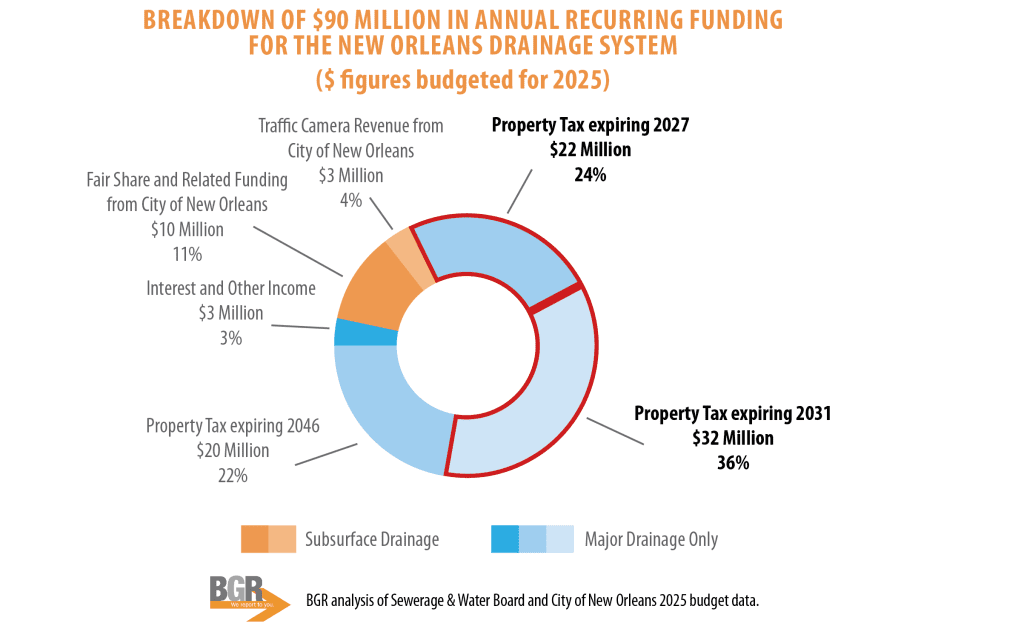
Paying for Drainage: Creating Fair, Transparent and Accountable Stormwater Funding for New Orleans details the Sewerage & Water Board’s current drainage funding structure, which relies primarily on property taxes. But these taxes, which account for most of the drainage system’s $90 million in annual revenue, haven’t been enough to address maintenance, repair, and capital needs.
Here’s a look at the challenge in numbers:
- About $54 million of annual property taxes, or roughly 60% of current drainage revenue, is set to expire by 2031.
- 37% of New Orleans’ assessed property value is exempt from property taxes, even though those properties benefit from the drainage system.
- Preliminary estimates show that traditional drainage needs could require $35 million to $60 million a year in new local funding.
- The Sewerage & Water Board has less than $7 million a year available to finance approximately $800 million in major drainage capital needs.
Without action, the city’s ability to effectively manage stormwater and reduce flood risk is at stake. In response, the Sewerage & Water Board is developing a proposal for voters to approve a stormwater fee, along with a long-term extension of some or all existing drainage taxes.
Because the utility has not released a formal proposal, BGR does not take a position in this report. Rather, BGR offers independent guidance on how the utility can craft fair, transparent and accountable stormwater funding. Citizens and community groups can use this report to assess the future proposal.
Before the Sewerage & Water Board issues a proposal for public consideration, BGR recommends several steps be taken in coordination with the City:
- Develop an accurate, comprehensive and public spending plan. A spending plan for new drainage system revenue should identify system needs and set funding priorities for both the Sewerage & Water Board and the City, including gray and green infrastructure.
- Set up effective and transparent management of stormwater fee revenue. The strategy should cover how the Sewerage & Water Board and the City will lead planning for stormwater management and provide the public with an easy dashboard to track financial and system performance.
- Clearly justify any tax-and-fee combination. The utility should explain why retaining some property taxes is necessary to meet New Orleans’ drainage challenges, how its proposed approach meets legal standards, and how it compares with alternatives.
- Consider increasing the number of tiers in the stormwater fee structure to enhance fairness and affordability for homeowners. The use of tiers in a stormwater fee structure can deliver greater equity and affordability compared to a single flat rate.
- Enhance City Council and citizen oversight of drainage system revenue. The council should have a clear process for reviewing tax and fee funding requests and monitoring drainage system performance. A citizen-led stormwater advisory committee can support the council’s oversight.
Click the button below or these links to read the full report, our two-page InBrief summary or the media release.