

Complete BGR Survey Responses, Alphabetical by Candidate’s Last Name


SUSAN HUTSON (INCUMBENT)
Jail Governance and Strategic Planning
Background Provided to All Candidates
The Orleans Parish jail has been under federal oversight or investigation for more than 50 years, longer than any other local jail in the country. It has suffered from chronic problems, including violence, understaffing, and insufficient medical and mental health care. The May 16, 2025, escape of 10 men from custody heightened the public’s concern about the jail’s problems.
BGR’s 2022 report, Keys to the Jail, linked the jail’s performance problems to the strained governance relationship between the Orleans Parish Sheriff’s Office and the City. Under Louisiana law, the Sheriff’s Office operates the jail, while the City must pay most of its costs – 79% of its $91.1 million total budget in 2025. This structure has blurred accountability for the jail’s performance and impeded progress toward improving its performance and exiting federal oversight.
For example, the parties have not agreed on a strategic plan for the jail. Having a joint strategy could improve trust and the effective use of jail resources. It could also provide a basis for coordinating with other justice system actors, such as the courts, prosecutors and public defenders – all of whom directly influence jail population, costs and staffing needs.
BGR recommended in Keys to the Jail and in a May 2025 release that the City and Sheriff’s Office develop a multi-year agreement to:
- Establish an ongoing strategic planning process in which they collaborate on the budget, facilities, employee compensation and training, and other jail needs.
- Improve fiscal transparency and accountability, both to ensure adequate City funding for the jail and careful tracking of how the Sheriff’s Office uses the money.
- Strengthen the appointment process for the top jail administrator by defining the job’s responsibilities and qualifications and by enabling City and public input on the candidates.
- Create an independent local entity to oversee jail performance to ensure ongoing monitoring of jail conditions and treatment of people in custody after federal court oversight ends.
Following the May 2025 escape and the risk of more finger-pointing between the City and Sheriff, BGR re-emphasized the importance of the City and Sheriff coming to a multi-year agreement.
On jail governance and strategic planning, BGR asked the candidates:
1. Should there be a cooperative agreement between the City and the Sheriff’s Office along the lines of what BGR recommends? If yes, please explain which components in the bullet point list above should be included in the agreement, plus any other priorities you would include. If not, please explain how you would work with the City to improve the jail’s performance.
Yes, a cooperative agreement between the City and OPSO, as BGR recommends, is both necessary and constructive. Currently, there is no true collaborative planning—just the budget hearing process, which often leaves critical needs unmet. A structured process, particularly between the CAO’s Office and the OPSO CFO, would help ensure we fulfill our responsibility to keep over 1,300 people safe, healthy, and alive, and address the urgent need to fairly compensate staff—nearly 10% of whom rely on public assistance. I’ve submitted a request for pay plan every year, but the City’s response has been limited to a $3/hour increase—well short of a living wage.
While we meet with the CAO’s Office under the consent decree and share payroll data, these interactions address immediate needs, not long-term strategy. The City also has direct access to our financial system, but it remains underused due to its outdated design.
Appointing the jail administrator is the Sheriff’s legal responsibility, but federal monitors—experts in corrections—review qualifications under the consent decree. Their oversight adds strong accountability.
I also support creating a local oversight entity. With 11 years as the Independent Police Monitor, I know the value of sustained civilian oversight. Establishing such a body now allows it to build credibility before the consent decree ends. The City and Council already receive daily jail data, and a medical contract monitor is in place.
Finally, political dynamics have influenced support for OPSO. Some councilmembers actively back another candidate, affecting their approach to our needs.
2. As Sheriff, how would you approach strategic planning for the jail in collaboration with the City, other justice system actors, and the public?
As Sheriff, I will continue to approach strategic planning for the jail through a collaborative, transparent, and structured process involving the City, justice system stakeholders, and the public. One practical step would be to leverage existing Criminal Justice Committee meetings, dedicating them to long-term planning and coordination. These meetings already include key system actors and offer a public forum for meaningful community input. However, effective planning must be paired with sustainable funding. There needs to be a formal mechanism—such as a cooperative endeavor agreement—that clearly outlines obligations, funding formulas, and shared responsibilities. This would ensure that the operational needs of the Sheriff’s Office are met without compromising the City’s fiscal stability. Best practices in public agency funding emphasize multi-year budgeting, performance-based allocations, and inter- agency agreements that align funding with outcomes. Transparent funding models grounded in objective data help depoliticize resource decisions and prioritize investments that improve safety, health, and operational efficiency. A strategic funding framework would enable the Sheriff’s Office and the City to responsibly plan for staffing, infrastructure, and programming—ensuring we can meet both our legal mandates and community expectations.
Jail Budget
Background Provided to All Candidates
The City provides the majority of funding for the Orleans Parish jail. This amounts to $71.8 million (79%) in 2025, making the jail the City’s third largest budget item behind the police and fire departments. The Sheriff’s tax provides the second largest funding source for the jail, about 13%, with the rest of the $91.1 million budget coming from federal and state grants and other revenues.
Cooperation between the Sheriff and the City is essential to achieving sufficient and sustainable funding for the jail. However, over the years, many funding disputes have arisen, in some cases leading to litigation. BGR recommended in Keys to the Jail and in a May 2025 release that the City and Sheriff develop a standard, transparent process for the City administration to review the Sheriff’s annual budget proposals. The Sheriff’s Office should support its funding requests with data, such as staffing and compensation studies. The proposed budgets also should include jail funding sources not provided by the City to present a complete financial picture. These other sources include the property tax that Orleans Parish voters recently renewed. The City administration should review the Sheriff’s budget proposals in the context of the strategic plan for the jail. The process should conclude with the administration’s report to the City Council explaining the rationale for any changes from the Sheriff’s original budget request. Citizens could then assess the City’s funding level and hold the mayor and councilmembers accountable for fulfilling their shared responsibilities.
These steps would improve transparency and accountability for the City’s adequate funding of the jail and the Sheriff’s efficient and effective use of taxpayer dollars.
On the jail budget, BGR asked the candidates:
3. How would you determine the appropriate funding level for the jail? Please describe any specific analyses or benchmarks that would inform this determination.
To determine the appropriate funding level for the jail, I would begin with a thorough review of recent budget requests (2022-2024) and the state-mandated financial audits completed by the Orleans Parish Sheriff’s Office over the past three years. These audits—now current after a backlog that predated my administration—provide a solid foundation for financial analysis and informed decision- making. From there, we would assess key priorities, particularly staffing levels, infrastructure needs, and the requirements imposed by the federal consent decree.
The City of New Orleans has the capacity and resources to partner in this effort, including conducting a comprehensive staffing and operational cost study. Such collaboration would ensure that funding decisions are based on evidence and shared accountability, rather than political considerations.
Best practices in determining appropriate public safety funding call for data-driven approaches that align resources with service demands, legal obligations, and performance goals. This includes workload-based staffing models, cost-per-inmate analyses, and benchmarking against similarly sized jurisdictions. By combining internal audit data with external studies and peer comparisons, we can identify a funding level that is both fiscally responsible and sufficient to maintain safety, constitutional care, and operational stability.
4. What steps would you take within the current budget to reduce security weaknesses – such as inadequate supervision and malfunctioning locks and cameras – and make the jail safer and more secure for detainees, staff and the public?
Within the current budget, I will continue the strategic approach I’ve used over the past three years: managing a jail population that has at times increased by 70%—without a matching increase in funding. This has required prioritizing urgent infrastructure needs such as plumbing, electrical, HVAC failures, and rising food costs, while also investing in long-term improvements to safety and professionalism.
To address supervision and security gaps, we launched an accredited training academy and introduced leadership and supervisory schools—firsts for OPSO. We’ve also opened leadership roles to professionals from other agencies to bring in fresh perspectives and improve standards. A structured pay plan is now in place to offer meaningful raises and career incentives, improving morale, retention, and reducing risks such as staff involvement in contraband smuggling.
We are also upgrading our jail management and investigative systems to replace outdated technology from the 1980s. These modern tools will enhance efficiency, especially for our understaffed workforce, by equipping deputies with handheld devices that provide real- time access to operational data. This upgrade allows us to identify trends, detect risks early, and respond quickly—enabling a more proactive and accountable jail environment.
Best practices in correctional safety emphasize strong training, consistent supervision, facility maintenance, and a culture of accountability. Even with limited resources, meaningful improvements can be made by prioritizing vulnerabilities, optimizing staffing, and using data-driven strategies. At OPSO, we are committed to balancing immediate needs with sustainable reform to ensure a safer, more secure facility for everyone.
Accountability to the City and the Public
Background Provided to All Candidates
Voters face unique challenges in trying to gauge the performance of a jail, which is largely closed to public observation. Citizens generally lack direct knowledge of jail operations and conditions. This limits their ability to evaluate the Sheriff’s performance. The City Council has also raised questions about Sheriff’s Office spending of City appropriations and wants more oversight.
BGR has suggested ways to improve both fiscal and performance accountability. The Sheriff’s Office can use its quarterly meetings with the City Council to present this information to the public. As BGR discussed in Keys to the Jail, its report on the Sheriff’s tax renewal, and a May 2025 release, the Sheriff’s Office should discuss expenditures of City appropriations and the Sheriff’s property tax. It can provide details on budget variances, contracts, operations, jail staffing, population and other cost drivers. The City Council can use its existing oversight powers, alongside those of the New Orleans Office of Inspector General, to probe any issues related to the use of City funds.
Relative to jail performance, the quarterly meetings with the City Council offer a high-profile forum for the Sheriff’s Office to keep the public updated on its efforts to improve conditions at the Orleans Parish jail. The Sheriff’s Office could provide timely insights on compliance and flag potential concerns that might need City assistance.
On accountability, BGR asked the candidates:
5. Describe specific initiatives that you would take to improve fiscal and performance accountability to the City and taxpayers.
To improve fiscal and performance accountability to the City and taxpayers, I would build on existing transparency measures by implementing standardized performance metrics, expanding public reporting, and enhancing internal auditing practices. We already share detailed financial data with the City as part of the consent decree, but I would formalize this further through regular public dashboards that track staffing levels, use-of-force incidents, response times, and other key indicators. Additionally, we are upgrading our jail management and investigative systems to improve real-time data collection and operational oversight.
Best practices in public sector accountability emphasize outcome-based budgeting, independent performance audits, and transparent reporting that links spending to measurable results. By adopting these approaches, OPSO can ensure that every taxpayer dollar is tied to improved safety, service delivery, and long-term institutional reform.
Federal Consent Decree Compliance
Background Provided to All Candidates
The jail remains under a long-running consent decree, a legal settlement with the federal government to meet basic constitutional jail conditions and treatment of detainees. The consent decree requires 174 specific improvements that the Sheriff must make to comply with constitutional standards of confinement. The mandates include, among other things, improving the jail’s security, sanitation, staffing levels, and medical and mental healthcare. Intensive, regular federal monitoring will continue until the Sheriff’s Office can maintain substantial compliance with all provisions for two consecutive years. At that point, the court can terminate the consent decree. However, BGR found that compliance has decreased steadily from a peak of 68% in 2020 to 41% as of the May 2025 compliance report (which reflects compliance as of September 30, 2024).
While there may be several more years of federal oversight ahead, the City and the Sheriff should consider what accountability might look like beyond the consent decree. BGR recommends in Keys to the Jail that their multi-year agreement should contemplate an eventual State legislative proposal to establish a local, external oversight body. This should be done in consultation with jail experts, parties to the consent decree and the public. This entity would regularly monitor conditions in the New Orleans jail, study its operations and treatment of people in custody, and investigate complaints. The oversight body would be independent from the Sheriff’s Office and the City in terms of its governance, staffing and funding. The entity would have broad access to the facility, records, staff, contractors and detainees. Finally, it would maintain a website and use it to regularly report its findings and recommendations to the public. Its recommendations would be non-enforceable proposals to help improve jail performance. In the long run, the body would represent significant cost savings for the jail and the City since maintaining such an entity is typically far less expensive than litigation and court-ordered oversight conducted by national consultants.
On federal consent decree compliance, BGR asked the candidates:
6. As Sheriff, describe specific initiatives that you would take to improve compliance with the federal consent decree.
Improving compliance with the federal consent decree has been a top priority of my administration. Having worked under consent decrees at the LAPD and NOPD, this is my third such experience, and I brought that knowledge to OPSO. One of my first major initiatives was the creation of the Compliance and Accountability Bureau in 2023 to track progress, coordinate corrective action plans, and ensure that each paragraph of the decree is actively addressed. As a result, we are now just five paragraphs away from having all 174 provisions in some level of compliance—a milestone that has only been reached twice in the history of this decree, both under extraordinary circumstances when the jail’s operation was removed from local control.
Achieving substantial compliance across all areas is our next goal, and adequate staffing remains a critical factor in getting there.
Best practices in consent decree implementation emphasize five foundational pillars: (1) strong, clear policies and procedures; (2) comprehensive training to ensure all staff understand and can apply them; (3) consistent supervision to enforce standards; (4) accountability for those who fail to follow established protocols; and (5) thorough documentation to demonstrate compliance at every level. These components work together to create a culture of constitutional care and continuous improvement. Our approach at OPSO is grounded in these principles, ensuring that our progress toward full compliance is sustainable, measurable, and rooted in national standards.
7. Would you support the development of a local, external oversight body along the lines of what BGR recommends for when the jail exits federal oversight? Why or why not?
Yes, I support the development of a local, external oversight body for the jail, as recommended by BGR, to ensure continued accountability once federal oversight concludes. With 17 years of experience in law enforcement oversight across three states—and as a former board member and president of both the National Association for Civilian Oversight of Law Enforcement (NACOLE) and the International Law Enforcement Auditors Association (ILEAA)—I bring deep expertise in designing and evaluating oversight systems. During my tenure with NACOLE, I helped develop the Principles for Effective Oversight, Oversight Basics training, and national standards for accountability and transparency.
While the federal consent judgment sets the constitutional standards we are currently required to meet, establishing a local oversight body now would allow it to build capacity, gain familiarity with jail operations, and work alongside federal monitors. This creates a seamless transition toward sustained, community-based oversight once the decree ends.
Best practices in correctional oversight call for independence, subject-matter expertise, transparency, and public accessibility. A well- structured local oversight entity grounded in these principles can promote continuous improvement, foster public trust, and uphold constitutional standards in the long term.
Jail Population
Background Provided to All Candidates
As shown in this BGR chart, the jail’s population has increased significantly since its lows during the pandemic. It averaged 1,383 people in June 2025, still well above the City Council’s 1,250-person desired maximum. However, the inflow and length of stay of detainees is largely out of the control of the Sheriff and primarily depends on other criminal justice agencies like the New Orleans Police Department and the court system.
On jail population, BGR asked the candidates:
8. What steps would you take to improve coordination with other criminal justice agencies and manage the jail population at a safer level?
To improve coordination with other criminal justice agencies and manage the jail population at a safer level, I established the Jail Population Management Unit (JPMU) in 2023. This unit conducts detailed analyses of jail data—including average and individual lengths of stay, charge types, and case status—and issues recommendations to streamline case processing and reduce unnecessary detention. These recommendations were shared with system stakeholders, including the District Attorney, judges in Criminal and Municipal Court, the Public Defender, and the Criminal Court Clerk. Even modest reductions in length of stay for individuals already set for release could lower the daily jail population by 100–200 people, improving safety and allowing for better housing unit management.
Examples of proposed improvements include transitioning certain misdemeanors to Municipal Court, which processes cases more quickly, and replacing manual delivery of release paperwork with electronic scanning and email. While not all agencies have adopted these changes, our recommendations align with the City’s goals under the Sandy Krasnoff Criminal Justice Coordinating Council run by the Office of Criminal Justice Coordination and the MacArthur Safety and Justice Challenge, both of which seek to reduce unnecessary incarceration.
Best practices in jail population management emphasize interagency collaboration, data-driven decision-making, and early case resolution strategies. OPSO remains committed to leading in this space and working with partners to ensure detention is safe, necessary, and as brief as justice allows.
Jail Administrator
Background Provided to All Candidates
The performance of the warden or top jail administrator directly impacts the security of the jail and the safety of staff and those held in custody. A jail administrator’s responsibilities typically include supervising staff, managing the budget, ensuring legal compliance, tracking performance, managing emergencies, and otherwise solving any day-to-day problems. The administrator should work closely with the elected sheriff on leadership issues, such as setting vision, strategy and policy, and communicating and collaborating with justice system stakeholders, including the City, and the public. The Sheriff’s appointment of the jail administrator is a crucial decision that should be made transparently and with community input.
BGR’s Keys to the Jail report recommends four key safeguards that can be specified in the agreement between the City and the Sheriff:
- Establish a jail administrator position reporting to the Sheriff and define its roles and responsibilities. The Sheriff should develop the job description, with input from the City, to clarify the administrator’s daily management and operations of the jail and areas in which the administrator will collaborate with the Sheriff and justice system stakeholders, including the City.
- Set minimum requirements for the appointment of the Sheriff’s top jail administrator. Among other things, they should require the jail administrator to have significant experience managing a correctional facility, as well as a professional certification in jail administration or to obtain one within a reasonable time frame of the appointment.
- Establish a role for the City in the selection of future jail administrators. At a minimum, a City administrator familiar with jail matters should serve on the Sheriff’s search team. The parties should consider requiring the City Council’s consent to the Sheriff’s appointment of the jail administrator.
- Provide for public participation in the selection process. This should include interviewing candidates in public and releasing information about their qualifications.
Collectively, these safeguards would support effective jail administration over time.
On jail administration, BGR asked the candidates:
9. When selecting a jail administrator, what qualifications would you seek in candidates for the position, and to what extent would you allow for input from the City and the public during the selection process?
When selecting a jail administrator, I adhere to the qualifications outlined in the federal consent judgment, which requires the appointment of a full-time professional corrections administrator with a minimum of: (a) a bachelor’s degree in criminal justice or a closely related field; (b) at least five years of experience supervising a large correctional facility; and (c) demonstrated knowledge of modern correctional standards, maintained through ongoing professional development. All of our administrators—also referred to as the Warden or Chief of Corrections—have met or exceeded these standards.
Although the consent decree requires that the corrections administrator report directly to the Sheriff and leaves the final appointment authority with my office, I would be willing to work with the City and community stakeholders to create a structured process for input and recommendations on candidates. Transparency and collaboration help build confidence in the selection process and ensure that community values are reflected in our leadership.
Best practices in correctional leadership emphasize not only technical qualifications and operational experience, but also a commitment to ethical governance, staff development, and the humane treatment of those in custody. A well-qualified, community- informed administrator plays a critical role in achieving those goals.
Jail Staffing
Background Provided to All Candidates
For years, sheriffs have pointed to staffing shortages as one of the main hurdles toward exiting federal oversight. As BGR reported in April, recruitment challenges and high turnover in jail security positions have been long-running problems. As shown in this chart, the Sheriff’s Office indicates the jail has an overall vacancy rate of 28% and needs more than 200 more employees to function optimally. The Phase III medical and mental health facility is scheduled open in 2026, increasing staffing needs by another 57 employees.
BGR recommends in Keys to the Jail and in a May 2025 release that the City and Sheriff agree to develop a compensation strategy for jail deputies and other employees. The City and Sheriff should accompany the strategy with (1) an annual jail staffing plan, (2) periodic independent studies of compensation levels, and (3) a budget for appropriate continuing education and training for employees to ensure a stable and professional jail workforce. The City and Sheriff should periodically evaluate the compensation strategy to determine whether it is achieving its goals of adequate staffing at the jail. Altogether, effective compensation and training can support federal compliance and desired outcomes for jail staff, detainees and the public.
On jail staffing, BGR asked the candidates:
10. How do you propose to address the jail’s staffing issues? Would you ask the City and/or the voters for more funding for salaries and other personnel costs?
I have increased the jail’s staffing level from 45% when I took office to approximately 60% today—a significant improvement given ongoing recruitment and retention challenges. However, sustained progress depends on implementing a competitive, structured pay plan with retention bonuses, defined steps and career advancement, similar to the NOPD model. Currently, OPSO lacks the transparency and predictability in compensation that other agencies offer and does not offer work vehicles for most deputies, which makes it harder to recruit and retain qualified personnel. While recent recruitment fairs have attracted over 200 applicants in the last six months, we continue to lose staff due to the absence of guaranteed raises and long-term incentives. When I took office, deputies had not received a raise in five years; I asked City Council to increase the starting wage from $15.50 to $18.50 per hour. Still, more is needed to ensure we remain competitive.
To properly fund salaries, I would collaborate with the City to establish a multi-year pay plan that aligns with legal funding obligations and allows for long-term planning. I would support bringing the matter to voters to secure adequate, sustainable funding for staffing— because public safety, constitutional care, and operational continuity depend on it.
Best practices in correctional staffing highlight the importance of competitive compensation, career development opportunities, predictable pay structures, and sustained investment in workforce well-being. A comprehensive staffing strategy, paired with transparent budgeting and shared planning, is essential to attracting and retaining the skilled personnel our jail—and our community— needs.

ERNESTEAYO J. “ERNEST” LEE SR.
Jail Governance and Strategic Planning
Background Provided to All Candidates
The Orleans Parish jail has been under federal oversight or investigation for more than 50 years, longer than any other local jail in the country. It has suffered from chronic problems, including violence, understaffing, and insufficient medical and mental health care. The May 16, 2025, escape of 10 men from custody heightened the public’s concern about the jail’s problems.
BGR’s 2022 report, Keys to the Jail, linked the jail’s performance problems to the strained governance relationship between the Orleans Parish Sheriff’s Office and the City. Under Louisiana law, the Sheriff’s Office operates the jail, while the City must pay most of its costs – 79% of its $91.1 million total budget in 2025. This structure has blurred accountability for the jail’s performance and impeded progress toward improving its performance and exiting federal oversight.
For example, the parties have not agreed on a strategic plan for the jail. Having a joint strategy could improve trust and the effective use of jail resources. It could also provide a basis for coordinating with other justice system actors, such as the courts, prosecutors and public defenders – all of whom directly influence jail population, costs and staffing needs.
BGR recommended in Keys to the Jail and in a May 2025 release that the City and Sheriff’s Office develop a multi-year agreement to:
- Establish an ongoing strategic planning process in which they collaborate on the budget, facilities, employee compensation and training, and other jail needs.
- Improve fiscal transparency and accountability, both to ensure adequate City funding for the jail and careful tracking of how the Sheriff’s Office uses the money.
- Strengthen the appointment process for the top jail administrator by defining the job’s responsibilities and qualifications and by enabling City and public input on the candidates.
- Create an independent local entity to oversee jail performance to ensure ongoing monitoring of jail conditions and treatment of people in custody after federal court oversight ends.
Following the May 2025 escape and the risk of more finger-pointing between the City and Sheriff, BGR re-emphasized the importance of the City and Sheriff coming to a multi-year agreement.
On jail governance and strategic planning, BGR asked the candidates:
1. Should there be a cooperative agreement between the City and the Sheriff’s Office along the lines of what BGR recommends? If yes, please explain which components in the bullet point list above should be included in the agreement, plus any other priorities you would include. If not, please explain how you would work with the City to improve the jail’s performance.
An agreement between the city and Sheriff’s office would improve the oversight with the Orleans Parish Jail. A collaboration on the budget, facilities, employee compensation, etc. is integral for my plan to improve the jail. I aim to focus on the allocation of funds and the state of the jails in my plan to improve our jail system. Also just as important in my endeavor is fiscal transparency and accountability. Tracking the funding of the jail and the Sheriff’s Office’s expenditures is another step in revamping the jail’s performance. Transparency and accountability would ensure funding is put in the right places, and they would ensure trust from the public. Strengthening the appointment process for the top jail administrator, and incorporating public input into it, would work well in improving the jail’s performance as the person in charge would have clear expectations in their duties and an incentive to live up to them. If the public wants a separate entity to exist and oversee the ongoings of the jail, I will strive to meet that expectation.
2. As Sheriff, how would you approach strategic planning for the jail in collaboration with the City, other justice system actors, and the public?
As Sheriff, I would focus my planning, in collaboration with the city, on funding the jail, providing the needed resources such as employee morale and training, specialized employee training, building improvement etc. As Sheriff, I will absolutely listen to the public during any collaborations. Their thoughts and opinions will be incorporated into any plans. Furthermore, the recommendations or input from the city will also be integrated. I will always welcome constructive criticism of the ideas I put forth.
Jail Budget
Background Provided to All Candidates
The City provides the majority of funding for the Orleans Parish jail. This amounts to $71.8 million (79%) in 2025, making the jail the City’s third largest budget item behind the police and fire departments. The Sheriff’s tax provides the second largest funding source for the jail, about 13%, with the rest of the $91.1 million budget coming from federal and state grants and other revenues.
Cooperation between the Sheriff and the City is essential to achieving sufficient and sustainable funding for the jail. However, over the years, many funding disputes have arisen, in some cases leading to litigation. BGR recommended in Keys to the Jail and in a May 2025 release that the City and Sheriff develop a standard, transparent process for the City administration to review the Sheriff’s annual budget proposals. The Sheriff’s Office should support its funding requests with data, such as staffing and compensation studies. The proposed budgets also should include jail funding sources not provided by the City to present a complete financial picture. These other sources include the property tax that Orleans Parish voters recently renewed. The City administration should review the Sheriff’s budget proposals in the context of the strategic plan for the jail. The process should conclude with the administration’s report to the City Council explaining the rationale for any changes from the Sheriff’s original budget request. Citizens could then assess the City’s funding level and hold the mayor and councilmembers accountable for fulfilling their shared responsibilities.
These steps would improve transparency and accountability for the City’s adequate funding of the jail and the Sheriff’s efficient and effective use of taxpayer dollars.
On the jail budget, BGR asked the candidates:
3. How would you determine the appropriate funding level for the jail? Please describe any specific analyses or benchmarks that would inform this determination.
My determination of the appropriate funding level will come from the jail’s financial demands. The right level of funding will provide for the employee training, facility maintaining, prisoner containment etc. If any of these areas need more financial support, it will be given. I aim to be transparent; the public will have a say. Should there be discontent with the funding level, alterations will be made.
4. What steps would you take within the current budget to reduce security weaknesses – such as inadequate supervision and malfunctioning locks and cameras – and make the jail safer and more secure for detainees, staff and the public?
With the current budget, I will ensure there are maintenance checks so that no one can drill a way out, employee training so that the jail is managed properly, and building updates so that technology works as it is supposed to. Malfunctioning locks and cameras must be managed, and I will do so with the current budget.
Accountability to the City and the Public
Background Provided to All Candidates
Voters face unique challenges in trying to gauge the performance of a jail, which is largely closed to public observation. Citizens generally lack direct knowledge of jail operations and conditions. This limits their ability to evaluate the Sheriff’s performance. The City Council has also raised questions about Sheriff’s Office spending of City appropriations and wants more oversight.
BGR has suggested ways to improve both fiscal and performance accountability. The Sheriff’s Office can use its quarterly meetings with the City Council to present this information to the public. As BGR discussed in Keys to the Jail, its report on the Sheriff’s tax renewal, and a May 2025 release, the Sheriff’s Office should discuss expenditures of City appropriations and the Sheriff’s property tax. It can provide details on budget variances, contracts, operations, jail staffing, population and other cost drivers. The City Council can use its existing oversight powers, alongside those of the New Orleans Office of Inspector General, to probe any issues related to the use of City funds.
Relative to jail performance, the quarterly meetings with the City Council offer a high-profile forum for the Sheriff’s Office to keep the public updated on its efforts to improve conditions at the Orleans Parish jail. The Sheriff’s Office could provide timely insights on compliance and flag potential concerns that might need City assistance.
On accountability, BGR asked the candidates:
5. Describe specific initiatives that you would take to improve fiscal and performance accountability to the City and taxpayers.
To improve fiscal and performance accountability to the city and taxpayers, I will attend the quarterly city council meeting prepared to be transparent and accountable. As recommended by BGR, I will openly discuss expenditures, the Sheriff’s property tax, the budget, contracts, staffing, operations and all things relevant. I will wholeheartedly strive for the public’s trust, and to gain this, I will be absolutely honest and transparent with the people and the council.
Federal Consent Decree Compliance
Background Provided to All Candidates
The jail remains under a long-running consent decree, a legal settlement with the federal government to meet basic constitutional jail conditions and treatment of detainees. The consent decree requires 174 specific improvements that the Sheriff must make to comply with constitutional standards of confinement. The mandates include, among other things, improving the jail’s security, sanitation, staffing levels, and medical and mental healthcare. Intensive, regular federal monitoring will continue until the Sheriff’s Office can maintain substantial compliance with all provisions for two consecutive years. At that point, the court can terminate the consent decree. However, BGR found that compliance has decreased steadily from a peak of 68% in 2020 to 41% as of the May 2025 compliance report (which reflects compliance as of September 30, 2024).
While there may be several more years of federal oversight ahead, the City and the Sheriff should consider what accountability might look like beyond the consent decree. BGR recommends in Keys to the Jail that their multi-year agreement should contemplate an eventual State legislative proposal to establish a local, external oversight body. This should be done in consultation with jail experts, parties to the consent decree and the public. This entity would regularly monitor conditions in the New Orleans jail, study its operations and treatment of people in custody, and investigate complaints. The oversight body would be independent from the Sheriff’s Office and the City in terms of its governance, staffing and funding. The entity would have broad access to the facility, records, staff, contractors and detainees. Finally, it would maintain a website and use it to regularly report its findings and recommendations to the public. Its recommendations would be non-enforceable proposals to help improve jail performance. In the long run, the body would represent significant cost savings for the jail and the City since maintaining such an entity is typically far less expensive than litigation and court-ordered oversight conducted by national consultants.
On federal consent decree compliance, BGR asked the candidates:
6. As Sheriff, describe specific initiatives that you would take to improve compliance with the federal consent decree.
To improve compliance with the federal consent decree, I will do just that; I will comply. I agree that the jail is in need of refurbishment. With the budget, I will attend to sanitation, staffing, security and other needs. The federal consent decree needs to be viewed as a responsibility and not a form of oppression. The Sheriff’s office has a responsibility to meet the demands of the decree, and I will embrace that responsibility. I will comply and improve the jail.
7. Would you support the development of a local, external oversight body along the lines of what BGR recommends for when the jail exits federal oversight? Why or why not?
I would support the development of an oversight body when the jail exits federal oversight if the people of the city wish me to. I deeply value the public’s opinion and expectations. I completely understand that the jail is a topic of concern. Indeed, there are problems with the staffing and functionality. I will wholeheartedly work to revamp the jail and its reliability. If an oversight committee would improve these things, I will pursue that endeavor.
Jail Population
Background Provided to All Candidates
As shown in this BGR chart, the jail’s population has increased significantly since its lows during the pandemic. It averaged 1,383 people in June 2025, still well above the City Council’s 1,250-person desired maximum. However, the inflow and length of stay of detainees is largely out of the control of the Sheriff and primarily depends on other criminal justice agencies like the New Orleans Police Department and the court system.
On jail population, BGR asked the candidates:
8. What steps would you take to improve coordination with other criminal justice agencies and manage the jail population at a safer level?
To improve coordination with other criminal justice agencies and manage the jail population at a safer level, I will emphasize communication and cooperation. The systems between the justice systems require updating if there is to be better organization. Software and programs used by the justice agencies need to be up to date so that the different parts of the justice system can properly work together. I will strive to make sure the systems we use function the way we need them to.
Jail Administrator
Background Provided to All Candidates
The performance of the warden or top jail administrator directly impacts the security of the jail and the safety of staff and those held in custody. A jail administrator’s responsibilities typically include supervising staff, managing the budget, ensuring legal compliance, tracking performance, managing emergencies, and otherwise solving any day-to-day problems. The administrator should work closely with the elected sheriff on leadership issues, such as setting vision, strategy and policy, and communicating and collaborating with justice system stakeholders, including the City, and the public. The Sheriff’s appointment of the jail administrator is a crucial decision that should be made transparently and with community input.
BGR’s Keys to the Jail report recommends four key safeguards that can be specified in the agreement between the City and the Sheriff:
- Establish a jail administrator position reporting to the Sheriff and define its roles and responsibilities. The Sheriff should develop the job description, with input from the City, to clarify the administrator’s daily management and operations of the jail and areas in which the administrator will collaborate with the Sheriff and justice system stakeholders, including the City.
- Set minimum requirements for the appointment of the Sheriff’s top jail administrator. Among other things, they should require the jail administrator to have significant experience managing a correctional facility, as well as a professional certification in jail administration or to obtain one within a reasonable time frame of the appointment.
- Establish a role for the City in the selection of future jail administrators. At a minimum, a City administrator familiar with jail matters should serve on the Sheriff’s search team. The parties should consider requiring the City Council’s consent to the Sheriff’s appointment of the jail administrator.
- Provide for public participation in the selection process. This should include interviewing candidates in public and releasing information about their qualifications.
Collectively, these safeguards would support effective jail administration over time.
On jail administration, BGR asked the candidates:
9. When selecting a jail administrator, what qualifications would you seek in candidates for the position, and to what extent would you allow for input from the City and the public during the selection process?
When selecting a jail administrator, I would prioritize transparency, reliability and experience. These things make a person easy to trust being in an administration position. I greatly value the trust of the people and my transparency with them, so I desire the jail administrator to express the same attributes, the same dedications. Input from the city and the public would most definitely be welcomed during the process. Should the public not like a potential candidate, I will adhere and search for another. Listening to the public is very important to me.
Jail Staffing
Background Provided to All Candidates
For years, sheriffs have pointed to staffing shortages as one of the main hurdles toward exiting federal oversight. As BGR reported in April, recruitment challenges and high turnover in jail security positions have been long-running problems. As shown in this chart, the Sheriff’s Office indicates the jail has an overall vacancy rate of 28% and needs more than 200 more employees to function optimally. The Phase III medical and mental health facility is scheduled open in 2026, increasing staffing needs by another 57 employees.
BGR recommends in Keys to the Jail and in a May 2025 release that the City and Sheriff agree to develop a compensation strategy for jail deputies and other employees. The City and Sheriff should accompany the strategy with (1) an annual jail staffing plan, (2) periodic independent studies of compensation levels, and (3) a budget for appropriate continuing education and training for employees to ensure a stable and professional jail workforce. The City and Sheriff should periodically evaluate the compensation strategy to determine whether it is achieving its goals of adequate staffing at the jail. Altogether, effective compensation and training can support federal compliance and desired outcomes for jail staff, detainees and the public.
On jail staffing, BGR asked the candidates:
10. How do you propose to address the jail’s staffing issues? Would you ask the City and/or the voters for more funding for salaries and other personnel costs?
To remedy the jail’s staffing issues, I will provide incentives for potential employees. Salaries are a good resource that can be used to bring in more staff. Additionally, the positions at the jail have to be adequate. More staff can be found once the jail’s infrastructure is improved. Potential employees would want the camera system functional and security measures in place. No person wants to work in an environment that is not safe. I would ask for more funding if I find that it is needed.

ROBERT “BOB” MURRAY
Jail Governance and Strategic Planning
Background Provided to All Candidates
The Orleans Parish jail has been under federal oversight or investigation for more than 50 years, longer than any other local jail in the country. It has suffered from chronic problems, including violence, understaffing, and insufficient medical and mental health care. The May 16, 2025, escape of 10 men from custody heightened the public’s concern about the jail’s problems.
BGR’s 2022 report, Keys to the Jail, linked the jail’s performance problems to the strained governance relationship between the Orleans Parish Sheriff’s Office and the City. Under Louisiana law, the Sheriff’s Office operates the jail, while the City must pay most of its costs – 79% of its $91.1 million total budget in 2025. This structure has blurred accountability for the jail’s performance and impeded progress toward improving its performance and exiting federal oversight.
For example, the parties have not agreed on a strategic plan for the jail. Having a joint strategy could improve trust and the effective use of jail resources. It could also provide a basis for coordinating with other justice system actors, such as the courts, prosecutors and public defenders – all of whom directly influence jail population, costs and staffing needs.
BGR recommended in Keys to the Jail and in a May 2025 release that the City and Sheriff’s Office develop a multi-year agreement to:
- Establish an ongoing strategic planning process in which they collaborate on the budget, facilities, employee compensation and training, and other jail needs.
- Improve fiscal transparency and accountability, both to ensure adequate City funding for the jail and careful tracking of how the Sheriff’s Office uses the money.
- Strengthen the appointment process for the top jail administrator by defining the job’s responsibilities and qualifications and by enabling City and public input on the candidates.
- Create an independent local entity to oversee jail performance to ensure ongoing monitoring of jail conditions and treatment of people in custody after federal court oversight ends.
Following the May 2025 escape and the risk of more finger-pointing between the City and Sheriff, BGR re-emphasized the importance of the City and Sheriff coming to a multi-year agreement.
On jail governance and strategic planning, BGR asked the candidates:
1. Should there be a cooperative agreement between the City and the Sheriff’s Office along the lines of what BGR recommends? If yes, please explain which components in the bullet point list above should be included in the agreement, plus any other priorities you would include. If not, please explain how you would work with the City to improve the jail’s performance.
There should be an agreement on all points provided by BGR and the sheriffs office.
2. As Sheriff, how would you approach strategic planning for the jail in collaboration with the City, other justice system actors, and the public?
I would hope all agencies work together to find common ground.
Jail Budget
Background Provided to All Candidates
The City provides the majority of funding for the Orleans Parish jail. This amounts to $71.8 million (79%) in 2025, making the jail the City’s third largest budget item behind the police and fire departments. The Sheriff’s tax provides the second largest funding source for the jail, about 13%, with the rest of the $91.1 million budget coming from federal and state grants and other revenues.
Cooperation between the Sheriff and the City is essential to achieving sufficient and sustainable funding for the jail. However, over the years, many funding disputes have arisen, in some cases leading to litigation. BGR recommended in Keys to the Jail and in a May 2025 release that the City and Sheriff develop a standard, transparent process for the City administration to review the Sheriff’s annual budget proposals. The Sheriff’s Office should support its funding requests with data, such as staffing and compensation studies. The proposed budgets also should include jail funding sources not provided by the City to present a complete financial picture. These other sources include the property tax that Orleans Parish voters recently renewed. The City administration should review the Sheriff’s budget proposals in the context of the strategic plan for the jail. The process should conclude with the administration’s report to the City Council explaining the rationale for any changes from the Sheriff’s original budget request. Citizens could then assess the City’s funding level and hold the mayor and councilmembers accountable for fulfilling their shared responsibilities.
These steps would improve transparency and accountability for the City’s adequate funding of the jail and the Sheriff’s efficient and effective use of taxpayer dollars.
On the jail budget, BGR asked the candidates:
3. How would you determine the appropriate funding level for the jail? Please describe any specific analyses or benchmarks that would inform this determination.
I would utilize our current budget and work within that budget
4. What steps would you take within the current budget to reduce security weaknesses – such as inadequate supervision and malfunctioning locks and cameras – and make the jail safer and more secure for detainees, staff and the public?
I would hire a contract to a major security firm and hire 100 state certified security officers within my first 100 days.
Accountability to the City and the Public
Background Provided to All Candidates
Voters face unique challenges in trying to gauge the performance of a jail, which is largely closed to public observation. Citizens generally lack direct knowledge of jail operations and conditions. This limits their ability to evaluate the Sheriff’s performance. The City Council has also raised questions about Sheriff’s Office spending of City appropriations and wants more oversight.
BGR has suggested ways to improve both fiscal and performance accountability. The Sheriff’s Office can use its quarterly meetings with the City Council to present this information to the public. As BGR discussed in Keys to the Jail, its report on the Sheriff’s tax renewal, and a May 2025 release, the Sheriff’s Office should discuss expenditures of City appropriations and the Sheriff’s property tax. It can provide details on budget variances, contracts, operations, jail staffing, population and other cost drivers. The City Council can use its existing oversight powers, alongside those of the New Orleans Office of Inspector General, to probe any issues related to the use of City funds.
Relative to jail performance, the quarterly meetings with the City Council offer a high-profile forum for the Sheriff’s Office to keep the public updated on its efforts to improve conditions at the Orleans Parish jail. The Sheriff’s Office could provide timely insights on compliance and flag potential concerns that might need City assistance.
On accountability, BGR asked the candidates:
5. Describe specific initiatives that you would take to improve fiscal and performance accountability to the City and taxpayers.
I would use perimeter robo cops with monitoring 24/7 with no cost to the tax payer.
Federal Consent Decree Compliance
Background Provided to All Candidates
The jail remains under a long-running consent decree, a legal settlement with the federal government to meet basic constitutional jail conditions and treatment of detainees. The consent decree requires 174 specific improvements that the Sheriff must make to comply with constitutional standards of confinement. The mandates include, among other things, improving the jail’s security, sanitation, staffing levels, and medical and mental healthcare. Intensive, regular federal monitoring will continue until the Sheriff’s Office can maintain substantial compliance with all provisions for two consecutive years. At that point, the court can terminate the consent decree. However, BGR found that compliance has decreased steadily from a peak of 68% in 2020 to 41% as of the May 2025 compliance report (which reflects compliance as of September 30, 2024).
While there may be several more years of federal oversight ahead, the City and the Sheriff should consider what accountability might look like beyond the consent decree. BGR recommends in Keys to the Jail that their multi-year agreement should contemplate an eventual State legislative proposal to establish a local, external oversight body. This should be done in consultation with jail experts, parties to the consent decree and the public. This entity would regularly monitor conditions in the New Orleans jail, study its operations and treatment of people in custody, and investigate complaints. The oversight body would be independent from the Sheriff’s Office and the City in terms of its governance, staffing and funding. The entity would have broad access to the facility, records, staff, contractors and detainees. Finally, it would maintain a website and use it to regularly report its findings and recommendations to the public. Its recommendations would be non-enforceable proposals to help improve jail performance. In the long run, the body would represent significant cost savings for the jail and the City since maintaining such an entity is typically far less expensive than litigation and court-ordered oversight conducted by national consultants.
On federal consent decree compliance, BGR asked the candidates:
6. As Sheriff, describe specific initiatives that you would take to improve compliance with the federal consent decree.
Utilize all federal state and local compliance measures to be in compliance
7. Would you support the development of a local, external oversight body along the lines of what BGR recommends for when the jail exits federal oversight? Why or why not?
Yes 100% because I believe BGR recommendations are within my vision .
Jail Population
Background Provided to All Candidates
As shown in this BGR chart, the jail’s population has increased significantly since its lows during the pandemic. It averaged 1,383 people in June 2025, still well above the City Council’s 1,250-person desired maximum. However, the inflow and length of stay of detainees is largely out of the control of the Sheriff and primarily depends on other criminal justice agencies like the New Orleans Police Department and the court system.
On jail population, BGR asked the candidates:
8. What steps would you take to improve coordination with other criminal justice agencies and manage the jail population at a safer level?
Link in our websites to know where we all are on a daily basis.
Jail Administrator
Background Provided to All Candidates
The performance of the warden or top jail administrator directly impacts the security of the jail and the safety of staff and those held in custody. A jail administrator’s responsibilities typically include supervising staff, managing the budget, ensuring legal compliance, tracking performance, managing emergencies, and otherwise solving any day-to-day problems. The administrator should work closely with the elected sheriff on leadership issues, such as setting vision, strategy and policy, and communicating and collaborating with justice system stakeholders, including the City, and the public. The Sheriff’s appointment of the jail administrator is a crucial decision that should be made transparently and with community input.
BGR’s Keys to the Jail report recommends four key safeguards that can be specified in the agreement between the City and the Sheriff:
- Establish a jail administrator position reporting to the Sheriff and define its roles and responsibilities. The Sheriff should develop the job description, with input from the City, to clarify the administrator’s daily management and operations of the jail and areas in which the administrator will collaborate with the Sheriff and justice system stakeholders, including the City.
- Set minimum requirements for the appointment of the Sheriff’s top jail administrator. Among other things, they should require the jail administrator to have significant experience managing a correctional facility, as well as a professional certification in jail administration or to obtain one within a reasonable time frame of the appointment.
- Establish a role for the City in the selection of future jail administrators. At a minimum, a City administrator familiar with jail matters should serve on the Sheriff’s search team. The parties should consider requiring the City Council’s consent to the Sheriff’s appointment of the jail administrator.
- Provide for public participation in the selection process. This should include interviewing candidates in public and releasing information about their qualifications.
Collectively, these safeguards would support effective jail administration over time.
On jail administration, BGR asked the candidates:
9. When selecting a jail administrator, what qualifications would you seek in candidates for the position, and to what extent would you allow for input from the City and the public during the selection process?
My process would be transparent to the city council and BGR for hiring approval.
Jail Staffing
Background Provided to All Candidates
For years, sheriffs have pointed to staffing shortages as one of the main hurdles toward exiting federal oversight. As BGR reported in April, recruitment challenges and high turnover in jail security positions have been long-running problems. As shown in this chart, the Sheriff’s Office indicates the jail has an overall vacancy rate of 28% and needs more than 200 more employees to function optimally. The Phase III medical and mental health facility is scheduled open in 2026, increasing staffing needs by another 57 employees.
BGR recommends in Keys to the Jail and in a May 2025 release that the City and Sheriff agree to develop a compensation strategy for jail deputies and other employees. The City and Sheriff should accompany the strategy with (1) an annual jail staffing plan, (2) periodic independent studies of compensation levels, and (3) a budget for appropriate continuing education and training for employees to ensure a stable and professional jail workforce. The City and Sheriff should periodically evaluate the compensation strategy to determine whether it is achieving its goals of adequate staffing at the jail. Altogether, effective compensation and training can support federal compliance and desired outcomes for jail staff, detainees and the public.
On jail staffing, BGR asked the candidates:
10. How do you propose to address the jail’s staffing issues? Would you ask the City and/or the voters for more funding for salaries and other personnel costs?
I would eliminate the 12 hour mandatory work shift that will allow jail deputies to have a regular routine for their occupation with added security guards.

JULIAN PARKER
Jail Governance and Strategic Planning
Background Provided to All Candidates
The Orleans Parish jail has been under federal oversight or investigation for more than 50 years, longer than any other local jail in the country. It has suffered from chronic problems, including violence, understaffing, and insufficient medical and mental health care. The May 16, 2025, escape of 10 men from custody heightened the public’s concern about the jail’s problems.
BGR’s 2022 report, Keys to the Jail, linked the jail’s performance problems to the strained governance relationship between the Orleans Parish Sheriff’s Office and the City. Under Louisiana law, the Sheriff’s Office operates the jail, while the City must pay most of its costs – 79% of its $91.1 million total budget in 2025. This structure has blurred accountability for the jail’s performance and impeded progress toward improving its performance and exiting federal oversight.
For example, the parties have not agreed on a strategic plan for the jail. Having a joint strategy could improve trust and the effective use of jail resources. It could also provide a basis for coordinating with other justice system actors, such as the courts, prosecutors and public defenders – all of whom directly influence jail population, costs and staffing needs.
BGR recommended in Keys to the Jail and in a May 2025 release that the City and Sheriff’s Office develop a multi-year agreement to:
- Establish an ongoing strategic planning process in which they collaborate on the budget, facilities, employee compensation and training, and other jail needs.
- Improve fiscal transparency and accountability, both to ensure adequate City funding for the jail and careful tracking of how the Sheriff’s Office uses the money.
- Strengthen the appointment process for the top jail administrator by defining the job’s responsibilities and qualifications and by enabling City and public input on the candidates.
- Create an independent local entity to oversee jail performance to ensure ongoing monitoring of jail conditions and treatment of people in custody after federal court oversight ends.
Following the May 2025 escape and the risk of more finger-pointing between the City and Sheriff, BGR re-emphasized the importance of the City and Sheriff coming to a multi-year agreement.
On jail governance and strategic planning, BGR asked the candidates:
1. Should there be a cooperative agreement between the City and the Sheriff’s Office along the lines of what BGR recommends? If yes, please explain which components in the bullet point list above should be included in the agreement, plus any other priorities you would include. If not, please explain how you would work with the City to improve the jail’s performance.
The establishment of an ongoing strategic planning process is long overdue. However, the entities must respect the separation of powers doctrine mentioned in the Constitution of Louisiana and the US Constitution. When I was the Chief Judge of the Criminal District Court, we had city council members with political agendas. Getting certain council members to address issues and stay on task was challenging. A planning process requires collaboration, cooperation, and respect for each elected official’s role. Remember that the city council’s membership changes regularly, but the sheriff’s position can be held by one person indefinitely. Judges stay in office as long as voters keep them there. An imbalance of power is inevitable. As sheriff, I will work with anyone who can prioritize best practices for the jail over personal political agendas.
2. As Sheriff, how would you approach strategic planning for the jail in collaboration with the City, other justice system actors, and the public?
The sheriff's strategic planning must always adhere to constitutional law. As Sheriff, I will work with other members of the criminal justice system. I will listen to the public's concerns. However, the sheriff is ultimately responsible for their decisions. The sheriff should hire experts to advise and counsel on strategic matters. Qualified and experienced professionals should fill top management roles; political appointees need not apply.
Jail Budget
Background Provided to All Candidates
The City provides the majority of funding for the Orleans Parish jail. This amounts to $71.8 million (79%) in 2025, making the jail the City’s third largest budget item behind the police and fire departments. The Sheriff’s tax provides the second largest funding source for the jail, about 13%, with the rest of the $91.1 million budget coming from federal and state grants and other revenues.
Cooperation between the Sheriff and the City is essential to achieving sufficient and sustainable funding for the jail. However, over the years, many funding disputes have arisen, in some cases leading to litigation. BGR recommended in Keys to the Jail and in a May 2025 release that the City and Sheriff develop a standard, transparent process for the City administration to review the Sheriff’s annual budget proposals. The Sheriff’s Office should support its funding requests with data, such as staffing and compensation studies. The proposed budgets also should include jail funding sources not provided by the City to present a complete financial picture. These other sources include the property tax that Orleans Parish voters recently renewed. The City administration should review the Sheriff’s budget proposals in the context of the strategic plan for the jail. The process should conclude with the administration’s report to the City Council explaining the rationale for any changes from the Sheriff’s original budget request. Citizens could then assess the City’s funding level and hold the mayor and councilmembers accountable for fulfilling their shared responsibilities.
These steps would improve transparency and accountability for the City’s adequate funding of the jail and the Sheriff’s efficient and effective use of taxpayer dollars.
On the jail budget, BGR asked the candidates:
3. How would you determine the appropriate funding level for the jail? Please describe any specific analyses or benchmarks that would inform this determination.
The budget for a city department changes each year. I will rely on the lessons I learned as chief judge when I prepare, submit, and support the OPSO budget. I will analyze the costs and expenditures of the office, heavily relying on advice from the CPAs. I will meet with the city council members before the budget hearing to review the numbers. If the counselor and the sheriff discuss any issues beforehand, we should be able to avoid a political fight once the news cameras start rolling. Transparency will be a top priority in my administration. It will be crucial in everything that the OPSO does, not just in the budget. I live in and own a home in Orleans Parish. Property tax is a significant part of our family budget. Like all taxpayers, I need to understand how my money is being spent.
4. What steps would you take within the current budget to reduce security weaknesses – such as inadequate supervision and malfunctioning locks and cameras – and make the jail safer and more secure for detainees, staff and the public?
a. Do not house high-risk inmates on the first floor.
b. High-risk inmates and inmates awaiting transport to the Department of Corrections will be housed in a special housing unit on the fourth floor.
c. The best guards and deputies will be assigned to the special housing unit.
d. Staff and deputies shall not leave their posts until relieved by another staff member or deputy. This applies to meal breaks.
e. Video monitors will constantly be monitored.
f. Bed checks will be made every sixty minutes. All deputies shall be issued a flashlight.
g. The loading docks shall be guarded and monitored twenty-four hours a day.
h. Deputies shall supervise civilian maintenance crew members working in the jail. We will hire a full-time locksmith.
In the unlikely event of an escape or another emergency, such as a prison riot, the sheriff shall notify the superintendent of the New Orleans Police Department immediately. Right after that, the sheriff shall inform the major news outlets unless, after consulting with the superintendent, there is a strong reason not to.
Some of these nine steps might seem like common sense; however, common sense has been severely lacking in the management of the OPSO for over ten years. My understanding of common sense is based on thirty-one years of working in the New Orleans criminal justice system.
Accountability to the City and the Public
Background Provided to All Candidates
Voters face unique challenges in trying to gauge the performance of a jail, which is largely closed to public observation. Citizens generally lack direct knowledge of jail operations and conditions. This limits their ability to evaluate the Sheriff’s performance. The City Council has also raised questions about Sheriff’s Office spending of City appropriations and wants more oversight.
BGR has suggested ways to improve both fiscal and performance accountability. The Sheriff’s Office can use its quarterly meetings with the City Council to present this information to the public. As BGR discussed in Keys to the Jail, its report on the Sheriff’s tax renewal, and a May 2025 release, the Sheriff’s Office should discuss expenditures of City appropriations and the Sheriff’s property tax. It can provide details on budget variances, contracts, operations, jail staffing, population and other cost drivers. The City Council can use its existing oversight powers, alongside those of the New Orleans Office of Inspector General, to probe any issues related to the use of City funds.
Relative to jail performance, the quarterly meetings with the City Council offer a high-profile forum for the Sheriff’s Office to keep the public updated on its efforts to improve conditions at the Orleans Parish jail. The Sheriff’s Office could provide timely insights on compliance and flag potential concerns that might need City assistance.
On accountability, BGR asked the candidates:
5. Describe specific initiatives that you would take to improve fiscal and performance accountability to the City and taxpayers.
I would strongly consider holding quarterly meetings with the city council to share information about the OPSO in general and the jail in particular with the public. Regarding the oversight powers of the city council and the inspector general, I would be willing to provide the IG with an office on the OPSO campus. I am eager to collaborate with the city council if they are open to working with me. However, what must be avoided is adding unnecessary layers of bureaucracy. The sheriff must comply with the law and the consent decree. The federal government is the overseer of the OPSO. I am an attorney and a retired judge. Therefore, I am uniquely qualified to administer the terms of the consent decree. I will work with the federal judges and not fight with them. We must keep in mind that the consent decree is not going to disappear overnight. The OPSO remains under the control of the consent decree, thirteen years later, because the last two sheriffs could neither understand it nor comply with it.
Federal Consent Decree Compliance
Background Provided to All Candidates
The jail remains under a long-running consent decree, a legal settlement with the federal government to meet basic constitutional jail conditions and treatment of detainees. The consent decree requires 174 specific improvements that the Sheriff must make to comply with constitutional standards of confinement. The mandates include, among other things, improving the jail’s security, sanitation, staffing levels, and medical and mental healthcare. Intensive, regular federal monitoring will continue until the Sheriff’s Office can maintain substantial compliance with all provisions for two consecutive years. At that point, the court can terminate the consent decree. However, BGR found that compliance has decreased steadily from a peak of 68% in 2020 to 41% as of the May 2025 compliance report (which reflects compliance as of September 30, 2024).
While there may be several more years of federal oversight ahead, the City and the Sheriff should consider what accountability might look like beyond the consent decree. BGR recommends in Keys to the Jail that their multi-year agreement should contemplate an eventual State legislative proposal to establish a local, external oversight body. This should be done in consultation with jail experts, parties to the consent decree and the public. This entity would regularly monitor conditions in the New Orleans jail, study its operations and treatment of people in custody, and investigate complaints. The oversight body would be independent from the Sheriff’s Office and the City in terms of its governance, staffing and funding. The entity would have broad access to the facility, records, staff, contractors and detainees. Finally, it would maintain a website and use it to regularly report its findings and recommendations to the public. Its recommendations would be non-enforceable proposals to help improve jail performance. In the long run, the body would represent significant cost savings for the jail and the City since maintaining such an entity is typically far less expensive than litigation and court-ordered oversight conducted by national consultants.
On federal consent decree compliance, BGR asked the candidates:
6. As Sheriff, describe specific initiatives that you would take to improve compliance with the federal consent decree.
A staff member will be designated to work with federal authorities to ensure compliance with the consent judgment. The initial step will be to identify which of the 174 improvements have been completed. Remaining areas of the judgment that are unmet will receive additional attention, including the provision of daily reports. Additional monitors, committees, or investigators beyond those already in place are not currently being considered, as this may not contribute to efficiency or effective use of resources.
7. Would you support the development of a local, external oversight body along the lines of what BGR recommends for when the jail exits federal oversight? Why or why not?
The jail will not soon escape federal oversight. It requires perseverance and hard work. The OPSO is a disaster, especially the jail. I spent most of my adult life working in the New Orleans criminal justice system, and I have never seen anything this bad. I am familiar with the issues because the OPSO and the current leadership have been in the news for the last thirteen years for all the wrong reasons. I am also familiar with the problems because, as the chief judge of Criminal Court, I dealt with the previous sheriff. To outline all of the issues would make my responses too long. I would be cautious about adding more oversight, even if the consent were lifted by the POTUS tomorrow. As sheriff, I will establish an advisory team comprising lawyers, penologists, and civilian members. Their role will be to offer expert advice and propose improvements. They will also recommend investigations when necessary. Additionally, with the inspector general, the mayor, and the city council, there will be adequate oversight. I oppose adding more committees, overseers, commissions, etc., as they would only create more bureaucracy and raise costs for taxpayers.
Jail Population
Background Provided to All Candidates
As shown in this BGR chart, the jail’s population has increased significantly since its lows during the pandemic. It averaged 1,383 people in June 2025, still well above the City Council’s 1,250-person desired maximum. However, the inflow and length of stay of detainees is largely out of the control of the Sheriff and primarily depends on other criminal justice agencies like the New Orleans Police Department and the court system.
On jail population, BGR asked the candidates:
8. What steps would you take to improve coordination with other criminal justice agencies and manage the jail population at a safer level?
A Criminal District Court judge might help reduce the jail population by adjudicating cases. For docket management to effectively control inmate numbers, the judge must have full cooperation and coordination from the sheriff and the district attorney. Getting 100% cooperation is almost impossible. The other “solution” is the free bail bond. However, it should not be the judiciary’s responsibility to use free bonds to lower the jail population to a safer level. When the jail was built, it was not large enough to hold the projected population. When I was chief judge, an “institute,” with a political agenda, convinced the city council that the solution to jail overcrowding was to make judges release as many arrestees as possible on free recognizance bonds. Even before the city council got involved, some judges believed in the wholesale issuance of get-out-of-jail-free recognizance bonds (ROR). If a person, while released on an ROR bond, committed a crime, especially homicide, the media, the district attorney, and the watchdog groups blamed the judge who issued the ROR. The Louisiana Supreme Court’s Judiciary Commission even instituted proceedings to remove a judge from office for granting large amounts of ROR bonds. The judge in question issued ROR bonds in cases assigned to other judges. I issued an order that ROR bonds should be approved by the judge to whom the case was allotted. I am willing to work with the other criminal agencies. However, based on my experience and knowledge of law, I understand that judges and the district attorney have limits on their authority.
Jail Administrator
Background Provided to All Candidates
The performance of the warden or top jail administrator directly impacts the security of the jail and the safety of staff and those held in custody. A jail administrator’s responsibilities typically include supervising staff, managing the budget, ensuring legal compliance, tracking performance, managing emergencies, and otherwise solving any day-to-day problems. The administrator should work closely with the elected sheriff on leadership issues, such as setting vision, strategy and policy, and communicating and collaborating with justice system stakeholders, including the City, and the public. The Sheriff’s appointment of the jail administrator is a crucial decision that should be made transparently and with community input.
BGR’s Keys to the Jail report recommends four key safeguards that can be specified in the agreement between the City and the Sheriff:
- Establish a jail administrator position reporting to the Sheriff and define its roles and responsibilities. The Sheriff should develop the job description, with input from the City, to clarify the administrator’s daily management and operations of the jail and areas in which the administrator will collaborate with the Sheriff and justice system stakeholders, including the City.
- Set minimum requirements for the appointment of the Sheriff’s top jail administrator. Among other things, they should require the jail administrator to have significant experience managing a correctional facility, as well as a professional certification in jail administration or to obtain one within a reasonable time frame of the appointment.
- Establish a role for the City in the selection of future jail administrators. At a minimum, a City administrator familiar with jail matters should serve on the Sheriff’s search team. The parties should consider requiring the City Council’s consent to the Sheriff’s appointment of the jail administrator.
- Provide for public participation in the selection process. This should include interviewing candidates in public and releasing information about their qualifications.
Collectively, these safeguards would support effective jail administration over time.
On jail administration, BGR asked the candidates:
9. When selecting a jail administrator, what qualifications would you seek in candidates for the position, and to what extent would you allow for input from the City and the public during the selection process?
I will conduct a nationwide search for a warden. The ideal candidate should have at least five years of experience as a jail administrator. The candidate must hold a master’s degree in criminal justice or an equivalent degree, such as public administration. The candidate should be able to become POST-certified and should not have a criminal record. The most crucial qualification is that the warden must be able to maintain composure in stressful situations.
Jail Staffing
Background Provided to All Candidates
For years, sheriffs have pointed to staffing shortages as one of the main hurdles toward exiting federal oversight. As BGR reported in April, recruitment challenges and high turnover in jail security positions have been long-running problems. As shown in this chart, the Sheriff’s Office indicates the jail has an overall vacancy rate of 28% and needs more than 200 more employees to function optimally. The Phase III medical and mental health facility is scheduled open in 2026, increasing staffing needs by another 57 employees.
BGR recommends in Keys to the Jail and in a May 2025 release that the City and Sheriff agree to develop a compensation strategy for jail deputies and other employees. The City and Sheriff should accompany the strategy with (1) an annual jail staffing plan, (2) periodic independent studies of compensation levels, and (3) a budget for appropriate continuing education and training for employees to ensure a stable and professional jail workforce. The City and Sheriff should periodically evaluate the compensation strategy to determine whether it is achieving its goals of adequate staffing at the jail. Altogether, effective compensation and training can support federal compliance and desired outcomes for jail staff, detainees and the public.
On jail staffing, BGR asked the candidates:
10. How do you propose to address the jail’s staffing issues? Would you ask the City and/or the voters for more funding for salaries and other personnel costs?
Members of the legislature have suggested that the state might be able to provide additional funding for jail staffing. I would start by exploring that option before asking the taxpayers for more money. We already allocate a large portion of our family budgets to property taxes. New Orleans taxpayers do not receive services to justify the high tax burden. Voters are not in favor of increasing the OPSO millage. It narrowly passed this year when voters agreed to extend the millage for another ten years. A possible funding source could be the city council, but I remain opposed to raising taxes. An audit of the OPSO will be carried out to assess how public funds are being used. To offer an attractive compensation package for recruits, salary cuts might be necessary at the top of the organizational chart. Certain high-paid staff positions could be eliminated. To retain deputies, we will offer POST certification training, take-home cars, and health insurance, contingent upon available funds.

EDWIN MARK SHORTY JR.
Jail Governance and Strategic Planning
Background Provided to All Candidates
The Orleans Parish jail has been under federal oversight or investigation for more than 50 years, longer than any other local jail in the country. It has suffered from chronic problems, including violence, understaffing, and insufficient medical and mental health care. The May 16, 2025, escape of 10 men from custody heightened the public’s concern about the jail’s problems.
BGR’s 2022 report, Keys to the Jail, linked the jail’s performance problems to the strained governance relationship between the Orleans Parish Sheriff’s Office and the City. Under Louisiana law, the Sheriff’s Office operates the jail, while the City must pay most of its costs – 79% of its $91.1 million total budget in 2025. This structure has blurred accountability for the jail’s performance and impeded progress toward improving its performance and exiting federal oversight.
For example, the parties have not agreed on a strategic plan for the jail. Having a joint strategy could improve trust and the effective use of jail resources. It could also provide a basis for coordinating with other justice system actors, such as the courts, prosecutors and public defenders – all of whom directly influence jail population, costs and staffing needs.
BGR recommended in Keys to the Jail and in a May 2025 release that the City and Sheriff’s Office develop a multi-year agreement to:
- Establish an ongoing strategic planning process in which they collaborate on the budget, facilities, employee compensation and training, and other jail needs.
- Improve fiscal transparency and accountability, both to ensure adequate City funding for the jail and careful tracking of how the Sheriff’s Office uses the money.
- Strengthen the appointment process for the top jail administrator by defining the job’s responsibilities and qualifications and by enabling City and public input on the candidates.
- Create an independent local entity to oversee jail performance to ensure ongoing monitoring of jail conditions and treatment of people in custody after federal court oversight ends.
Following the May 2025 escape and the risk of more finger-pointing between the City and Sheriff, BGR re-emphasized the importance of the City and Sheriff coming to a multi-year agreement.
On jail governance and strategic planning, BGR asked the candidates:
1. Should there be a cooperative agreement between the City and the Sheriff’s Office along the lines of what BGR recommends? If yes, please explain which components in the bullet point list above should be included in the agreement, plus any other priorities you would include. If not, please explain how you would work with the City to improve the jail’s performance.
Yes. There should be a cooperative agreement between the City and the Sheriff’s Office, including joint strategic planning to establish benchmarks and develop a blueprint to meet said benchmarks, fiscal transparency, oversight through annual independent audits, and community engagement. The agreement should be a living document that holds the City and the Sheriff’s Office accountable and keeps the public informed. Collaboration between the entities is the key to building lasting reform.
2. As Sheriff, how would you approach strategic planning for the jail in collaboration with the City, other justice system actors, and the public?
Strategic planning for the jail starts with a comprehensive audit of current jail operations and conditions to provide a baseline. The audit results should then be presented to a strategic planning committee consisting of the OPSO Sheriff, OPSO Chief of Corrections, OPSO Chief Financial Officer, OPSO Chief Administrative Officer, OPSO Medical Director, city officials from the mayor’s office and city council, as well as representatives from NOPD, criminal court, district attorney’s office, public defender’s office, and community advocates to identify areas in need of improvement, establish benchmarks, and develop a plan to achieve the benchmarks. The committee should meet quarterly to evaluate performance metrics and make necessary adjustments. Updates on the jail will be provided to the public in real time if it is a matter of public safety. Otherwise, general updates on operations and conditions of the jail will be provided to the public through the OPSO website, town hall meetings, and city council meetings.
Jail Budget
Background Provided to All Candidates
The City provides the majority of funding for the Orleans Parish jail. This amounts to $71.8 million (79%) in 2025, making the jail the City’s third largest budget item behind the police and fire departments. The Sheriff’s tax provides the second largest funding source for the jail, about 13%, with the rest of the $91.1 million budget coming from federal and state grants and other revenues.
Cooperation between the Sheriff and the City is essential to achieving sufficient and sustainable funding for the jail. However, over the years, many funding disputes have arisen, in some cases leading to litigation. BGR recommended in Keys to the Jail and in a May 2025 release that the City and Sheriff develop a standard, transparent process for the City administration to review the Sheriff’s annual budget proposals. The Sheriff’s Office should support its funding requests with data, such as staffing and compensation studies. The proposed budgets also should include jail funding sources not provided by the City to present a complete financial picture. These other sources include the property tax that Orleans Parish voters recently renewed. The City administration should review the Sheriff’s budget proposals in the context of the strategic plan for the jail. The process should conclude with the administration’s report to the City Council explaining the rationale for any changes from the Sheriff’s original budget request. Citizens could then assess the City’s funding level and hold the mayor and councilmembers accountable for fulfilling their shared responsibilities.
These steps would improve transparency and accountability for the City’s adequate funding of the jail and the Sheriff’s efficient and effective use of taxpayer dollars.
On the jail budget, BGR asked the candidates:
3. How would you determine the appropriate funding level for the jail? Please describe any specific analyses or benchmarks that would inform this determination.
Monies requested from the City for funding of the jail will be based on a historical analysis of actual costs incurred to fund the jail, current jail population, projected jail population, current cost of goods and services, adjustments for the cost of goods and services based on inflation, tariffs, and other economic factors, staffing requirements, cost of living in Orleans Parish, revenue received from state and federal partners, and any other trend not presently known that will impact the cost of running an efficient jail. Creation of the strategic task force committee will provide an avenue for conversations about the financial needs of the jail throughout the year, which yields greater transparency and less conflict when the annual budget is presented to the City for funding.
4. What steps would you take within the current budget to reduce security weaknesses – such as inadequate supervision and malfunctioning locks and cameras – and make the jail safer and more secure for detainees, staff and the public?
First, there must be a comprehensive review of current jail conditions to identify all security weaknesses, including but not limited to inadequate supervision, malfunctioning locks, and malfunctioning cameras. Simultaneously, there must be a comprehensive review of the existing budget to identify funds that can be reallocated to fix structural breaches such as malfunctioning locks and cameras.
Inadequate staffing of the jail will be addressed by working with the current deputies to determine what scheduling accommodations can be implemented to increase availability to work in the jail immediately.
Accountability to the City and the Public
Background Provided to All Candidates
Voters face unique challenges in trying to gauge the performance of a jail, which is largely closed to public observation. Citizens generally lack direct knowledge of jail operations and conditions. This limits their ability to evaluate the Sheriff’s performance. The City Council has also raised questions about Sheriff’s Office spending of City appropriations and wants more oversight.
BGR has suggested ways to improve both fiscal and performance accountability. The Sheriff’s Office can use its quarterly meetings with the City Council to present this information to the public. As BGR discussed in Keys to the Jail, its report on the Sheriff’s tax renewal, and a May 2025 release, the Sheriff’s Office should discuss expenditures of City appropriations and the Sheriff’s property tax. It can provide details on budget variances, contracts, operations, jail staffing, population and other cost drivers. The City Council can use its existing oversight powers, alongside those of the New Orleans Office of Inspector General, to probe any issues related to the use of City funds.
Relative to jail performance, the quarterly meetings with the City Council offer a high-profile forum for the Sheriff’s Office to keep the public updated on its efforts to improve conditions at the Orleans Parish jail. The Sheriff’s Office could provide timely insights on compliance and flag potential concerns that might need City assistance.
On accountability, BGR asked the candidates:
5. Describe specific initiatives that you would take to improve fiscal and performance accountability to the City and taxpayers.
The Chief Financial Officer will be tasked with overseeing the annual budget as well as quarterly forecasts that project the estimated revenue and expenditures of the Sheriff’s Office. Quarterly reports will be generated to outline actual revenue and expenditures. The quarterly forecasts as well as the quarterly report will be presented to the City Council and made available online for the public viewing at least one (1) week prior to presentation at the City Council meeting. This will afford both the City and taxpayers an opportunity to review the reports, ask informed questions about fiscal issues, and increase transparency. Additionally, performance benchmarks established by the strategic planning committee as well as performance metrics will be presented to the City Council and made available online for public viewing quarterly. Again, this will give the City and taxpayers an opportunity to ask informed questions and increase transparency.
Federal Consent Decree Compliance
Background Provided to All Candidates
The jail remains under a long-running consent decree, a legal settlement with the federal government to meet basic constitutional jail conditions and treatment of detainees. The consent decree requires 174 specific improvements that the Sheriff must make to comply with constitutional standards of confinement. The mandates include, among other things, improving the jail’s security, sanitation, staffing levels, and medical and mental healthcare. Intensive, regular federal monitoring will continue until the Sheriff’s Office can maintain substantial compliance with all provisions for two consecutive years. At that point, the court can terminate the consent decree. However, BGR found that compliance has decreased steadily from a peak of 68% in 2020 to 41% as of the May 2025 compliance report (which reflects compliance as of September 30, 2024).
While there may be several more years of federal oversight ahead, the City and the Sheriff should consider what accountability might look like beyond the consent decree. BGR recommends in Keys to the Jail that their multi-year agreement should contemplate an eventual State legislative proposal to establish a local, external oversight body. This should be done in consultation with jail experts, parties to the consent decree and the public. This entity would regularly monitor conditions in the New Orleans jail, study its operations and treatment of people in custody, and investigate complaints. The oversight body would be independent from the Sheriff’s Office and the City in terms of its governance, staffing and funding. The entity would have broad access to the facility, records, staff, contractors and detainees. Finally, it would maintain a website and use it to regularly report its findings and recommendations to the public. Its recommendations would be non-enforceable proposals to help improve jail performance. In the long run, the body would represent significant cost savings for the jail and the City since maintaining such an entity is typically far less expensive than litigation and court-ordered oversight conducted by national consultants.
On federal consent decree compliance, BGR asked the candidates:
6. As Sheriff, describe specific initiatives that you would take to improve compliance with the federal consent decree.
A comprehensive review of the federal consent decree, jail operations, and the most recent compliance report will take place to identify what areas need to be brought into compliance and what funds are needed to ensure the jail remains in compliance. The findings will be presented to the strategic planning committee to develop a plan to bring the jail into 100% compliance. Internal quarterly reviews will be performed to assess compliance levels and determine necessary adjustments to ensure a steady increase in compliance. The internal quarterly review results will be made available to the City and the taxpayers, thereby increasing transparency and accountability.
7. Would you support the development of a local, external oversight body along the lines of what BGR recommends for when the jail exits federal oversight? Why or why not?
I would support the development of a local, external oversight body to perform an annual review/audit of jail operations and conditions and issue a report to the public. This will increase transparency, accountability, and public confidence. It will also provide additional insight on how to continue to maintain a safe jail for both staff and detainees.
Jail Population
Background Provided to All Candidates
As shown in this BGR chart, the jail’s population has increased significantly since its lows during the pandemic. It averaged 1,383 people in June 2025, still well above the City Council’s 1,250-person desired maximum. However, the inflow and length of stay of detainees is largely out of the control of the Sheriff and primarily depends on other criminal justice agencies like the New Orleans Police Department and the court system.
On jail population, BGR asked the candidates:
8. What steps would you take to improve coordination with other criminal justice agencies and manage the jail population at a safer level?
First, I would make sure detainees are being transported to court hearings timely. I would also schedule monthly meetings with representatives from NOPD, the district attorney’s office, public defender’s office, and criminal court to discuss metrics such as issuance of citations in lieu of arrest, release on recognizance (ROR), bonds, timeline for release after posting bond, and average length of time being detained between arrest and trial. Collaboration between the various criminal justice agencies will lead to more efficient management of the jail population at a safer level.
Jail Administrator
Background Provided to All Candidates
The performance of the warden or top jail administrator directly impacts the security of the jail and the safety of staff and those held in custody. A jail administrator’s responsibilities typically include supervising staff, managing the budget, ensuring legal compliance, tracking performance, managing emergencies, and otherwise solving any day-to-day problems. The administrator should work closely with the elected sheriff on leadership issues, such as setting vision, strategy and policy, and communicating and collaborating with justice system stakeholders, including the City, and the public. The Sheriff’s appointment of the jail administrator is a crucial decision that should be made transparently and with community input.
BGR’s Keys to the Jail report recommends four key safeguards that can be specified in the agreement between the City and the Sheriff:
- Establish a jail administrator position reporting to the Sheriff and define its roles and responsibilities. The Sheriff should develop the job description, with input from the City, to clarify the administrator’s daily management and operations of the jail and areas in which the administrator will collaborate with the Sheriff and justice system stakeholders, including the City.
- Set minimum requirements for the appointment of the Sheriff’s top jail administrator. Among other things, they should require the jail administrator to have significant experience managing a correctional facility, as well as a professional certification in jail administration or to obtain one within a reasonable time frame of the appointment.
- Establish a role for the City in the selection of future jail administrators. At a minimum, a City administrator familiar with jail matters should serve on the Sheriff’s search team. The parties should consider requiring the City Council’s consent to the Sheriff’s appointment of the jail administrator.
- Provide for public participation in the selection process. This should include interviewing candidates in public and releasing information about their qualifications.
Collectively, these safeguards would support effective jail administration over time.
On jail administration, BGR asked the candidates:
9. When selecting a jail administrator, what qualifications would you seek in candidates for the position, and to what extent would you allow for input from the City and the public during the selection process?
When selecting a jail administrator, our office will post the position and consider both internal and external candidates. Qualifications will include a bachelor's degree in criminal justice, public administration, or a related field along with experience in corrections in a supervisory role. I am open to having a dialogue with other criminal justice actors and the public to obtain input qualifications and the selection process.
Jail Staffing
Background Provided to All Candidates
For years, sheriffs have pointed to staffing shortages as one of the main hurdles toward exiting federal oversight. As BGR reported in April, recruitment challenges and high turnover in jail security positions have been long-running problems. As shown in this chart, the Sheriff’s Office indicates the jail has an overall vacancy rate of 28% and needs more than 200 more employees to function optimally. The Phase III medical and mental health facility is scheduled open in 2026, increasing staffing needs by another 57 employees.
BGR recommends in Keys to the Jail and in a May 2025 release that the City and Sheriff agree to develop a compensation strategy for jail deputies and other employees. The City and Sheriff should accompany the strategy with (1) an annual jail staffing plan, (2) periodic independent studies of compensation levels, and (3) a budget for appropriate continuing education and training for employees to ensure a stable and professional jail workforce. The City and Sheriff should periodically evaluate the compensation strategy to determine whether it is achieving its goals of adequate staffing at the jail. Altogether, effective compensation and training can support federal compliance and desired outcomes for jail staff, detainees and the public.
On jail staffing, BGR asked the candidates:
10. How do you propose to address the jail’s staffing issues? Would you ask the City and/or the voters for more funding for salaries and other personnel costs?
I propose addressing the jail’s staffing issues by developing and implementing a comprehensive recruitment program, including recruitment of current college students, as well as active and reserve military personnel. I would also offer flexible schedules and part- time positions. Prior to making a determination as to whether I will ask the City and/or the voters for more funding and other personnel costs, I have to increase transparency and public trust by performing a comprehensive review of the current budget, reduce fiscal waste, evaluate cost of living trends, and assess national pay standards for all employee levels at OPSO. This information will be made available to the City and voters for review.

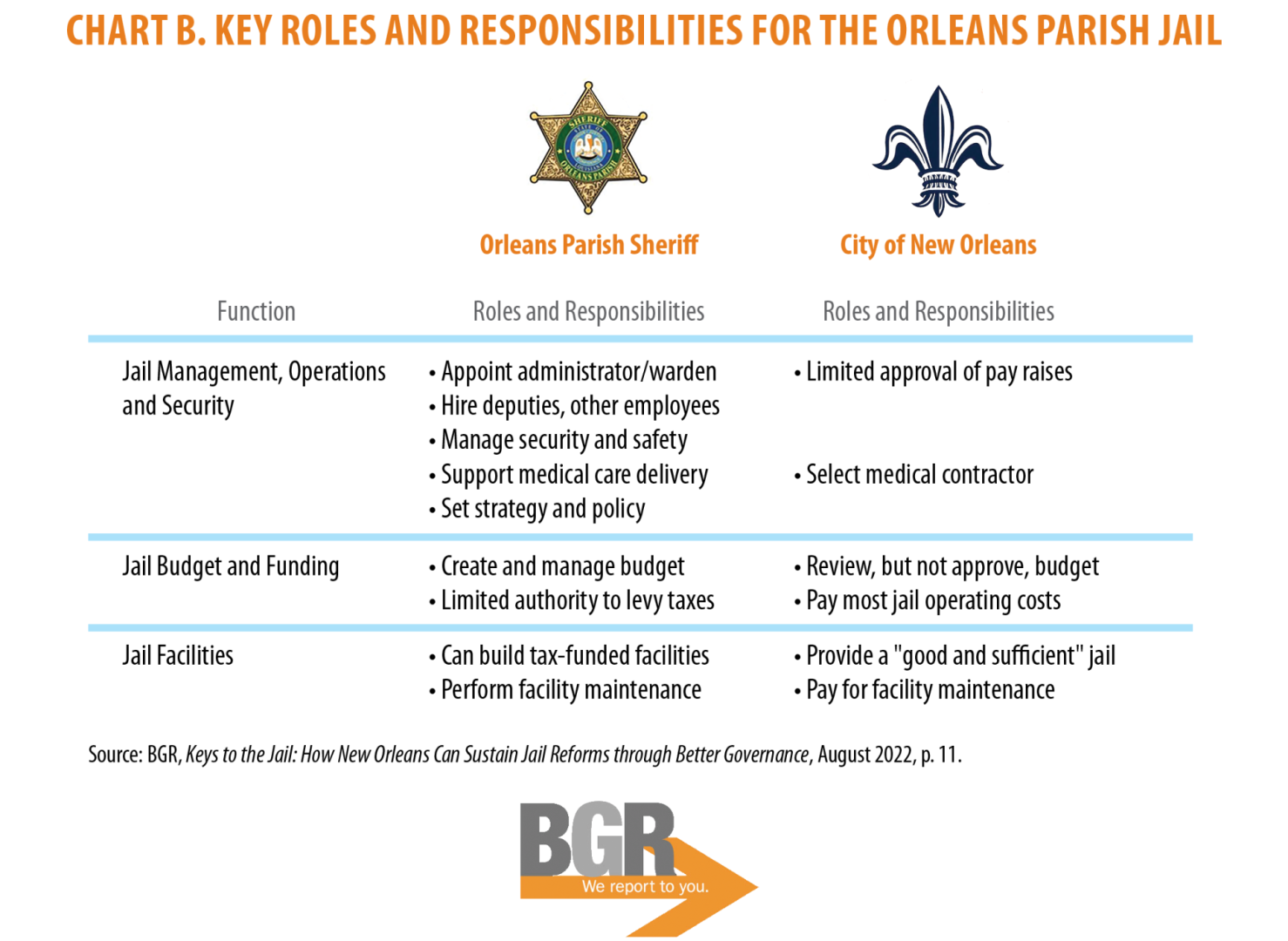

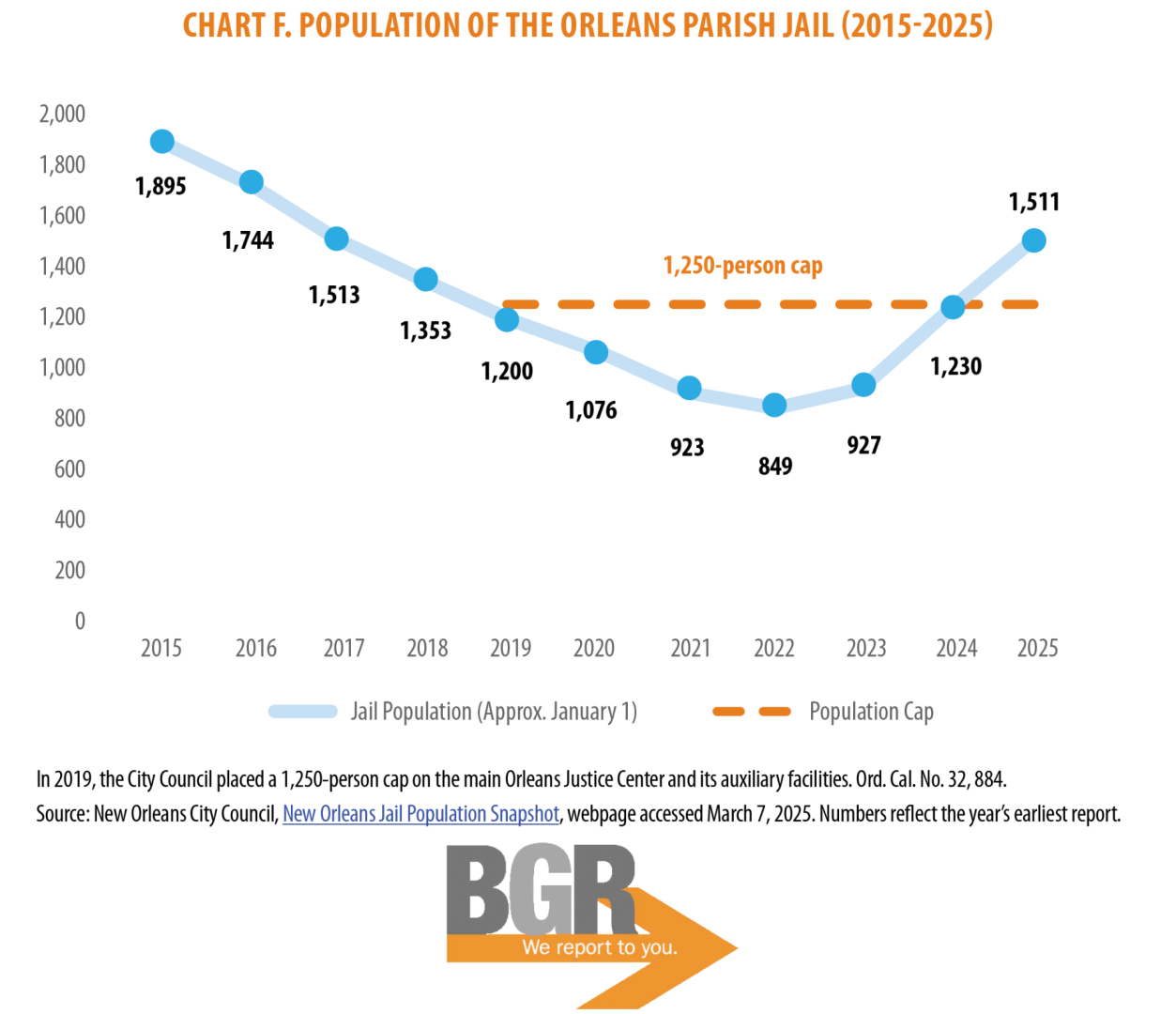

MICHELLE WOODFORK
Jail Governance and Strategic Planning
Background Provided to All Candidates
The Orleans Parish jail has been under federal oversight or investigation for more than 50 years, longer than any other local jail in the country. It has suffered from chronic problems, including violence, understaffing, and insufficient medical and mental health care. The May 16, 2025, escape of 10 men from custody heightened the public’s concern about the jail’s problems.
BGR’s 2022 report, Keys to the Jail, linked the jail’s performance problems to the strained governance relationship between the Orleans Parish Sheriff’s Office and the City. Under Louisiana law, the Sheriff’s Office operates the jail, while the City must pay most of its costs – 79% of its $91.1 million total budget in 2025. This structure has blurred accountability for the jail’s performance and impeded progress toward improving its performance and exiting federal oversight.
For example, the parties have not agreed on a strategic plan for the jail. Having a joint strategy could improve trust and the effective use of jail resources. It could also provide a basis for coordinating with other justice system actors, such as the courts, prosecutors and public defenders – all of whom directly influence jail population, costs and staffing needs.
BGR recommended in Keys to the Jail and in a May 2025 release that the City and Sheriff’s Office develop a multi-year agreement to:
- Establish an ongoing strategic planning process in which they collaborate on the budget, facilities, employee compensation and training, and other jail needs.
- Improve fiscal transparency and accountability, both to ensure adequate City funding for the jail and careful tracking of how the Sheriff’s Office uses the money.
- Strengthen the appointment process for the top jail administrator by defining the job’s responsibilities and qualifications and by enabling City and public input on the candidates.
- Create an independent local entity to oversee jail performance to ensure ongoing monitoring of jail conditions and treatment of people in custody after federal court oversight ends.
Following the May 2025 escape and the risk of more finger-pointing between the City and Sheriff, BGR re-emphasized the importance of the City and Sheriff coming to a multi-year agreement.
On jail governance and strategic planning, BGR asked the candidates:
1. Should there be a cooperative agreement between the City and the Sheriff’s Office along the lines of what BGR recommends? If yes, please explain which components in the bullet point list above should be included in the agreement, plus any other priorities you would include. If not, please explain how you would work with the City to improve the jail’s performance.
The jail’s long history of underperformance and the recent high-profile escape makes it clear that fractured governance and lack of coordination are undermining public safety and progress. As Sheriff, I will lead efforts to formalize a shared strategic framework that brings accountability, stability, and a results-oriented approach to jail operations.
The agreement must include a collaborative strategic planning process between the Sheriff’s Office and the City that covers budgeting, staffing levels, compensation structures, and capital improvements. Without shared planning, we will continue to repeat the cycle of underfunding, emergency fixes, and finger-pointing. Fiscal transparency is also essential. I will fully support regular reporting on how taxpayer funds are spent, not only to the City Council but also to the public, through detailed financial disclosures and performance dashboards.
I also support strengthening the jail administrator selection process, with minimum qualifications, a transparent appointment process, and input from the City and the public. And while I am committed to exiting the federal consent decree, I believe establishing a local, independent oversight body is the right long-term step for accountability.
In addition to BGR’s recommendations, I would include a shared population management plan, developed with NOPD, the courts, and the DA’s Office, to reduce overcrowding and target resources effectively. A formal agreement will help ensure the jail is safe, constitutional, and well-managed, now and into the future.
2. As Sheriff, how would you approach strategic planning for the jail in collaboration with the City, other justice system actors, and the public?
I will lead strategic planning with a mindset rooted in accountability, coordination, and transparency. Our jail does not operate in isolation, it is part of a larger public safety system. That’s why I will bring together stakeholders from the City, NOPD, the courts, the District Attorney, Public Defender, and community partners to build a long-term plan focused on compliance, safety, and efficiency.
My approach will begin with a full operational assessment to understand where the jail stands today in terms of staffing, security, healthcare, and population trends. From there, I will work with the City to develop a strategic plan that sets measurable goals for each major function: staffing, facility maintenance, medical care, and fiscal management. The plan will be tied to actual data and performance indicators, so that progress can be tracked over time.
I will ensure this plan is updated annually and informed by quarterly reviews with justice system partners. Coordination is essential, especially when other agencies influence how many people enter and stay in the jail.
Having helped NOPD develop and execute strategic plans during federal oversight, I understand how critical this work is. Strategic planning is not about paperwork, it’s about setting direction, staying focused, and making sure the entire system is aligned to serve the people of New Orleans.
Jail Budget
Background Provided to All Candidates
The City provides the majority of funding for the Orleans Parish jail. This amounts to $71.8 million (79%) in 2025, making the jail the City’s third largest budget item behind the police and fire departments. The Sheriff’s tax provides the second largest funding source for the jail, about 13%, with the rest of the $91.1 million budget coming from federal and state grants and other revenues.
Cooperation between the Sheriff and the City is essential to achieving sufficient and sustainable funding for the jail. However, over the years, many funding disputes have arisen, in some cases leading to litigation. BGR recommended in Keys to the Jail and in a May 2025 release that the City and Sheriff develop a standard, transparent process for the City administration to review the Sheriff’s annual budget proposals. The Sheriff’s Office should support its funding requests with data, such as staffing and compensation studies. The proposed budgets also should include jail funding sources not provided by the City to present a complete financial picture. These other sources include the property tax that Orleans Parish voters recently renewed. The City administration should review the Sheriff’s budget proposals in the context of the strategic plan for the jail. The process should conclude with the administration’s report to the City Council explaining the rationale for any changes from the Sheriff’s original budget request. Citizens could then assess the City’s funding level and hold the mayor and councilmembers accountable for fulfilling their shared responsibilities.
These steps would improve transparency and accountability for the City’s adequate funding of the jail and the Sheriff’s efficient and effective use of taxpayer dollars.
On the jail budget, BGR asked the candidates:
3. How would you determine the appropriate funding level for the jail? Please describe any specific analyses or benchmarks that would inform this determination.
I will create a detailed annual operational and staffing plan that outlines the actual resources needed to safely and constitutionally run the jail. This plan will be grounded in independent staffing and compensation studies, current jail population data, and compliance requirements under the federal consent decree. These benchmarks will guide both my internal budget planning and the funding requests I submit to the City.
To support this process, I will ensure every budget proposal includes a full accounting of all funding sources, not just City appropriations, but also revenue from the Sheriff’s property tax, federal and state grants, and other contracts. This transparency will give both the City Council and the public a complete picture of how OPSO is funded and how every dollar is being spent. I fully support BGR’s recommendation to establish a standard, collaborative budget review process between the Sheriff and the City. This includes presenting budget justifications in the context of a long-term strategic plan for the jail and working with the City to produce a report explaining any changes made to the Sheriff’s original proposal.
Having managed one of the city’s largest budgets as Superintendent of NOPD, I understand how to build financial plans that are responsible, transparent, and aligned with operational needs. My goal is to secure sustainable funding through data, accountability, and trust, ensuring taxpayer dollars are used efficiently and effectively.
4. What steps would you take within the current budget to reduce security weaknesses – such as inadequate supervision and malfunctioning locks and cameras – and make the jail safer and more secure for detainees, staff and the public?
I will take immediate action within the current budget to address critical weaknesses that put detainees, staff, and the public at risk. My first step will be to conduct a full security and infrastructure audit, a comprehensive review of locks, surveillance systems, tier supervision, and staffing coverage. This will allow me to identify the most urgent threats and target funding toward fixing them without delay.
I will reallocate existing resources away from wasteful or non-essential spending, such as unnecessary contract extras, underused programs, or inflated operational costs, and redirect those funds toward security repairs and technology upgrades. Malfunctioning door locks, broken cameras, and inconsistent supervision are not just maintenance issues, they are safety risks that must be addressed immediately. I will also ensure every deputy has a clearly defined post, proper training, and the tools needed to effectively monitor housing units and respond to incidents.
In addition, I will enforce strict accountability for staff performance and contract compliance. Contractors responsible for security systems or maintenance will be held to clear performance standards, and OPSO will actively track service requests and completion timelines. Safety and order inside the jail start with leadership that is hands-on, disciplined, and focused on getting results. I’ve done it before at NOPD, and I will bring that same standard of professionalism and urgency to OPSO from day one.
Accountability to the City and the Public
Background Provided to All Candidates
Voters face unique challenges in trying to gauge the performance of a jail, which is largely closed to public observation. Citizens generally lack direct knowledge of jail operations and conditions. This limits their ability to evaluate the Sheriff’s performance. The City Council has also raised questions about Sheriff’s Office spending of City appropriations and wants more oversight.
BGR has suggested ways to improve both fiscal and performance accountability. The Sheriff’s Office can use its quarterly meetings with the City Council to present this information to the public. As BGR discussed in Keys to the Jail, its report on the Sheriff’s tax renewal, and a May 2025 release, the Sheriff’s Office should discuss expenditures of City appropriations and the Sheriff’s property tax. It can provide details on budget variances, contracts, operations, jail staffing, population and other cost drivers. The City Council can use its existing oversight powers, alongside those of the New Orleans Office of Inspector General, to probe any issues related to the use of City funds.
Relative to jail performance, the quarterly meetings with the City Council offer a high-profile forum for the Sheriff’s Office to keep the public updated on its efforts to improve conditions at the Orleans Parish jail. The Sheriff’s Office could provide timely insights on compliance and flag potential concerns that might need City assistance.
On accountability, BGR asked the candidates:
5. Describe specific initiatives that you would take to improve fiscal and performance accountability to the City and taxpayers.
The jail operates largely out of public view, which makes it even more important to provide transparent, regular updates to both the City Council and the public. I will use quarterly meetings with the City Council to present clear, detailed reports on spending, staffing, population trends, contracts, and progress toward consent decree compliance. These reports will include budget variances, cost drivers, and performance benchmarks so the public can see exactly where taxpayer dollars are going and what results they are producing.
I will also implement a public-facing data dashboard that tracks key indicators like staffing levels, medical and mental health response times, and incident trends. Additionally, I will support the oversight roles of the City Council and the Office of Inspector General and cooperate fully with any inquiries or audits related to OPSO spending.
Having successfully moved the NOPD toward substantial compliance in the consent decree, I know that accountability starts with leadership. I will bring that same discipline and transparency to OPSO. Taxpayers deserve to know how their money is being used, and I will make sure that every dollar spent is tied to measurable outcomes that improve safety, efficiency, and compliance inside the jail.
Federal Consent Decree Compliance
Background Provided to All Candidates
The jail remains under a long-running consent decree, a legal settlement with the federal government to meet basic constitutional jail conditions and treatment of detainees. The consent decree requires 174 specific improvements that the Sheriff must make to comply with constitutional standards of confinement. The mandates include, among other things, improving the jail’s security, sanitation, staffing levels, and medical and mental healthcare. Intensive, regular federal monitoring will continue until the Sheriff’s Office can maintain substantial compliance with all provisions for two consecutive years. At that point, the court can terminate the consent decree. However, BGR found that compliance has decreased steadily from a peak of 68% in 2020 to 41% as of the May 2025 compliance report (which reflects compliance as of September 30, 2024).
While there may be several more years of federal oversight ahead, the City and the Sheriff should consider what accountability might look like beyond the consent decree. BGR recommends in Keys to the Jail that their multi-year agreement should contemplate an eventual State legislative proposal to establish a local, external oversight body. This should be done in consultation with jail experts, parties to the consent decree and the public. This entity would regularly monitor conditions in the New Orleans jail, study its operations and treatment of people in custody, and investigate complaints. The oversight body would be independent from the Sheriff’s Office and the City in terms of its governance, staffing and funding. The entity would have broad access to the facility, records, staff, contractors and detainees. Finally, it would maintain a website and use it to regularly report its findings and recommendations to the public. Its recommendations would be non-enforceable proposals to help improve jail performance. In the long run, the body would represent significant cost savings for the jail and the City since maintaining such an entity is typically far less expensive than litigation and court-ordered oversight conducted by national consultants.
On federal consent decree compliance, BGR asked the candidates:
6. As Sheriff, describe specific initiatives that you would take to improve compliance with the federal consent decree.
As Superintendent of NOPD, the department made substantial progress in the federal consent decree. By implementing reforms, policies and procedures promoting sustainable constitutional policing. I will bring that same approach to OPSO. On day one, I will launch a comprehensive review of all mandated areas, identify where we are falling short, and put a compliance-focused leadership team in place. That includes creating a Consent Decree Compliance Unit within OPSO to track progress, enforce deadlines, and work directly with federal monitors.
Key areas like staffing, medical and mental health care, sanitation, and security will be addressed with measurable plans tied to performance and budget priorities. I will hold both staff and contractors accountable and make sure the public can see our progress. Compliance is not just a legal requirement – this is about running a safe, professional, and constitutional jail that the people of New Orleans can trust.
7. Would you support the development of a local, external oversight body along the lines of what BGR recommends for when the jail exits federal oversight? Why or why not?
I support the creation of a local, independent oversight body as BGR recommends. Long-term accountability should not end when the consent decree does. A well-designed, community-informed oversight body can provide regular monitoring, identify problems early, and offer non-enforceable but valuable recommendations, without the high cost of federal litigation.
As Sheriff, I would welcome fair oversight and public transparency. That is how we rebuild trust and ensure the jail continues to meet constitutional standards well beyond the life of the consent decree.
Jail Population
Background Provided to All Candidates
As shown in this BGR chart, the jail’s population has increased significantly since its lows during the pandemic. It averaged 1,383 people in June 2025, still well above the City Council’s 1,250-person desired maximum. However, the inflow and length of stay of detainees is largely out of the control of the Sheriff and primarily depends on other criminal justice agencies like the New Orleans Police Department and the court system.
On jail population, BGR asked the candidates:
8. What steps would you take to improve coordination with other criminal justice agencies and manage the jail population at a safer level?
With my experience at both NOPD and working alongside the District Attorney’s Office, I understand how the system works and where coordination often breaks down. I will advocate for the expanded use of summonses, timely case reviews, and responsible pretrial release for low-level, nonviolent offenses. I will also support diversion programs and reentry planning to prevent people from cycling in and out of custody.
Internally, I will implement a strategic plan like I did at NOPD that includes an annual jail staffing and capacity plan, tracking of population trends, and a review of every available space to ensure it is being used safely and efficiently. Managing the jail population is about leadership, communication, and accountability. I will bring all three to OPSO to keep our facility secure and reduce overcrowding in a responsible, collaborative way.
Jail Administrator
Background Provided to All Candidates
The performance of the warden or top jail administrator directly impacts the security of the jail and the safety of staff and those held in custody. A jail administrator’s responsibilities typically include supervising staff, managing the budget, ensuring legal compliance, tracking performance, managing emergencies, and otherwise solving any day-to-day problems. The administrator should work closely with the elected sheriff on leadership issues, such as setting vision, strategy and policy, and communicating and collaborating with justice system stakeholders, including the City, and the public. The Sheriff’s appointment of the jail administrator is a crucial decision that should be made transparently and with community input.
BGR’s Keys to the Jail report recommends four key safeguards that can be specified in the agreement between the City and the Sheriff:
- Establish a jail administrator position reporting to the Sheriff and define its roles and responsibilities. The Sheriff should develop the job description, with input from the City, to clarify the administrator’s daily management and operations of the jail and areas in which the administrator will collaborate with the Sheriff and justice system stakeholders, including the City.
- Set minimum requirements for the appointment of the Sheriff’s top jail administrator. Among other things, they should require the jail administrator to have significant experience managing a correctional facility, as well as a professional certification in jail administration or to obtain one within a reasonable time frame of the appointment.
- Establish a role for the City in the selection of future jail administrators. At a minimum, a City administrator familiar with jail matters should serve on the Sheriff’s search team. The parties should consider requiring the City Council’s consent to the Sheriff’s appointment of the jail administrator.
- Provide for public participation in the selection process. This should include interviewing candidates in public and releasing information about their qualifications.
Collectively, these safeguards would support effective jail administration over time.
On jail administration, BGR asked the candidates:
9. When selecting a jail administrator, what qualifications would you seek in candidates for the position, and to what extent would you allow for input from the City and the public during the selection process?
When selecting a jail administrator, I will prioritize candidates with proven experience, a deep understanding of constitutional requirements, and strong leadership skills. From my time as Superintendent of NOPD, I know how critical it is to surround yourself with qualified, capable individuals, leadership starts with building the right team.
While the final decision rests with the Sheriff, I believe transparency and collaboration are essential. I will involve a City representative with jail expertise in the search process and share finalist qualifications with the public. I will also hold a public forum to allow for community input. This ensures the process is open and focused on merit, not politics.
The jail administrator plays a key role in daily operations, staff management, budget oversight, and legal compliance. This is not a political appointment, it is a professional one that must be made with care, input, and accountability. My goal is to restore trust in OPSO by making smart, transparent leadership decisions that put safety and professionalism first.
Jail Staffing
Background Provided to All Candidates
For years, sheriffs have pointed to staffing shortages as one of the main hurdles toward exiting federal oversight. As BGR reported in April, recruitment challenges and high turnover in jail security positions have been long-running problems. As shown in this chart, the Sheriff’s Office indicates the jail has an overall vacancy rate of 28% and needs more than 200 more employees to function optimally. The Phase III medical and mental health facility is scheduled open in 2026, increasing staffing needs by another 57 employees.
BGR recommends in Keys to the Jail and in a May 2025 release that the City and Sheriff agree to develop a compensation strategy for jail deputies and other employees. The City and Sheriff should accompany the strategy with (1) an annual jail staffing plan, (2) periodic independent studies of compensation levels, and (3) a budget for appropriate continuing education and training for employees to ensure a stable and professional jail workforce. The City and Sheriff should periodically evaluate the compensation strategy to determine whether it is achieving its goals of adequate staffing at the jail. Altogether, effective compensation and training can support federal compliance and desired outcomes for jail staff, detainees and the public.
On jail staffing, BGR asked the candidates:
10. How do you propose to address the jail’s staffing issues? Would you ask the City and/or the voters for more funding for salaries and other personnel costs?
Staffing is one of the most urgent challenges at OPSO, and I have a clear plan to fix it. As Sheriff, I will implement a strategic staffing plan that sets clear hiring goals, tracks progress, and ensures every position is filled based on qualifications, not politics. I will review and revise the pay scale to make sure salaries are competitive and promotions are earned through performance and experience. High turnover and low morale will not be solved by quick fixes, they require steady leadership and a commitment to fairness and professionalism.
I will also invest in ongoing training and career development to support a stable, well-prepared workforce. With the Phase III medical and mental health facility opening in 2026, we need to be recruiting and preparing now, not scrambling later. I will work with the City to align budget priorities with actual staffing needs, but any request for additional funding will come with accountability, transparency, and measurable results.
At NOPD, I tripled recruitment by improving the hiring process and restoring confidence in leadership. I will bring that same focus to OPSO, because a safe, well-run jail starts with the people working inside it every day.