
Complete BGR Survey Responses, Alphabetical by Candidate’s Last Name
District E Candidate Jason Hughes declined to participate in the survey. Candidate Nathaniel Jones did not respond to BGR’s invitations and outreach.

RICHARD BELL SR.
CITY GOVERNMENT PERFORMANCE
Background Provided to All Candidates
BGR’s mission is to provide independent research to support informed public policy making and the effective use of public resources. We recognize that each candidate enters the race with a vision for improving City of New Orleans (City) government and delivering more effective services to citizens. BGR’s 2019 report analyzing the previous decade of the City’s General Fund budgets highlighted the lack of funding to address the vast scope of the City’s needs. Therefore, every General Fund dollar that is not well spent represents a dollar’s worth of high priority needs that will go unmet. The report urged the City to reevaluate current expenditures with an eye toward optimal deployment of existing resources to critical needs.
On City government performance, BGR asked the candidates:
1. What two City services, programs or operations are most in need of improvement, and what strategies (financial, organizational, operational or otherwise) will you use to fix them? Please explain why.
Sewerage & Water Board. Plan will be discussed if elected to office
Entergy
2. Where do you see opportunities to redirect General Fund dollars to higher impact uses? Please be specific about the expenditures you would cut or reduce and what you would fund in their place.
Roads in my District E
CITY BUDGET AND FINANCIAL MANAGEMENT
Background Provided to All Candidates
Strategic management of limited public resources will be key to improving the performance of City government. The City emerged from the COVID-19 pandemic in a stronger financial position thanks in large part to nearly $400 million in federal relief funding. But the windfall is over. The City projects little growth in revenue as it faces looming new costs. To help policymakers navigate this new reality, BGR analyzed the City’s financial management practices.
In After the Windfall, BGR recommended that the City administration develop a five-year financial plan and review it annually with the City Council. Having this roadmap can put the City on track to address fiscal challenges and opportunities. The plan should move the City toward a structurally balanced budget. A structural balance is when recurring revenues equal or exceed the recurring expenditures necessary to sustain public services and properly maintain facilities and infrastructure. Currently, the City relies on one-time reserves to balance its budget, and it does not adequately fund maintenance. Street maintenance alone would need an estimated $36 million increase in annual funding. Achieving structural balance is important for the City government’s fiscal health, but also for New Orleans’ sustainability and quality of life.
BGR also recommended the City administration develop, and the council adopt by ordinance, a policy for the use and preservation of its General Fund reserves to ensure an adequate financial cushion. Given New Orleans’ vulnerability to disasters, City officials should strongly consider a reserve level higher than the minimum of two months of General Fund expenses (about 17%, or $158 million this year) recommended by government finance experts.
Before the onset of the COVID-19 pandemic in 2020, the City’s reserves remained well below 17% and even turned negative in some years, signifying a deficit. The federal pandemic relief funding enabled the City to bolster its reserves, reaching a high of $344 million, or 54% of General Fund expenses in 2022. But three years of spending from the reserves could again reduce them below the minimum recommended level by the end of this year. Maintaining adequate reserves is important because it helps avoid cuts to essential services and increases in taxes and fees during financial crises. A reduction in reserves also could hurt the City’s credit rating, driving up taxpayer-funded borrowing costs for capital projects, such as street repairs.
On City budget and financial management, BGR asked the candidates:
3. Do you agree that the City should adopt and maintain a five-year financial plan that aims for a structurally balanced budget? Why or why not? Please describe any spending reductions or revenue-raising opportunities that you would consider to achieve a structurally balanced budget.
Yes. Use the one cent sales tax.
4. What percentage of the General Fund budget should the City keep as a financial reserve, and why?
10% percent
PUBLIC SAFETY
Background Provided to All Candidates
When New Orleans voters last elected their mayor and council four years ago, the city was reeling from a violent crime surge during the COVID-19 pandemic. The number of sworn officers in the New Orleans Police Department (NOPD) had fallen by nearly 20%. BGR hosted a Breakfast Briefing speaker series on public safety in spring 2022 that analyzed New Orleans’ longstanding crime problem and presented both law enforcement and community-based approaches to addressing it.
The City implemented recruitment and retention bonuses for NOPD officers – covering the initial costs with a substantial portion of its federal pandemic relief funds. It expanded its collaboration with other law enforcement agencies, including the Louisiana State Police, as the NOPD superintendent explained at a December 2023 BGR Breakfast Briefing. The City also invested in several public safety initiatives besides law enforcement, from mental health crisis response to violence prevention. Nonprofit organizations, businesses and others came together to form the NOLA Coalition in summer 2022 to invest in both NOPD and youth support services.
Crime has fallen significantly from its 2022 peak, and a recent public opinion survey found increasing satisfaction with NOPD and neighborhood safety. But public safety remains a top concern for many residents. NOPD’s officer strength has stopped its downward trend but hasn’t markedly improved. The department is the City’s largest annual General Fund expenditure, accounting for about a fifth of the budget. BGR’s recent report on the City’s financial management highlighted inaccurate budget projections for NOPD in 2024. Overtime costs have been a key driver in tens of millions of dollars of unplanned expenditures.
On public safety, BGR asked the candidates:
5. Would you seek an increase in funding for NOPD? Why or why not? If yes, please specify the increase level and what the additional funds would support. If no, please specify any changes to the department’s current budget that you would seek.
No. The NOPD needs some improvement with the public.
6. Beyond NOPD, what do you think are the top two areas where City resources can most effectively drive improvements in public safety? Why does the City’s involvement in these areas have strong potential for improving outcomes?
Street and water drainage
ORLEANS PARISH JAIL
Background Provided to All Candidates
The Orleans Parish jail has been under federal oversight or investigation for more than 50 years, longer than any other local jail in the country. It has suffered from chronic problems, including violence, understaffing, and insufficient medical and mental health care. The May 16, 2025, escape of 10 men from custody heightened the public’s concern about the jail’s problems.
BGR’s 2022 report, Keys to the Jail, linked the jail’s performance problems to the strained governance relationship between the Orleans Parish Sheriff’s Office and the City. Under Louisiana law, the Sheriff’s Office operates the jail, while the City must pay most of its costs – 79% of its $91.1 million total budget in 2025. This structure has blurred accountability for the jail’s performance and impeded progress toward improving its performance and exiting federal oversight. BGR recommended the City and Sheriff’s Office develop a multi-year agreement to:
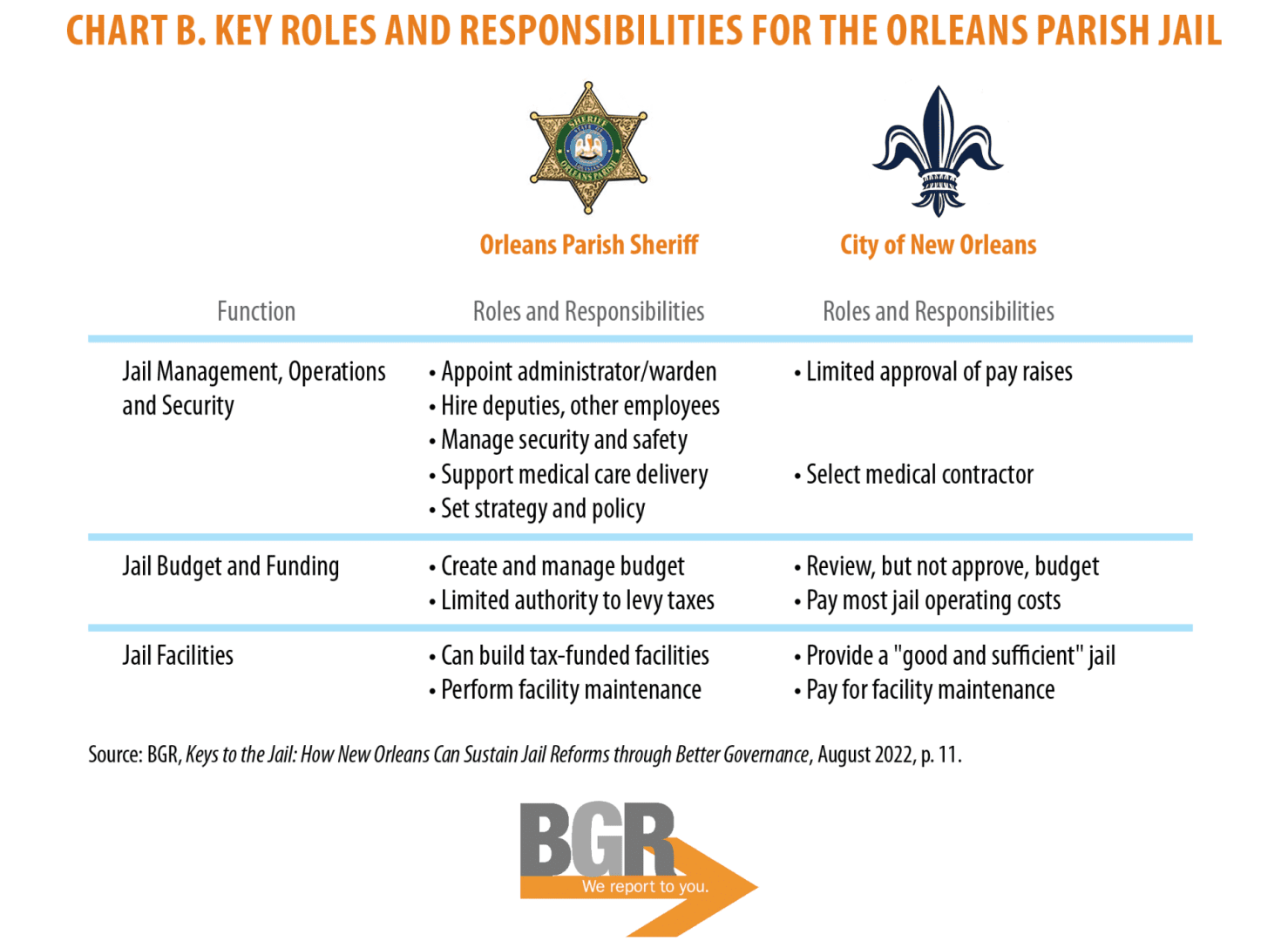
- Establish an ongoing strategic planning process in which they collaborate on the budget, facilities, employee compensation and training, and other jail needs.
- Improve fiscal transparency and accountability, both to ensure adequate City funding for the jail and careful tracking of how the Sheriff’s Office uses the money.
- Strengthen the appointment process for the top jail administrator by defining the job’s responsibilities and qualifications and by enabling City and public input on the candidates.
- Create an independent local entity to oversee jail performance to ensure ongoing monitoring of jail conditions and treatment of people in custody after federal court oversight ends.
In April 2025, voters renewed the Sheriff’s property tax for the jail. BGR supported the renewal based on its analysis showing the tax provides essential funding for the jail that would otherwise have to come from the City. However, BGR recommended that the Sheriff’s Office regularly report on tax expenditures and the office’s progress toward improving jail compliance, performance and outcomes. Following the May 2025 escape and the risk of more finger-pointing between the City and Sheriff, BGR re-emphasized the importance of the City and Sheriff’s Office coming to a long-term agreement.
On the Orleans Parish jail, BGR asked the candidates:
7. Should there be a cooperative agreement between the City and the Sheriff’s Office along the lines of what BGR recommends? If yes, please explain which components in the bullet point list above should be included in the agreement, plus any other priorities you would include. If not, please explain how you would work with the Sheriff to improve the jail’s performance.
Yes
STREET MAINTENANCE
Background Provided to All Candidates
The City is making more than $2 billion in federally funded repairs to streets and subsurface infrastructure damaged during Hurricane Katrina. However, the long-term benefits of this once-in-a-lifetime investment are threatened by the City’s chronic underfunding of street maintenance. As BGR reported in 2024, the Public Works department estimates it would cost $50 million a year to properly maintain the City’s 1,500 miles of streets. The City spends about $14 million, or $36 million less than is needed. This is particularly problematic because preventive street maintenance tends to pay for itself over time. Public Works has estimated that every dollar spent on preventive maintenance saves $4 to $5 on repair and reconstruction costs down the road.
On street maintenance, BGR asked the candidates:
8. What would you do to address the City’s underfunding of street maintenance? Please be specific on funding levels and how you would go about finding more revenue for streets.
Yes. I will address the City if elected.
SEWERAGE & WATER BOARD GOVERNANCE
Background Provided to All Candidates
The Sewerage & Water Board is a state-created utility over which the mayor and City Council have substantial influence. The mayor serves as president of the utility’s board of directors, which is responsible for its operations and finances. The City Council has a seat on the board and controls the utility’s water and sewer rates and drainage property taxes.
One key task for the next mayor and council is supporting better Sewerage & Water Board performance. While the utility is implementing a wide-ranging strategic plan, long-term success will depend on improving the Sewerage & Water Board’s governance structure. This means the laws and policies that shape the powers, roles and responsibilities of the utility and those involved in its operations.
A core problem is that the Sewerage & Water Board must operate New Orleans’ water, sewer and drainage systems, but the City Council controls the fees and taxes that support them. Over the years, this tension between operational responsibility and funding control has allowed politics to influence funding decisions. This has resulted in underfunding, contributing to today’s deteriorated infrastructure and shifting costs to current and future ratepayers.
BGR suggests either strengthening the Sewerage & Water Board as a stand-alone utility that operates separately from City government or replacing it with a municipal utility that functions as part of City government. BGR’s 2023 report, Waterworks in Progress, details the potential benefits of each option over the status quo. But each option would present new complications that require further study. The next mayor should initiate that study and coordinate these efforts with the City Council and the Sewerage & Water Board, as well as seek public input.
In the near term, the City Council can improve its process for considering Sewerage & Water Board funding requests. As BGR outlined in its 2023 letter, the council should (1) objectively evaluate funding proposals, (2) regularly assess the utility’s performance, (3) track outcomes against desired goals, and (4) review strategic and financial plans and reports. These efforts would build on the council’s important work to expand its oversight of the utility, set up processes with State legislative support to help resolve customer billing problems, and help fund important infrastructure, such as a new electrical power complex to improve drainage pumping.
On Sewerage & Water Board governance, BGR asked the candidates:
9. What changes to management, operations, or governance of the Sewerage & Water Board would you support, and why?
Billing for senior
10. How would you improve the City Council’s approach to reviewing funding requests from the Sewerage & Water Board for rates and taxes?
No
STORMWATER FEE
Background Provided to All Candidates
In 2027, one of New Orleans’ three drainage property taxes will expire unless it is renewed by voters. It provides $22 million a year, or nearly a quarter of drainage system revenue. Even with the tax, the system faces substantial unmet funding needs, for everything from cleaning catch basins to fixing pipes to upgrading pump stations. And experts have recommended supplementing traditional drainage with “green infrastructure,” or natural rainfall retention projects that can lighten the load on pipes and pumps and reduce ground subsidence.
To meet these funding needs, the Sewerage & Water Board, the City, and others, including BGR, have suggested creating a stormwater fee. As discussed in a 2017 BGR report, this type of user fee charges a property owner based on an estimate of stormwater runoff that the system collects from the property and discharges into local waterways. Generally, a fee has a couple of advantages over a tax. It applies to both taxable and tax-exempt property, spreading out the cost burden. Also, it is tied to a property’s runoff, rather than the property’s value, which improves fairness.
Sewerage & Water Board and City officials have not yet made a stormwater fee proposal to the public. As a first step, BGR urges them to review the funding needs of the entire drainage system. BGR also recommends careful planning, administration, and oversight to ensure a fair fee structure, effective use of the new revenue, and public accountability.
On stormwater fees, BGR asked the candidates:
11. Do you favor pursuing a citywide stormwater fee? If yes, please explain what the fee proposal should include to ensure effectiveness, fairness and accountability. If you do not favor a stormwater fee, please explain how you would address the drainage system’s financial needs.
No
AFFORDABLE HOUSING
Background Provided to All Candidates
In November 2024, voters amended the City charter to require an annual budget dedication equal to at least 2% of the City’s General Fund budget to the Housing Trust Fund, starting in 2026. The City will use the trust fund to preserve and expand affordable housing for low- to moderate-income residents. BGR’s report on the proposition identified acute problems in housing affordability in the city and the need for increased housing investment. However, BGR took a position against the proposed charter amendment citing the budget inflexibility of the charter-based dedication.
The City has tapped two public agencies, Finance New Orleans and the New Orleans Redevelopment Authority, to administer the Housing Trust Fund. In addition, the City Council formed the Housing Trust Fund Advisory Committee to advise the council on appropriations from the fund. In December 2024, BGR wrote a letter to the mayor and City Council recommending ways to ensure effective administration and use of Housing Trust Fund dollars. These recommendations include establishing clear metrics and criteria for examining program performance and expanded accountability measures, such as independent auditing of trust fund revenue. BGR also highlighted the need for other initiatives outside the trust fund to increase affordable housing, such as zoning reforms and tax incentives. As discussed in a previous section, the City should have a long-term financial plan that balances funding for the Housing Trust Fund with other needs.
On affordable housing, BGR asked the candidates:
12. How can Housing Trust Fund dollars be used most effectively in New Orleans?
To help the community with a better way of living
13. What other initiatives besides Housing Trust Fund investments would you support to address housing affordability issues in New Orleans?
None
ECONOMIC DEVELOPMENT
Background Provided to All Candidates
The City and other economic development entities should take a rigorous approach to reviewing private development projects seeking tax subsidies. Developers and public officials often view these subsidies as free money. But the tax breaks represent an allocation of future resources and should be evaluated with a rigor worthy of a long-term investment. BGR’s reports on payments in lieu of taxes (PILOT) and tax increment financing (TIF) emphasize several criteria:
- The project advances priorities specified in the City’s economic development strategic plan.
- Independent analyses demonstrate the market will not produce a desirable outcome for the project site, therefore making a public subsidy necessary.
- The subsidy provides only the minimum needed for the project to proceed. In addition, the subsidy should not compensate for basic financial weaknesses in a developer or a transaction (e.g., inadequate equity investment) or a lack of demand for a service or product.
- Effective subsidies produce a significant positive ratio of benefits to costs, as supported by a rigorous cost-benefit analysis.
- Subsidies should not create unfair impacts on local competitors or the surrounding neighborhood.
The City is not the sole entity with authority to abate local taxes in New Orleans to promote economic development. Others include the New Orleans Industrial Development Board and special economic development districts. This potentially makes it more difficult to implement a unified subsidy strategy, especially if the entities do not share the same economic development priorities.
On economic development, BGR asked the candidates:
14. What do you think New Orleans should emphasize in a strategic plan for economic development, and what would you do to ensure cohesive support from business, community and regional stakeholders necessary to achieve the plan’s goals?
My district E needs more schools and department stores
15. What, if any, changes would you pursue to how local tax subsidies for economic development are used and administered in New Orleans?
Change the way the city uses tax dollars
PENSIONS
Background Provided to All Candidates
BGR has documented the sharply rising costs of pensions for public employees in a series of reports. The City’s total annual pension contributions have increased nearly 50% from $78 million in 2010 to more than $110 million this year. BGR’s research linked the problem to several factors, including benefits that far exceed national norms, past underfunding by the City, poor investment decisions, and overly optimistic assumptions about investment returns.
The City adopted a series of pension reforms during the last decade. These included increasing funding for pensions and lowering benefits for newly hired employees aside from police officers. However, the City has already reversed some of these reforms, and the rest are at risk.
Starting in 2018, the City reduced pension benefits to match national norms for new hires in the New Orleans Municipal Employees’ Retirement System (NOMERS), which includes all City employees except police and firefighters. But the City reversed many of the reforms in 2020 with almost no public discussion or justification.
Another set of reforms for the New Orleans Fire Fighters’ pension fund are part of a landmark 2016 legal settlement. The settlement includes higher annual contributions from the City and lower benefits for new firefighters. Voters also approved a 2.5-mill tax to help fund the settlement, which has made limited progress on improving the pension fund’s financial health. BGR found in 2024 that the ratio of the fund’s assets to its liabilities is just 11.5%. The recommended goal is 100%, and anything less than 70% is cause for serious concern. Despite the fund’s continued poor health, firefighters and pension system officials have stated their desire to undo the reforms. Meanwhile, the City’s current annual contribution of $45 million would need to increase by $23 million to put the fund on track to be fully funded, according to the fund’s annual actuarial report.
On pensions, BGR asked the candidates:
16. How should the City address the substantial costs of pensions while ensuring its total compensation packages for current and new employees are competitive? Please be specific about the changes you would pursue.
Pension funds need to be improved for all workers

WILLIE MORGAN
CITY GOVERNMENT PERFORMANCE
Background Provided to All Candidates
BGR’s mission is to provide independent research to support informed public policy making and the effective use of public resources. We recognize that each candidate enters the race with a vision for improving City of New Orleans (City) government and delivering more effective services to citizens. BGR’s 2019 report analyzing the previous decade of the City’s General Fund budgets highlighted the lack of funding to address the vast scope of the City’s needs. Therefore, every General Fund dollar that is not well spent represents a dollar’s worth of high priority needs that will go unmet. The report urged the City to reevaluate current expenditures with an eye toward optimal deployment of existing resources to critical needs.
On City government performance, BGR asked the candidates:
1. What two City services, programs or operations are most in need of improvement, and what strategies (financial, organizational, operational or otherwise) will you use to fix them? Please explain why.
Two City services most in need of improvement are public utilities and recreational programming.
Public utilities, particularly Entergy and the Sewerage & Water Board, continue to fail residents with frequent outages, inaccurate billing, drainage failures, and poor communication during emergencies. These are not just inconveniences—they’re public safety risks. If elected, I will work with the Council to explore stronger oversight and long-term restructuring, including public ownership models that put people before profit. I’ll advocate for a utility accountability task force made up of experts and residents to review performance, propose solutions, and ensure transparency. I’ll also push for smarter infrastructure investments that improve resilience and affordability.
Recreational services—parks, playgrounds, and youth programming—are severely underfunded and often inaccessible, especially in underserved neighborhoods like the Lower 9th Ward. Investing in recreation is investing in public health, youth development, and violence prevention. I will advocate for dedicated funding streams for Rec Centers, including partnering with local nonprofits and leveraging state/federal grants. I will also push for community-driven planning, ensuring facilities reflect the needs of each neighborhood, with expanded hours, safe staffing levels, and quality programs.
Improving these services will help rebuild trust, improve quality of life, and create a safer, more equitable New Orleans for all.
2. Where do you see opportunities to redirect General Fund dollars to higher impact uses? Please be specific about the expenditures you would cut or reduce and what you would fund in their place.
While I haven’t had full access to the City’s entire budget, I believe the budget should reflect the priorities of the people. If elected, I will work to identify and reduce low-impact or redundant expenditures and redirect funds to areas that matter most to District E residents—such as strengthening our recreational programming, supporting small business development, improving sanitation and blight removal, and ensuring our neighborhoods are safe. I will collaborate with budget experts, community stakeholders, and city departments to ensure every dollar works harder for our people and leads to visible, equitable outcomes.
CITY BUDGET AND FINANCIAL MANAGEMENT
Background Provided to All Candidates
Strategic management of limited public resources will be key to improving the performance of City government. The City emerged from the COVID-19 pandemic in a stronger financial position thanks in large part to nearly $400 million in federal relief funding. But the windfall is over. The City projects little growth in revenue as it faces looming new costs. To help policymakers navigate this new reality, BGR analyzed the City’s financial management practices.
In After the Windfall, BGR recommended that the City administration develop a five-year financial plan and review it annually with the City Council. Having this roadmap can put the City on track to address fiscal challenges and opportunities. The plan should move the City toward a structurally balanced budget. A structural balance is when recurring revenues equal or exceed the recurring expenditures necessary to sustain public services and properly maintain facilities and infrastructure. Currently, the City relies on one-time reserves to balance its budget, and it does not adequately fund maintenance. Street maintenance alone would need an estimated $36 million increase in annual funding. Achieving structural balance is important for the City government’s fiscal health, but also for New Orleans’ sustainability and quality of life.
BGR also recommended the City administration develop, and the council adopt by ordinance, a policy for the use and preservation of its General Fund reserves to ensure an adequate financial cushion. Given New Orleans’ vulnerability to disasters, City officials should strongly consider a reserve level higher than the minimum of two months of General Fund expenses (about 17%, or $158 million this year) recommended by government finance experts.
Before the onset of the COVID-19 pandemic in 2020, the City’s reserves remained well below 17% and even turned negative in some years, signifying a deficit. The federal pandemic relief funding enabled the City to bolster its reserves, reaching a high of $344 million, or 54% of General Fund expenses in 2022. But three years of spending from the reserves could again reduce them below the minimum recommended level by the end of this year. Maintaining adequate reserves is important because it helps avoid cuts to essential services and increases in taxes and fees during financial crises. A reduction in reserves also could hurt the City’s credit rating, driving up taxpayer-funded borrowing costs for capital projects, such as street repairs.
On City budget and financial management, BGR asked the candidates:
3. Do you agree that the City should adopt and maintain a five-year financial plan that aims for a structurally balanced budget? Why or why not? Please describe any spending reductions or revenue-raising opportunities that you would consider to achieve a structurally balanced budget.
Yes, I agree that the City should adopt and maintain a five-year financial plan aimed at achieving a structurally balanced budget. Long-term planning promotes accountability, fiscal discipline, and smart investments that reflect community priorities. To support this, I would consider reducing spending on inefficient contracts, consolidating overlapping services, and redirecting resources toward programs that produce measurable outcomes—like youth recreation, public safety, and neighborhood revitalization. I would also prioritize efforts in New Orleans East and the Lower 9 to bring more businesses online—boosting local jobs, expanding the tax base, and contributing to the city’s long-term financial health. A structurally sound budget gives us the foundation to deliver reliable services and build public trust.
4. What percentage of the General Fund budget should the City keep as a financial reserve, and why?
I believe the City should lean on experts and conduct thorough research to determine the appropriate financial reserve level. Governing should never happen in a silo—decisions like this require input from the people who elected us and from professionals who understand the city’s fiscal realities. Together, we can identify the best course to ensure New Orleans’ financial stability and resilience.
PUBLIC SAFETY
Background Provided to All Candidates
When New Orleans voters last elected their mayor and council four years ago, the city was reeling from a violent crime surge during the COVID-19 pandemic. The number of sworn officers in the New Orleans Police Department (NOPD) had fallen by nearly 20%. BGR hosted a Breakfast Briefing speaker series on public safety in spring 2022 that analyzed New Orleans’ longstanding crime problem and presented both law enforcement and community-based approaches to addressing it.
The City implemented recruitment and retention bonuses for NOPD officers – covering the initial costs with a substantial portion of its federal pandemic relief funds. It expanded its collaboration with other law enforcement agencies, including the Louisiana State Police, as the NOPD superintendent explained at a December 2023 BGR Breakfast Briefing. The City also invested in several public safety initiatives besides law enforcement, from mental health crisis response to violence prevention. Nonprofit organizations, businesses and others came together to form the NOLA Coalition in summer 2022 to invest in both NOPD and youth support services.
Crime has fallen significantly from its 2022 peak, and a recent public opinion survey found increasing satisfaction with NOPD and neighborhood safety. But public safety remains a top concern for many residents. NOPD’s officer strength has stopped its downward trend but hasn’t markedly improved. The department is the City’s largest annual General Fund expenditure, accounting for about a fifth of the budget. BGR’s recent report on the City’s financial management highlighted inaccurate budget projections for NOPD in 2024. Overtime costs have been a key driver in tens of millions of dollars of unplanned expenditures.
On public safety, BGR asked the candidates:
5. Would you seek an increase in funding for NOPD? Why or why not? If yes, please specify the increase level and what the additional funds would support. If no, please specify any changes to the department’s current budget that you would seek.
No, I would not support an increase in funding for NOPD without first thoroughly understanding how the current budget is being utilized. Before considering any additional funds, I would demand transparency and accountability to ensure existing resources are effectively supporting community safety and crime reduction. My priority is to invest in programs that address the root causes of violence, such as youth development, mental health services, and community-led initiatives, which often provide more sustainable and equitable outcomes.
6. Beyond NOPD, what do you think are the top two areas where City resources can most effectively drive improvements in public safety? Why does the City’s involvement in these areas have strong potential for improving outcomes?
Beyond NOPD, the two top areas where City resources can most effectively improve public safety are youth programs and economic development/job creation. Investing in youth through education, recreation, and mentorship keeps young people engaged and away from violence. Economic development creates stable jobs and opportunities, reducing poverty-related crime drivers. The City’s involvement is critical because it can coordinate resources, foster partnerships, and ensure these initiatives reach the communities most impacted by violence, creating long-term safety and resilience.
ORLEANS PARISH JAIL
Background Provided to All Candidates
The Orleans Parish jail has been under federal oversight or investigation for more than 50 years, longer than any other local jail in the country. It has suffered from chronic problems, including violence, understaffing, and insufficient medical and mental health care. The May 16, 2025, escape of 10 men from custody heightened the public’s concern about the jail’s problems.
BGR’s 2022 report, Keys to the Jail, linked the jail’s performance problems to the strained governance relationship between the Orleans Parish Sheriff’s Office and the City. Under Louisiana law, the Sheriff’s Office operates the jail, while the City must pay most of its costs – 79% of its $91.1 million total budget in 2025. This structure has blurred accountability for the jail’s performance and impeded progress toward improving its performance and exiting federal oversight. BGR recommended the City and Sheriff’s Office develop a multi-year agreement to:
- Establish an ongoing strategic planning process in which they collaborate on the budget, facilities, employee compensation and training, and other jail needs.
- Improve fiscal transparency and accountability, both to ensure adequate City funding for the jail and careful tracking of how the Sheriff’s Office uses the money.
- Strengthen the appointment process for the top jail administrator by defining the job’s responsibilities and qualifications and by enabling City and public input on the candidates.
- Create an independent local entity to oversee jail performance to ensure ongoing monitoring of jail conditions and treatment of people in custody after federal court oversight ends.
In April 2025, voters renewed the Sheriff’s property tax for the jail. BGR supported the renewal based on its analysis showing the tax provides essential funding for the jail that would otherwise have to come from the City. However, BGR recommended that the Sheriff’s Office regularly report on tax expenditures and the office’s progress toward improving jail compliance, performance and outcomes. Following the May 2025 escape and the risk of more finger-pointing between the City and Sheriff, BGR re-emphasized the importance of the City and Sheriff’s Office coming to a long-term agreement.
On the Orleans Parish jail, BGR asked the candidates:
7. Should there be a cooperative agreement between the City and the Sheriff’s Office along the lines of what BGR recommends? If yes, please explain which components in the bullet point list above should be included in the agreement, plus any other priorities you would include. If not, please explain how you would work with the Sheriff to improve the jail’s performance.
Yes, I support a cooperative agreement between the City and the Sheriff’s Office that includes ongoing strategic planning around budget, facilities, employee compensation, training, and other jail needs. Improving fiscal transparency and accountability is essential to ensure funds are used effectively. Strengthening the appointment process for the top jail administrator with clear qualifications and public input is also critical. Frankly, any sensible New Orleanian would expect these common-sense measures to already be in place. If elected, I will push to make sure these standards are upheld and that collaboration truly happens to improve the jail’s performance.
STREET MAINTENANCE
Background Provided to All Candidates
The City is making more than $2 billion in federally funded repairs to streets and subsurface infrastructure damaged during Hurricane Katrina. However, the long-term benefits of this once-in-a-lifetime investment are threatened by the City’s chronic underfunding of street maintenance. As BGR reported in 2024, the Public Works department estimates it would cost $50 million a year to properly maintain the City’s 1,500 miles of streets. The City spends about $14 million, or $36 million less than is needed. This is particularly problematic because preventive street maintenance tends to pay for itself over time. Public Works has estimated that every dollar spent on preventive maintenance saves $4 to $5 on repair and reconstruction costs down the road.
On street maintenance, BGR asked the candidates:
8. What would you do to address the City’s underfunding of street maintenance? Please be specific on funding levels and how you would go about finding more revenue for streets.
Addressing the City’s underfunding of street maintenance requires collaboration with experts and the citizens of New Orleans to thoroughly assess needs and identify sustainable funding sources. We all know we must do more with less, especially in neighborhoods like the Lower 9th and New Orleans East that have long been neglected. As someone who commutes daily and dodges potholes, I strongly believe street maintenance should be fully funded or as close to that as possible within the city’s financial constraints. Being smart and intentional about prioritizing repairs and exploring creative revenue options will be key to improving our streets and quality of life.
SEWERAGE & WATER BOARD GOVERNANCE
Background Provided to All Candidates
The Sewerage & Water Board is a state-created utility over which the mayor and City Council have substantial influence. The mayor serves as president of the utility’s board of directors, which is responsible for its operations and finances. The City Council has a seat on the board and controls the utility’s water and sewer rates and drainage property taxes.
One key task for the next mayor and council is supporting better Sewerage & Water Board performance. While the utility is implementing a wide-ranging strategic plan, long-term success will depend on improving the Sewerage & Water Board’s governance structure. This means the laws and policies that shape the powers, roles and responsibilities of the utility and those involved in its operations.
A core problem is that the Sewerage & Water Board must operate New Orleans’ water, sewer and drainage systems, but the City Council controls the fees and taxes that support them. Over the years, this tension between operational responsibility and funding control has allowed politics to influence funding decisions. This has resulted in underfunding, contributing to today’s deteriorated infrastructure and shifting costs to current and future ratepayers.
BGR suggests either strengthening the Sewerage & Water Board as a stand-alone utility that operates separately from City government or replacing it with a municipal utility that functions as part of City government. BGR’s 2023 report, Waterworks in Progress, details the potential benefits of each option over the status quo. But each option would present new complications that require further study. The next mayor should initiate that study and coordinate these efforts with the City Council and the Sewerage & Water Board, as well as seek public input.
In the near term, the City Council can improve its process for considering Sewerage & Water Board funding requests. As BGR outlined in its 2023 letter, the council should (1) objectively evaluate funding proposals, (2) regularly assess the utility’s performance, (3) track outcomes against desired goals, and (4) review strategic and financial plans and reports. These efforts would build on the council’s important work to expand its oversight of the utility, set up processes with State legislative support to help resolve customer billing problems, and help fund important infrastructure, such as a new electrical power complex to improve drainage pumping.
On Sewerage & Water Board governance, BGR asked the candidates:
9. What changes to management, operations, or governance of the Sewerage & Water Board would you support, and why?
I agree with BGR’s suggested improvements to the Sewerage & Water Board’s management and governance. Strengthening oversight, objectively evaluating funding proposals, regularly assessing performance, and ensuring transparency are essential to improving the utility’s operations. I support a thorough study of options to either strengthen the Board as a stand-alone utility or transition to a municipal utility model. Ultimately, better governance is critical to fixing infrastructure, restoring public trust, and providing reliable water, sewer, and drainage services to all New Orleanians.
10. How would you improve the City Council’s approach to reviewing funding requests from the Sewerage & Water Board for rates and taxes?
While I’m not fully familiar with the City Council’s current process for reviewing Sewerage & Water Board funding requests, I believe any review should be transparent, align with clear objectives, and prioritize accountability. Ensuring the public understands how rate and tax decisions are made builds trust and helps guarantee funds are used effectively to improve critical infrastructure.
STORMWATER FEE
Background Provided to All Candidates
In 2027, one of New Orleans’ three drainage property taxes will expire unless it is renewed by voters. It provides $22 million a year, or nearly a quarter of drainage system revenue. Even with the tax, the system faces substantial unmet funding needs, for everything from cleaning catch basins to fixing pipes to upgrading pump stations. And experts have recommended supplementing traditional drainage with “green infrastructure,” or natural rainfall retention projects that can lighten the load on pipes and pumps and reduce ground subsidence.
To meet these funding needs, the Sewerage & Water Board, the City, and others, including BGR, have suggested creating a stormwater fee. As discussed in a 2017 BGR report, this type of user fee charges a property owner based on an estimate of stormwater runoff that the system collects from the property and discharges into local waterways. Generally, a fee has a couple of advantages over a tax. It applies to both taxable and tax-exempt property, spreading out the cost burden. Also, it is tied to a property’s runoff, rather than the property’s value, which improves fairness.
Sewerage & Water Board and City officials have not yet made a stormwater fee proposal to the public. As a first step, BGR urges them to review the funding needs of the entire drainage system. BGR also recommends careful planning, administration, and oversight to ensure a fair fee structure, effective use of the new revenue, and public accountability.
On stormwater fees, BGR asked the candidates:
11. Do you favor pursuing a citywide stormwater fee? If yes, please explain what the fee proposal should include to ensure effectiveness, fairness and accountability. If you do not favor a stormwater fee, please explain how you would address the drainage system’s financial needs.
At this time, I do not support implementing a citywide stormwater fee. However, I do support developing a well-researched proposal that the people of New Orleans can fully learn about and decide on. Imposing such a fee without public engagement would only deepen the mistrust many residents already have toward elected officials. Transparency, fairness, and accountability must guide any new funding approach for our drainage system.
AFFORDABLE HOUSING
Background Provided to All Candidates
In November 2024, voters amended the City charter to require an annual budget dedication equal to at least 2% of the City’s General Fund budget to the Housing Trust Fund, starting in 2026. The City will use the trust fund to preserve and expand affordable housing for low- to moderate-income residents. BGR’s report on the proposition identified acute problems in housing affordability in the city and the need for increased housing investment. However, BGR took a position against the proposed charter amendment citing the budget inflexibility of the charter-based dedication.
The City has tapped two public agencies, Finance New Orleans and the New Orleans Redevelopment Authority, to administer the Housing Trust Fund. In addition, the City Council formed the Housing Trust Fund Advisory Committee to advise the council on appropriations from the fund. In December 2024, BGR wrote a letter to the mayor and City Council recommending ways to ensure effective administration and use of Housing Trust Fund dollars. These recommendations include establishing clear metrics and criteria for examining program performance and expanded accountability measures, such as independent auditing of trust fund revenue. BGR also highlighted the need for other initiatives outside the trust fund to increase affordable housing, such as zoning reforms and tax incentives. As discussed in a previous section, the City should have a long-term financial plan that balances funding for the Housing Trust Fund with other needs.
On affordable housing, BGR asked the candidates:
12. How can Housing Trust Fund dollars be used most effectively in New Orleans?
Housing Trust Fund dollars should be used strategically to increase affordable housing in District E, which is in dire need of safe, quality homes that meet basic living standards. Effective use means prioritizing projects that serve low- to moderate-income residents and ensuring strict accountability through clear performance metrics and independent audits. Beyond funding, we need complementary efforts like zoning reforms and tax incentives to encourage development while protecting existing communities from displacement. This holistic approach will help create lasting, affordable housing solutions for New Orleans.
13. What other initiatives besides Housing Trust Fund investments would you support to address housing affordability issues in New Orleans?
Besides Housing Trust Fund investments, I would support property tax assistance programs for low-income homeowners facing displacement due to rising taxes. Additionally, I would advocate for inclusionary zoning policies that require developers to include affordable units in new housing projects, helping preserve mixed-income communities. Finally, I would back tenant protection measures, such as stronger rent stabilization and anti-eviction laws, to ensure renters are safeguarded against sudden rent hikes and unjust displacement.
ECONOMIC DEVELOPMENT
Background Provided to All Candidates
The City and other economic development entities should take a rigorous approach to reviewing private development projects seeking tax subsidies. Developers and public officials often view these subsidies as free money. But the tax breaks represent an allocation of future resources and should be evaluated with a rigor worthy of a long-term investment. BGR’s reports on payments in lieu of taxes (PILOT) and tax increment financing (TIF) emphasize several criteria:
- The project advances priorities specified in the City’s economic development strategic plan.
- Independent analyses demonstrate the market will not produce a desirable outcome for the project site, therefore making a public subsidy necessary.
- The subsidy provides only the minimum needed for the project to proceed. In addition, the subsidy should not compensate for basic financial weaknesses in a developer or a transaction (e.g., inadequate equity investment) or a lack of demand for a service or product.
- Effective subsidies produce a significant positive ratio of benefits to costs, as supported by a rigorous cost-benefit analysis.
- Subsidies should not create unfair impacts on local competitors or the surrounding neighborhood.
The City is not the sole entity with authority to abate local taxes in New Orleans to promote economic development. Others include the New Orleans Industrial Development Board and special economic development districts. This potentially makes it more difficult to implement a unified subsidy strategy, especially if the entities do not share the same economic development priorities.
On economic development, BGR asked the candidates:
14. What do you think New Orleans should emphasize in a strategic plan for economic development, and what would you do to ensure cohesive support from business, community and regional stakeholders necessary to achieve the plan’s goals?
New Orleans’ strategic plan for economic development should emphasize supporting small businesses and fostering the creation of new ones, especially in underserved neighborhoods like District E. This includes addressing zoning barriers that can hinder small business growth and encouraging mixed-use developments that boost local commerce. To ensure cohesive support, I would prioritize collaboration between business owners, community leaders, and regional partners through regular forums and transparent communication. This inclusive approach will help align priorities, build trust, and drive sustainable economic growth that benefits all residents.
15. What, if any, changes would you pursue to how local tax subsidies for economic development are used and administered in New Orleans?
Until I have the opportunity to thoroughly review current tax subsidies and consult with experts, I would not pursue any changes. It’s important to have a solid, strategic plan that aligns subsidies with the city’s economic development goals before making adjustments. Responsible oversight and data-driven decision-making should guide any future changes to ensure subsidies deliver real benefits to New Orleans residents.
PENSIONS
Background Provided to All Candidates
BGR has documented the sharply rising costs of pensions for public employees in a series of reports. The City’s total annual pension contributions have increased nearly 50% from $78 million in 2010 to more than $110 million this year. BGR’s research linked the problem to several factors, including benefits that far exceed national norms, past underfunding by the City, poor investment decisions, and overly optimistic assumptions about investment returns.
The City adopted a series of pension reforms during the last decade. These included increasing funding for pensions and lowering benefits for newly hired employees aside from police officers. However, the City has already reversed some of these reforms, and the rest are at risk.
Starting in 2018, the City reduced pension benefits to match national norms for new hires in the New Orleans Municipal Employees’ Retirement System (NOMERS), which includes all City employees except police and firefighters. But the City reversed many of the reforms in 2020 with almost no public discussion or justification.
Another set of reforms for the New Orleans Fire Fighters’ pension fund are part of a landmark 2016 legal settlement. The settlement includes higher annual contributions from the City and lower benefits for new firefighters. Voters also approved a 2.5-mill tax to help fund the settlement, which has made limited progress on improving the pension fund’s financial health. BGR found in 2024 that the ratio of the fund’s assets to its liabilities is just 11.5%. The recommended goal is 100%, and anything less than 70% is cause for serious concern. Despite the fund’s continued poor health, firefighters and pension system officials have stated their desire to undo the reforms. Meanwhile, the City’s current annual contribution of $45 million would need to increase by $23 million to put the fund on track to be fully funded, according to the fund’s annual actuarial report.
On pensions, BGR asked the candidates:
16. How should the City address the substantial costs of pensions while ensuring its total compensation packages for current and new employees are competitive? Please be specific about the changes you would pursue.
Similar to my approach with tax subsidies, I would not pursue any changes to pension costs until I have a full understanding of the facts and data. It’s essential to develop a solid, comprehensive plan that balances fiscal responsibility with the need to offer competitive compensation packages for current and new employees. Any changes must be transparent, equitable, and sustainable to protect the city’s financial health and workforce stability.

CYNDI NGUYEN
CITY GOVERNMENT PERFORMANCE
Background Provided to All Candidates
BGR’s mission is to provide independent research to support informed public policy making and the effective use of public resources. We recognize that each candidate enters the race with a vision for improving City of New Orleans (City) government and delivering more effective services to citizens. BGR’s 2019 report analyzing the previous decade of the City’s General Fund budgets highlighted the lack of funding to address the vast scope of the City’s needs. Therefore, every General Fund dollar that is not well spent represents a dollar’s worth of high priority needs that will go unmet. The report urged the City to reevaluate current expenditures with an eye toward optimal deployment of existing resources to critical needs.
On City government performance, BGR asked the candidates:
1. What two City services, programs or operations are most in need of improvement, and what strategies (financial, organizational, operational or otherwise) will you use to fix them? Please explain why.
Many residents and small businesses experience delays, confusion, and inconsistent communication when applying for permits— whether it’s for building, zoning, or renovations. These bottlenecks can slow down economic growth, hinder affordable housing development, and frustrate entrepreneurs trying to improve their properties. To fix this, I would push for streamlining and modernizing the permit system by investing in user-friendly digital platforms that allow applicants to track progress in real time. Increasing staff training and accountability can ensure consistent, timely responses. Additionally, I’d advocate for clearer guidelines and community outreach so residents understand requirements upfront, reducing back-and-forth delays. Simplifying the permit process would encourage responsible development, support small business growth, and ultimately make New Orleans a more welcoming place to invest and live.
Both NORD (New Orleans Recreation Development Commission) and Job1 play crucial roles in serving our youth, but there’s room for improvement to better meet their needs and prepare them for the future. NORD provides vital recreational and enrichment programs, but many facilities are outdated and under-resourced, limiting access and quality. To improve, I would advocate for increased funding to renovate and maintain parks and recreation centers, expand after-school and summer programs, and build partnerships with schools and nonprofits to offer more diverse activities—especially those that develop leadership, arts, and STEM skills. Engaging youth directly in program design can help ensure offerings are relevant and inspiring.
Job1 is essential for workforce development, but its reach and effectiveness can be expanded. I’d push to strengthen Job1’s connections with local businesses to create more apprenticeships, internships, and job placement opportunities—especially in growing industries like technology, healthcare, and green energy. Offering tailored career counseling and skill-building workshops can also help youth navigate the job market with confidence.
By investing in these programs and improving collaboration between them, we can create a stronger support system that helps our young people thrive academically, socially, and economically.
2. Where do you see opportunities to redirect General Fund dollars to higher impact uses? Please be specific about the expenditures you would cut or reduce and what you would fund in their place.
Before redirecting General Fund dollars toward higher-impact uses, we must start with a clear-eyed audit of current spending— identifying inefficiencies, outdated contracts, and areas where returns do not justify the cost. I see several specific opportunities for reallocation:
While public safety is critical, too many General Fund dollars are spent on reactive, punitive measures—that don’t address root causes of crime. I would reduce spending in these areas and invest instead in violence prevention programs, youth mentorship, and community-based crisis response teams that are proven to reduce crime in a more humane and cost-effective way.
Inefficient contracts and administrative duplication: We need stronger oversight of third-party vendor contracts where we often see high costs with limited performance accountability. I would push for renegotiation or termination of underperforming contracts and redirect funds toward improving basic services, like timely trash collection, drainage maintenance, and blight removal, particularly in underserved neighborhoods.
Excessive reliance on consultants: The city frequently outsources studies, assessments, and strategy development that could be done in-house with the right staffing and training. I would reduce this reliance and use the savings to bolster internal capacity— especially in departments that provide housing assistance, workforce development, or small business support.
By reallocating funds from punishment to prevention, from inefficiency to community investment, we can create a budget that truly reflects our city’s values and delivers real, lasting impact.
CITY BUDGET AND FINANCIAL MANAGEMENT
Background Provided to All Candidates
Strategic management of limited public resources will be key to improving the performance of City government. The City emerged from the COVID-19 pandemic in a stronger financial position thanks in large part to nearly $400 million in federal relief funding. But the windfall is over. The City projects little growth in revenue as it faces looming new costs. To help policymakers navigate this new reality, BGR analyzed the City’s financial management practices.
In After the Windfall, BGR recommended that the City administration develop a five-year financial plan and review it annually with the City Council. Having this roadmap can put the City on track to address fiscal challenges and opportunities. The plan should move the City toward a structurally balanced budget. A structural balance is when recurring revenues equal or exceed the recurring expenditures necessary to sustain public services and properly maintain facilities and infrastructure. Currently, the City relies on one-time reserves to balance its budget, and it does not adequately fund maintenance. Street maintenance alone would need an estimated $36 million increase in annual funding. Achieving structural balance is important for the City government’s fiscal health, but also for New Orleans’ sustainability and quality of life.
BGR also recommended the City administration develop, and the council adopt by ordinance, a policy for the use and preservation of its General Fund reserves to ensure an adequate financial cushion. Given New Orleans’ vulnerability to disasters, City officials should strongly consider a reserve level higher than the minimum of two months of General Fund expenses (about 17%, or $158 million this year) recommended by government finance experts.
Before the onset of the COVID-19 pandemic in 2020, the City’s reserves remained well below 17% and even turned negative in some years, signifying a deficit. The federal pandemic relief funding enabled the City to bolster its reserves, reaching a high of $344 million, or 54% of General Fund expenses in 2022. But three years of spending from the reserves could again reduce them below the minimum recommended level by the end of this year. Maintaining adequate reserves is important because it helps avoid cuts to essential services and increases in taxes and fees during financial crises. A reduction in reserves also could hurt the City’s credit rating, driving up taxpayer-funded borrowing costs for capital projects, such as street repairs.
On City budget and financial management, BGR asked the candidates:
3. Do you agree that the City should adopt and maintain a five-year financial plan that aims for a structurally balanced budget? Why or why not? Please describe any spending reductions or revenue-raising opportunities that you would consider to achieve a structurally balanced budget.
Yes, I agree that the City of New Orleans should adopt and maintain a five-year financial plan that aims for a structurally balanced budget. A structurally balanced budget—where ongoing revenues match or exceed ongoing expenditures—is essential for long-term financial stability, transparency, and public trust. It ensures that we’re not relying on one-time fixes, federal windfalls, or unsustainable cuts that harm basic services in future years.
To move toward a structurally balanced budget, we must make responsible spending decisions and explore equitable revenue strategies:
Audit and streamline city contracts: Renegotiate or eliminate underperforming vendor contracts and reduce over-reliance on consultants.
Redirect funds from over-policing and jail expansion to community-based prevention, mental health services, and diversion programs.
Reduce administrative duplication: Consolidate overlapping functions across city departments to eliminate waste and improve efficiency.
Revenue Opportunities:
(1) Collect unpaid property taxes and fees: Strengthen enforcement of delinquent property tax collections and short-term rental fees.
(2) Develop incentives program to motivate developments for future property taxes
(3) Green infrastructure investment: Leverage state and federal grants that align with resilience and sustainability goals to offset General Fund obligations.
A five-year plan provides the discipline and foresight needed to prevent future budget crises, protect essential services, and invest in a city that works for all residents—especially those who’ve historically been left behind.
4. What percentage of the General Fund budget should the City keep as a financial reserve, and why?
The City of New Orleans should aim to maintain a financial reserve of at least 15% of the General Fund budget. This level of reserve ensures fiscal stability, protects the City’s credit rating, and allows us to respond quickly to emergencies—whether that’s a hurricane, public health crisis, economic downturn, or unexpected infrastructure failure.
New Orleans is uniquely vulnerable to natural disasters and revenue fluctuations, so a strong reserve is not just good policy—it’s essential. Maintaining a 15% reserve provides a financial cushion that prevents drastic service cuts or layoffs during tough times and allows us to plan long-term rather than make reactive, short-term decisions.
PUBLIC SAFETY
Background Provided to All Candidates
When New Orleans voters last elected their mayor and council four years ago, the city was reeling from a violent crime surge during the COVID-19 pandemic. The number of sworn officers in the New Orleans Police Department (NOPD) had fallen by nearly 20%. BGR hosted a Breakfast Briefing speaker series on public safety in spring 2022 that analyzed New Orleans’ longstanding crime problem and presented both law enforcement and community-based approaches to addressing it.
The City implemented recruitment and retention bonuses for NOPD officers – covering the initial costs with a substantial portion of its federal pandemic relief funds. It expanded its collaboration with other law enforcement agencies, including the Louisiana State Police, as the NOPD superintendent explained at a December 2023 BGR Breakfast Briefing. The City also invested in several public safety initiatives besides law enforcement, from mental health crisis response to violence prevention. Nonprofit organizations, businesses and others came together to form the NOLA Coalition in summer 2022 to invest in both NOPD and youth support services.
Crime has fallen significantly from its 2022 peak, and a recent public opinion survey found increasing satisfaction with NOPD and neighborhood safety. But public safety remains a top concern for many residents. NOPD’s officer strength has stopped its downward trend but hasn’t markedly improved. The department is the City’s largest annual General Fund expenditure, accounting for about a fifth of the budget. BGR’s recent report on the City’s financial management highlighted inaccurate budget projections for NOPD in 2024. Overtime costs have been a key driver in tens of millions of dollars of unplanned expenditures.
On public safety, BGR asked the candidates:
5. Would you seek an increase in funding for NOPD? Why or why not? If yes, please specify the increase level and what the additional funds would support. If no, please specify any changes to the department’s current budget that you would seek.
I would not seek a blanket increase in funding for the New Orleans Police Department (NOPD). While public safety is a top priority, more funding does not automatically equate to better outcomes—especially if that funding continues to support outdated, reactive models of policing rather than holistic approaches that address the root causes of crime.
I would reallocate existing resources within the department to prioritize reforms, transparency, and community-based strategies such as:
(1) Civilian positions to handle administrative and nonviolent service calls, freeing up sworn officers for priority responses;
(2) Mental health crisis teams and co-responder models that pair social workers with police for behavioral health emergencies;
(3) Improved training focused on de-escalation, racial bias, and community engagement.
I would also push for stronger budget oversight and public reporting to ensure existing dollars are used efficiently and equitably, with clear metrics tied to trust-building and harm reduction—not just arrest numbers.
Additionally, I would advocate for shifting more General Fund dollars into violence prevention, reentry support, youth programming, and job training—investments that make communities safer in the long run.
Safety is about more than police presence—it’s about stability, opportunity, and trust.
6. Beyond NOPD, what do you think are the top two areas where City resources can most effectively drive improvements in public safety? Why does the City’s involvement in these areas have strong potential for improving outcomes?
Beyond NOPD, the two most impactful areas where City resources can effectively improvements in public safety are Economic Development and Youth Development.
First, investing in youth development—including after-school programs, mentorship, summer jobs, and violence prevention initiatives— directly addresses the root causes of crime. Many young people in New Orleans lack safe spaces, stable support systems, or access to opportunity. By funding programs that engage youth early and consistently, the City can interrupt cycles of violence and incarceration before they begin. This approach is backed by data and community demand, and helps create a culture of prevention, not punishment. Keep them busy and positively engaged in productive activities.
Second, when businesses are able to open, we create jobs, and our people benefit from it. Right now, many small businesses, especially local entrepreneurs and minority-owned startups, face long delays, confusing regulations, and inconsistent communication when trying to open or expand. That slows down progress and discourages reinvestment. I would push for permit reform that includes guaranteed response timelines, a simplified digital system, and technical assistance for small businesses, especially those unfamiliar with city processes.
Economic development must be inclusive, accessible, and tied to community needs. That means investing in safety infrastructure, creating predictable permitting processes, and ensuring local entrepreneurs have a fair shot. If we create a city that is safe, clean, and easy to do business in, we can attract not just any development—but the right kind of development: equitable, sustainable, and rooted in the community.
ORLEANS PARISH JAIL
Background Provided to All Candidates
The Orleans Parish jail has been under federal oversight or investigation for more than 50 years, longer than any other local jail in the country. It has suffered from chronic problems, including violence, understaffing, and insufficient medical and mental health care. The May 16, 2025, escape of 10 men from custody heightened the public’s concern about the jail’s problems.
BGR’s 2022 report, Keys to the Jail, linked the jail’s performance problems to the strained governance relationship between the Orleans Parish Sheriff’s Office and the City. Under Louisiana law, the Sheriff’s Office operates the jail, while the City must pay most of its costs – 79% of its $91.1 million total budget in 2025. This structure has blurred accountability for the jail’s performance and impeded progress toward improving its performance and exiting federal oversight. BGR recommended the City and Sheriff’s Office develop a multi-year agreement to:
- Establish an ongoing strategic planning process in which they collaborate on the budget, facilities, employee compensation and training, and other jail needs.
- Improve fiscal transparency and accountability, both to ensure adequate City funding for the jail and careful tracking of how the Sheriff’s Office uses the money.
- Strengthen the appointment process for the top jail administrator by defining the job’s responsibilities and qualifications and by enabling City and public input on the candidates.
- Create an independent local entity to oversee jail performance to ensure ongoing monitoring of jail conditions and treatment of people in custody after federal court oversight ends.
In April 2025, voters renewed the Sheriff’s property tax for the jail. BGR supported the renewal based on its analysis showing the tax provides essential funding for the jail that would otherwise have to come from the City. However, BGR recommended that the Sheriff’s Office regularly report on tax expenditures and the office’s progress toward improving jail compliance, performance and outcomes. Following the May 2025 escape and the risk of more finger-pointing between the City and Sheriff, BGR re-emphasized the importance of the City and Sheriff’s Office coming to a long-term agreement.
On the Orleans Parish jail, BGR asked the candidates:
7. Should there be a cooperative agreement between the City and the Sheriff’s Office along the lines of what BGR recommends? If yes, please explain which components in the bullet point list above should be included in the agreement, plus any other priorities you would include. If not, please explain how you would work with the Sheriff to improve the jail’s performance.
Yes, I support a formal cooperative agreement between the City of New Orleans and the Orleans Parish Sheriff’s Office, as recommended by the Bureau of Governmental Research (BGR). The jail is a major public institution with enormous implications for public safety, civil rights, and the City budget. A cooperative agreement would bring clarity, accountability, and shared responsibility to its operation and oversight.
Key components from BGR’s recommendation that should be included are:
(1) A clearly defined scope of services the City will fund, aligned with legal standards and community expectations—not simply an open-ended budget.
(2) Detailed budget performance measures and reporting requirements to ensure transparency on how funds are spent and what outcomes are achieved.
(3) Stronger coordination on reentry services, so individuals leaving the jail have housing, healthcare, and employment support— critical to reducing recidivism.
This agreement should not be a power struggle—it should be a shared tool for better governance. It protects public dollars, improves conditions inside the jail, and ensures both the City and Sheriff are accountable to the public. With transparency, collaboration, and shared goals, we can make the jail safer, smaller, and more humane.
STREET MAINTENANCE
Background Provided to All Candidates
The City is making more than $2 billion in federally funded repairs to streets and subsurface infrastructure damaged during Hurricane Katrina. However, the long-term benefits of this once-in-a-lifetime investment are threatened by the City’s chronic underfunding of street maintenance. As BGR reported in 2024, the Public Works department estimates it would cost $50 million a year to properly maintain the City’s 1,500 miles of streets. The City spends about $14 million, or $36 million less than is needed. This is particularly problematic because preventive street maintenance tends to pay for itself over time. Public Works has estimated that every dollar spent on preventive maintenance saves $4 to $5 on repair and reconstruction costs down the road.
On street maintenance, BGR asked the candidates:
8. What would you do to address the City’s underfunding of street maintenance? Please be specific on funding levels and how you would go about finding more revenue for streets.
Addressing the City’s chronic underfunding of street maintenance is essential to protecting our infrastructure investment and avoiding costly, avoidable reconstruction in the future. I fully support increasing the annual street maintenance budget from the current $14 million to at least $40–50 million, in line with what the Department of Public Works has identified as necessary to preserve our 1,500 miles of streets.
To get there, I would take a multi-pronged approach:
(1) Reprioritize General Fund spending by auditing underperforming contracts and departments. Redirecting even a small percentage from inefficiencies or duplicative administrative costs could yield significant increases for Public Works.
(2) Dedicate a portion of revenue from short-term rentals (STRs) and other tourism-related income—sectors that benefit from well- maintained streets—to street maintenance, especially in neighborhoods with high traffic volume or commercial activity.
(3) Leverage federal and state infrastructure grants where possible to supplement local funds, and ensure we’re meeting match requirements by allocating appropriate local resources upfront.
Maintaining our streets isn’t just about potholes—it’s about safety, economic development, drainage, and quality of life. We must treat maintenance not as a cost to delay, but as an investment to protect.
SEWERAGE & WATER BOARD GOVERNANCE
Background Provided to All Candidates
The Sewerage & Water Board is a state-created utility over which the mayor and City Council have substantial influence. The mayor serves as president of the utility’s board of directors, which is responsible for its operations and finances. The City Council has a seat on the board and controls the utility’s water and sewer rates and drainage property taxes.
One key task for the next mayor and council is supporting better Sewerage & Water Board performance. While the utility is implementing a wide-ranging strategic plan, long-term success will depend on improving the Sewerage & Water Board’s governance structure. This means the laws and policies that shape the powers, roles and responsibilities of the utility and those involved in its operations.
A core problem is that the Sewerage & Water Board must operate New Orleans’ water, sewer and drainage systems, but the City Council controls the fees and taxes that support them. Over the years, this tension between operational responsibility and funding control has allowed politics to influence funding decisions. This has resulted in underfunding, contributing to today’s deteriorated infrastructure and shifting costs to current and future ratepayers.
BGR suggests either strengthening the Sewerage & Water Board as a stand-alone utility that operates separately from City government or replacing it with a municipal utility that functions as part of City government. BGR’s 2023 report, Waterworks in Progress, details the potential benefits of each option over the status quo. But each option would present new complications that require further study. The next mayor should initiate that study and coordinate these efforts with the City Council and the Sewerage & Water Board, as well as seek public input.
In the near term, the City Council can improve its process for considering Sewerage & Water Board funding requests. As BGR outlined in its 2023 letter, the council should (1) objectively evaluate funding proposals, (2) regularly assess the utility’s performance, (3) track outcomes against desired goals, and (4) review strategic and financial plans and reports. These efforts would build on the council’s important work to expand its oversight of the utility, set up processes with State legislative support to help resolve customer billing problems, and help fund important infrastructure, such as a new electrical power complex to improve drainage pumping.
On Sewerage & Water Board governance, BGR asked the candidates:
9. What changes to management, operations, or governance of the Sewerage & Water Board would you support, and why?
I support key changes to the governance, management, and operations of the Sewerage & Water Board (S&WB) that would improve transparency, efficiency, and accountability to the public. New Orleanians deserve a utility that delivers reliable service, fair billing, and clear communication—none of which are consistently happening under the current structure.
1. Governance Reform
The current structure—where S&WB operates independently but relies on the City Council for funding decisions—creates confusion, political delays, and underfunding. I support adding additional council members to serve as a member of the Board of Directors.
2. Operational Improvements
We must modernize S&WB’s billing systems, customer service, and infrastructure repair processes. I support: (A) Implementing performance-based benchmarks for customer service, infrastructure repair timelines, and billing accuracy. (B) Prioritizing the development of real-time stormwater and power management systems, like the ongoing power facility upgrades. (C) Investing in staff training and technology to improve service delivery and reduce emergency costs.
3. Management Accountability
Senior leadership should be held to clear performance goals tied to reliability, billing accuracy, and capital project delivery. Annual public reviews should be standard.
Ultimately, I support reforms that depoliticize essential infrastructure, improve long-term planning, and restore public trust in the systems we all rely on.
10. How would you improve the City Council’s approach to reviewing funding requests from the Sewerage & Water Board for rates and taxes?
To improve the City Council’s approach to reviewing funding requests from the Sewerage & Water Board (S&WB), we need a process that is transparent, data-driven, and grounded in accountability—not politics.
1. The Council should establish clear, consistent criteria for evaluating rate and tax requests.
This includes assessing:
(A) Alignment with the utility’s long-term strategic and capital improvement plans,
(B) Past performance (including project delivery, billing accuracy, and service reliability),
(C) Community impact, especially on low-income and flood-prone areas.
2. Require Independent Financial and Operational Audits
Before approving any increase, the Council should commission or require third-party reviews of S&WB’s finances, project costs, and operational efficiency. This builds public trust and ensures decisions are based on real need—not estimates alone.
3. Tie Approvals to Measurable Outcomes
Rate and tax increases should be tied to specific deliverables and deadlines—like reducing billing errors, completing major drainage projects, or cutting service interruptions. S&WB should report quarterly on these goals in public sessions.
4. Increase Public Engagement
The Council should host community forums and hearings in impacted neighborhoods before voting on funding requests. Residents deserve to understand where their money is going—and have a say in what they get in return.
By combining transparency, accountability, and community voice, we can ensure S&WB’s funding process serves the public interest— not bureaucracy or politics.
STORMWATER FEE
Background Provided to All Candidates
In 2027, one of New Orleans’ three drainage property taxes will expire unless it is renewed by voters. It provides $22 million a year, or nearly a quarter of drainage system revenue. Even with the tax, the system faces substantial unmet funding needs, for everything from cleaning catch basins to fixing pipes to upgrading pump stations. And experts have recommended supplementing traditional drainage with “green infrastructure,” or natural rainfall retention projects that can lighten the load on pipes and pumps and reduce ground subsidence.
To meet these funding needs, the Sewerage & Water Board, the City, and others, including BGR, have suggested creating a stormwater fee. As discussed in a 2017 BGR report, this type of user fee charges a property owner based on an estimate of stormwater runoff that the system collects from the property and discharges into local waterways. Generally, a fee has a couple of advantages over a tax. It applies to both taxable and tax-exempt property, spreading out the cost burden. Also, it is tied to a property’s runoff, rather than the property’s value, which improves fairness.
Sewerage & Water Board and City officials have not yet made a stormwater fee proposal to the public. As a first step, BGR urges them to review the funding needs of the entire drainage system. BGR also recommends careful planning, administration, and oversight to ensure a fair fee structure, effective use of the new revenue, and public accountability.
On stormwater fees, BGR asked the candidates:
11. Do you favor pursuing a citywide stormwater fee? If yes, please explain what the fee proposal should include to ensure effectiveness, fairness and accountability. If you do not favor a stormwater fee, please explain how you would address the drainage system’s financial needs.
Yes, I support pursuing a citywide stormwater fee—but only if it is implemented with equity, transparency, and accountability at its core. New Orleans faces increasingly intense rainfall and flooding, yet our current funding structure for drainage is outdated, insufficient, and inequitable.
A well-designed stormwater fee would create a dedicated, sustainable funding source for maintaining and improving our drainage infrastructure—without relying solely on unpredictable taxes or General Fund transfers.
AFFORDABLE HOUSING
Background Provided to All Candidates
In November 2024, voters amended the City charter to require an annual budget dedication equal to at least 2% of the City’s General Fund budget to the Housing Trust Fund, starting in 2026. The City will use the trust fund to preserve and expand affordable housing for low- to moderate-income residents. BGR’s report on the proposition identified acute problems in housing affordability in the city and the need for increased housing investment. However, BGR took a position against the proposed charter amendment citing the budget inflexibility of the charter-based dedication.
The City has tapped two public agencies, Finance New Orleans and the New Orleans Redevelopment Authority, to administer the Housing Trust Fund. In addition, the City Council formed the Housing Trust Fund Advisory Committee to advise the council on appropriations from the fund. In December 2024, BGR wrote a letter to the mayor and City Council recommending ways to ensure effective administration and use of Housing Trust Fund dollars. These recommendations include establishing clear metrics and criteria for examining program performance and expanded accountability measures, such as independent auditing of trust fund revenue. BGR also highlighted the need for other initiatives outside the trust fund to increase affordable housing, such as zoning reforms and tax incentives. As discussed in a previous section, the City should have a long-term financial plan that balances funding for the Housing Trust Fund with other needs.
On affordable housing, BGR asked the candidates:
12. How can Housing Trust Fund dollars be used most effectively in New Orleans?
To ensure the Housing Trust Fund is used effectively, I would advocate for clear, transparent, and measurable criteria to guide how funds are awarded and monitored. This includes setting performance benchmarks—such as the number of units created or preserved, cost per unit, and impact on deeply affordable housing—and requiring annual independent audits of both revenue and expenditures. We must ensure that every dollar goes toward truly expanding access for low- to moderate-income residents, not just subsidizing market- rate development with marginal affordability.
The Housing Trust Fund is a vital tool—but it must be part of a comprehensive housing strategy that includes policy, planning, and deep community engagement to ensure equity and sustainability.
13. What other initiatives besides Housing Trust Fund investments would you support to address housing affordability issues in New Orleans?
In addition to fully supporting and strengthening the Housing Trust Fund, I would champion a comprehensive housing strategy that uses a combination of policy reforms, incentives, and community-led tools to address affordability, prevent displacement, and expand housing access in New Orleans.
1. Property Tax Relief for Vulnerable Homeowners
Many long-time residents, especially seniors and low-income families, face rising property taxes that threaten displacement. I would advocate for expanded property tax exemptions or freezes for qualifying residents and explore circuit breaker programs to cap tax burdens based on income.
2. Support for Community Land Trusts (CLTs)
CLTs allow communities to own land collectively and keep homes permanently affordable. I would fund and partner with CLTs, especially in gentrifying areas, to preserve affordability and community control.
3. Tenant Protections and Rental Assistance
I support good cause eviction protections, expanded rental assistance programs, and legal support for tenants facing unjust evictions, to keep families stably housed.
Housing is a human right, and these initiatives help ensure that right is protected in every neighborhood.
ECONOMIC DEVELOPMENT
Background Provided to All Candidates
The City and other economic development entities should take a rigorous approach to reviewing private development projects seeking tax subsidies. Developers and public officials often view these subsidies as free money. But the tax breaks represent an allocation of future resources and should be evaluated with a rigor worthy of a long-term investment. BGR’s reports on payments in lieu of taxes (PILOT) and tax increment financing (TIF) emphasize several criteria:
- The project advances priorities specified in the City’s economic development strategic plan.
- Independent analyses demonstrate the market will not produce a desirable outcome for the project site, therefore making a public subsidy necessary.
- The subsidy provides only the minimum needed for the project to proceed. In addition, the subsidy should not compensate for basic financial weaknesses in a developer or a transaction (e.g., inadequate equity investment) or a lack of demand for a service or product.
- Effective subsidies produce a significant positive ratio of benefits to costs, as supported by a rigorous cost-benefit analysis.
- Subsidies should not create unfair impacts on local competitors or the surrounding neighborhood.
The City is not the sole entity with authority to abate local taxes in New Orleans to promote economic development. Others include the New Orleans Industrial Development Board and special economic development districts. This potentially makes it more difficult to implement a unified subsidy strategy, especially if the entities do not share the same economic development priorities.
On economic development, BGR asked the candidates:
14. What do you think New Orleans should emphasize in a strategic plan for economic development, and what would you do to ensure cohesive support from business, community and regional stakeholders necessary to achieve the plan’s goals?
New Orleans’ strategic plan for economic development should emphasize inclusive growth, resilient industries, and community reinvestment—prioritizing investments that create quality jobs, build local wealth, and improve infrastructure in historically underinvested neighborhoods.
1. The City must prioritize development that benefits residents first, especially Black, Indigenous, and working-class communities. That means supporting small businesses, workforce development, and access to capital for BIPOC entrepreneurs. We should also tie public subsidies to job creation, living wages, and local hiring requirements.
2. Economic growth must align with our climate realities. The plan should promote green infrastructure, renewable energy, stormwater innovation, and disaster-resilient housing and construction. These sectors not only future-proof our city but also provide accessible career pathways.
3. Subsidies like PILOTs and TIFs must be tied to clear public benefits, such as affordable housing, community amenities, or infrastructure improvements. I would push for a unified public subsidy review board with representatives from the City Council, business, labor, and impacted neighborhoods, ensuring all projects meet strict cost-benefit and equity standards.
To align stakeholders, I would convene regular regional economic summits that include the City, Industrial Development Board, community leaders, local businesses, and academic partners. Through shared metrics, joint planning, and transparent decision- making, we can drive growth that lifts all New Orleanians—not just a select few.
15. What, if any, changes would you pursue to how local tax subsidies for economic development are used and administered in New Orleans?
I would pursue several critical reforms to how local tax subsidies for economic development are used and administered in New Orleans to ensure they are transparent, equitable, and result in real public benefits—not just private profit.
1. Create a Unified Public Review Process - Currently, multiple entities—including the City, the Industrial Development Board (IDB), and special economic development districts—can issue tax subsidies like PILOTs and TIFs, often without coordination. I would push for a centralized review board or interagency task force that evaluates all subsidy requests using the same criteria, priorities, and cost- benefit framework. This ensures consistency, transparency, and alignment with the City’s strategic plan.
2. Tie Subsidies to Clear, Measurable Public Benefits - All subsidies should require: (1) Job creation targets with living wages and local hiring, (2) Affordable housing or community amenities, where applicable, (3) Green building standards or infrastructure investment, (4) And public reporting on performance metrics. If these goals aren’t met, there should be clear clawback provisions to recover public funds.
3. Independent Financial Analysis - Before approving any tax subsidy, an independent third-party financial analysis should determine if the project truly needs public support and if the proposed subsidy is the minimum necessary. This protects the public from subsidizing underperforming or unnecessary developments.
4. Community Impact Review - I would require a neighborhood-level impact assessment to ensure that subsidies do not lead to displacement, unfair competition with local businesses, or environmental harm.
These changes would restore trust in public investments and ensure that every tax dollar contributes to inclusive, long-term economic growth.
PENSIONS
Background Provided to All Candidates
BGR has documented the sharply rising costs of pensions for public employees in a series of reports. The City’s total annual pension contributions have increased nearly 50% from $78 million in 2010 to more than $110 million this year. BGR’s research linked the problem to several factors, including benefits that far exceed national norms, past underfunding by the City, poor investment decisions, and overly optimistic assumptions about investment returns.
The City adopted a series of pension reforms during the last decade. These included increasing funding for pensions and lowering benefits for newly hired employees aside from police officers. However, the City has already reversed some of these reforms, and the rest are at risk.
Starting in 2018, the City reduced pension benefits to match national norms for new hires in the New Orleans Municipal Employees’ Retirement System (NOMERS), which includes all City employees except police and firefighters. But the City reversed many of the reforms in 2020 with almost no public discussion or justification.
Another set of reforms for the New Orleans Fire Fighters’ pension fund are part of a landmark 2016 legal settlement. The settlement includes higher annual contributions from the City and lower benefits for new firefighters. Voters also approved a 2.5-mill tax to help fund the settlement, which has made limited progress on improving the pension fund’s financial health. BGR found in 2024 that the ratio of the fund’s assets to its liabilities is just 11.5%. The recommended goal is 100%, and anything less than 70% is cause for serious concern. Despite the fund’s continued poor health, firefighters and pension system officials have stated their desire to undo the reforms. Meanwhile, the City’s current annual contribution of $45 million would need to increase by $23 million to put the fund on track to be fully funded, according to the fund’s annual actuarial report.
On pensions, BGR asked the candidates:
16. How should the City address the substantial costs of pensions while ensuring its total compensation packages for current and new employees are competitive? Please be specific about the changes you would pursue.
The City must take a balanced, transparent, and fiscally responsible approach to addressing rising pension costs while continuing to offer competitive total compensation to attract and retain a high-quality workforce.
I support forming a Pension Oversight Commission composed of fiscal experts, employee representatives, and community stakeholders to regularly review pension health, recommend reforms, and ensure decisions are made in the open with public input. Balancing long-term fiscal health with employee fairness is tough but necessary—and we must act now before pension costs threaten the entire city’s future.

GAVIN RICHARD
CITY GOVERNMENT PERFORMANCE
Background Provided to All Candidates
BGR’s mission is to provide independent research to support informed public policy making and the effective use of public resources. We recognize that each candidate enters the race with a vision for improving City of New Orleans (City) government and delivering more effective services to citizens. BGR’s 2019 report analyzing the previous decade of the City’s General Fund budgets highlighted the lack of funding to address the vast scope of the City’s needs. Therefore, every General Fund dollar that is not well spent represents a dollar’s worth of high priority needs that will go unmet. The report urged the City to reevaluate current expenditures with an eye toward optimal deployment of existing resources to critical needs.
On City government performance, BGR asked the candidates:
1. What two City services, programs or operations are most in need of improvement, and what strategies (financial, organizational, operational or otherwise) will you use to fix them? Please explain why.
Department of Public Works & Policing:
We need a police department that is committed to not only protecting and serving the community, but also officers who are from those area, walking the beat. I would be instrumental in creating a subcommittee, in conjunction with NOPD, to work on recruiting more officers to that district, and work on officers engagement with local citizens.
Department of Public Works is another issue. Our roads in New Orleans East and Lower Ninth Ward are jacked up. The service roads are closed and areas near Lake Forest Blvd., Michoud, and Little Woods are pitch black at night. This is a safety issue. I want an oversight group to look at the response times for fixing the lights, and petitioning DOTD if need be to do that.
2. Where do you see opportunities to redirect General Fund dollars to higher impact uses? Please be specific about the expenditures you would cut or reduce and what you would fund in their place.
I believe General Fund dollars need to be redirected in part to the areas that are lacking economic development, mainly New Orleans East & the Lower Ninth Ward. These were a part of the hardest hit areas in the city after the 2005 flood, and I believe it’s a shame that there are still blighted properties in commercial areas.
I believe money needs to go there. How it gets there? It starts by having government transparency and communication with the public. I’m not aware of the total of amount of money has been spent where and to whom, but if it’s going to something that’s not needed, I’d certainly look at reducing that to go the places in the East and the Lower 9th Ward.
CITY BUDGET AND FINANCIAL MANAGEMENT
Background Provided to All Candidates
Strategic management of limited public resources will be key to improving the performance of City government. The City emerged from the COVID-19 pandemic in a stronger financial position thanks in large part to nearly $400 million in federal relief funding. But the windfall is over. The City projects little growth in revenue as it faces looming new costs. To help policymakers navigate this new reality, BGR analyzed the City’s financial management practices.
In After the Windfall, BGR recommended that the City administration develop a five-year financial plan and review it annually with the City Council. Having this roadmap can put the City on track to address fiscal challenges and opportunities. The plan should move the City toward a structurally balanced budget. A structural balance is when recurring revenues equal or exceed the recurring expenditures necessary to sustain public services and properly maintain facilities and infrastructure. Currently, the City relies on one-time reserves to balance its budget, and it does not adequately fund maintenance. Street maintenance alone would need an estimated $36 million increase in annual funding. Achieving structural balance is important for the City government’s fiscal health, but also for New Orleans’ sustainability and quality of life.
BGR also recommended the City administration develop, and the council adopt by ordinance, a policy for the use and preservation of its General Fund reserves to ensure an adequate financial cushion. Given New Orleans’ vulnerability to disasters, City officials should strongly consider a reserve level higher than the minimum of two months of General Fund expenses (about 17%, or $158 million this year) recommended by government finance experts.
Before the onset of the COVID-19 pandemic in 2020, the City’s reserves remained well below 17% and even turned negative in some years, signifying a deficit. The federal pandemic relief funding enabled the City to bolster its reserves, reaching a high of $344 million, or 54% of General Fund expenses in 2022. But three years of spending from the reserves could again reduce them below the minimum recommended level by the end of this year. Maintaining adequate reserves is important because it helps avoid cuts to essential services and increases in taxes and fees during financial crises. A reduction in reserves also could hurt the City’s credit rating, driving up taxpayer-funded borrowing costs for capital projects, such as street repairs.
On City budget and financial management, BGR asked the candidates:
3. Do you agree that the City should adopt and maintain a five-year financial plan that aims for a structurally balanced budget? Why or why not? Please describe any spending reductions or revenue-raising opportunities that you would consider to achieve a structurally balanced budget.
Any project that requires a large amount of money or where money is to be allocated should have a budget. Why? It’s about accountability, transparency, and efficiency when it’s being used to these area. I certainly think a plan would be beneficial.
We certainly do not want to reduce the reserves, so that money would be strictly used on the most important of projects. Another alternative to preserve the reserves, would be using money from outside the reserve to be allocated with those projects. We need to avoid cutting essential services, but we may consider cuts on those things that are non-essential to help with that preservation.
4. What percentage of the General Fund budget should the City keep as a financial reserve, and why?
I would say no more than 20 to 25 % of the budget. This would allow our reserves to be at an adequate level according to the recommendations by the government experts. Also, if there are emergency issues, I think it would be beneficial that we have a sufficient surplus to tackle those issues, i.e. hurricane preparation, flooding, etc.
PUBLIC SAFETY
Background Provided to All Candidates
When New Orleans voters last elected their mayor and council four years ago, the city was reeling from a violent crime surge during the COVID-19 pandemic. The number of sworn officers in the New Orleans Police Department (NOPD) had fallen by nearly 20%. BGR hosted a Breakfast Briefing speaker series on public safety in spring 2022 that analyzed New Orleans’ longstanding crime problem and presented both law enforcement and community-based approaches to addressing it.
The City implemented recruitment and retention bonuses for NOPD officers – covering the initial costs with a substantial portion of its federal pandemic relief funds. It expanded its collaboration with other law enforcement agencies, including the Louisiana State Police, as the NOPD superintendent explained at a December 2023 BGR Breakfast Briefing. The City also invested in several public safety initiatives besides law enforcement, from mental health crisis response to violence prevention. Nonprofit organizations, businesses and others came together to form the NOLA Coalition in summer 2022 to invest in both NOPD and youth support services.
Crime has fallen significantly from its 2022 peak, and a recent public opinion survey found increasing satisfaction with NOPD and neighborhood safety. But public safety remains a top concern for many residents. NOPD’s officer strength has stopped its downward trend but hasn’t markedly improved. The department is the City’s largest annual General Fund expenditure, accounting for about a fifth of the budget. BGR’s recent report on the City’s financial management highlighted inaccurate budget projections for NOPD in 2024. Overtime costs have been a key driver in tens of millions of dollars of unplanned expenditures.
On public safety, BGR asked the candidates:
5. Would you seek an increase in funding for NOPD? Why or why not? If yes, please specify the increase level and what the additional funds would support. If no, please specify any changes to the department’s current budget that you would seek.
It would depend on what the increase funding was for and how the money would be allocated. I find that in recent times, a lot of young people are not too keen on being police officers. This is five years after the incident with George Floyd, so there is some disdain in some communities about policing. Also, being a police officer is not a huge paying job, which may be another reason why enlistment is low.
I would support an increase in funding and support putting a substation out in the Lower Ninth Ward to address that area, but it would depend on other factors. I certainly think there could be an increase in salary for those officer that are veterans and have served the community with merit, but that would depend on our budget and other factors.
Non-essential spending may be reduced to achieve that.
6. Beyond NOPD, what do you think are the top two areas where City resources can most effectively drive improvements in public safety? Why does the City’s involvement in these areas have strong potential for improving outcomes?
Roads and Lighting. I believe having dark streets and broken lamp posts along areas of our interstate and service roads create a dangerous situation. If someone gets a flat tire on Michoud Blvd. or on Lake Forest Blvd, how will they be able to fix it.
The roads are filled with potholes. Some streets, such as Morrison Ave., have side streets to residential houses that are still closed off. That can’t continue. The city can bolster support for the community by fixing essential things in a timely manner.
ORLEANS PARISH JAIL
Background Provided to All Candidates
The Orleans Parish jail has been under federal oversight or investigation for more than 50 years, longer than any other local jail in the country. It has suffered from chronic problems, including violence, understaffing, and insufficient medical and mental health care. The May 16, 2025, escape of 10 men from custody heightened the public’s concern about the jail’s problems.
BGR’s 2022 report, Keys to the Jail, linked the jail’s performance problems to the strained governance relationship between the Orleans Parish Sheriff’s Office and the City. Under Louisiana law, the Sheriff’s Office operates the jail, while the City must pay most of its costs – 79% of its $91.1 million total budget in 2025. This structure has blurred accountability for the jail’s performance and impeded progress toward improving its performance and exiting federal oversight. BGR recommended the City and Sheriff’s Office develop a multi-year agreement to:
- Establish an ongoing strategic planning process in which they collaborate on the budget, facilities, employee compensation and training, and other jail needs.
- Improve fiscal transparency and accountability, both to ensure adequate City funding for the jail and careful tracking of how the Sheriff’s Office uses the money.
- Strengthen the appointment process for the top jail administrator by defining the job’s responsibilities and qualifications and by enabling City and public input on the candidates.
- Create an independent local entity to oversee jail performance to ensure ongoing monitoring of jail conditions and treatment of people in custody after federal court oversight ends.
In April 2025, voters renewed the Sheriff’s property tax for the jail. BGR supported the renewal based on its analysis showing the tax provides essential funding for the jail that would otherwise have to come from the City. However, BGR recommended that the Sheriff’s Office regularly report on tax expenditures and the office’s progress toward improving jail compliance, performance and outcomes. Following the May 2025 escape and the risk of more finger-pointing between the City and Sheriff, BGR re-emphasized the importance of the City and Sheriff’s Office coming to a long-term agreement.
On the Orleans Parish jail, BGR asked the candidates:
7. Should there be a cooperative agreement between the City and the Sheriff’s Office along the lines of what BGR recommends? If yes, please explain which components in the bullet point list above should be included in the agreement, plus any other priorities you would include. If not, please explain how you would work with the Sheriff to improve the jail’s performance.
I believe this would go beyond a cooperative agreement with the city and sheriff’s office. I believe the city should have complete oversight of the Orleans Parish Jail, along with federal cooperation, especially in light of the most recent jail breakout.
The sheriff’s office operates the jail, but the city pays 79% of its costs. I don’t see how a 50/50 relationship can work cohesively like that, and the city have no oversight or say. Nevertheless, all options are on the table to improve the jail, and if the proposed cooperative agreement would do that, I think it should be on a trial basis until improvements come about.
STREET MAINTENANCE
Background Provided to All Candidates
The City is making more than $2 billion in federally funded repairs to streets and subsurface infrastructure damaged during Hurricane Katrina. However, the long-term benefits of this once-in-a-lifetime investment are threatened by the City’s chronic underfunding of street maintenance. As BGR reported in 2024, the Public Works department estimates it would cost $50 million a year to properly maintain the City’s 1,500 miles of streets. The City spends about $14 million, or $36 million less than is needed. This is particularly problematic because preventive street maintenance tends to pay for itself over time. Public Works has estimated that every dollar spent on preventive maintenance saves $4 to $5 on repair and reconstruction costs down the road.
On street maintenance, BGR asked the candidates:
8. What would you do to address the City’s underfunding of street maintenance? Please be specific on funding levels and how you would go about finding more revenue for streets.
I would call for an audit of the underfunding for the street maintenance. Set up an oversight committee of people from the different neighborhoods/areas in the city.
A portion of the money to fund our streets could come from the reserves, but I would caution that it be a significant amount. Another way to get money might be requesting a grant from the state through DOTD to help cover the costs of maintenance on the roads. Also, one final way to get some of our streets fixed would be requesting that areas be designated as a cultural district. That would be one way to maintain the area, including the fixing of our streets.
SEWERAGE & WATER BOARD GOVERNANCE
Background Provided to All Candidates
The Sewerage & Water Board is a state-created utility over which the mayor and City Council have substantial influence. The mayor serves as president of the utility’s board of directors, which is responsible for its operations and finances. The City Council has a seat on the board and controls the utility’s water and sewer rates and drainage property taxes.
One key task for the next mayor and council is supporting better Sewerage & Water Board performance. While the utility is implementing a wide-ranging strategic plan, long-term success will depend on improving the Sewerage & Water Board’s governance structure. This means the laws and policies that shape the powers, roles and responsibilities of the utility and those involved in its operations.
A core problem is that the Sewerage & Water Board must operate New Orleans’ water, sewer and drainage systems, but the City Council controls the fees and taxes that support them. Over the years, this tension between operational responsibility and funding control has allowed politics to influence funding decisions. This has resulted in underfunding, contributing to today’s deteriorated infrastructure and shifting costs to current and future ratepayers.
BGR suggests either strengthening the Sewerage & Water Board as a stand-alone utility that operates separately from City government or replacing it with a municipal utility that functions as part of City government. BGR’s 2023 report, Waterworks in Progress, details the potential benefits of each option over the status quo. But each option would present new complications that require further study. The next mayor should initiate that study and coordinate these efforts with the City Council and the Sewerage & Water Board, as well as seek public input.
In the near term, the City Council can improve its process for considering Sewerage & Water Board funding requests. As BGR outlined in its 2023 letter, the council should (1) objectively evaluate funding proposals, (2) regularly assess the utility’s performance, (3) track outcomes against desired goals, and (4) review strategic and financial plans and reports. These efforts would build on the council’s important work to expand its oversight of the utility, set up processes with State legislative support to help resolve customer billing problems, and help fund important infrastructure, such as a new electrical power complex to improve drainage pumping.
On Sewerage & Water Board governance, BGR asked the candidates:
9. What changes to management, operations, or governance of the Sewerage & Water Board would you support, and why?
Our pumping stations have been a problem every hard rain and/or hurricane season. At times, they stop working or go broke before a storm even arrives. I believe a completely new system should be put in place as a result.
Like my campaign, we need an overhaul and something fresh in our government. Our maintenance system is outdated, and our citizens deserve much better. That’s why an upgrade is needed to protect us from flooding.
10. How would you improve the City Council’s approach to reviewing funding requests from the Sewerage & Water Board for rates and taxes?
Oversight committee. It goes back to transparency with the community and its citizens. I believe having an oversight committee would help with review funding requests. This would likely include having an audit on spending done at the request of S&W board.
STORMWATER FEE
Background Provided to All Candidates
In 2027, one of New Orleans’ three drainage property taxes will expire unless it is renewed by voters. It provides $22 million a year, or nearly a quarter of drainage system revenue. Even with the tax, the system faces substantial unmet funding needs, for everything from cleaning catch basins to fixing pipes to upgrading pump stations. And experts have recommended supplementing traditional drainage with “green infrastructure,” or natural rainfall retention projects that can lighten the load on pipes and pumps and reduce ground subsidence.
To meet these funding needs, the Sewerage & Water Board, the City, and others, including BGR, have suggested creating a stormwater fee. As discussed in a 2017 BGR report, this type of user fee charges a property owner based on an estimate of stormwater runoff that the system collects from the property and discharges into local waterways. Generally, a fee has a couple of advantages over a tax. It applies to both taxable and tax-exempt property, spreading out the cost burden. Also, it is tied to a property’s runoff, rather than the property’s value, which improves fairness.
Sewerage & Water Board and City officials have not yet made a stormwater fee proposal to the public. As a first step, BGR urges them to review the funding needs of the entire drainage system. BGR also recommends careful planning, administration, and oversight to ensure a fair fee structure, effective use of the new revenue, and public accountability.
On stormwater fees, BGR asked the candidates:
11. Do you favor pursuing a citywide stormwater fee? If yes, please explain what the fee proposal should include to ensure effectiveness, fairness and accountability. If you do not favor a stormwater fee, please explain how you would address the drainage system’s financial needs.
It would depend on how much of a stormwater fee would be assessed to the citizens. The people of New Orleans are already paying more money in property tax, compared with other cities. I’d need more information to answer.
AFFORDABLE HOUSING
Background Provided to All Candidates
In November 2024, voters amended the City charter to require an annual budget dedication equal to at least 2% of the City’s General Fund budget to the Housing Trust Fund, starting in 2026. The City will use the trust fund to preserve and expand affordable housing for low- to moderate-income residents. BGR’s report on the proposition identified acute problems in housing affordability in the city and the need for increased housing investment. However, BGR took a position against the proposed charter amendment citing the budget inflexibility of the charter-based dedication.
The City has tapped two public agencies, Finance New Orleans and the New Orleans Redevelopment Authority, to administer the Housing Trust Fund. In addition, the City Council formed the Housing Trust Fund Advisory Committee to advise the council on appropriations from the fund. In December 2024, BGR wrote a letter to the mayor and City Council recommending ways to ensure effective administration and use of Housing Trust Fund dollars. These recommendations include establishing clear metrics and criteria for examining program performance and expanded accountability measures, such as independent auditing of trust fund revenue. BGR also highlighted the need for other initiatives outside the trust fund to increase affordable housing, such as zoning reforms and tax incentives. As discussed in a previous section, the City should have a long-term financial plan that balances funding for the Housing Trust Fund with other needs.
On affordable housing, BGR asked the candidates:
12. How can Housing Trust Fund dollars be used most effectively in New Orleans?
Allocating the money to go to the neighborhoods where it is most needed. However, we can’t just put up any type of low to moderate income housing just anywhere and leave it like that. The area, the property, and houses have to be well maintained. That again would require oversight.
13. What other initiatives besides Housing Trust Fund investments would you support to address housing affordability issues in New Orleans?
Grant money from the federal government would be helpful. Another factor would be imposing sanctions on slum lords who fail to maintain their properties where people live. The fines could be used to rehabilitate the blighted property. This certainly would improve affordable housing.
ECONOMIC DEVELOPMENT
Background Provided to All Candidates
The City and other economic development entities should take a rigorous approach to reviewing private development projects seeking tax subsidies. Developers and public officials often view these subsidies as free money. But the tax breaks represent an allocation of future resources and should be evaluated with a rigor worthy of a long-term investment. BGR’s reports on payments in lieu of taxes (PILOT) and tax increment financing (TIF) emphasize several criteria:
- The project advances priorities specified in the City’s economic development strategic plan.
- Independent analyses demonstrate the market will not produce a desirable outcome for the project site, therefore making a public subsidy necessary.
- The subsidy provides only the minimum needed for the project to proceed. In addition, the subsidy should not compensate for basic financial weaknesses in a developer or a transaction (e.g., inadequate equity investment) or a lack of demand for a service or product.
- Effective subsidies produce a significant positive ratio of benefits to costs, as supported by a rigorous cost-benefit analysis.
- Subsidies should not create unfair impacts on local competitors or the surrounding neighborhood.
The City is not the sole entity with authority to abate local taxes in New Orleans to promote economic development. Others include the New Orleans Industrial Development Board and special economic development districts. This potentially makes it more difficult to implement a unified subsidy strategy, especially if the entities do not share the same economic development priorities.
On economic development, BGR asked the candidates:
14. What do you think New Orleans should emphasize in a strategic plan for economic development, and what would you do to ensure cohesive support from business, community and regional stakeholders necessary to achieve the plan’s goals?
New Orleans should allocate economic development in its largest district, District E. A competent leader would advocate for businesses to come to this area by stressing both the need for those businesses for the community, and the economic benefits those businesses would receive.
Certainly, New Orleans East and the Lower Ninth Ward are in need of economic development, and sadly, these areas have suffered from benign neglect. The city should not be dedicating all economic development just to the CBD and French Quarter. Its citizens deserve a place to shop, eat, and relax. Our tourism industry has been our main focus in New Orleans because that’s where it gets a bulk of its money from. We need to shift building an industrial base as well that would provide jobs and development.
15. What, if any, changes would you pursue to how local tax subsidies for economic development are used and administered in New Orleans?
I would suggest independent studies to look at our tax subsidies. That would include an oversight committee. We’d look at those studies to determine how tax subsidies can be administered.
Ultimately, we know the areas that need economic development already. I don’t think it’s a secret that District E is hungry for grocery stores, retail outlets, movie theaters, etc. It really should not require that much research since we know where and what the problems are.
Therefore, a study would be minimal. The implementation of a standard proposal would be most effective.
PENSIONS
Background Provided to All Candidates
BGR has documented the sharply rising costs of pensions for public employees in a series of reports. The City’s total annual pension contributions have increased nearly 50% from $78 million in 2010 to more than $110 million this year. BGR’s research linked the problem to several factors, including benefits that far exceed national norms, past underfunding by the City, poor investment decisions, and overly optimistic assumptions about investment returns.
The City adopted a series of pension reforms during the last decade. These included increasing funding for pensions and lowering benefits for newly hired employees aside from police officers. However, the City has already reversed some of these reforms, and the rest are at risk.
Starting in 2018, the City reduced pension benefits to match national norms for new hires in the New Orleans Municipal Employees’ Retirement System (NOMERS), which includes all City employees except police and firefighters. But the City reversed many of the reforms in 2020 with almost no public discussion or justification.
Another set of reforms for the New Orleans Fire Fighters’ pension fund are part of a landmark 2016 legal settlement. The settlement includes higher annual contributions from the City and lower benefits for new firefighters. Voters also approved a 2.5-mill tax to help fund the settlement, which has made limited progress on improving the pension fund’s financial health. BGR found in 2024 that the ratio of the fund’s assets to its liabilities is just 11.5%. The recommended goal is 100%, and anything less than 70% is cause for serious concern. Despite the fund’s continued poor health, firefighters and pension system officials have stated their desire to undo the reforms. Meanwhile, the City’s current annual contribution of $45 million would need to increase by $23 million to put the fund on track to be fully funded, according to the fund’s annual actuarial report.
On pensions, BGR asked the candidates:
16. How should the City address the substantial costs of pensions while ensuring its total compensation packages for current and new employees are competitive? Please be specific about the changes you would pursue.
I think the city needs to cut back on spending on non essential projects. A comprehensive study would need to be done on that, as it would help with the city’s overall budget. That’s a start in decreasing the cities budget.
I don’t necessarily believe in cutting the costs of pensions. However, I do think reforms are necessary to increase the budget and cut back on spending. The citizens have already approved a 2.5 mill tax, which means more taxes. Our citizens will not continue to stand for that.
Certain reforms in the city’s budget are necessary.

JONATHAN ANTHONY ROBERTS
CITY GOVERNMENT PERFORMANCE
Background Provided to All Candidates
BGR’s mission is to provide independent research to support informed public policy making and the effective use of public resources. We recognize that each candidate enters the race with a vision for improving City of New Orleans (City) government and delivering more effective services to citizens. BGR’s 2019 report analyzing the previous decade of the City’s General Fund budgets highlighted the lack of funding to address the vast scope of the City’s needs. Therefore, every General Fund dollar that is not well spent represents a dollar’s worth of high priority needs that will go unmet. The report urged the City to reevaluate current expenditures with an eye toward optimal deployment of existing resources to critical needs.
On City government performance, BGR asked the candidates:
1. What two City services, programs or operations are most in need of improvement, and what strategies (financial, organizational, operational or otherwise) will you use to fix them? Please explain why.
Two of the most critical areas in need of improvement are youth investment and street maintenance — because they impact not only the future of our young people, but the daily safety and dignity of our neighborhoods.
Youth investment isn’t optional — it’s the foundation for public safety, economic mobility, and a thriving city. Yet too many young people in New Orleans lack access to safe spaces, meaningful mentorship, or real job opportunities. As Councilmember, I will reallocate city funding toward after-school programs, mentorship pipelines, mental health services, and summer employment — especially in areas like the East and the Lower 9, where the need is highest. We’ll partner with local schools, nonprofits, and employers to create pathways that empower our youth to lead, succeed, and stay rooted here.
Street maintenance is another long-neglected basic. For decades, District E has been left behind when it comes to infrastructure. Our roads flood, crack, and crumble — putting lives and property at risk. I’ll fight for a dedicated street maintenance fund that prioritizes equity and tracks investments by neighborhood. I’ll also push for transparency tools so residents can see when their streets are scheduled for repair — and hold the city accountable when delays happen.
This isn’t just about pavement and programs — it’s about building a city that invests in people, not just projects. Our youth deserve a future they can believe in, and our residents deserve streets that reflect the pride they have in their communities.
2. Where do you see opportunities to redirect General Fund dollars to higher impact uses? Please be specific about the expenditures you would cut or reduce and what you would fund in their place.
We need to be honest about how city dollars are being spent — and whether those investments are actually improving people’s lives. One clear opportunity lies in re-evaluating the expansion of the Mayor’s Office. According to the Bureau of Governmental Research’s 2019 report “A Look Back to Plan Ahead,” funding for the Mayor’s Office more than doubled between 2010 and 2019, growing from $6.7 million to $14.2 million. Much of this growth was driven by the creation of new special offices — not frontline services.
I would prioritize scaling back duplicative administrative costs and redirecting that funding toward deeply needed investments in youth development, infrastructure, and mental health services — especially in underserved neighborhoods. We also need stronger contract accountability. Public dollars going to consultants or service providers must be tied to measurable outcomes, not political access.
Every dollar we spend should be traceable and purposeful — that means investing in programs that prevent crime by expanding opportunity, and fixing our streets and drainage systems before they fail. I would also advocate for a participatory budgeting process in District E, giving residents a direct say in where their neighborhood dollars go. We don’t have a funding problem — we have a priorities problem. And I intend to change that.
CITY BUDGET AND FINANCIAL MANAGEMENT
Background Provided to All Candidates
Strategic management of limited public resources will be key to improving the performance of City government. The City emerged from the COVID-19 pandemic in a stronger financial position thanks in large part to nearly $400 million in federal relief funding. But the windfall is over. The City projects little growth in revenue as it faces looming new costs. To help policymakers navigate this new reality, BGR analyzed the City’s financial management practices.
In After the Windfall, BGR recommended that the City administration develop a five-year financial plan and review it annually with the City Council. Having this roadmap can put the City on track to address fiscal challenges and opportunities. The plan should move the City toward a structurally balanced budget. A structural balance is when recurring revenues equal or exceed the recurring expenditures necessary to sustain public services and properly maintain facilities and infrastructure. Currently, the City relies on one-time reserves to balance its budget, and it does not adequately fund maintenance. Street maintenance alone would need an estimated $36 million increase in annual funding. Achieving structural balance is important for the City government’s fiscal health, but also for New Orleans’ sustainability and quality of life.
BGR also recommended the City administration develop, and the council adopt by ordinance, a policy for the use and preservation of its General Fund reserves to ensure an adequate financial cushion. Given New Orleans’ vulnerability to disasters, City officials should strongly consider a reserve level higher than the minimum of two months of General Fund expenses (about 17%, or $158 million this year) recommended by government finance experts.
Before the onset of the COVID-19 pandemic in 2020, the City’s reserves remained well below 17% and even turned negative in some years, signifying a deficit. The federal pandemic relief funding enabled the City to bolster its reserves, reaching a high of $344 million, or 54% of General Fund expenses in 2022. But three years of spending from the reserves could again reduce them below the minimum recommended level by the end of this year. Maintaining adequate reserves is important because it helps avoid cuts to essential services and increases in taxes and fees during financial crises. A reduction in reserves also could hurt the City’s credit rating, driving up taxpayer-funded borrowing costs for capital projects, such as street repairs.
On City budget and financial management, BGR asked the candidates:
3. Do you agree that the City should adopt and maintain a five-year financial plan that aims for a structurally balanced budget? Why or why not? Please describe any spending reductions or revenue-raising opportunities that you would consider to achieve a structurally balanced budget.
Yes, I agree that the City should adopt and maintain a five-year financial plan aimed at achieving a structurally balanced budget. We owe it to the people of New Orleans — especially those in underinvested areas like District E — to plan responsibly, spend transparently, and ensure public money supports long-term stability, not short-term fixes.
According to the Bureau of Governmental Research (BGR), the City has no formal policy to manage its reserves and lacks a multi- year financial strategy — a failure that contributed to a $42 million shortfall in NOPD’s 2024 personnel budget and ongoing reserve depletion. Without a long-range plan, we risk repeating the same cycles of reactive budgeting, underfunded services, and infrastructure collapse.
To move toward balance, I would support:
• Spending reductions in opaque, low-impact consulting contracts and administrative overhead that lack public performance metrics.
• Redirecting tourism revenue more equitably — including Fair Share funds — to core infrastructure needs like streets and drainage, especially with current Public Works funding falling short by over $35 million annually (BGR, 2024).
• Revenue opportunities such as strengthening enforcement on short-term rentals, updating fee schedules for large-scale developments, and exploring progressive fee structures that don’t overburden working families.
As Councilmember, I’ll support codifying a reserve policy by ordinance and require annual public hearings on the City’s five-year plan. Structural balance isn’t just a finance issue — it’s a justice issue. Because when budgets fall short, it’s our communities that pay the price.
4. What percentage of the General Fund budget should the City keep as a financial reserve, and why?
At minimum, the City should maintain reserves equal to at least 17% of its General Fund, which represents two months’ worth of expenses — the threshold recommended by national government finance experts. But given New Orleans’ unique risks — from hurricanes to revenue disruptions — I believe we should aim closer to 25% as a target. That gives us a stronger cushion to protect city services during emergencies and economic downturns, without having to raise taxes or slash essential programs when our people are most vulnerable.
Let’s be real — reserves aren’t just numbers in a spreadsheet. They represent whether we can keep the lights on, respond to a storm, or pay first responders on time. Right now, we’ve already started to draw down the $344 million in emergency reserves we had in 2022
— and projections show we may dip below the recommended minimum by the end of this year (BGR, Improving Financial Management, 2025). That’s a warning sign we can’t ignore.
As your Councilmember, I’ll support a formal reserve policy adopted by ordinance — not just for rainy days, but to build long-term trust in how we manage our public dollars. At the same time, we can’t use reserves to mask broken budgeting. We need structural fixes, smarter priorities, and honest transparency about where the money’s going. Strong reserves are a safeguard — not a slush fund.
PUBLIC SAFETY
Background Provided to All Candidates
When New Orleans voters last elected their mayor and council four years ago, the city was reeling from a violent crime surge during the COVID-19 pandemic. The number of sworn officers in the New Orleans Police Department (NOPD) had fallen by nearly 20%. BGR hosted a Breakfast Briefing speaker series on public safety in spring 2022 that analyzed New Orleans’ longstanding crime problem and presented both law enforcement and community-based approaches to addressing it.
The City implemented recruitment and retention bonuses for NOPD officers – covering the initial costs with a substantial portion of its federal pandemic relief funds. It expanded its collaboration with other law enforcement agencies, including the Louisiana State Police, as the NOPD superintendent explained at a December 2023 BGR Breakfast Briefing. The City also invested in several public safety initiatives besides law enforcement, from mental health crisis response to violence prevention. Nonprofit organizations, businesses and others came together to form the NOLA Coalition in summer 2022 to invest in both NOPD and youth support services.
Crime has fallen significantly from its 2022 peak, and a recent public opinion survey found increasing satisfaction with NOPD and neighborhood safety. But public safety remains a top concern for many residents. NOPD’s officer strength has stopped its downward trend but hasn’t markedly improved. The department is the City’s largest annual General Fund expenditure, accounting for about a fifth of the budget. BGR’s recent report on the City’s financial management highlighted inaccurate budget projections for NOPD in 2024. Overtime costs have been a key driver in tens of millions of dollars of unplanned expenditures.
On public safety, BGR asked the candidates:
5. Would you seek an increase in funding for NOPD? Why or why not? If yes, please specify the increase level and what the additional funds would support. If no, please specify any changes to the department’s current budget that you would seek.
I would not support a blanket increase to NOPD’s budget without first addressing how the current funds are being used and where inefficiencies exist. NOPD already receives about 20% of the General Fund — the largest share of any department — yet recent BGR analysis revealed major overspending on overtime and inaccurate forecasting that led to a $42 million budget shortfall in 2024. That deficit remains unaddressed in the 2025 budget. We can’t throw more money at a broken process.
Before asking taxpayers for more, we need a full audit of where current dollars go — especially on overtime, vacancies, and administrative overhead. If reforms show clear gaps that are preventing officers from being deployed effectively, I’d support targeted investments in three areas: recruitment, civilian support staff, and technology upgrades that reduce administrative strain on commissioned officers.
New Orleans needs a police force that is better staffed and better supported — not just better funded. If we fix recruitment and retention, we reduce burnout and costly overtime. If we use smart budgeting, we can meet public safety goals without shortchanging other essential services like youth programs, mental health response, and blight enforcement.
In short: we must spend smarter, not just spend more. Our residents deserve a police department that is both effective and accountable.
6. Beyond NOPD, what do you think are the top two areas where City resources can most effectively drive improvements in public safety? Why does the City’s involvement in these areas have strong potential for improving outcomes?
First, we must expand access to youth engagement and enrichment opportunities — not just in the summer, but year-round. Too many of our young people in District E and across the city are disconnected from school, work, and purpose. That’s when they’re most vulnerable to cycles of violence. The NOLA Coalition has already shown that investment in youth support services can go hand-in- hand with a safer city. But to be transformative, the City must commit stable, annual funding — not just one-time grants or temporary initiatives. By partnering with community organizations already doing the work, we can scale mentorship, conflict resolution, job training, and mental health support where it’s needed most.
Second, the City must take blight seriously as a public safety issue. But we believe every neighborhood deserves investment — not punishment. And we know the difference between neglect and hardship. That’s why we’ll fight for clean, safe streets without displacing the very people who’ve fought to stay since Katrina. Our blight policy will prioritize support, repair, and retention — because building up communities starts with protecting the ones already here.
ORLEANS PARISH JAIL
Background Provided to All Candidates
The Orleans Parish jail has been under federal oversight or investigation for more than 50 years, longer than any other local jail in the country. It has suffered from chronic problems, including violence, understaffing, and insufficient medical and mental health care. The May 16, 2025, escape of 10 men from custody heightened the public’s concern about the jail’s problems.
BGR’s 2022 report, Keys to the Jail, linked the jail’s performance problems to the strained governance relationship between the Orleans Parish Sheriff’s Office and the City. Under Louisiana law, the Sheriff’s Office operates the jail, while the City must pay most of its costs – 79% of its $91.1 million total budget in 2025. This structure has blurred accountability for the jail’s performance and impeded progress toward improving its performance and exiting federal oversight. BGR recommended the City and Sheriff’s Office develop a multi-year agreement to:
- Establish an ongoing strategic planning process in which they collaborate on the budget, facilities, employee compensation and training, and other jail needs.
- Improve fiscal transparency and accountability, both to ensure adequate City funding for the jail and careful tracking of how the Sheriff’s Office uses the money.
- Strengthen the appointment process for the top jail administrator by defining the job’s responsibilities and qualifications and by enabling City and public input on the candidates.
- Create an independent local entity to oversee jail performance to ensure ongoing monitoring of jail conditions and treatment of people in custody after federal court oversight ends.
In April 2025, voters renewed the Sheriff’s property tax for the jail. BGR supported the renewal based on its analysis showing the tax provides essential funding for the jail that would otherwise have to come from the City. However, BGR recommended that the Sheriff’s Office regularly report on tax expenditures and the office’s progress toward improving jail compliance, performance and outcomes. Following the May 2025 escape and the risk of more finger-pointing between the City and Sheriff, BGR re-emphasized the importance of the City and Sheriff’s Office coming to a long-term agreement.
On the Orleans Parish jail, BGR asked the candidates:
7. Should there be a cooperative agreement between the City and the Sheriff’s Office along the lines of what BGR recommends? If yes, please explain which components in the bullet point list above should be included in the agreement, plus any other priorities you would include. If not, please explain how you would work with the Sheriff to improve the jail’s performance.
Yes, I support a cooperative agreement between the City and the Sheriff’s Office along the lines of what BGR recommends — and I believe it’s long overdue.
The people of New Orleans deserve a jail system that is safe, transparent, and accountable. That won’t happen without shared responsibility and real collaboration. The current structure—where the City funds most jail operations but lacks true oversight—has led to decades of finger-pointing, dysfunction, and federal court involvement. We can’t afford that anymore.
A long-term agreement should include:
• A joint strategic planning process for budgeting, staffing, facilities, and training, reviewed and updated annually.
• Clear standards for fiscal transparency, including how tax revenues and City funds are tracked and reported.
• Public input and City Council review in the selection of top jail leadership, to ensure professionalism, experience, and accountability.
• Independent oversight of jail conditions and detainee treatment to monitor progress beyond federal consent decrees.
But I’d go a step further: we also need to invest in alternatives to incarceration, including diversion programs, mental health treatment, and reentry support. Nearly 80% of the jail population is awaiting trial, not serving a sentence. We can’t continue to rely on the jail as a default response to poverty, addiction, and trauma.
At the end of the day, this is about justice, not just management. A safe, constitutional jail is part of public safety — and it’s part of respecting the dignity of every person in our system. The City should not just write the checks. We should be at the table, working for a better outcome.
STREET MAINTENANCE
Background Provided to All Candidates
The City is making more than $2 billion in federally funded repairs to streets and subsurface infrastructure damaged during Hurricane Katrina. However, the long-term benefits of this once-in-a-lifetime investment are threatened by the City’s chronic underfunding of street maintenance. As BGR reported in 2024, the Public Works department estimates it would cost $50 million a year to properly maintain the City’s 1,500 miles of streets. The City spends about $14 million, or $36 million less than is needed. This is particularly problematic because preventive street maintenance tends to pay for itself over time. Public Works has estimated that every dollar spent on preventive maintenance saves $4 to $5 on repair and reconstruction costs down the road.
On street maintenance, BGR asked the candidates:
8. What would you do to address the City’s underfunding of street maintenance? Please be specific on funding levels and how you would go about finding more revenue for streets.
To address the City’s chronic underfunding of street maintenance, I would prioritize closing the $36 million annual gap between what’s needed ($50 million) and what’s currently budgeted ($14 million), as identified in the Bureau of Governmental Research’s (BGR) 2024 report Paying for Street Maintenance in New Orleans. We’re at risk of undermining the long-term impact of the $2 billion in federally funded post-Katrina repairs — and we know every $1 spent on preventive maintenance can save $4–$5 in reconstruction down the line (BGR, 2024).
To meet this need, I would propose:
• Redirecting a portion of existing traffic-related revenues — such as red light camera and parking ticket proceeds — which BGR found generate over $50 million annually but currently aren’t allocated to street maintenance.
• Creating a dedicated General Fund allocation, committing at least $25 million annually to bring us closer to the $50 million maintenance target.
• Strengthening transparency and oversight of Fair Share revenue spending within Public Works, aligning it with the standards already applied to the Sewerage & Water Board (BGR, How Has “Fair Share” Fared?, 2024).
• Exploring long-term revenue tools like a Transportation Utility Fee, as recommended by BGR, to better align funding responsibility with actual impact on our roads.
Streets are foundational — they affect everything from safety and mobility to quality of life. It’s time we fund them like it.
SEWERAGE & WATER BOARD GOVERNANCE
Background Provided to All Candidates
The Sewerage & Water Board is a state-created utility over which the mayor and City Council have substantial influence. The mayor serves as president of the utility’s board of directors, which is responsible for its operations and finances. The City Council has a seat on the board and controls the utility’s water and sewer rates and drainage property taxes.
One key task for the next mayor and council is supporting better Sewerage & Water Board performance. While the utility is implementing a wide-ranging strategic plan, long-term success will depend on improving the Sewerage & Water Board’s governance structure. This means the laws and policies that shape the powers, roles and responsibilities of the utility and those involved in its operations.
A core problem is that the Sewerage & Water Board must operate New Orleans’ water, sewer and drainage systems, but the City Council controls the fees and taxes that support them. Over the years, this tension between operational responsibility and funding control has allowed politics to influence funding decisions. This has resulted in underfunding, contributing to today’s deteriorated infrastructure and shifting costs to current and future ratepayers.
BGR suggests either strengthening the Sewerage & Water Board as a stand-alone utility that operates separately from City government or replacing it with a municipal utility that functions as part of City government. BGR’s 2023 report, Waterworks in Progress, details the potential benefits of each option over the status quo. But each option would present new complications that require further study. The next mayor should initiate that study and coordinate these efforts with the City Council and the Sewerage & Water Board, as well as seek public input.
In the near term, the City Council can improve its process for considering Sewerage & Water Board funding requests. As BGR outlined in its 2023 letter, the council should (1) objectively evaluate funding proposals, (2) regularly assess the utility’s performance, (3) track outcomes against desired goals, and (4) review strategic and financial plans and reports. These efforts would build on the council’s important work to expand its oversight of the utility, set up processes with State legislative support to help resolve customer billing problems, and help fund important infrastructure, such as a new electrical power complex to improve drainage pumping.
On Sewerage & Water Board governance, BGR asked the candidates:
9. What changes to management, operations, or governance of the Sewerage & Water Board would you support, and why?
The Sewerage & Water Board plays a vital role in our daily lives — from keeping our water clean to keeping our streets dry. But let’s be honest: the current setup isn’t working for the people of New Orleans. I support meaningful reform to the S&WB’s governance structure because we can’t afford to keep patching over a broken foundation.
I believe it’s time we study — seriously and publicly — the two options BGR has outlined: either strengthen the S&WB as a stand- alone utility or replace it with a City-run municipal utility. Both options come with tradeoffs, but doing nothing is unacceptable. As councilmember, I’d work with the mayor to launch that formal study, bring in outside experts, and involve the public every step of the way.
In the meantime, we need changes now. I support creating a formal City Council process for reviewing S&WB funding requests — including expert analysis, public input, and clear timelines. We also need more regular oversight based on performance metrics, not politics. As BGR pointed out in their Waterworks in Progress report (May 2023), this kind of accountability will lead to better outcomes for the systems we all rely on.
Finally, I’d push for better coordination between the S&WB and the Department of Public Works. The split between major and minor drainage just doesn’t make sense anymore. Let’s streamline that work and give residents a system that actually works when the rain comes down.
10. How would you improve the City Council’s approach to reviewing funding requests from the Sewerage & Water Board for rates and taxes?
Right now, the City Council’s approach to Sewerage & Water Board funding is reactive and overly political. That’s not serving the people of New Orleans — it’s just adding to the dysfunction. I believe we need a clear, consistent, and transparent process for evaluating S&WB funding requests, and I’d lead the effort to put that structure in place.
First, I support BGR’s call to create a formal review process that includes independent financial analysis, opportunities for public input, and well-defined timelines and criteria. That means we stop treating each request like a political football and start making decisions based on data, need, and long-term impact.
Second, we need to separate accountability from financial control. Instead of using funding decisions to punish or pressure the utility, the Council should focus on regular performance evaluations. That means reviewing strategic and financial plans, tracking system outcomes, and holding S&WB leadership to measurable goals.
We also need to be honest with the public. When infrastructure fails, people suffer. So if we’re going to say no to a funding request — like the recent $13 million ask to maintain our major drainage system — we better be able to explain what the plan is instead.
Bottom line: We need to stop playing politics with infrastructure. Let’s build a fair and professional process that earns the public’s trust and delivers the services our city deserves.
STORMWATER FEE
Background Provided to All Candidates
In 2027, one of New Orleans’ three drainage property taxes will expire unless it is renewed by voters. It provides $22 million a year, or nearly a quarter of drainage system revenue. Even with the tax, the system faces substantial unmet funding needs, for everything from cleaning catch basins to fixing pipes to upgrading pump stations. And experts have recommended supplementing traditional drainage with “green infrastructure,” or natural rainfall retention projects that can lighten the load on pipes and pumps and reduce ground subsidence.
To meet these funding needs, the Sewerage & Water Board, the City, and others, including BGR, have suggested creating a stormwater fee. As discussed in a 2017 BGR report, this type of user fee charges a property owner based on an estimate of stormwater runoff that the system collects from the property and discharges into local waterways. Generally, a fee has a couple of advantages over a tax. It applies to both taxable and tax-exempt property, spreading out the cost burden. Also, it is tied to a property’s runoff, rather than the property’s value, which improves fairness.
Sewerage & Water Board and City officials have not yet made a stormwater fee proposal to the public. As a first step, BGR urges them to review the funding needs of the entire drainage system. BGR also recommends careful planning, administration, and oversight to ensure a fair fee structure, effective use of the new revenue, and public accountability.
On stormwater fees, BGR asked the candidates:
11. Do you favor pursuing a citywide stormwater fee? If yes, please explain what the fee proposal should include to ensure effectiveness, fairness and accountability. If you do not favor a stormwater fee, please explain how you would address the drainage system’s financial needs.
Yes, I favor pursuing a citywide stormwater fee—if it’s done the right way. Our drainage system is underfunded, overburdened, and critical to protecting every resident and business in this city. A stormwater fee, if properly structured, can provide a more sustainable and equitable revenue source than our current ad valorem taxes.
To ensure fairness, the fee must be tied to a property’s contribution to runoff—not just property value. This creates a direct link between what someone pays and the demand their property places on the drainage system. That structure also encourages property owners to implement green infrastructure solutions like permeable paving or rain gardens, which can reduce runoff and qualify for credits on their bill. A fee system like this would apply even to tax-exempt properties, expanding the payer base and easing the burden on homeowners.
For effectiveness, the City and Sewerage & Water Board must begin with a full review of the drainage system’s financial needs, including both routine maintenance and capital investments. This assessment should be transparent and shared with the public in plain language.
Accountability will be key. The fee should come with clear reporting requirements, independent oversight, and a public dashboard showing how funds are spent and what progress is being made. The public deserves a system they can trust.
BGR’s 2017 report, Beneath the Surface, and the Greater New Orleans Urban Water Plan both provide excellent frameworks for crafting a stormwater fee that’s rooted in equity, sustainability, and smart urban design.
AFFORDABLE HOUSING
Background Provided to All Candidates
In November 2024, voters amended the City charter to require an annual budget dedication equal to at least 2% of the City’s General Fund budget to the Housing Trust Fund, starting in 2026. The City will use the trust fund to preserve and expand affordable housing for low- to moderate-income residents. BGR’s report on the proposition identified acute problems in housing affordability in the city and the need for increased housing investment. However, BGR took a position against the proposed charter amendment citing the budget inflexibility of the charter-based dedication.
The City has tapped two public agencies, Finance New Orleans and the New Orleans Redevelopment Authority, to administer the Housing Trust Fund. In addition, the City Council formed the Housing Trust Fund Advisory Committee to advise the council on appropriations from the fund. In December 2024, BGR wrote a letter to the mayor and City Council recommending ways to ensure effective administration and use of Housing Trust Fund dollars. These recommendations include establishing clear metrics and criteria for examining program performance and expanded accountability measures, such as independent auditing of trust fund revenue. BGR also highlighted the need for other initiatives outside the trust fund to increase affordable housing, such as zoning reforms and tax incentives. As discussed in a previous section, the City should have a long-term financial plan that balances funding for the Housing Trust Fund with other needs.
On affordable housing, BGR asked the candidates:
12. How can Housing Trust Fund dollars be used most effectively in New Orleans?
To use Housing Trust Fund dollars most effectively, we need to approach affordable housing in New Orleans as both a social responsibility and an economic opportunity. First and foremost, funds should be directed toward projects that create long-term, deeply affordable housing units—prioritizing developments that serve residents at or below 50% of the area median income (AMI). This means investing in both new construction and the preservation of existing affordable housing stock.
I support setting clear, transparent eligibility criteria for applicants—both developers and residents—to ensure equitable access and outcomes. We also need robust performance metrics and regular, independent evaluations of program outcomes, as recommended by the Bureau of Governmental Research (BGR). That includes tracking the cost per unit, depth and duration of affordability, geographic equity, and the number of residents served per income tier.
To stretch each dollar further, we should actively leverage Housing Trust Fund investments to attract private capital and state or federal funds. Coordination between Finance New Orleans, the New Orleans Redevelopment Authority, and the City’s housing offices is essential to streamline resources and avoid duplication.
Finally, effective use of this fund also means aligning it with broader policy tools—like zoning reforms to allow for more affordable housing development, and tax incentives for landlords to maintain affordability. When these strategies work together, the Housing Trust Fund can serve as a catalyst for a more stable and inclusive housing market in New Orleans.
13. What other initiatives besides Housing Trust Fund investments would you support to address housing affordability issues in New Orleans?
In addition to fully leveraging the Housing Trust Fund, I support a multi-pronged strategy to address housing affordability—especially in underserved areas like District E, where residents face some of the highest cost burdens in the city.
First, we must reform zoning to encourage more mixed-income and multifamily developments, particularly along major corridors in New Orleans East and the Lower Ninth Ward. By easing restrictions and allowing for higher-density, transit-accessible housing, we can attract responsible development that meets local needs while preserving neighborhood character.
Second, I would push for targeted tax abatements and incentives for landlords and homeowners who maintain long-term affordability. We should reward those who keep rents or home prices stable and affordable for working families, rather than allowing market pressures to displace longtime residents.
Third, we must invest in pathways to homeownership, especially for first-generation buyers. That includes expanding down payment assistance and supporting community land trusts that preserve affordability for generations. In District E, this can help stem the tide of property speculation and vacancy.
Lastly, addressing affordability means addressing housing quality. Too many homes in District E suffer from deferred maintenance, mold, or storm damage. I’d advocate for increased investment in home repair programs, including those for seniors and low-income homeowners, to help families stay in place.
Affordable housing isn’t just about cost—it’s about stability, opportunity, and dignity. These tools, alongside the Housing Trust Fund, will help us build a more equitable New Orleans for all.
ECONOMIC DEVELOPMENT
Background Provided to All Candidates
The City and other economic development entities should take a rigorous approach to reviewing private development projects seeking tax subsidies. Developers and public officials often view these subsidies as free money. But the tax breaks represent an allocation of future resources and should be evaluated with a rigor worthy of a long-term investment. BGR’s reports on payments in lieu of taxes (PILOT) and tax increment financing (TIF) emphasize several criteria:
- The project advances priorities specified in the City’s economic development strategic plan.
- Independent analyses demonstrate the market will not produce a desirable outcome for the project site, therefore making a public subsidy necessary.
- The subsidy provides only the minimum needed for the project to proceed. In addition, the subsidy should not compensate for basic financial weaknesses in a developer or a transaction (e.g., inadequate equity investment) or a lack of demand for a service or product.
- Effective subsidies produce a significant positive ratio of benefits to costs, as supported by a rigorous cost-benefit analysis.
- Subsidies should not create unfair impacts on local competitors or the surrounding neighborhood.
The City is not the sole entity with authority to abate local taxes in New Orleans to promote economic development. Others include the New Orleans Industrial Development Board and special economic development districts. This potentially makes it more difficult to implement a unified subsidy strategy, especially if the entities do not share the same economic development priorities.
On economic development, BGR asked the candidates:
14. What do you think New Orleans should emphasize in a strategic plan for economic development, and what would you do to ensure cohesive support from business, community and regional stakeholders necessary to achieve the plan’s goals?
New Orleans needs an economic development strategy that prioritizes equity, resilience, and long-term growth, especially in historically underserved areas like District E. The plan should emphasize:
• Job creation with upward mobility, especially in green infrastructure, maritime logistics, technology, and hospitality sectors that offer stable career pathways.
• Support for local small businesses, particularly those owned by Black, Indigenous, and people of color (BIPOC), through grants, technical assistance, and streamlined permitting.
• Reinvestment in neighborhoods that have seen decades of disinvestment—using development as a tool to build wealth within communities, not displace them.
• Workforce training aligned with emerging industries, in partnership with local schools, unions, and colleges.
To ensure cohesive support, I would:
1. Convene a permanent Economic Development Roundtable with representatives from the business community, labor unions, neighborhood leaders, and youth organizations to guide implementation and hold the City accountable to its goals.
2. Push for transparency and alignment among entities that grant subsidies, like the Industrial Development Board and economic development districts. We need a unified framework tied to measurable public benefits—not piecemeal giveaways.
3. Involve community voices early in shaping public-private projects. That means community benefit agreements, strong public engagement standards, and equitable outcomes as non-negotiables.
Our city can’t afford to let incentives flow without guarantees. Every public dollar should be an investment that multiplies benefits for the people who live here—especially those who’ve historically been left behind. That’s how we grow smart and fair.
15. What, if any, changes would you pursue to how local tax subsidies for economic development are used and administered in New Orleans?
I support major changes to how local tax subsidies are used and administered in New Orleans to ensure they are transparent, accountable, and truly beneficial to our communities—especially in underserved areas like District E.
First, I would push for standardized, citywide guidelines for tax subsidies like PILOTs and TIFs. These should include firm eligibility criteria, third-party cost-benefit analyses, and proof that the project would not happen without public support. We can’t afford to hand out subsidies just because someone asks.
Second, I would require public-facing scorecards for every subsidy application, showing how the project aligns with the City’s economic development plan, the return on investment for taxpayers, and potential community impacts—positive or negative.
Third, I want to centralize oversight. Right now, too many agencies operate in silos. I would work to align the New Orleans Industrial Development Board, the City Council, and economic development districts under a shared evaluation framework. Every subsidy should go through the same rigorous lens, with clear public accountability.
Fourth, I would champion Community Benefit Agreements tied to public subsidies—ensuring that residents see real gains in jobs, affordable housing, or infrastructure in exchange for tax breaks.
We need to shift from a “developer-first” to a “community-first” mindset. Taxpayer dollars are not free money—they are public investments, and the return should be measured in local opportunity, not just private profit.
PENSIONS
Background Provided to All Candidates
BGR has documented the sharply rising costs of pensions for public employees in a series of reports. The City’s total annual pension contributions have increased nearly 50% from $78 million in 2010 to more than $110 million this year. BGR’s research linked the problem to several factors, including benefits that far exceed national norms, past underfunding by the City, poor investment decisions, and overly optimistic assumptions about investment returns.
The City adopted a series of pension reforms during the last decade. These included increasing funding for pensions and lowering benefits for newly hired employees aside from police officers. However, the City has already reversed some of these reforms, and the rest are at risk.
Starting in 2018, the City reduced pension benefits to match national norms for new hires in the New Orleans Municipal Employees’ Retirement System (NOMERS), which includes all City employees except police and firefighters. But the City reversed many of the reforms in 2020 with almost no public discussion or justification.
Another set of reforms for the New Orleans Fire Fighters’ pension fund are part of a landmark 2016 legal settlement. The settlement includes higher annual contributions from the City and lower benefits for new firefighters. Voters also approved a 2.5-mill tax to help fund the settlement, which has made limited progress on improving the pension fund’s financial health. BGR found in 2024 that the ratio of the fund’s assets to its liabilities is just 11.5%. The recommended goal is 100%, and anything less than 70% is cause for serious concern. Despite the fund’s continued poor health, firefighters and pension system officials have stated their desire to undo the reforms. Meanwhile, the City’s current annual contribution of $45 million would need to increase by $23 million to put the fund on track to be fully funded, according to the fund’s annual actuarial report.
On pensions, BGR asked the candidates:
16. How should the City address the substantial costs of pensions while ensuring its total compensation packages for current and new employees are competitive? Please be specific about the changes you would pursue.
The cost of pensions is rising fast, and New Orleanians deserve both transparency and real solutions. According to the Bureau of Governmental Research (BGR), the City’s annual pension contributions have climbed nearly 50% since 2010, topping $110 million this year. That level of spending puts pressure on critical services like public safety, infrastructure, and affordable housing.
First, I support restoring the 2018 pension reforms for new hires in the New Orleans Municipal Employees’ Retirement System (NOMERS). BGR noted these changes brought benefits in line with national norms, and reversing them in 2020 without public input was wrong. We need to rebuild trust by putting transparency and fiscal responsibility back into pension decisions.
Second, the 2016 firefighter pension settlement was a hard-fought compromise, but the fund is still in crisis — just 11.5% funded, according to BGR. Until we reach the 80% benchmark laid out in the settlement, it would be reckless to undo those reforms.
I also support exploring hybrid retirement models that pair modest guaranteed benefits with defined contributions. That could offer more portability for workers and help stabilize City finances over time.
I understand people are tired of hearing about “more studies.” But what we need are clear, independent assessments that lead to action — not delay. BGR is right: decisions this big should be based on facts, not guesswork. Let’s make sure we’re solving the right problems, the right way, and putting the people of New Orleans first.