
Complete BGR Survey Responses, Alphabetical by Candidate’s Last Name


BELDEN “NOONIE MAN” BATISTE
CITY GOVERNMENT PERFORMANCE
Background Provided to All Candidates
BGR’s mission is to provide independent research to support informed public policy making and the effective use of public resources. We recognize that each candidate enters the race with a vision for improving City of New Orleans (City) government and delivering more effective services to citizens. BGR’s 2019 report analyzing the previous decade of the City’s General Fund budgets highlighted the lack of funding to address the vast scope of the City’s needs. Therefore, every General Fund dollar that is not well spent represents a dollar’s worth of high priority needs that will go unmet. The report urged the City to reevaluate current expenditures with an eye toward optimal deployment of existing resources to critical needs.
On City government performance, BGR asked the candidates:
1. What two City services, programs or operations are most in need of improvement, and what strategies (financial, organizational, operational or otherwise) will you use to fix them? Please explain why.
The City of New Orleans is a place I’m proud to call home. Quality of life issues such as illegal dumping must be given more priority. Our team will ensure proper management of citizen complaints with check and balances in place to avoid missteps.
Secondly, a top to bottom audit will be ordered during my first week in office. Frivolous spending absent any accountability will not be allowed under my watch.
Our third and most pressing issue is the number of unhoused people in our city. A team of social workers including those familiar with working with our youth, veterans, and mentally challenged individuals will be assigned cases with weekly reporting to supervisors. We will ensure proper management of these cases with assistance from government agencies such as HUD.
2. Where do you see opportunities to redirect General Fund dollars to higher impact uses? Please be specific about the expenditures you would cut or reduce and what you would fund in their place.
Positions in city government that are not needed will be phased out with reassignment of personnel to those offices with greater workloads. There is no reason for any of our residents to stand in long lines for hours to receive service from the city.
CITY BUDGET AND FINANCIAL MANAGEMENT
Background Provided to All Candidates
Strategic management of limited public resources will be key to improving the performance of City government. The City emerged from the COVID-19 pandemic in a stronger financial position thanks in large part to nearly $400 million in federal relief funding. But the windfall is over. The City projects little growth in revenue as it faces looming new costs. To help policymakers navigate this new reality, BGR analyzed the City’s financial management practices.
In After the Windfall, BGR recommended that the City administration develop a five-year financial plan and review it annually with the City Council. Having this roadmap can put the City on track to address fiscal challenges and opportunities. The plan should move the City toward a structurally balanced budget. A structural balance is when recurring revenues equal or exceed the recurring expenditures necessary to sustain public services and properly maintain facilities and infrastructure. Currently, the City relies on one-time reserves to balance its budget, and it does not adequately fund maintenance. Street maintenance alone would need an estimated $36 million increase in annual funding. Achieving structural balance is important for the City government’s fiscal health, but also for New Orleans’ sustainability and quality of life.
BGR also recommended the City administration develop, and the council adopt by ordinance, a policy for the use and preservation of its General Fund reserves to ensure an adequate financial cushion. Given New Orleans’ vulnerability to disasters, City officials should strongly consider a reserve level higher than the minimum of two months of General Fund expenses (about 17%, or $158 million this year) recommended by government finance experts.
Before the onset of the COVID-19 pandemic in 2020, the City’s reserves remained well below 17% and even turned negative in some years, signifying a deficit. The federal pandemic relief funding enabled the City to bolster its reserves, reaching a high of $344 million, or 54% of General Fund expenses in 2022. But three years of spending from the reserves could again reduce them below the minimum recommended level by the end of this year. Maintaining adequate reserves is important because it helps avoid cuts to essential services and increases in taxes and fees during financial crises. A reduction in reserves also could hurt the City’s credit rating, driving up taxpayer-funded borrowing costs for capital projects, such as street repairs.
On City budget and financial management, BGR asked the candidates:
3. Do you agree that the City should adopt and maintain a five-year financial plan that aims for a structurally balanced budget? Why or why not? Please describe any spending reductions or revenue-raising opportunities that you would consider to achieve a structurally balanced budget.
Five years is too long to play with our citizens money. I’m sure there is a city with similar crisis we can model for immediate action with accountability and transparency.
4. What percentage of the General Fund budget should the City keep as a financial reserve, and why?
That number will need to fluctuate based on the needs of the community. When we have blight in neighborhoods that become hazardous… that needs to be resolved quickly to avoid any danger to lives. Additionally, when there is a surplus, periodic maintenance of infrastructure must be done to save us problems in the long run.
PUBLIC SAFETY
Background Provided to All Candidates
When New Orleans voters last elected their mayor and council four years ago, the city was reeling from a violent crime surge during the COVID-19 pandemic. The number of sworn officers in the New Orleans Police Department (NOPD) had fallen by nearly 20%. BGR hosted a Breakfast Briefing speaker series on public safety in spring 2022 that analyzed New Orleans’ longstanding crime problem and presented both law enforcement and community-based approaches to addressing it.
The City implemented recruitment and retention bonuses for NOPD officers – covering the initial costs with a substantial portion of its federal pandemic relief funds. It expanded its collaboration with other law enforcement agencies, including the Louisiana State Police, as the NOPD superintendent explained at a December 2023 BGR Breakfast Briefing. The City also invested in several public safety initiatives besides law enforcement, from mental health crisis response to violence prevention. Nonprofit organizations, businesses and others came together to form the NOLA Coalition in summer 2022 to invest in both NOPD and youth support services.
Crime has fallen significantly from its 2022 peak, and a recent public opinion survey found increasing satisfaction with NOPD and neighborhood safety. But public safety remains a top concern for many residents. NOPD’s officer strength has stopped its downward trend but hasn’t markedly improved. The department is the City’s largest annual General Fund expenditure, accounting for about a fifth of the budget. BGR’s recent report on the City’s financial management highlighted inaccurate budget projections for NOPD in 2024. Overtime costs have been a key driver in tens of millions of dollars of unplanned expenditures.
On public safety, BGR asked the candidates:
5. Would you seek an increase in funding for NOPD? Why or why not? If yes, please specify the increase level and what the additional funds would support. If no, please specify any changes to the department’s current budget that you would seek.
It’s been a while since these hard working officers received a substantial raise although the cost of living continues to rise. There is no price on the cost of keeping the city safe, but we need to demand our fair share of funding from Baton Rouge. This city brings in the most revenue from tourism than any other place in this state and the mosey we receive does not equate to what we are paying out.
6. Beyond NOPD, what do you think are the top two areas where City resources can most effectively drive improvements in public safety? Why does the City’s involvement in these areas have strong potential for improving outcomes?
Homelessness and drug fueled crime are additional areas we need to focus on. Also upkeep of neighborhood parks and playgrounds are a necessity to keep our young men and women out of the criminal justice system.
ORLEANS PARISH JAIL
Background Provided to All Candidates
The Orleans Parish jail has been under federal oversight or investigation for more than 50 years, longer than any other local jail in the country. It has suffered from chronic problems, including violence, understaffing, and insufficient medical and mental health care. The May 16, 2025, escape of 10 men from custody heightened the public’s concern about the jail’s problems.
BGR’s 2022 report, Keys to the Jail, linked the jail’s performance problems to the strained governance relationship between the Orleans Parish Sheriff’s Office and the City. Under Louisiana law, the Sheriff’s Office operates the jail, while the City must pay most of its costs – 79% of its $91.1 million total budget in 2025. This structure has blurred accountability for the jail’s performance and impeded progress toward improving its performance and exiting federal oversight. BGR recommended the City and Sheriff’s Office develop a multi-year agreement to:
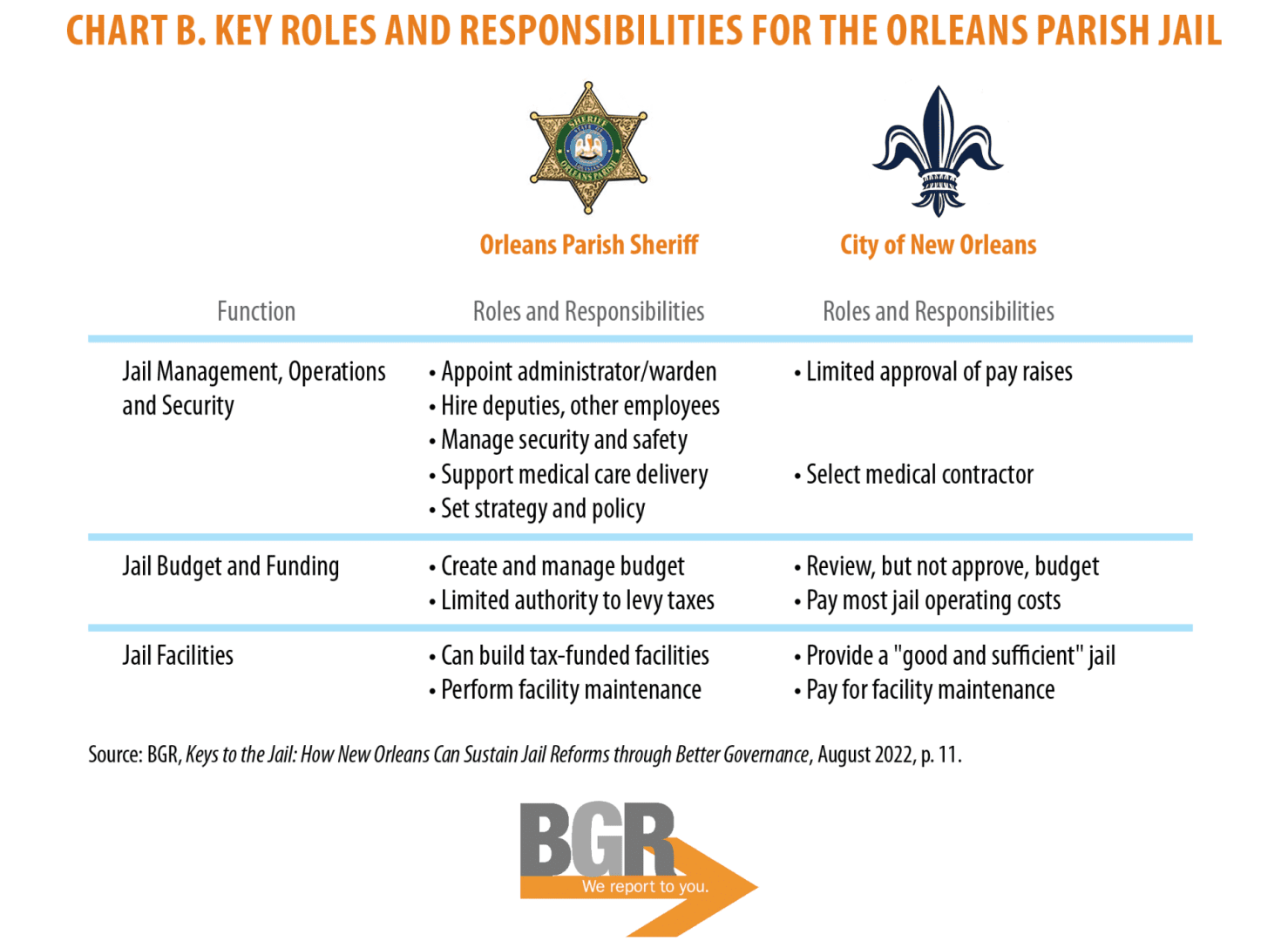
- Establish an ongoing strategic planning process in which they collaborate on the budget, facilities, employee compensation and training, and other jail needs.
- Improve fiscal transparency and accountability, both to ensure adequate City funding for the jail and careful tracking of how the Sheriff’s Office uses the money.
- Strengthen the appointment process for the top jail administrator by defining the job’s responsibilities and qualifications and by enabling City and public input on the candidates.
- Create an independent local entity to oversee jail performance to ensure ongoing monitoring of jail conditions and treatment of people in custody after federal court oversight ends.
In April 2025, voters renewed the Sheriff’s property tax for the jail. BGR supported the renewal based on its analysis showing the tax provides essential funding for the jail that would otherwise have to come from the City. However, BGR recommended that the Sheriff’s Office regularly report on tax expenditures and the office’s progress toward improving jail compliance, performance and outcomes. Following the May 2025 escape and the risk of more finger-pointing between the City and Sheriff, BGR re-emphasized the importance of the City and Sheriff’s Office coming to a long-term agreement.
On the Orleans Parish jail, BGR asked the candidates:
7. Should there be a cooperative agreement between the City and the Sheriff’s Office along the lines of what BGR recommends? If yes, please explain which components in the bullet point list above should be included in the agreement, plus any other priorities you would include. If not, please explain how you would work with the Sheriff to improve the jail’s performance.
All those suggestions appear valid. And we can’t change 50 years of problems in a 4 year period. We need to hire someone who specializes in consent decree review and ensure they have everything they need to get us out of this court ordered sanction and to ensure the rights of everyone houses in our custody are maintained. There needs to be a major overhaul of the jail and we must work on programs for release and rehabilitation of non-violent offenders.
STREET MAINTENANCE
Background Provided to All Candidates
The City is making more than $2 billion in federally funded repairs to streets and subsurface infrastructure damaged during Hurricane Katrina. However, the long-term benefits of this once-in-a-lifetime investment are threatened by the City’s chronic underfunding of street maintenance. As BGR reported in 2024, the Public Works department estimates it would cost $50 million a year to properly maintain the City’s 1,500 miles of streets. The City spends about $14 million, or $36 million less than is needed. This is particularly problematic because preventive street maintenance tends to pay for itself over time. Public Works has estimated that every dollar spent on preventive maintenance saves $4 to $5 on repair and reconstruction costs down the road.
On street maintenance, BGR asked the candidates:
8. What would you do to address the City’s underfunding of street maintenance? Please be specific on funding levels and how you would go about finding more revenue for streets.
Ensure the management team of that department are accountable to the work done and not allow potholes linger as we see has been happening for years. Shame on Landrieu for not properly using that funding properly and leaving our streets in disarray.
SEWERAGE & WATER BOARD GOVERNANCE
Background Provided to All Candidates
The Sewerage & Water Board is a state-created utility over which the mayor and City Council have substantial influence. The mayor serves as president of the utility’s board of directors, which is responsible for its operations and finances. The City Council has a seat on the board and controls the utility’s water and sewer rates and drainage property taxes.
One key task for the next mayor and council is supporting better Sewerage & Water Board performance. While the utility is implementing a wide-ranging strategic plan, long-term success will depend on improving the Sewerage & Water Board’s governance structure. This means the laws and policies that shape the powers, roles and responsibilities of the utility and those involved in its operations.
A core problem is that the Sewerage & Water Board must operate New Orleans’ water, sewer and drainage systems, but the City Council controls the fees and taxes that support them. Over the years, this tension between operational responsibility and funding control has allowed politics to influence funding decisions. This has resulted in underfunding, contributing to today’s deteriorated infrastructure and shifting costs to current and future ratepayers.
BGR suggests either strengthening the Sewerage & Water Board as a stand-alone utility that operates separately from City government or replacing it with a municipal utility that functions as part of City government. BGR’s 2023 report, Waterworks in Progress, details the potential benefits of each option over the status quo. But each option would present new complications that require further study. The next mayor should initiate that study and coordinate these efforts with the City Council and the Sewerage & Water Board, as well as seek public input.
In the near term, the City Council can improve its process for considering Sewerage & Water Board funding requests. As BGR outlined in its 2023 letter, the council should (1) objectively evaluate funding proposals, (2) regularly assess the utility’s performance, (3) track outcomes against desired goals, and (4) review strategic and financial plans and reports. These efforts would build on the council’s important work to expand its oversight of the utility, set up processes with State legislative support to help resolve customer billing problems, and help fund important infrastructure, such as a new electrical power complex to improve drainage pumping.
On Sewerage & Water Board governance, BGR asked the candidates:
9. What changes to management, operations, or governance of the Sewerage & Water Board would you support, and why?
The mayor needs to focus on other areas of city government and allow sewerage and water board to operate their business. What mayor will head an agency and acknowledge lack of accountability and oversight? Hire a business leader to turn sewerage and water board around and update our drainage system.
10. How would you improve the City Council’s approach to reviewing funding requests from the Sewerage & Water Board for rates and taxes?
Sewerage and water board collects more than enough money from our community. They need to show improvements and use the collected money wisely before approaching the council.
STORMWATER FEE
Background Provided to All Candidates
In 2027, one of New Orleans’ three drainage property taxes will expire unless it is renewed by voters. It provides $22 million a year, or nearly a quarter of drainage system revenue. Even with the tax, the system faces substantial unmet funding needs, for everything from cleaning catch basins to fixing pipes to upgrading pump stations. And experts have recommended supplementing traditional drainage with “green infrastructure,” or natural rainfall retention projects that can lighten the load on pipes and pumps and reduce ground subsidence.
To meet these funding needs, the Sewerage & Water Board, the City, and others, including BGR, have suggested creating a stormwater fee. As discussed in a 2017 BGR report, this type of user fee charges a property owner based on an estimate of stormwater runoff that the system collects from the property and discharges into local waterways. Generally, a fee has a couple of advantages over a tax. It applies to both taxable and tax-exempt property, spreading out the cost burden. Also, it is tied to a property’s runoff, rather than the property’s value, which improves fairness.
Sewerage & Water Board and City officials have not yet made a stormwater fee proposal to the public. As a first step, BGR urges them to review the funding needs of the entire drainage system. BGR also recommends careful planning, administration, and oversight to ensure a fair fee structure, effective use of the new revenue, and public accountability.
On stormwater fees, BGR asked the candidates:
11. Do you favor pursuing a citywide stormwater fee? If yes, please explain what the fee proposal should include to ensure effectiveness, fairness and accountability. If you do not favor a stormwater fee, please explain how you would address the drainage system’s financial needs.
I favor NOT taxing the citizens and holding sewerage and water board accountable. The same areas of the city flood during thunderstorms. There is certainly a need for proper management in that department.
AFFORDABLE HOUSING
Background Provided to All Candidates
In November 2024, voters amended the City charter to require an annual budget dedication equal to at least 2% of the City’s General Fund budget to the Housing Trust Fund, starting in 2026. The City will use the trust fund to preserve and expand affordable housing for low- to moderate-income residents. BGR’s report on the proposition identified acute problems in housing affordability in the city and the need for increased housing investment. However, BGR took a position against the proposed charter amendment citing the budget inflexibility of the charter-based dedication.
The City has tapped two public agencies, Finance New Orleans and the New Orleans Redevelopment Authority, to administer the Housing Trust Fund. In addition, the City Council formed the Housing Trust Fund Advisory Committee to advise the council on appropriations from the fund. In December 2024, BGR wrote a letter to the mayor and City Council recommending ways to ensure effective administration and use of Housing Trust Fund dollars. These recommendations include establishing clear metrics and criteria for examining program performance and expanded accountability measures, such as independent auditing of trust fund revenue. BGR also highlighted the need for other initiatives outside the trust fund to increase affordable housing, such as zoning reforms and tax incentives. As discussed in a previous section, the City should have a long-term financial plan that balances funding for the Housing Trust Fund with other needs.
On affordable housing, BGR asked the candidates:
12. How can Housing Trust Fund dollars be used most effectively in New Orleans?
That’s something that we need to ask the community. We need to know their needs and act on them.
13. What other initiatives besides Housing Trust Fund investments would you support to address housing affordability issues in New Orleans?
My team would research that information and ensure the best person or group is hired for the project.
ECONOMIC DEVELOPMENT
Background Provided to All Candidates
The City and other economic development entities should take a rigorous approach to reviewing private development projects seeking tax subsidies. Developers and public officials often view these subsidies as free money. But the tax breaks represent an allocation of future resources and should be evaluated with a rigor worthy of a long-term investment. BGR’s reports on payments in lieu of taxes (PILOT) and tax increment financing (TIF) emphasize several criteria:
- The project advances priorities specified in the City’s economic development strategic plan.
- Independent analyses demonstrate the market will not produce a desirable outcome for the project site, therefore making a public subsidy necessary.
- The subsidy provides only the minimum needed for the project to proceed. In addition, the subsidy should not compensate for basic financial weaknesses in a developer or a transaction (e.g., inadequate equity investment) or a lack of demand for a service or product.
- Effective subsidies produce a significant positive ratio of benefits to costs, as supported by a rigorous cost-benefit analysis.
- Subsidies should not create unfair impacts on local competitors or the surrounding neighborhood.
The City is not the sole entity with authority to abate local taxes in New Orleans to promote economic development. Others include the New Orleans Industrial Development Board and special economic development districts. This potentially makes it more difficult to implement a unified subsidy strategy, especially if the entities do not share the same economic development priorities.
On economic development, BGR asked the candidates:
14. What do you think New Orleans should emphasize in a strategic plan for economic development, and what would you do to ensure cohesive support from business, community and regional stakeholders necessary to achieve the plan’s goals?
We need more businesses in the city. Our money is mostly from tourism. We need to encourage grass roots entrepreneurs to invest in brick and mortar businesses with financial assistance from the government.
15. What, if any, changes would you pursue to how local tax subsidies for economic development are used and administered in New Orleans?
This is a broad question that needs to be researched.
PENSIONS
Background Provided to All Candidates
BGR has documented the sharply rising costs of pensions for public employees in a series of reports. The City’s total annual pension contributions have increased nearly 50% from $78 million in 2010 to more than $110 million this year. BGR’s research linked the problem to several factors, including benefits that far exceed national norms, past underfunding by the City, poor investment decisions, and overly optimistic assumptions about investment returns.
The City adopted a series of pension reforms during the last decade. These included increasing funding for pensions and lowering benefits for newly hired employees aside from police officers. However, the City has already reversed some of these reforms, and the rest are at risk.
Starting in 2018, the City reduced pension benefits to match national norms for new hires in the New Orleans Municipal Employees’ Retirement System (NOMERS), which includes all City employees except police and firefighters. But the City reversed many of the reforms in 2020 with almost no public discussion or justification.
Another set of reforms for the New Orleans Fire Fighters’ pension fund are part of a landmark 2016 legal settlement. The settlement includes higher annual contributions from the City and lower benefits for new firefighters. Voters also approved a 2.5-mill tax to help fund the settlement, which has made limited progress on improving the pension fund’s financial health. BGR found in 2024 that the ratio of the fund’s assets to its liabilities is just 11.5%. The recommended goal is 100%, and anything less than 70% is cause for serious concern. Despite the fund’s continued poor health, firefighters and pension system officials have stated their desire to undo the reforms. Meanwhile, the City’s current annual contribution of $45 million would need to increase by $23 million to put the fund on track to be fully funded, according to the fund’s annual actuarial report.
On pensions, BGR asked the candidates:
16. How should the City address the substantial costs of pensions while ensuring its total compensation packages for current and new employees are competitive? Please be specific about the changes you would pursue.
These public servants worked hard for their communities and deserve the best pay possible. We found money to pay two consent decrees, we can find the money to pay these heroes.

EUGENE GREEN (INCUMBENT)
CITY GOVERNMENT PERFORMANCE
Background Provided to All Candidates
BGR’s mission is to provide independent research to support informed public policy making and the effective use of public resources. We recognize that each candidate enters the race with a vision for improving City of New Orleans (City) government and delivering more effective services to citizens. BGR’s 2019 report analyzing the previous decade of the City’s General Fund budgets highlighted the lack of funding to address the vast scope of the City’s needs. Therefore, every General Fund dollar that is not well spent represents a dollar’s worth of high priority needs that will go unmet. The report urged the City to reevaluate current expenditures with an eye toward optimal deployment of existing resources to critical needs.
On City government performance, BGR asked the candidates:
1. What two City services, programs or operations are most in need of improvement, and what strategies (financial, organizational, operational or otherwise) will you use to fix them? Please explain why.
I believe two city services most in need of improvement are: Infrastructure Maintenance, such as sewerage, water, and street maintenance, as well as Safety & Permits.
Critical infrastructure, especially sewerage, water, and drainage systems continue to lag behind basic standards. Problems such as water main breaks, chronic street flooding, crumbling roads, and slow repairs are widely reported and directly impact safety, economic development, and residents’ quality of life. The Sewerage & Water Board and related departments face frequent criticism for delays, mismanagement, and a lack of transparency.
Some strategies could include shifting toward proactive infrastructure maintenance and repair, with dedicated funding. Ensuring all designated revenues (local, state, federal) are transparently allocated for their intended purpose. Aggressively using federal and state funding opportunities with robust oversight and public progress tracking. Offering transparent, portals for repair/service requests and status updates that can be tracked by the general public. Empowering cross-department leadership for integrated response, and providing continuous training and professional development for operations teams.
The Department of Safety & Permits is widely recognized by residents and stakeholders as one of the most frustrating city departments, often described as dysfunctional, unresponsive, and lacking accountability. Issues include excessive delays and lack of transparency in permitting and inspection processes. Confusing, inconsistent, or poorly communicated requirements that hinder both residents and businesses. Insufficient staffing, inadequate staff compensation, and lack of professional development. Fragmented coordination with related agencies, causing overlapping requirements and duplicated effort. Recent policy changes (such as new re-roofing or rental registration permits) risk compounding bottlenecks unless implemented with user-friendly systems and proactive outreach.
Some strategies could include establishing published timelines for permits & inspections and displaying real-time status dashboards online. Soliciting applicant feedback after permit closure and publishing department performance metrics regularly. Providing ongoing training and increasing compensation to attract and retain qualified inspectors and reviewers. Scheduling regular departmentwide training days, as recently implemented, to improve consistency and knowledge.
Expanding public information sessions, partnering with neighborhood and industry groups, and clarifying complex ordinances with clear guides. Empowering department heads to implement best practices, setting clear expectations, and enforcing accountability for results.
2. Where do you see opportunities to redirect General Fund dollars to higher impact uses? Please be specific about the expenditures you would cut or reduce and what you would fund in their place.
The city should start prioritizing a higher portion of General Fund dollars for preventive maintenance, leveraging external grants and low-interest bonds only for sustainable, cost-effective capital projects. Also, the city could consider increasing funding for code enforcement staff and technology. Additionally, the city should explore more partnerships for cost-sharing with state and federal agencies.
CITY BUDGET AND FINANCIAL MANAGEMENT
Background Provided to All Candidates
Strategic management of limited public resources will be key to improving the performance of City government. The City emerged from the COVID-19 pandemic in a stronger financial position thanks in large part to nearly $400 million in federal relief funding. But the windfall is over. The City projects little growth in revenue as it faces looming new costs. To help policymakers navigate this new reality, BGR analyzed the City’s financial management practices.
In After the Windfall, BGR recommended that the City administration develop a five-year financial plan and review it annually with the City Council. Having this roadmap can put the City on track to address fiscal challenges and opportunities. The plan should move the City toward a structurally balanced budget. A structural balance is when recurring revenues equal or exceed the recurring expenditures necessary to sustain public services and properly maintain facilities and infrastructure. Currently, the City relies on one-time reserves to balance its budget, and it does not adequately fund maintenance. Street maintenance alone would need an estimated $36 million increase in annual funding. Achieving structural balance is important for the City government’s fiscal health, but also for New Orleans’ sustainability and quality of life.
BGR also recommended the City administration develop, and the council adopt by ordinance, a policy for the use and preservation of its General Fund reserves to ensure an adequate financial cushion. Given New Orleans’ vulnerability to disasters, City officials should strongly consider a reserve level higher than the minimum of two months of General Fund expenses (about 17%, or $158 million this year) recommended by government finance experts.
Before the onset of the COVID-19 pandemic in 2020, the City’s reserves remained well below 17% and even turned negative in some years, signifying a deficit. The federal pandemic relief funding enabled the City to bolster its reserves, reaching a high of $344 million, or 54% of General Fund expenses in 2022. But three years of spending from the reserves could again reduce them below the minimum recommended level by the end of this year. Maintaining adequate reserves is important because it helps avoid cuts to essential services and increases in taxes and fees during financial crises. A reduction in reserves also could hurt the City’s credit rating, driving up taxpayer-funded borrowing costs for capital projects, such as street repairs.
On City budget and financial management, BGR asked the candidates:
3. Do you agree that the City should adopt and maintain a five-year financial plan that aims for a structurally balanced budget? Why or why not? Please describe any spending reductions or revenue-raising opportunities that you would consider to achieve a structurally balanced budget.
Yes, I strongly agree that the city should adopt and maintain a five-year financial plan that aims for a structurally balanced budget.
A five-year financial plan gives city leaders a strategic roadmap. It helps anticipate problems, set priorities, and make informed decisions about resource allocation, rather than operating with a short-term outlook.
A structurally balanced budget where recurring revenues match or exceed recurring expenditures ensures the city isn’t relying on one- time fixes or reserves to cover ongoing costs.
Maintaining structural balance and adequate reserves supports a higher credit rating, which lowers interest rates on borrowing for vital infrastructure upgrades. This saves taxpayers money and enhances future capital projects.
With New Orleans’ vulnerability to disasters and economic volatility, good planning and a healthy reserve cushion are essential for continuing essential services during emergencies without resorting to emergency tax increases or drastic service cuts.
Some strategies for cost savings may include conducting targeted reviews of city operations to identify and eliminate inefficiencies, or redundancies. Evaluating staffing levels across departments, focusing on positions left vacant, overtime dependence, and opportunities for responsible consolidation. Prioritizing capital investments, potentially delaying lower-priority projects until revenues support them. Also, shifting from reactive to preventive maintenance, particularly with streets and public buildings, which reduces long- term repair costs.
There are opportunities for increasing revenues by regularly reviewing and adjusting city service fees and fines to reflect actual costs and inflation. Encouraging targeted business attraction and retention to grow the tax base, with a focus on sectors poised for post- pandemic growth. Also, the city should review exemptions, abatements, and assessment practices to ensure that all property owners contribute fairly.
4. What percentage of the General Fund budget should the City keep as a financial reserve, and why?
For New Orleans specifically, due to its disaster risk profile, policymakers and financial experts advise keeping reserves higher than 17%, aiming for a level that equates to at least two months of general fund expenses.
Maintaining these reserves is crucial because they protect essential services during financial crises or disasters. They prevent the need for abrupt tax increases or severe spending cuts. Also, they help preserve the city’s credit rating, keeping borrowing costs lower.
Therefore, at least two months of the general fund budget should be kept as a financial reserve, and local factors may justify a higher percentage to ensure true fiscal resilience.
PUBLIC SAFETY
Background Provided to All Candidates
When New Orleans voters last elected their mayor and council four years ago, the city was reeling from a violent crime surge during the COVID-19 pandemic. The number of sworn officers in the New Orleans Police Department (NOPD) had fallen by nearly 20%. BGR hosted a Breakfast Briefing speaker series on public safety in spring 2022 that analyzed New Orleans’ longstanding crime problem and presented both law enforcement and community-based approaches to addressing it.
The City implemented recruitment and retention bonuses for NOPD officers – covering the initial costs with a substantial portion of its federal pandemic relief funds. It expanded its collaboration with other law enforcement agencies, including the Louisiana State Police, as the NOPD superintendent explained at a December 2023 BGR Breakfast Briefing. The City also invested in several public safety initiatives besides law enforcement, from mental health crisis response to violence prevention. Nonprofit organizations, businesses and others came together to form the NOLA Coalition in summer 2022 to invest in both NOPD and youth support services.
Crime has fallen significantly from its 2022 peak, and a recent public opinion survey found increasing satisfaction with NOPD and neighborhood safety. But public safety remains a top concern for many residents. NOPD’s officer strength has stopped its downward trend but hasn’t markedly improved. The department is the City’s largest annual General Fund expenditure, accounting for about a fifth of the budget. BGR’s recent report on the City’s financial management highlighted inaccurate budget projections for NOPD in 2024. Overtime costs have been a key driver in tens of millions of dollars of unplanned expenditures.
On public safety, BGR asked the candidates:
5. Would you seek an increase in funding for NOPD? Why or why not? If yes, please specify the increase level and what the additional funds would support. If no, please specify any changes to the department’s current budget that you would seek.
Given recent improvements in crime rates but persistent concerns about officer shortages and financial management, the case for increasing NOPD funding depends on clearly targeted priorities rather than across-the-board budget growth.
In supporting an increase in funding for NOPD, the additional funds should be directed toward: Officer recruitment and retention: The department has lost nearly a third of its force over the past decade and is currently at approximately 800 to 1,000 officers, well below the approximately 1,400 considered necessary for citywide coverage. This additional funding supports workforce stabilization that includes targeted hiring bonuses, improved benefits, and support for wellness programs, which have already shown some promise in halting the downward trend in officer numbers. Continued investment in advanced policing technology, data analysis, and community policing has contributed to significant reductions in violent crime over the past year. An increase in funding could range from 5 – 10% over current operational support, with a specific focus on the above priorities and not to further expand unplanned overtime, which has driven budget overruns.
Other cost saving opportunities such as a reallocation of the existing budget to restrain overtime costs through scheduling efficiencies and use more civilians for non-enforcement roles. Shifting resources to community-based violence prevention and mental health crisis interventions, which have become increasingly important in the city’s multi-pronged approach to public safety. Demanding tighter budget projections and financial oversight, given historic overestimation of available resources for the NOPD.
Any change in NOPD funding should be transparent, narrowly focused on resolving the agency’s core personnel challenges, and coupled with firm fiscal discipline to avoid further unplanned expenditures and ensure taxpayer resources produce sustainable improvements in public safety.
6. Beyond NOPD, what do you think are the top two areas where City resources can most effectively drive improvements in public safety? Why does the City’s involvement in these areas have strong potential for improving outcomes?
The top two areas where city resources can most effectively drive improvements in public safety are youth development & violence prevention programs. A significant portion of violent crime in New Orleans is connected to youth involvement, either as victims or perpetrators. Many young people in the city face limited access to quality education, after-school programs, and mental health resources, all factors that can lead to increased vulnerability to crime.
The City is uniquely positioned to coordinate youth-focused services across public schools, nonprofit partners, and criminal justice agencies. By investing in and expanding programs like mentorship and conflict resolution programs, job training and apprenticeship opportunities, and community-based mental health and trauma services.
The City can proactively address the root causes of violence, reduce recidivism, and steer at-risk youth toward productive paths. City leadership also brings visibility and legitimacy to these efforts, encouraging public and private investment.
The second thing is affordable housing & neighborhood revitalization. There is a strong correlation between public safety and stable, well-resourced neighborhoods. High-crime areas in New Orleans often coincide with blighted properties, housing instability, and poor infrastructure. When residents face housing insecurity or live in neglected environments.
The City controls zoning, development incentives, and access to federal housing funds. Through investments in affordable, mixed- income housing, rehabilitation of blighted properties, and targeted infrastructure improvements in high-crime areas. The city can create safer, more resilient communities. Stable housing also enables families to access better jobs, and health care, all of which reduce the social conditions that breed crime.
The city’s involvement in youth development and housing stability targets the underlying conditions that lead to crime, rather than just responding to it after the fact. These interventions create long-term, systemic change and build stronger, safer communities from the ground up.
ORLEANS PARISH JAIL
Background Provided to All Candidates
The Orleans Parish jail has been under federal oversight or investigation for more than 50 years, longer than any other local jail in the country. It has suffered from chronic problems, including violence, understaffing, and insufficient medical and mental health care. The May 16, 2025, escape of 10 men from custody heightened the public’s concern about the jail’s problems.
BGR’s 2022 report, Keys to the Jail, linked the jail’s performance problems to the strained governance relationship between the Orleans Parish Sheriff’s Office and the City. Under Louisiana law, the Sheriff’s Office operates the jail, while the City must pay most of its costs – 79% of its $91.1 million total budget in 2025. This structure has blurred accountability for the jail’s performance and impeded progress toward improving its performance and exiting federal oversight. BGR recommended the City and Sheriff’s Office develop a multi-year agreement to:
- Establish an ongoing strategic planning process in which they collaborate on the budget, facilities, employee compensation and training, and other jail needs.
- Improve fiscal transparency and accountability, both to ensure adequate City funding for the jail and careful tracking of how the Sheriff’s Office uses the money.
- Strengthen the appointment process for the top jail administrator by defining the job’s responsibilities and qualifications and by enabling City and public input on the candidates.
- Create an independent local entity to oversee jail performance to ensure ongoing monitoring of jail conditions and treatment of people in custody after federal court oversight ends.
In April 2025, voters renewed the Sheriff’s property tax for the jail. BGR supported the renewal based on its analysis showing the tax provides essential funding for the jail that would otherwise have to come from the City. However, BGR recommended that the Sheriff’s Office regularly report on tax expenditures and the office’s progress toward improving jail compliance, performance and outcomes. Following the May 2025 escape and the risk of more finger-pointing between the City and Sheriff, BGR re-emphasized the importance of the City and Sheriff’s Office coming to a long-term agreement.
On the Orleans Parish jail, BGR asked the candidates:
7. Should there be a cooperative agreement between the City and the Sheriff’s Office along the lines of what BGR recommends? If yes, please explain which components in the bullet point list above should be included in the agreement, plus any other priorities you would include. If not, please explain how you would work with the Sheriff to improve the jail’s performance.
Yes, there should be a cooperative agreement between the City of New Orleans and the Orleans Parish Sheriff’s Office along the lines recommended by the Bureau of Governmental Research (BGR). Given the jail’s chronic performance issues, longstanding federal oversight, and the unique governance and funding structure, a formal, transparent partnership is essential to improving accountability and outcomes.
Some benefits are collaborative strategic planning such as joint planning on budget, facilities, staffing, compensation, and training is critical. This can ensure the jail has adequate resources and staff, Prioritize investments in safety, security, and health care, and help prevent crises like the May 2025 escape.
Also, both the city and the public have a right to see where tax dollars are going and if money is being used efficiently and effectively. Therefore, fiscal transparency and accountability are essential to assuring the public that city agencies are good stewards of the public’s resources.
Additionally, regular, detailed reporting by the Sheriff’s Office should be mandatory, covering budget allocations, outcomes tied to spending (e.g., staffing levels, improvements, compliance with federal consent decrees).
It is very important for long-term improvement for independent local oversight. A local oversight board, separate from federal court monitoring, ensures that progress is sustained and that the jail is held to community standards for safety, health, and human rights, even after federal oversight ends.
Additional priorities to include clear lines of accountability. The agreement should define roles and clarify how to resolve disputes between the city and the Sheriff’s Office, to prevent blame-shifting and gridlock. Specific, measurable goals for safety, healthcare access, staffing ratios, and compliance with consent decree standards with timelines and consequences for non-compliance. Regular public forums or reports to ensure community concerns and suggestions are considered in the jail’s management and reform. Also, a commitment for multi-year budgeting so the jail can make long-term improvements, not just year-to-year fixes.
If a formal cooperative agreement is not possible, the City must use its budget approval powers to require detailed plans and performance reports from the Sheriff before releasing funds. Increase public transparency by publishing jail audits, inspection results, and expenditure data. Collaborate closely with federal monitors and independent watchdog organizations to maintain pressure for reform.
A well-structured, binding cooperative agreement as outlined by BGR would align incentives, improve transparency, and put Orleans Parish Jail on a clear path toward reform and eventual exit from federal oversight. All four BGR recommendations should be included, along with additional measures to assure accountability, measurable progress, and public involvement.
STREET MAINTENANCE
Background Provided to All Candidates
The City is making more than $2 billion in federally funded repairs to streets and subsurface infrastructure damaged during Hurricane Katrina. However, the long-term benefits of this once-in-a-lifetime investment are threatened by the City’s chronic underfunding of street maintenance. As BGR reported in 2024, the Public Works department estimates it would cost $50 million a year to properly maintain the City’s 1,500 miles of streets. The City spends about $14 million, or $36 million less than is needed. This is particularly problematic because preventive street maintenance tends to pay for itself over time. Public Works has estimated that every dollar spent on preventive maintenance saves $4 to $5 on repair and reconstruction costs down the road.
On street maintenance, BGR asked the candidates:
8. What would you do to address the City’s underfunding of street maintenance? Please be specific on funding levels and how you would go about finding more revenue for streets.
To address the City of New Orleans’ chronic underfunding of street maintenance, the funding gap of $36 million per year must be closed to meet the recommended $50 million annual maintenance requirement for the city’s 1,500 miles of streets. Below are some suggested strategies:
Audit current revenues dedicated to transportation (such as vehicle registration fees, traffic fines, and state or local gas tax allocations) to ensure all funds are spent efficiently on street maintenance as intended. Enhancing transparency and enforcing dedicated spending can marginally improve available funds.
Consider reallocating a targeted portion of current property tax revenue to street maintenance. This could involve dedicating a certain number of tax millages or a percentage of the general fund to achieve the $50 million required. This may require a public referendum, depending on state law and local precedent.
Leverage grants and matching funds where available for preventive street maintenance to supplement local spending. While generally less reliable, grants can provide bridge funding while more sustainable revenue streams are created.
A modest, dedicated sales tax increment for street maintenance could provide a significant revenue bump. This approach typically requires voter approval and should be presented with clear public outreach on the benefits (e.g., “every $1 in preventive maintenance saves $4 to 5 in major repairs.”)
For areas with high street deterioration or more intensive infrastructure needs, establish special assessment districts where benefiting property owners pay an annual surcharge earmarked solely for maintenance in their zone. While this doesn’t fix citywide underfunding, it can help with high-priority corridors.
By adopting a multi-pronged approach with specific revenue targets, New Orleans can sustainably fund the $50 million per year necessary to protect its $2 billion infrastructure investment and maximize long-term cost efficiencies.
SEWERAGE & WATER BOARD GOVERNANCE
Background Provided to All Candidates
The Sewerage & Water Board is a state-created utility over which the mayor and City Council have substantial influence. The mayor serves as president of the utility’s board of directors, which is responsible for its operations and finances. The City Council has a seat on the board and controls the utility’s water and sewer rates and drainage property taxes.
One key task for the next mayor and council is supporting better Sewerage & Water Board performance. While the utility is implementing a wide-ranging strategic plan, long-term success will depend on improving the Sewerage & Water Board’s governance structure. This means the laws and policies that shape the powers, roles and responsibilities of the utility and those involved in its operations.
A core problem is that the Sewerage & Water Board must operate New Orleans’ water, sewer and drainage systems, but the City Council controls the fees and taxes that support them. Over the years, this tension between operational responsibility and funding control has allowed politics to influence funding decisions. This has resulted in underfunding, contributing to today’s deteriorated infrastructure and shifting costs to current and future ratepayers.
BGR suggests either strengthening the Sewerage & Water Board as a stand-alone utility that operates separately from City government or replacing it with a municipal utility that functions as part of City government. BGR’s 2023 report, Waterworks in Progress, details the potential benefits of each option over the status quo. But each option would present new complications that require further study. The next mayor should initiate that study and coordinate these efforts with the City Council and the Sewerage & Water Board, as well as seek public input.
In the near term, the City Council can improve its process for considering Sewerage & Water Board funding requests. As BGR outlined in its 2023 letter, the council should (1) objectively evaluate funding proposals, (2) regularly assess the utility’s performance, (3) track outcomes against desired goals, and (4) review strategic and financial plans and reports. These efforts would build on the council’s important work to expand its oversight of the utility, set up processes with State legislative support to help resolve customer billing problems, and help fund important infrastructure, such as a new electrical power complex to improve drainage pumping.
On Sewerage & Water Board governance, BGR asked the candidates:
9. What changes to management, operations, or governance of the Sewerage & Water Board would you support, and why?
To address the long-standing challenges facing the Sewerage & Water Board of New Orleans, I would support changes that directly improve its governance structure, accountability, and funding mechanisms. The current arrangement where the utility is responsible for critical infrastructure, but the City Council controls its rates and taxes creates a disconnect that introduces political influence and complicates effective, long-term planning.
The following changes would improve management, operations, and governance such as initiating a comprehensive and public study, in partnership with the City Council and utility leadership, to evaluate two primary options as suggested by the Bureau of Governmental Research (BGR). Also, strengthening the Sewerage & Water Board as an independent, stand-alone utility, separate from direct City government control. Transforming it into a true municipal utility, making it an official part of City government, aligning operational responsibility and funding oversight. Each option could yield benefits over the status quo, but both have significant trade-offs that need detailed analysis and community input before moving forward.
In the short term, I would advocate for the City Council to objectively review all Sewerage & Water Board funding proposals. Institute regular, metrics-based performance reviews of the utility. Track utility outcomes against clearly defined goals. Continually review and evaluate strategic and financial plans and reports.
These steps would limit political interference, ensure funds are used effectively, and align spending with actual infrastructure needs.
Structural change must involve stakeholders including ratepayers, state legislators, and relevant city departments and allow for robust public comment, transparency, and clear communication about goals and progress. I would back ongoing efforts to modernize and stabilize the water, sewer, and drainage systems (such as supporting the new electrical power complex for drainage), and incorporate state legislative support to address persistent customer service issues.
By pursuing these reforms, the Sewerage & Water Board can become more effective, resilient, and accountable—improving infrastructure, restoring public trust, and providing sustainable, high-quality service to New Orleans residents.
10. How would you improve the City Council’s approach to reviewing funding requests from the Sewerage & Water Board for rates and taxes?
To improve the City Council’s approach to reviewing funding requests from the Sewerage & Water Board (S&WB) for rates and taxes, I would recommend the following key enhancements.
Based on the advocating of a change to the way the City Council approaches reviewing S&WB’s funding request by the Bureau of Governmental Research (BGR), the City Council should establish a clear and formal process to objectively review S&WB funding proposals. This would involve thoroughly assessing technical and financial merits of the request to improve funding reliability.
Instead of using control over funding sources as the main tool for oversight, the City Council should institute regular, data-driven performance reviews of S&WB. This includes tracking outcomes against defined goals related to service quality, infrastructure condition, and customer service. Regular assessments would hold S&WB accountable for results and inform funding needs more transparently.
The Council should closely review the utility’s strategic and financial plans and its reports on progress. This integrated oversight will help ensure that funding aligns with prioritized capital projects and sustainable operation plans, preventing underfunding.
The process should include mechanisms for public input and transparency, enabling ratepayers and community members to understand and weigh in on funding proposals. This also encourages trust and shared responsibility for utility sustainability.
Given the technical and funding challenges, the City Council should work in coordination with state authorities when necessary to support legislative actions that can strengthen oversight and financial frameworks.
Improving the City Council’s approach should also include promoting solutions to customer service challenges, such as billing problems, as these impact trust and willingness to pay.
These steps would lead to more objective, accountable, and transparent funding decisions that better support infrastructure needs, operational improvements, and long-term financial sustainability of S&WB for the city of New Orleans.
STORMWATER FEE
Background Provided to All Candidates
In 2027, one of New Orleans’ three drainage property taxes will expire unless it is renewed by voters. It provides $22 million a year, or nearly a quarter of drainage system revenue. Even with the tax, the system faces substantial unmet funding needs, for everything from cleaning catch basins to fixing pipes to upgrading pump stations. And experts have recommended supplementing traditional drainage with “green infrastructure,” or natural rainfall retention projects that can lighten the load on pipes and pumps and reduce ground subsidence.
To meet these funding needs, the Sewerage & Water Board, the City, and others, including BGR, have suggested creating a stormwater fee. As discussed in a 2017 BGR report, this type of user fee charges a property owner based on an estimate of stormwater runoff that the system collects from the property and discharges into local waterways. Generally, a fee has a couple of advantages over a tax. It applies to both taxable and tax-exempt property, spreading out the cost burden. Also, it is tied to a property’s runoff, rather than the property’s value, which improves fairness.
Sewerage & Water Board and City officials have not yet made a stormwater fee proposal to the public. As a first step, BGR urges them to review the funding needs of the entire drainage system. BGR also recommends careful planning, administration, and oversight to ensure a fair fee structure, effective use of the new revenue, and public accountability.
On stormwater fees, BGR asked the candidates:
11. Do you favor pursuing a citywide stormwater fee? If yes, please explain what the fee proposal should include to ensure effectiveness, fairness and accountability. If you do not favor a stormwater fee, please explain how you would address the drainage system’s financial needs.
Yes, pursuing a citywide stormwater fee in New Orleans appears to be a favored approach to address the substantial, unmet funding needs of the city’s drainage system. A stormwater fee charges property owners based on the impervious surface area of their properties, reflecting stormwater runoff that the drainage system must collect and manage. This method spreads the cost more fairly because it applies to both taxable and tax-exempt properties and is tied to runoff rather than property value, which improves fairness.
A recent legislative proposal, House Bill 609, seeks to authorize the Sewerage and Water Board to impose such a fee based on impervious surface area. For single-family homes, the fee is standardized to a unit representing the median residential impervious surface, with proportional fees for larger or more impervious properties. The bill also provides for discounts for properties with advanced stormwater retention or those discharging directly to Lake Pontchartrain with proper treatment, helping encourage green infrastructure adoption. The fee would be included in annual property tax bills, with delinquent payments subject to penalties. The bill caps the fee for single-family homes at 16.34 mills.
To ensure effectiveness, fairness, and accountability, the fee proposal should include careful assessment of the entire drainage system’s funding needs and transparency about how fee revenues are allocated and used. A fair fee structure based on measurable impervious surface area, with allowances for fee reductions or credits for properties that invest in stormwater mitigation or discharge stormwater responsibly. Public accountability measures, including oversight by city bodies and clear communication with property owners about fee purposes and benefits. Inclusion of all property types in the fee base, covering taxable and exempt properties, to spread costs equitably. Integration with existing drainage property taxes to avoid double charging and ensure revenue adequacy.
The Bureau of Governmental Research (BGR) has urged city officials to review funding needs
comprehensively and implement strong planning, administration, and oversight to maintain fairness, effectiveness, and accountability in stormwater fee programs.
Therefore, a well-planned, transparent stormwater fee could provide sustainable funding for drainage maintenance, upgrades, cleaning catch basins, fixing pipes, and investing in green infrastructure, addressing the city’s infrastructure challenges more fairly and effectively than relying solely on property taxes, some of which expire or fall short of system needs.
AFFORDABLE HOUSING
Background Provided to All Candidates
In November 2024, voters amended the City charter to require an annual budget dedication equal to at least 2% of the City’s General Fund budget to the Housing Trust Fund, starting in 2026. The City will use the trust fund to preserve and expand affordable housing for low- to moderate-income residents. BGR’s report on the proposition identified acute problems in housing affordability in the city and the need for increased housing investment. However, BGR took a position against the proposed charter amendment citing the budget inflexibility of the charter-based dedication.
The City has tapped two public agencies, Finance New Orleans and the New Orleans Redevelopment Authority, to administer the Housing Trust Fund. In addition, the City Council formed the Housing Trust Fund Advisory Committee to advise the council on appropriations from the fund. In December 2024, BGR wrote a letter to the mayor and City Council recommending ways to ensure effective administration and use of Housing Trust Fund dollars. These recommendations include establishing clear metrics and criteria for examining program performance and expanded accountability measures, such as independent auditing of trust fund revenue. BGR also highlighted the need for other initiatives outside the trust fund to increase affordable housing, such as zoning reforms and tax incentives. As discussed in a previous section, the City should have a long-term financial plan that balances funding for the Housing Trust Fund with other needs.
On affordable housing, BGR asked the candidates:
12. How can Housing Trust Fund dollars be used most effectively in New Orleans?
To use Housing Trust Fund dollars most effectively in New Orleans, several strategies and principles should be followed, based on the context you provided and best practices in affordable housing funding are to define specific, measurable objectives for how the funds will increase affordable housing supply and preserve existing affordable units for low to moderate-income residents. Develop performance metrics such as the number of housing units created or preserved, cost per unit, income levels served, and geographic distribution within the city. Regularly review these metrics to assess program success and adjust strategies accordingly. Implement independent auditing of Housing Trust Fund revenues and expenditures to maintain public trust and fiscal responsibility. Make reporting on fund usage, program outcomes, and financial audits publicly available.
The Housing Trust Fund Advisory Committee should have a transparent role with clear reporting to the City Council and the public.
The City should leverage multiple public agencies and community partnerships such as of Finance New Orleans and the New Orleans Redevelopment Authority for efficient fund management and program implementation. Engage local nonprofits, developers, and community groups to ensure programs meet residents’ needs and encourage innovative housing solutions.
While the charter mandates a 2% minimum allocation, the City should design flexible programs under the fund’s umbrella to respond to changing housing market conditions and priorities. Allow for a mix of preservation and development activities, rental assistance, homeownership support, and infrastructure improvements related to affordable housing. As BGR recommended, combine Housing Trust Fund investments with other policies such as employing tax incentives or subsidies to attract private investment in affordable housing projects. Working toward a long-term financial plan that balances housing needs with other municipal priorities. Focusing on Equity and Targeting Low- to Moderate-Income Residents Prioritizing projects that serve the most vulnerable populations facing housing insecurity. Addressing geographic equity to avoid concentrating affordable housing in limited areas and promoting diverse, inclusive neighborhoods.
The effective use of Housing Trust Fund dollars in New Orleans hinges on clear goal-setting, strong oversight, multi-agency collaboration, programmatic flexibility, complementary housing policies, and an enduring commitment to equity and accountability. This approach will help maximize the impact of the dedicated funding on alleviating housing affordability challenges in the city.
13. What other initiatives besides Housing Trust Fund investments would you support to address housing affordability issues in New Orleans?
Besides Housing Trust Fund investments, several other initiatives can effectively address housing affordability issues in New Orleans.
The City of New Orleans offers financial assistance programs for low-income families to help with down payments and closing costs, facilitating pathways to homeownership and alleviating demand on rental markets.
Programs that provide short-term rental subsidies for low-income households, focusing on families, elderly residents, and those with disabilities, along with case management services for housing stability. The My Choice Rental Assistance program delivers monthly rental subsidies to help tenants afford safe and decent housing, especially families transitioning from homelessness or substandard conditions. Section 8 vouchers and public housing initiatives provide rental subsidies and maintain public housing quality, including supportive services like job training and childcare.
Organizations such as UNITY of Greater New Orleans, Habitat for Humanity, People’s Housing+, and the New Orleans Redevelopment Authority (NORA) work on developing and preserving affordable housing, rapid rehousing, tenant rights advocacy, and community engagement.
Programs funded through the Office of Community Development support substantial rehabilitation, health and safety improvements, home modifications, and painting for owner-occupied homes to preserve housing stock.
Initiatives like NORA’s Façade RENEW program support small businesses and commercial corridors to boost local economies and revitalize neighborhoods, indirectly supporting housing stability. Foundations like the OnPath Foundation offer grants to first-time homebuyers to break cycles of generational poverty and help overcome upfront costs of homeownership.
Together, these initiatives complement the Housing Trust Fund by addressing the affordability crisis through multiple angles such as, homebuyer support, rental assistance, preservation of existing housing, nonprofit collaboration, policy reforms, and economic development, all aiming for a holistic, sustainable impact on the housing challenges that the city of New Orleans faces.
ECONOMIC DEVELOPMENT
Background Provided to All Candidates
The City and other economic development entities should take a rigorous approach to reviewing private development projects seeking tax subsidies. Developers and public officials often view these subsidies as free money. But the tax breaks represent an allocation of future resources and should be evaluated with a rigor worthy of a long-term investment. BGR’s reports on payments in lieu of taxes (PILOT) and tax increment financing (TIF) emphasize several criteria:
- The project advances priorities specified in the City’s economic development strategic plan.
- Independent analyses demonstrate the market will not produce a desirable outcome for the project site, therefore making a public subsidy necessary.
- The subsidy provides only the minimum needed for the project to proceed. In addition, the subsidy should not compensate for basic financial weaknesses in a developer or a transaction (e.g., inadequate equity investment) or a lack of demand for a service or product.
- Effective subsidies produce a significant positive ratio of benefits to costs, as supported by a rigorous cost-benefit analysis.
- Subsidies should not create unfair impacts on local competitors or the surrounding neighborhood.
The City is not the sole entity with authority to abate local taxes in New Orleans to promote economic development. Others include the New Orleans Industrial Development Board and special economic development districts. This potentially makes it more difficult to implement a unified subsidy strategy, especially if the entities do not share the same economic development priorities.
On economic development, BGR asked the candidates:
14. What do you think New Orleans should emphasize in a strategic plan for economic development, and what would you do to ensure cohesive support from business, community and regional stakeholders necessary to achieve the plan’s goals?
New Orleans should emphasize in its strategic economic development plan, a rigorous and criteria-driven approach to private development projects seeking tax subsidies, such as payments in lieu of taxes (PILOT) and tax increment financing (TIF). Important emphases include aligning projects with priorities specified in the city’s economic development strategic plan to ensure public funds support agreed-upon goals. Requiring independent analysis to demonstrate that the market alone will not produce the desired outcomes, thereby justifying the necessity of public subsidies. Ensuring subsidies are the minimum necessary to enable projects to proceed without covering basic financial weaknesses or compensating for lack of demand. Conducting rigorous cost-benefit analyses to confirm that subsidies produce a significant positive ratio of benefits to costs. Avoiding unfair competitive impacts on local businesses or neighborhoods. Coordinating among various entities with tax abatement authority (e.g., Industrial Development Board, special districts) to unify subsidy strategies and avoid conflicting priorities.
To ensure cohesive support from business, community, and regional stakeholders to achieve these goals, New Orleans should facilitate inclusive stakeholder engagement processes that involve representatives from the business community, neighborhood groups, regional partners, and public officials early in plan development. Communicate transparently about subsidy criteria, expected outcomes, and accountability measures to build trust and shared understanding. Establish inter-agency coordination forums to align multiple economic development authorities toward common priorities and strategies. Incorporate feedback mechanisms and regular reporting to maintain accountability and adjust approaches based on stakeholder input and evolving economic conditions. Promote strategic incentives that leverage significant private investment without displacing existing businesses or encouraging market inefficiencies.
Such an approach aligns with the rigorous evaluation criteria advocated by the Bureau of Governmental Research (BGR) for New Orleans’s PILOT and TIF projects and reflects best practices in economic development planning to maximize returns on public investments while maintaining fairness and transparency.
15. What, if any, changes would you pursue to how local tax subsidies for economic development are used and administered in New Orleans?
To improve how local tax subsidies for economic development are used and administered in New Orleans, I would pursue the following changes based on recent developments and best practices.
Enforce stricter criteria for granting subsidies, including detailed independent cost-benefit analyses to ensure subsidies only cover necessary gaps and produce a positive return for the community. There must be transparency on how subsidies align with city priorities and ongoing reporting on outcomes to maintain accountability. Since New Orleans has multiple entities with the power to grant tax abatements (the City, Industrial Development Board, special districts), creating an inter-agency coordination mechanism would unify subsidy strategies, prevent overlapping, and align subsidies with a cohesive economic development plan.
Subsidies should not support projects with fundamental financial weaknesses or low demand, nor should they unfairly disadvantage existing local businesses or neighborhoods. Careful review to prevent market distortions and promote equitable growth is essential.
Louisiana recently enacted significant tax reforms including repealing the corporate franchise tax effective 2026 and flattening income tax rates while increasing sales tax rates to compensate revenue losses. In this shifting fiscal landscape, local subsidy programs should be calibrated to complement state tax policy changes and maintain sustainable funding for development incentives without undermining public revenue needed for essential services. Adjust subsidies to advance specific city priorities such as housing affordability, job creation, and neighborhood revitalization, rather than broad or unfocused incentives. Consider targeted credits or payment plans to support key sectors, as seen with recent property tax payment options launched by New Orleans to assist businesses with tax balance management. Maintain inclusive engagement with business, community, and regional stakeholders to build consensus, adapt subsidy criteria as needs evolve, and foster shared responsibility for economic development goals.
By focusing on rigorous evaluation, coordination, equity, alignment with tax reform, targeted incentives, and stakeholder engagement, New Orleans can improve the effectiveness and fairness of local tax subsidies driving economic development.
PENSIONS
Background Provided to All Candidates
BGR has documented the sharply rising costs of pensions for public employees in a series of reports. The City’s total annual pension contributions have increased nearly 50% from $78 million in 2010 to more than $110 million this year. BGR’s research linked the problem to several factors, including benefits that far exceed national norms, past underfunding by the City, poor investment decisions, and overly optimistic assumptions about investment returns.
The City adopted a series of pension reforms during the last decade. These included increasing funding for pensions and lowering benefits for newly hired employees aside from police officers. However, the City has already reversed some of these reforms, and the rest are at risk.
Starting in 2018, the City reduced pension benefits to match national norms for new hires in the New Orleans Municipal Employees’ Retirement System (NOMERS), which includes all City employees except police and firefighters. But the City reversed many of the reforms in 2020 with almost no public discussion or justification.
Another set of reforms for the New Orleans Fire Fighters’ pension fund are part of a landmark 2016 legal settlement. The settlement includes higher annual contributions from the City and lower benefits for new firefighters. Voters also approved a 2.5-mill tax to help fund the settlement, which has made limited progress on improving the pension fund’s financial health. BGR found in 2024 that the ratio of the fund’s assets to its liabilities is just 11.5%. The recommended goal is 100%, and anything less than 70% is cause for serious concern. Despite the fund’s continued poor health, firefighters and pension system officials have stated their desire to undo the reforms. Meanwhile, the City’s current annual contribution of $45 million would need to increase by $23 million to put the fund on track to be fully funded, according to the fund’s annual actuarial report.
On pensions, BGR asked the candidates:
16. How should the City address the substantial costs of pensions while ensuring its total compensation packages for current and new employees are competitive? Please be specific about the changes you would pursue.
To address the substantial pension costs while keeping total compensation competitive for current and new employees, the City should consider the following specific changes based on the New Orleans situation and best practices for public pension reform:
The City reduced pension benefits starting in 2018 to align with national norms for new hires in the New Orleans Municipal Employees’ Retirement System. However, these reforms were reversed in 2020, increasing benefits retroactively by 32% for about 1,000 employees hired since 2018. BGR criticized this rollback for being opaque, lacking evidence of recruitment problems, and substantially increasing taxpayer costs while exceeding national norms. Therefore, the City should reinstate the 2018 reforms and maintain these more sustainable benefit levels moving forward, with clear public discussion and justification to ensure transparency.
The 2016 legal settlement for the Fire Fighters’ pension fund included higher City contributions, lower benefits for new hires, and voter- approved tax increases. Despite this, the fund’s assets-to-liabilities ratio remains critically low at 11.5%. The goal is 100%, minimum concern threshold of 70%. The city’s contribution would need to increase by $23 million annually to reach full funding. The city should maintain the settlement reforms, resist undoing them, and prioritize increasing funding levels to gradually improve the fund’s health while continuing to manage costs.
Pension problems have been linked to past city underfunding, poor investment decisions, and overly optimistic return assumptions. The city should adopt conservative actuarial assumptions that better reflect market realities, ensure full annual contributions as recommended, and improve governance to prevent underfunding or risky investments.
Previous pension benefit increases lacked public justification and discussion. The city should commit to transparent decision-making with public input, clear data about recruitment, retention, and cost impacts to justify any changes to compensation or benefits. To keep compensation competitive without excessive pension costs, the city might consider enhancing non-pension benefits or wages where needed, but with a controlled pension package tied to sustainable contribution levels. This reduces future unfunded liabilities while remaining attractive to employees. Regularly monitor pension fund health, workforce needs, and compensation competitiveness, adjusting policies accordingly to avoid large unfunded liabilities or surprise cost spikes.
Therefore, the city should reinstate pension benefit reforms aligned with national norms for new hires, maintain and fund settlement reforms for firefighters, adopt conservative funding practices, improve transparency, and balance overall compensation packages to control costs while maintaining workforce competitiveness. This approach addresses the steeply rising pension expenses in a sustainable way without abrupt reversals that increase taxpayer burden without clear benefit.

LEILANI HENO
CITY GOVERNMENT PERFORMANCE
Background Provided to All Candidates
BGR’s mission is to provide independent research to support informed public policy making and the effective use of public resources. We recognize that each candidate enters the race with a vision for improving City of New Orleans (City) government and delivering more effective services to citizens. BGR’s 2019 report analyzing the previous decade of the City’s General Fund budgets highlighted the lack of funding to address the vast scope of the City’s needs. Therefore, every General Fund dollar that is not well spent represents a dollar’s worth of high priority needs that will go unmet. The report urged the City to reevaluate current expenditures with an eye toward optimal deployment of existing resources to critical needs.
On City government performance, BGR asked the candidates:
1. What two City services, programs or operations are most in need of improvement, and what strategies (financial, organizational, operational or otherwise) will you use to fix them? Please explain why.
Two City services urgently needing improvement are infrastructure delivery and staffing capacity in public-facing departments. Both directly affect daily life and the City’s ability to serve residents effectively and fairly.
First, New Orleans is struggling to manage drainage and infrastructure projects. There are over $800 million in unmet needs and more than 90 delayed or stalled projects. The disjointed relationship between the Sewerage & Water Board (S&WB) and the Department of Public Works (DPW) causes confusion, delays, and wasted money. As a council member, I’d push for governance reform, either restructuring S&WB or aligning its work more directly with DPW, to streamline operations and improve accountability. I’d also require monthly public updates on project timelines, spending, and contractor performance.
Second, chronic understaffing in key departments, like Safety & Permits, Public Works, and Libraries, slows services and frustrates residents. Many departments operate at just 70–80% staffing, despite strong revenues and access to federal funds. This affects everything from pothole repairs to permit approvals. I would lead a staffing restoration initiative to fill vacancies, improve pay, and speed up hiring. I’d also push for better oversight of costly emergency contracts to ensure city dollars support in-house staff, not just outside consultants.
These reforms would directly improve daily services, especially for working families, educators, and students who depend on safe streets, timely permits, and functioning infrastructure.
2. Where do you see opportunities to redirect General Fund dollars to higher impact uses? Please be specific about the expenditures you would cut or reduce and what you would fund in their place.
Based on the current city budget and recent analyses, there are real opportunities to shift General Fund dollars from lower-impact areas to services that directly support families, students, and community well-being.
Public safety makes up nearly 32% of the General Fund, with over half a billion dollars going to police, jails, and the criminal legal system. While safety is essential, reallocating just 5–8% of that, about $30–45 million, could significantly expand programs proven to reduce violence and improve long-term outcomes. I’d shift some of those funds to scale up youth workforce initiatives like YouthForce NOLA and summer jobs, and to expand mental health care—especially school-based counseling and mobile crisis response teams. These services are cost-effective, lower youth incarceration, and strengthen schools and neighborhoods.
Housing is another major gap receiving less than 0.5% of the General Fund, even though stable housing is key to family success and school attendance. I’d reduce discretionary spending on things like unnecessary consulting contracts, underused facilities, and oversized event security. At least $15–20 million a year should be redirected to the local Affordable Housing Trust Fund to build and preserve deeply affordable homes, support energy upgrades, and prevent displacement—especially in gentrifying areas.
This kind of reallocation makes the budget work for people—not just systems. By investing in housing, job training, and mental health, we can make communities safer, help students thrive, and build a stronger, more equitable New Orleans for every family.
CITY BUDGET AND FINANCIAL MANAGEMENT
Background Provided to All Candidates
Strategic management of limited public resources will be key to improving the performance of City government. The City emerged from the COVID-19 pandemic in a stronger financial position thanks in large part to nearly $400 million in federal relief funding. But the windfall is over. The City projects little growth in revenue as it faces looming new costs. To help policymakers navigate this new reality, BGR analyzed the City’s financial management practices.
In After the Windfall, BGR recommended that the City administration develop a five-year financial plan and review it annually with the City Council. Having this roadmap can put the City on track to address fiscal challenges and opportunities. The plan should move the City toward a structurally balanced budget. A structural balance is when recurring revenues equal or exceed the recurring expenditures necessary to sustain public services and properly maintain facilities and infrastructure. Currently, the City relies on one-time reserves to balance its budget, and it does not adequately fund maintenance. Street maintenance alone would need an estimated $36 million increase in annual funding. Achieving structural balance is important for the City government’s fiscal health, but also for New Orleans’ sustainability and quality of life.
BGR also recommended the City administration develop, and the council adopt by ordinance, a policy for the use and preservation of its General Fund reserves to ensure an adequate financial cushion. Given New Orleans’ vulnerability to disasters, City officials should strongly consider a reserve level higher than the minimum of two months of General Fund expenses (about 17%, or $158 million this year) recommended by government finance experts.
Before the onset of the COVID-19 pandemic in 2020, the City’s reserves remained well below 17% and even turned negative in some years, signifying a deficit. The federal pandemic relief funding enabled the City to bolster its reserves, reaching a high of $344 million, or 54% of General Fund expenses in 2022. But three years of spending from the reserves could again reduce them below the minimum recommended level by the end of this year. Maintaining adequate reserves is important because it helps avoid cuts to essential services and increases in taxes and fees during financial crises. A reduction in reserves also could hurt the City’s credit rating, driving up taxpayer-funded borrowing costs for capital projects, such as street repairs.
On City budget and financial management, BGR asked the candidates:
3. Do you agree that the City should adopt and maintain a five-year financial plan that aims for a structurally balanced budget? Why or why not? Please describe any spending reductions or revenue-raising opportunities that you would consider to achieve a structurally balanced budget.
Yes, I strongly support the City adopting and maintaining a five-year financial plan to achieve a structurally balanced budget. That means making sure recurring revenues cover recurring expenses, not depending on one-time federal relief or draining reserves to fill budget gaps. Without this discipline, we risk cuts to essential services like street maintenance, sanitation, and public safety, especially during emergencies.
To build structural balance, we must address both spending and revenue. On the spending side, I’d target inefficiencies starting with trimming non-essential contracts, including excessive consultant fees and emergency procurements that lack transparency. These dollars should be redirected to core needs like infrastructure. For instance, our street maintenance budget is short by about $36 million each year. Closing that gap is vital for public safety and economic growth.
On the revenue side, we need smarter, more equitable tools. That includes improving enforcement of existing hotel and short-term rental taxes, pursuing fair-share contributions from large nonprofits and tourism entities, and exploring voter-approved funding streams for resilience and housing, like a stormwater utility fee or housing trust levy.
Finally, I support adopting a General Fund reserve policy by ordinance, as BGR recommends. With New Orleans’ exposure to hurricanes and economic shocks, a strong reserve, ideally above the 17% minimum, helps protect essential services during a crisis.
This kind of long-term financial planning isn’t just good governance. It’s how we build a stronger, more stable New Orleans for the next generation.
4. What percentage of the General Fund budget should the City keep as a financial reserve, and why?
Given New Orleans’ high vulnerability to hurricanes, flooding, and other economic shocks, I believe the city should aim for a higher reserve level, closer to 20–25% when financially feasible.
Maintaining a strong reserve is not just sound budgeting, it’s critical for protecting essential services during emergencies. A healthy reserve gives the city flexibility to respond to disasters without making deep cuts to public safety, sanitation, infrastructure, or youth programs. It also helps protect the city’s credit rating, keeping borrowing costs down for large-scale capital projects like road repairs and drainage improvements.
In short, a robust reserve is a cushion that buys us time and options during a crisis. It prevents sudden tax hikes or service cuts and ensures we can keep New Orleans running and resilient when we need it most.
PUBLIC SAFETY
Background Provided to All Candidates
When New Orleans voters last elected their mayor and council four years ago, the city was reeling from a violent crime surge during the COVID-19 pandemic. The number of sworn officers in the New Orleans Police Department (NOPD) had fallen by nearly 20%. BGR hosted a Breakfast Briefing speaker series on public safety in spring 2022 that analyzed New Orleans’ longstanding crime problem and presented both law enforcement and community-based approaches to addressing it.
The City implemented recruitment and retention bonuses for NOPD officers – covering the initial costs with a substantial portion of its federal pandemic relief funds. It expanded its collaboration with other law enforcement agencies, including the Louisiana State Police, as the NOPD superintendent explained at a December 2023 BGR Breakfast Briefing. The City also invested in several public safety initiatives besides law enforcement, from mental health crisis response to violence prevention. Nonprofit organizations, businesses and others came together to form the NOLA Coalition in summer 2022 to invest in both NOPD and youth support services.
Crime has fallen significantly from its 2022 peak, and a recent public opinion survey found increasing satisfaction with NOPD and neighborhood safety. But public safety remains a top concern for many residents. NOPD’s officer strength has stopped its downward trend but hasn’t markedly improved. The department is the City’s largest annual General Fund expenditure, accounting for about a fifth of the budget. BGR’s recent report on the City’s financial management highlighted inaccurate budget projections for NOPD in 2024. Overtime costs have been a key driver in tens of millions of dollars of unplanned expenditures.
On public safety, BGR asked the candidates:
5. Would you seek an increase in funding for NOPD? Why or why not? If yes, please specify the increase level and what the additional funds would support. If no, please specify any changes to the department’s current budget that you would seek.
I would not seek a blanket increase in NOPD funding at this time. While I fully support efforts to improve public safety and rebuild trust in our police department, we need to use existing resources more efficiently and transparently before asking residents to pay more. NOPD already receives a large share of the City’s General Fund and continues to exceed its budget, especially due to uncontrolled overtime. That’s not sustainable.
Instead of increasing funding, I’d push for reforms within the current budget. First, I’d advocate for stricter controls on overtime, including real-time tracking, approval oversight, and public reporting. Second, I’d support hiring more civilian staff, like administrative and non-emergency roles, so officers can focus on core policing. It’s more cost-effective and improves service.
I also support expanding alternative public safety strategies that have worked in other cities: mobile crisis response teams, violence interruption programs, and community-led patrols. These approaches reduce crime while easing pressure on NOPD.
If any funding increase is considered, it should be performance-based, tied to clear outcomes, like faster response times, higher closure rates for violent crimes, and progress on constitutional policing goals.
Public safety is a top priority, but it’s not just about spending more money. It’s about spending smarter, holding departments accountable, and investing in a public safety system that truly works for all residents.
6. Beyond NOPD, what do you think are the top two areas where City resources can most effectively drive improvements in public safety? Why does the City’s involvement in these areas have strong potential for improving outcomes?
1. Youth Development and Opportunity
Many root causes of crime such as, poverty, lack of opportunity, and unstable housing, disproportionately impact young people. Investing in paid internships, mentorship programs, after-school enrichment, and youth entrepreneurship gives young residents real alternatives to street violence. These programs also build long-term economic mobility, community engagement, and trust in public institutions. The City can leverage schools, libraries, recreation centers, and public-private partnerships to reach youth directly where they are. Cities like Oakland and Atlanta have seen reduced youth crime through similar models.
2. Mental Health Crisis Response
A significant number of 911 calls involve mental health or substance use crises, not violent crimes. Equipping the city with Mobile Crisis Response Teams, staffed by trained professionals rather than police, allows for faster, safer, and more effective interventions. This reduces unnecessary arrests, relieves pressure on officers, and connects residents to the care they need. The City’s leadership is important because it can fund and coordinate between EMS, public health departments, and community providers to build a strong, citywide crisis response system.
Both areas improve public safety not by reacting to crime, but by being proactive and preventing crime before it happens, building stronger, more resilient communities and reducing the need for emergency intervention in the future.
ORLEANS PARISH JAIL
Background Provided to All Candidates
The Orleans Parish jail has been under federal oversight or investigation for more than 50 years, longer than any other local jail in the country. It has suffered from chronic problems, including violence, understaffing, and insufficient medical and mental health care. The May 16, 2025, escape of 10 men from custody heightened the public’s concern about the jail’s problems.
BGR’s 2022 report, Keys to the Jail, linked the jail’s performance problems to the strained governance relationship between the Orleans Parish Sheriff’s Office and the City. Under Louisiana law, the Sheriff’s Office operates the jail, while the City must pay most of its costs – 79% of its $91.1 million total budget in 2025. This structure has blurred accountability for the jail’s performance and impeded progress toward improving its performance and exiting federal oversight. BGR recommended the City and Sheriff’s Office develop a multi-year agreement to:
- Establish an ongoing strategic planning process in which they collaborate on the budget, facilities, employee compensation and training, and other jail needs.
- Improve fiscal transparency and accountability, both to ensure adequate City funding for the jail and careful tracking of how the Sheriff’s Office uses the money.
- Strengthen the appointment process for the top jail administrator by defining the job’s responsibilities and qualifications and by enabling City and public input on the candidates.
- Create an independent local entity to oversee jail performance to ensure ongoing monitoring of jail conditions and treatment of people in custody after federal court oversight ends.
In April 2025, voters renewed the Sheriff’s property tax for the jail. BGR supported the renewal based on its analysis showing the tax provides essential funding for the jail that would otherwise have to come from the City. However, BGR recommended that the Sheriff’s Office regularly report on tax expenditures and the office’s progress toward improving jail compliance, performance and outcomes. Following the May 2025 escape and the risk of more finger-pointing between the City and Sheriff, BGR re-emphasized the importance of the City and Sheriff’s Office coming to a long-term agreement.
On the Orleans Parish jail, BGR asked the candidates:
7. Should there be a cooperative agreement between the City and the Sheriff’s Office along the lines of what BGR recommends? If yes, please explain which components in the bullet point list above should be included in the agreement, plus any other priorities you would include. If not, please explain how you would work with the Sheriff to improve the jail’s performance.
Yes, there absolutely should be a cooperative agreement between the City of New Orleans and the Orleans Parish Sheriff’s Office, as BGR recommends. The lack of a clear structure has contributed to ongoing problems at the jail, violence, understaffing, and poor medical and mental health care, which continues to delay progress toward ending federal oversight.
First, the agreement must begin with joint strategic planning. Budget, staffing, facilities, and programming decisions shouldn’t happen in silos. A shared, transparent approach helps both the City and Sheriff’s Office stay aligned and accountable.
Second, with nearly 80% of the jail’s $91 million budget coming from the City, there must be fiscal transparency. Taxpayers deserve to see how that money is being spent, and whether it’s improving safety, healthcare, and conditions.
Third, the jail administrator role must be professionalized. This is too important to be a political appointment. There should be clear qualifications, a transparent selection process, and input from both the City and the public.
I also support creating an independent oversight body to monitor jail performance once federal oversight ends. Local accountability is essential to avoid repeating past failures.
In addition, I’d push for real community engagement. Families of incarcerated people, staff, and advocates should have a voice in shaping policies that impact rehabilitation, safety, and human rights. This can’t happen behind closed doors.
By aligning leadership, improving transparency, and including community voices, we can build a jail system that is safer, more humane, and accountable.
STREET MAINTENANCE
Background Provided to All Candidates
The City is making more than $2 billion in federally funded repairs to streets and subsurface infrastructure damaged during Hurricane Katrina. However, the long-term benefits of this once-in-a-lifetime investment are threatened by the City’s chronic underfunding of street maintenance. As BGR reported in 2024, the Public Works department estimates it would cost $50 million a year to properly maintain the City’s 1,500 miles of streets. The City spends about $14 million, or $36 million less than is needed. This is particularly problematic because preventive street maintenance tends to pay for itself over time. Public Works has estimated that every dollar spent on preventive maintenance saves $4 to $5 on repair and reconstruction costs down the road.
On street maintenance, BGR asked the candidates:
8. What would you do to address the City’s underfunding of street maintenance? Please be specific on funding levels and how you would go about finding more revenue for streets.
Addressing the chronic underfunding of street maintenance in New Orleans must be a top priority to protect the $2 billion in federally funded infrastructure repairs now underway. As BGR noted in 2024, the Department of Public Works estimates it needs $50 million annually to properly maintain our 1,500 miles of streets, but the City only allocates $14 million, leaving a $36 million shortfall each year. This gap causes premature road damage and leads to much higher reconstruction costs.
To close this gap, I would advocate for the City to dedicate a fixed portion of the General Fund, at least $10–15 million more annually, to street maintenance. This would help us move toward the $50 million target over time and provide predictable funding for upkeep.
Next, I’d push for a dedicated street maintenance fund supported by fees or surcharges on short-term rentals, heavy commercial vehicles, and large developments that cause road wear. These sources fairly link street use to upkeep costs.
I would also work with state and federal partners to secure recurring infrastructure grants, not just for big projects but for ongoing maintenance, and advocate for more flexibility in spending federal dollars.
Finally, we need transparency and public reporting on street maintenance spending, with neighborhood-level updates so residents can see what’s being done and where more investment is needed.
Maintaining our infrastructure is just as important as building it. Prioritizing street maintenance now will save taxpayer money and ensure safer streets for the future.
SEWERAGE & WATER BOARD GOVERNANCE
Background Provided to All Candidates
The Sewerage & Water Board is a state-created utility over which the mayor and City Council have substantial influence. The mayor serves as president of the utility’s board of directors, which is responsible for its operations and finances. The City Council has a seat on the board and controls the utility’s water and sewer rates and drainage property taxes.
One key task for the next mayor and council is supporting better Sewerage & Water Board performance. While the utility is implementing a wide-ranging strategic plan, long-term success will depend on improving the Sewerage & Water Board’s governance structure. This means the laws and policies that shape the powers, roles and responsibilities of the utility and those involved in its operations.
A core problem is that the Sewerage & Water Board must operate New Orleans’ water, sewer and drainage systems, but the City Council controls the fees and taxes that support them. Over the years, this tension between operational responsibility and funding control has allowed politics to influence funding decisions. This has resulted in underfunding, contributing to today’s deteriorated infrastructure and shifting costs to current and future ratepayers.
BGR suggests either strengthening the Sewerage & Water Board as a stand-alone utility that operates separately from City government or replacing it with a municipal utility that functions as part of City government. BGR’s 2023 report, Waterworks in Progress, details the potential benefits of each option over the status quo. But each option would present new complications that require further study. The next mayor should initiate that study and coordinate these efforts with the City Council and the Sewerage & Water Board, as well as seek public input.
In the near term, the City Council can improve its process for considering Sewerage & Water Board funding requests. As BGR outlined in its 2023 letter, the council should (1) objectively evaluate funding proposals, (2) regularly assess the utility’s performance, (3) track outcomes against desired goals, and (4) review strategic and financial plans and reports. These efforts would build on the council’s important work to expand its oversight of the utility, set up processes with State legislative support to help resolve customer billing problems, and help fund important infrastructure, such as a new electrical power complex to improve drainage pumping.
On Sewerage & Water Board governance, BGR asked the candidates:
9. What changes to management, operations, or governance of the Sewerage & Water Board would you support, and why?
I support a full evaluation of the Sewerage & Water Board’s governance structure to address the long-standing disconnect between operational responsibility and funding control. The current model allows politics to override infrastructure needs, contributing to chronic underfunding and weakened performance. As BGR’s Waterworks in Progress report recommends, we need a serious study initiated by the mayor and supported by the council on whether SWB should operate as a fully independent utility or be brought under direct city control. Public input must be central to that process.
In the near term, I would strengthen council oversight by adopting BGR’s 2023 recommendations: objectively evaluating SWB’s funding requests, assessing its performance regularly, tracking outcomes, and reviewing all strategic and financial plans. These measures are essential to build transparency and restore public trust.
Beyond SWB, I believe in holding all city departments to clear performance metrics tied to funding. Every agency, including SWB, should be required to report on measurable goals, whether it’s reducing boil water advisories, improving drainage response time, or fixing billing issues. Taxpayers deserve to see exactly how their dollars are being used and what results they’re getting in return.
10. How would you improve the City Council’s approach to reviewing funding requests from the Sewerage & Water Board for rates and taxes?
To improve the City Council’s review of Sewerage & Water Board (SWB) funding requests, I would implement a more structured, transparent, and performance-based process that prioritizes accountability and long-term infrastructure needs.
First, the Council should adopt a formal evaluation framework that examines whether funding requests align with SWB’s strategic goals and address critical system failures. This review must include independent financial and technical analysis, and not just rely on internal projections.
Second, I support tying rate or tax approvals to clear performance metrics. For example, funding should be contingent on measurable improvements like reducing boil water advisories, fixing billing errors, or increasing pump station reliability. If those benchmarks aren’t met, future funding should face added conditions.
Third, the Council should require public-facing reports that show residents how ratepayer dollars are spent and what progress is being made. Transparency builds trust and ensures accountability.
Fourth, regular oversight hearings, not just during budget season, should require SWB leadership to update the Council on financial status, infrastructure projects, and customer service performance.
Finally, the Council should have access to independent technical experts in water systems and rate design. This would strengthen our ability to make informed decisions, separate from political pressure or incomplete information.
These steps would ensure that funding decisions are based on need, performance, and transparency, not politics.
STORMWATER FEE
Background Provided to All Candidates
In 2027, one of New Orleans’ three drainage property taxes will expire unless it is renewed by voters. It provides $22 million a year, or nearly a quarter of drainage system revenue. Even with the tax, the system faces substantial unmet funding needs, for everything from cleaning catch basins to fixing pipes to upgrading pump stations. And experts have recommended supplementing traditional drainage with “green infrastructure,” or natural rainfall retention projects that can lighten the load on pipes and pumps and reduce ground subsidence.
To meet these funding needs, the Sewerage & Water Board, the City, and others, including BGR, have suggested creating a stormwater fee. As discussed in a 2017 BGR report, this type of user fee charges a property owner based on an estimate of stormwater runoff that the system collects from the property and discharges into local waterways. Generally, a fee has a couple of advantages over a tax. It applies to both taxable and tax-exempt property, spreading out the cost burden. Also, it is tied to a property’s runoff, rather than the property’s value, which improves fairness.
Sewerage & Water Board and City officials have not yet made a stormwater fee proposal to the public. As a first step, BGR urges them to review the funding needs of the entire drainage system. BGR also recommends careful planning, administration, and oversight to ensure a fair fee structure, effective use of the new revenue, and public accountability.
On stormwater fees, BGR asked the candidates:
11. Do you favor pursuing a citywide stormwater fee? If yes, please explain what the fee proposal should include to ensure effectiveness, fairness and accountability. If you do not favor a stormwater fee, please explain how you would address the drainage system’s financial needs.
Yes, I support pursuing a citywide stormwater fee, but only with careful planning, transparency, and public engagement to ensure fairness and effectiveness. With one of our three drainage property taxes expiring in 2027 and ongoing system needs like catch basin cleaning, pipe repairs, and pump upgrades, we must find sustainable, equitable funding.
A stormwater fee has two major advantages over traditional taxes: it applies to both taxable and tax-exempt properties, and it’s based on a property’s actual runoff impact, not its market value. This creates a more fair and balanced approach, especially in a city where large institutions often don’t contribute proportionally to drainage costs.
To be effective, the proposal must include:
• A comprehensive review of citywide drainage needs to justify the fee structure.
• Tiered billing, based on impervious surface area, with credits for green infrastructure like rain gardens or permeable paving.
• Clear public education and outreach, so residents understand how the fee is calculated and how it benefits them.
• Transparent oversight and annual reporting to track how funds are used and whether performance goals, like reduced flooding or subsidence, are being met.
• A clear plan for integrating green infrastructure alongside traditional drainage investments.
A well-designed stormwater fee can help modernize our outdated drainage system while distributing the cost more fairly. But the rollout must be accountable, transparent, and rooted in community trust. We can’t afford another piecemeal solution, we need long-term answers.
AFFORDABLE HOUSING
Background Provided to All Candidates
In November 2024, voters amended the City charter to require an annual budget dedication equal to at least 2% of the City’s General Fund budget to the Housing Trust Fund, starting in 2026. The City will use the trust fund to preserve and expand affordable housing for low- to moderate-income residents. BGR’s report on the proposition identified acute problems in housing affordability in the city and the need for increased housing investment. However, BGR took a position against the proposed charter amendment citing the budget inflexibility of the charter-based dedication.
The City has tapped two public agencies, Finance New Orleans and the New Orleans Redevelopment Authority, to administer the Housing Trust Fund. In addition, the City Council formed the Housing Trust Fund Advisory Committee to advise the council on appropriations from the fund. In December 2024, BGR wrote a letter to the mayor and City Council recommending ways to ensure effective administration and use of Housing Trust Fund dollars. These recommendations include establishing clear metrics and criteria for examining program performance and expanded accountability measures, such as independent auditing of trust fund revenue. BGR also highlighted the need for other initiatives outside the trust fund to increase affordable housing, such as zoning reforms and tax incentives. As discussed in a previous section, the City should have a long-term financial plan that balances funding for the Housing Trust Fund with other needs.
On affordable housing, BGR asked the candidates:
12. How can Housing Trust Fund dollars be used most effectively in New Orleans?
Housing Trust Fund dollars can be used most effectively in New Orleans by focusing on transparency, accountability, and strategic impact. As BGR recommends, the City should establish clear goals and performance metrics to assess how well funds are addressing housing needs, such as the number of affordable units built or preserved and the income levels served.
Independent audits and public reporting can strengthen oversight and build public trust. To maximize impact, the City should prioritize cost-effective projects that produce long-term affordability and leverage additional funding sources like federal housing programs or private investment.
Strong coordination between administering agencies (Finance New Orleans and the New Orleans Redevelopment Authority) is essential to avoid duplication and ensure alignment with citywide housing goals. The advisory committee should play an active role in guiding investments based on data and community need.
However, BGR emphasizes that the trust fund alone is not a complete solution. Effective use of HTF dollars must be paired with broader initiatives such as zoning reforms, tax incentives, and streamlined permitting to expand affordable housing citywide.
Finally, HTF spending should be integrated into a long-term financial plan to ensure it doesn’t crowd out other city priorities. By balancing targeted investments with structural reforms and fiscal discipline, we can make meaningful progress on housing affordability.
13. What other initiatives besides Housing Trust Fund investments would you support to address housing affordability issues in New Orleans?
To address housing affordability in New Orleans, we need more than Housing Trust Fund investments. We need a broader, community- driven strategy. As a council member, I believe it’s my job to listen closely, engage honestly, and lead with equity.
Different neighborhoods in District D have different histories and visions. Some welcome duplexes and small-scale multi-family housing to support generational living and fight displacement. Others are more cautious, shaped by past experiences of unchecked development or being overburdened. That’s why I support a neighborhood-specific, community-led approach to zoning reform.
This means:
• Prioritizing housing density in areas with strong infrastructure, transit access, and underused lots.
• Creating opt-in zoning overlays or pilot areas where communities can allow ADUs or duplexes, tied to affordability or ownership requirements.
• Applying design standards to ensure new development fits neighborhood character.
Ensuring every neighborhood contributes to meeting citywide housing needs, while respecting local context.
In addition, I support conditional expansion of rental assistance, preserving existing affordable housing, offering tax incentives for affordability, and using public land for strategic development. These efforts should complement Housing Trust Fund spending—not replace it.
We can’t solve a citywide crisis with a one-size-fits-all plan—but we also can’t let fear or gridlock stall progress. I’ll work to find that balance with transparency, accountability, and respect for the voices of District D.
ECONOMIC DEVELOPMENT
Background Provided to All Candidates
The City and other economic development entities should take a rigorous approach to reviewing private development projects seeking tax subsidies. Developers and public officials often view these subsidies as free money. But the tax breaks represent an allocation of future resources and should be evaluated with a rigor worthy of a long-term investment. BGR’s reports on payments in lieu of taxes (PILOT) and tax increment financing (TIF) emphasize several criteria:
- The project advances priorities specified in the City’s economic development strategic plan.
- Independent analyses demonstrate the market will not produce a desirable outcome for the project site, therefore making a public subsidy necessary.
- The subsidy provides only the minimum needed for the project to proceed. In addition, the subsidy should not compensate for basic financial weaknesses in a developer or a transaction (e.g., inadequate equity investment) or a lack of demand for a service or product.
- Effective subsidies produce a significant positive ratio of benefits to costs, as supported by a rigorous cost-benefit analysis.
- Subsidies should not create unfair impacts on local competitors or the surrounding neighborhood.
The City is not the sole entity with authority to abate local taxes in New Orleans to promote economic development. Others include the New Orleans Industrial Development Board and special economic development districts. This potentially makes it more difficult to implement a unified subsidy strategy, especially if the entities do not share the same economic development priorities.
On economic development, BGR asked the candidates:
14. What do you think New Orleans should emphasize in a strategic plan for economic development, and what would you do to ensure cohesive support from business, community and regional stakeholders necessary to achieve the plan’s goals?
New Orleans’ economic development plan should focus on growing the city in ways that benefit everyone, with an emphasis on equity, good jobs, and strong communities.
That means:
1. Creating opportunities for local residents, especially those who have been left out before, by supporting good-paying jobs and small businesses.
2. Investing in industries with real potential, like green energy, tech, cultural tourism, and affordable housing.
3. Using public subsidies carefully. They should only be given when absolutely necessary, line up with the city’s goals, and clearly deliver more benefits than costs without hurting local businesses or neighborhoods.
4. Improving infrastructure like transit and broadband and boosting workforce training so more people can join the economy.
To bring everyone together, business, community groups, and regional partners, I’d focus on:
• Regular, open conversations that include all voices.
• Making sure all groups with the power to offer tax breaks and incentives are working together and sharing the same goals.
• Tracking progress with clear goals and sharing results publicly.
• Partnering with regional leaders, schools, and businesses to pool resources and work toward shared success.
By keeping things transparent, fair, and focused on people, We can build an economy that works for the whole city.
15. What, if any, changes would you pursue to how local tax subsidies for economic development are used and administered in New Orleans?
I believe tax subsidies for economic development should be treated like serious public investments, not giveaways. These incentives are essentially future tax dollars, so we have to be sure they’re used wisely and fairly.
First, I’d push for a citywide, transparent subsidy policy that applies across all agencies, whether it’s the City, the Industrial Development Board, or a special economic district. Everyone should be working from the same playbook, tied to a shared economic development strategy.
Second, I’d require independent analysis before approving any PILOT or TIF deal. We need to know the market won’t deliver the same outcome without public help, and that the subsidy is truly the minimum needed to make the project happen. Taxpayers shouldn’t be covering for poor planning or risky financing.
I’d also require a rigorous cost-benefit analysis to ensure the public gets a strong return, jobs, affordable housing, infrastructure, or other measurable benefits, and that we’re not hurting local competitors or neighborhoods in the process.
Finally, I want this process to be transparent and easy to follow. That means public dashboards showing who’s getting subsidies, how much, for how long, and what outcomes we’re seeing in return. If a project isn’t meeting its commitments, we should have the ability to scale back or end the subsidy.
Done right, incentives can support growth that benefits everyone. But they need guardrails, oversight, and a clear public purpose.
PENSIONS
Background Provided to All Candidates
BGR has documented the sharply rising costs of pensions for public employees in a series of reports. The City’s total annual pension contributions have increased nearly 50% from $78 million in 2010 to more than $110 million this year. BGR’s research linked the problem to several factors, including benefits that far exceed national norms, past underfunding by the City, poor investment decisions, and overly optimistic assumptions about investment returns.
The City adopted a series of pension reforms during the last decade. These included increasing funding for pensions and lowering benefits for newly hired employees aside from police officers. However, the City has already reversed some of these reforms, and the rest are at risk.
Starting in 2018, the City reduced pension benefits to match national norms for new hires in the New Orleans Municipal Employees’ Retirement System (NOMERS), which includes all City employees except police and firefighters. But the City reversed many of the reforms in 2020 with almost no public discussion or justification.
Another set of reforms for the New Orleans Fire Fighters’ pension fund are part of a landmark 2016 legal settlement. The settlement includes higher annual contributions from the City and lower benefits for new firefighters. Voters also approved a 2.5-mill tax to help fund the settlement, which has made limited progress on improving the pension fund’s financial health. BGR found in 2024 that the ratio of the fund’s assets to its liabilities is just 11.5%. The recommended goal is 100%, and anything less than 70% is cause for serious concern. Despite the fund’s continued poor health, firefighters and pension system officials have stated their desire to undo the reforms. Meanwhile, the City’s current annual contribution of $45 million would need to increase by $23 million to put the fund on track to be fully funded, according to the fund’s annual actuarial report.
On pensions, BGR asked the candidates:
16. How should the City address the substantial costs of pensions while ensuring its total compensation packages for current and new employees are competitive? Please be specific about the changes you would pursue.
First, I’d prioritize restoring and protecting the pension reforms that were made in recent years, especially those aligning benefits for new hires with national standards. Reversing reforms without public discussion only creates confusion and financial risk. For firefighters and other employees, reforms must balance fiscal responsibility with respect for their service.
Second, the City should improve transparency and public engagement around pension funding decisions. Residents deserve to know the real numbers and trade-offs, so we can make informed choices together.
Third, I’d push for responsible actuarial assumptions and investment strategies that avoid overly optimistic projections. This will give us a clearer picture of pension obligations and help prevent future shortfalls.
To keep compensation competitive, the City can explore offering a balanced package that includes fair wages, performance incentives, and benefits that reflect market norms without creating unsustainable long-term costs.
Lastly, I’d support exploring options like gradually increasing pension contributions alongside careful cost controls in other budget areas, so we don’t burden taxpayers or employees unfairly.
By staying transparent, sticking to smart reforms, and balancing fair pay with financial health, New Orleans can address its pension challenges without sacrificing quality public service or the city’s fiscal future.