$25K Donation Match for GiveNOLA Day!

$25K Donation Match for GiveNOLA Day!

GiveNOLA Day 2026 is here! After a week of early giving, today is the big day. If you’ve been waiting for the right moment to support BGR, this is it.

Thanks to a generous match from Stokes Family Office, any gift made today is doubled dollar-for-dollar up to $25,000.

BGR’s research on everything from the city budget and drainage funding to local government accountability is free for everyone to read. But it takes real resources to produce.

A gift of any amount makes you a BGR member and helps keep our work available to all New Orleanians.

Give today at givenola.org/organization/bgr.

BGR: City’s Casino Revenue Deal Makes Sense, but Add Safeguards Now

On Tuesday, May 5 and Thursday, May 7, the New Orleans Building Corp. board and the City Council plan to vote on a deal to sell rights to future Caesars casino lease payments for $102.6 million in immediate cash. BGR supports the deal as a necessary step to rebuild the City’s depleted emergency reserves.

But the ordinance as introduced has no restrictions on how the money gets used. Without safeguards, this money could follow the path of the previous $100 million emergency reserve in 2023, which was spent on non-emergency purposes without public reporting (approximately $200 million was spent from reserves without policy guidance).

BGR is calling on the City Council to amend the ordinance before voting to add:

  • Spending restrictions ensuring the money goes only to emergency reserves. (Note: After BGR raised this issue with the City in a draft of this report, the administration said it is preparing such an amendment.)
  • A transparency requirement for regular public reporting on the fund balance and use of casino revenues.

The City Council should also commit to adopting a formal reserve management policy before the mayor proposes the 2027 budget to prevent future crises.

With these protections in place, this deal can meaningfully strengthen the City’s financial stability.

BGR Kicks Off GiveNOLA Day Early Giving With a $25K Match

Early giving for GiveNOLA Day 2026 is officially open, and BGR is ready to make the most of it!

Thanks to a generous match from Stokes Family Office, every gift to BGR between Tuesday, April 28 and Tuesday, May 5 will be doubled dollar-for-dollar up to $25,000.

GiveNOLA Day is an annual day of giving hosted by the Greater New Orleans Foundation that raises millions for local nonprofits. This year, BGR is aiming for $40,000, and your support can help us get there.

BGR’s research is free and available to everyone. If you value independent, nonpartisan research on how your local government works and how it could work better, this is a great time to support us.

A gift of any amount makes you a BGR member, and right now every dollar you give is matched.

Give today at givenola.org/organization/bgr.

Poster promoting Give NOLA Day with a city skyline at sunset, bold "$25K MATCH!" header, BGR logo, and 'GIVE NOLA DAY' branding; May 5.

BGR to Legislature: Don’t Cut Orleans Parish Judges Without a Full Study

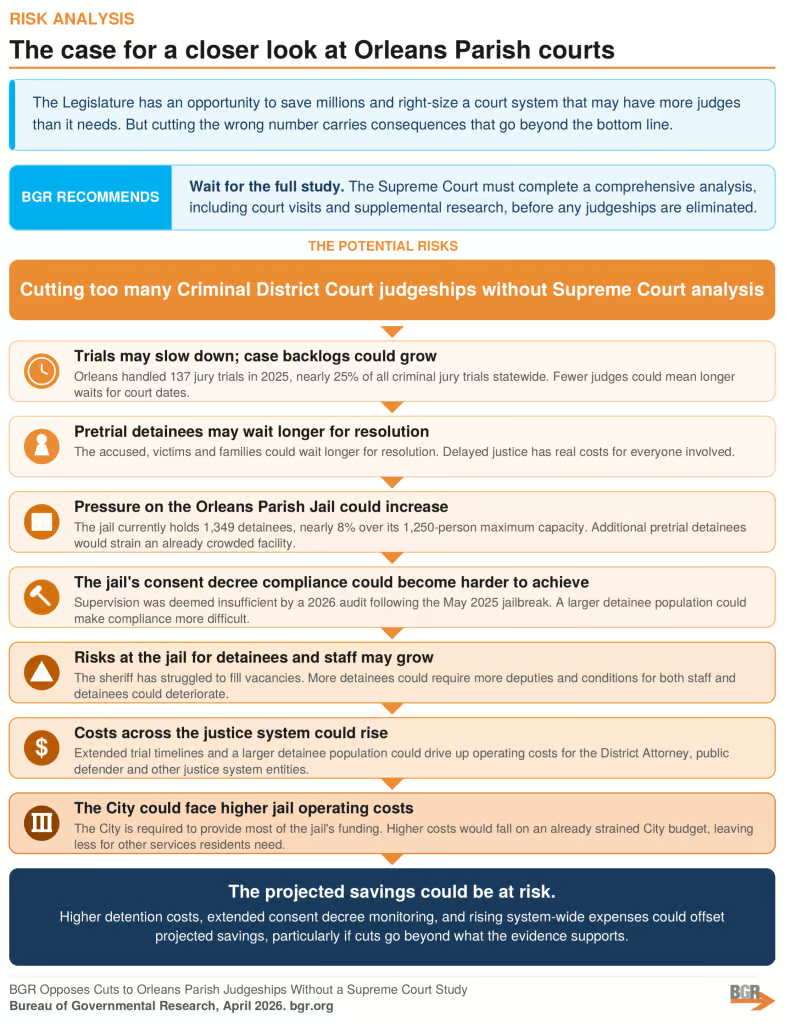
On Monday, April 20, 2026, the Louisiana Legislature is scheduled to vote on two bills— House Bill 911 and Senate Bill 217 — that would eliminate nine judgeships in Orleans Parish, consolidating courts and potentially saving millions for the State and City of New Orleans. BGR has long called for careful review of potential excess judgeships in the parish, and the City’s financial crisis makes that review more urgent than ever.

But in a new report, BGR finds that the proposed cuts are moving faster than the evidence supports.

The bills rely largely on a preliminary caseload formula developed by the Louisiana Supreme Court, but the Supreme Court’s own chief justice has said that formula is just a starting point. A final determination of how many judges the courts need requires court visits, interviews with judges, and supplemental research that hasn’t been done yet.

Without it, the Legislature risks cutting too many judgeships, particularly at Criminal District Court where case backlogs, jail overcrowding, and rising detention costs could end up wiping out the projected savings.

The Supreme Court has delayed action on this question three times since Hurricane Katrina. BGR is calling on it to finish the job, and on the Legislature to wait for the results before making cuts that could take years to undo.

BGR RISK ANALYSIS BREAKS DOWN THE POTENTIAL CONSEQUENCES IN DETAIL

Infographic titled 'The case for a closer look at Orleans Parish courts,' outlining legislative opportunity, a recommended full study, and potential risks to the justice system and costs from cuts without analysis (April 2026).

$510 Million in Bonds: What New Orleans Residents Should Know

Last fall, New Orleans voters approved $510 million in bonds to pay for infrastructure, drainage and stormwater projects, and affordable housing. In simple terms, a bond is a loan that the City takes out to pay for large projects now, then repays over time with interest using a dedicated property tax.

As the City prepares to issue up to $185 million in new bond debt this year, BGR has shared a letter with recommendations for the Mayor and City Council focused on one core question: How do we make sure this money delivers results without creating unnecessary costs for taxpayers?

Here are the key issues residents should be paying attention to:

1. BORROWING COSTS ARE NOT FIXED.

Recent credit rating downgrades could make it more expensive for the City to borrow. Choices about how bonds are issued and how quickly the money is spent can either limit interest costs or increase them for decades. When bonds are managed well, taxpayers save millions — the 2019 bonds are projected to generate $88.5 million in interest savings over 30 years. When they are not, the bill grows quietly over time.

When new bonds are proposed, residents can ask how long the debt will be repaid and how interest costs factor into the total price tag.

2. SPENDING NEEDS PUBLIC VISIBILITY.

Residents shouldn’t have to dig through multiple ordinances to understand where bond money is going. BGR recommends a public-facing dashboard that clearly shows what projects are funded, how much has been spent, and what those projects are supposed to deliver.

Residents can look for this information when bond spending is discussed publicly and raise questions if it is difficult to find or incomplete.

3. BUILDING IS ONLY PART OF THE INVESTMENT.

New roads, drainage projects, and facilities only hold their value if the City commits to maintaining them. BGR has found that every dollar spent on street maintenance can save $4 to $5 on long-term repair and reconstruction costs. Without reliable maintenance funding, projects wear out faster and cost more to fix later. Long-term planning matters as much as construction.

When projects are announced, residents can ask whether there is a plan to pay for maintenance once construction is complete.

4. BONDS ARE MEANT FOR BIG PROJECTS, NOT ONGOING BILLS.

Some bond funds are being used to support ongoing needs. For example, the City is reallocating $6.3 million in bond funds to hire and equip 50 new Public Works employees. While a worthwhile investment, it’s one that needs a sustainable funding source once those bond dollars run out.

Additionally, the City plans to use bond proceeds to cover its mandatory annual Housing Trust Fund dedication, roughly $16 million per year to support affordable housing. Bonds can serve as a short-term bridge, but borrowing to meet an annual budget obligation is costly: that same $16 million, financed over 30 years, ends up costing taxpayers $26.6 million.

Clear, sustainable funding plans are essential. Residents can pay attention to whether the City outlines long-term funding plans alongside these temporary uses of bond dollars.

With major bond issuances coming this year, now is the time to engage. Residents can share questions or concerns with their City Councilmembers as bond proposals come up for consideration.

BGR Welcomes New Director of Communications & Engagement

The Bureau of Governmental Research (BGR) has welcomed Megan McNeill as its new Director of Communications & Engagement, strengthening the organization’s efforts to share its independent research more broadly with the New Orleans community.

In this role, McNeill leads BGR’s communications strategy, focused on expanding the reach and impact of its research and strengthening how the organization’s work and brand are presented to the public. Her work supports public understanding and civic dialogue across greater New Orleans.

McNeill brings more than 15 years of experience in marketing and communications across nonprofit, higher education, technology, and real estate sectors. Most recently, she served as Brand Strategy Director at The Vault Collective and previously led marketing and communications for The Domain Companies’ national real estate portfolio.

“Megan joins BGR at a time when people are asking harder questions about how local government functions and why outcomes look the way they do,” said BGR President and CEO Rebecca Mowbray. “Her background in strategic communications and public storytelling will help ensure our research reaches more people and plays a meaningful role in public understanding and decision making.”

A New Orleans resident for 13 years, McNeill said she was drawn to BGR by its ability to turn complex public policy issues into actionable insight for the community.

Read the full press release [PDF] to learn more about McNeill and her role at BGR.

BGR Welcomes Three New Members to Its Board of Directors for 2026

The Bureau of Governmental Research (BGR) has welcomed three new members to its Board of Directors, adding deep expertise in finance, public policy, and technology.

The new board members are Ben Billings, Bob Brickman, and Merrick Sloss. Each brings a strong record of civic engagement and professional leadership, along with a shared commitment to improving how local government works.

Billings, Chief Strategy Officer at Civix Consulting Group, contributes more than two decades of experience spanning government, consulting, and nonprofit leadership. Brickman, a CPA and partner at EisnerAmper, brings a background in financial oversight and governance. Sloss, President of Bellwether Technology, adds expertise in information technology and systems strategy.

“These new board members strengthen BGR at an important moment,” said BGR President and CEO Rebecca Mowbray. “Their experience will help guide our work as we continue asking hard questions and providing analysis that supports informed decision‑making in the public interest.”

BGR also announced its officers for the coming year, led by Anne Baños as chair, along with the reappointment of several directors to new three‑year terms, providing continuity and experienced leadership.

Read the full press release [PDF] to learn more about the new board members. You can find BGR’s full Board of Directors list here.

After water main breaks, Mayor Helena Moreno puts S&WB on frontburner

Mayor Helena Moreno didn’t plan to spend so much time on the Sewerage & Water Board so early in her tenure.

When she chaired her first S&WB meeting in January, she remained mostly tight-lipped about her vision for the agency. And in an interview a week later at Washington Mardi Gras, Moreno said that people demanding changes at the S&WB and other agencies needed to manage their expectations.

“People are like ‘What’s the big reform for Sewerage and Water Board?’ and ‘What about the Regional Transit Authority?’” Moreno said. “I’m like, ‘Okay, let me just figure out how to get all the lights on’.”

But Moreno’s plans were scrambled on March 9 at 2:54 a.m., when she woke up to a text message from the S&WB’s interim general superintendent, alerting her to a major water main break Uptown.

It was the third such break in less than two months, flooding cars and homes and shuttering businesses. On Thursday, another water main burst open, flooding the area near Tulane University as the campus’ popular Book Festival was underway.

The recent spate of breaks has forced Moreno, who took office on Jan. 12, to confront head-on the issues at the S&WB, including its aging, decrepit water mains, which have seen less attention in recent years than have its drainage pumps and power.

So far, Moreno has sought to use her position as mayor to put pressure on S&WB Executive Director Randy Hayman to move more quickly. She publicly criticized his leadership last week after he failed to provide her with specifics on a plan to prevent future breaks. And she sent in Deputy Chief Administrative Officer Steve Nelson — the former S&WB general superintendent — to help Hayman’s team figure out next steps.

Hayman in a video posted on social media Thursday detailed several immediate steps to address leaks and said additional funding would be needed. A plan the S&WB issued late Monday suggested it could cost up to $680 million to replace the system’s oldest water mains.

At the same time, Moreno is seeking approval from the state Legislature for a proposal that would give the City Council more control over the S&WB, a reform she argues is needed to make the agency more accountable.

“I cannot have this be the norm,” Moreno said Friday. “That’s why all of us have to come together — me, the Legislature, the City Council — to force [the S&WB] to come up with a plan.”

Silas Lee, a New Orleans-based pollster and political advisor, said Moreno should have the support of residents on her plan to give the council more control of the S&WB, pointing to the agency’s dismal approval ratings.

“People want accountability and improvement in services,” Lee said.

Governance an issue


Moreno said that under its current governing structure, the S&WB isn’t accountable to anyone.

“I don’t have control over this particular agency,” Moreno said.

The mayor serves as president of the 11-member board, while a City Council member holds another seat. The board also consists of five citizen members from each council district, nominated by local colleges and universities and appointed by the mayor.

Two representatives of the city’s Board of Liquidation – City Debt and two customer advocates, also appointed by the mayor, round it out. Its funding is determined by the City Council, and it is regulated by state laws.

The Bureau of Governmental Research, a New Orleans-based good government group, agrees that the governance is flawed. Either the S&WB needs to be abolished and folded completely into city government, or it needs far greater autonomy, BGR wrote in a 2023 report.

“There’s a lot of cooks in the kitchen, but nobody has direct and influential oversight,” said Becky Mowbray, BGR’s CEO.

Board members serve staggered, four-year terms, and most of the current members were appointed by former Mayor LaToya Cantrell. A lone Moreno appointee, Jonathan Stewart, is up for consideration at the council’s Governmental Affairs Committee this week, to replace Janet Howard as the Council District B representative.

The council has veto power over S&WB rate hikes and must sign off on any tax proposal before it goes to voters. A state law passed in 2022 also gave the council authority to mediate billing disputes. But the council doesn’t have a say in how the S&WB spends its money. The council sent a letter to the S&WB Thursday requesting a detailed report on all water main leaks and repairs over the last year and its policy for notifying customers of water shutoffs.

Moreno’s proposal for the S&WB will be hashed out in House Bill 573, authored by state Rep. Stephanie Hilferty, R-Lakeview.

The language in the bill is expected to morph throughout the session, but Moreno said the goal is the same: give the council more control over the S&WB.

“Bottom line: There would be an entity that could finally, in a very transparent way, bring them to the table, have them show up, and they would have to then ultimately start performing better,” Moreno said.

Moreno spoke by phone with Gov. Jeff Landry on Wednesday before meeting with his staff in Baton Rouge. She said she doesn’t expect pushback from state leaders, who she characterized as tired of hearing about the S&WB’s woes every spring during the legislative session.

New leadership?


Moreno, on Friday, wouldn’t say whether she thinks Hayman is the right person to lead the S&WB. But she’s keeping close tabs on his performance.

“This is a very important and high-priority situation for me. So how it’s handled by the executive director is something that I’m really going to be watching,” she said.

The former chief executive of the Philadelphia Water Department, Hayman was selected to lead the S&WB in April in a split board vote.

Moreno said she expects city agencies to work with urgency and when there’s a “problem persisting, do all possible to find solutions, to try to fix it.”

She said she didn’t see that out of the S&WB, at least initially.

She made those frustrations clear last week when she took the extraordinary step of sharing an email exchange that she had with Hayman, blasting his lack of a game plan as unacceptable.

“We can’t move forward on fixing this problem until we get a very specific plan, and also a very specific funding request,” Moreno said.

After the first water main break in January, Moreno said she was miffed that her own communications team had to explain what happened to the public.

“There was silence from the Sewerage and Water Board,” she said.

Since then, Moreno said she’s seen improvement among the S&WB’s communication team. She also gave high marks to the S&WB’s interim superintendent, Kaitlin Tymrak, for her efforts to keep the Mayor’s Office and council members in the know. (Tymrak was the one who woke Moreno up via text on Monday.)

But Moreno said Hayman needs to do more to keep city and state leaders abreast of what’s going on.

“Mr. Hayman still needs to work on that, on keeping us in the loop,” Moreno said.

On trash fee hike, Mayor Helena Moreno cites New Orleans finances, says she has ‘no choice’

The City of New Orleans at one point last week had just $30,000 in its general fund, Mayor Helena Moreno said Wednesday, a low balance for an account that’s budgeted to fund $800 million in operating expenses this year.

But Moreno, who took office in January, said that “with some very aggressive moves,” she predicts that City Hall will dig itself out of its budget crisis by 2027 — much sooner than the four years that Legislative Auditor Mike Waguespack has said he expected it will take.

Moreno discussed the city’s budget and her administration’s priorities during a wide-ranging conversation Wednesday morning with Becky Mowbray, CEO of the Bureau of Governmental Research, a local good government nonprofit.

The mayor laid out the city’s financial picture days after she announced plans to seek an increase in the $24 per month fee that households pay for once-per-week garbage and recycling pick-up. The fee only covers a fraction of what it costs the city to pay its contractors, requiring City Hall to spend $24 million out of this year’s general fund to fill the gap.

“Politically it’s horrible,” Moreno said of the increase, adding that she’s had to stay away from social media because “people hate it so much.”

“But we’re to the point where we have no choice,” she said.

Moreno reiterated that it will be up to the City Council to iron out the details of that fee increase and whether it will pay for additional services. She said New Orleans should follow Jefferson Parish and tie the fee to the cost of its sanitation contracts.

Moreno said she’ll also seek permission from state leaders later this year to issue another bond, after depleting a $125 million short-term loan the city secured in November to cover payroll expenses. Instead of securing another revenue anticipation note, Moreno said her goal will be to secure a longer-term bond that can be paid off over several years.

New Orleans’ finances have been hanging by a thread since before Moreno took office, thanks to overly rosy revenue estimates, failures to account for overtime spending and new state laws limiting traffic camera revenue.

The City Council at Moreno’s direction approved a 2026 budget that included $150 million in spending cuts to City Hall departments and once-per-pay-period furloughs for 14% of the city’s workforce, roughly 700 employees. The spending plan also relies on $75 million in new revenues, though there’s no guarantee all of the money will materialize.

Moreno said she has cash management meetings three times a week, where she reviews every expense, and that both she and her Chief Administrative Officer Joe Giarrusso are losing sleep over the city’s finances, often texting about it as early as 3 a.m.

City leaders have also continued to search for excess cash. On Tuesday, Council Budget Chair Lesli Harris announced a deal with the Municipal and Traffic Court of New Orleans to transfer $5 million in reserves to city coffers. Moreno, in an interview following Wednesday’s event, said she also expects the New Orleans Building Corporation — a public benefit corporation that owns, leases, develops, and manages real estate assets for the city — to approve sending $15 million from its reserves at its meeting next week.

Moreno also provided an update at Wednesday’s event on the city’s efforts to secure an extension with the Federal Emergency Management Agency on a June deadline to spend down around $500 million in federal infrastructure grants.

Moreno said extending that deadline to 2028 has bipartisan support among Louisiana’s congressional delegation — including from House Speaker Mike Johnson — but nobody can seem to figure out how to get the application in front of the correct FEMA officials.

“We are stuck in this black hole of FEMA right now with our extension request,” Moreno said.

Moreno also detailed her plan to improve the city’s credit rating, which suffered a serious blow in February when Moody’s Ratings dropped it near the bottom of its investment grade and warned investors of moderate risk on future bond sale.

To receive an upgrade, Moody’s said the city needs to boost its reserves close to 40% of revenue and show it can operate without cash flow borrowing. Moreno said Wednesday she hopes to replenish the city’s reserves by offloading unused city buildings and renegotiating the city’s long-term lease agreements to receive upfront payments.

On public safety, Moreno said she supports a New Orleans Police Department proposal to use drone technology to remotely respond to 911 calls, pointing to similar efforts in Jefferson Parish. A pilot program is planned for the French Quarter, and Moreno said she expects it to expand to New Orleans East. She’s also asked NOPD to come up with a plan to beef up recruitment efforts beyond “putting up billboards and making commercials.”

Moreno told Mowbray that New Orleans “has to stop counting” itself out. She said that all too often, when she suggests reaching out “to whatever billionaire from another part of the country to do certain types of investments,” she’s met with resistance locally from folks who say New Orleans doesn’t have the market to attract their interest.

“With that kind of attitude, of course not,” Moreno said.

Moreno said she talks to Louisiana Economic Development Secretary Susan Bourgeois daily, describing her as an “absolute rockstar,” and echoed her call to reshape the narrative about New Orleans and Louisiana.

Moreno also said she wants to see major changes at the Regional Transit Authority. She said she’s spoken with Jefferson Parish President Cynthia Lee Sheng about rejoining the RTA but said she doesn’t expect that to happen “until they see some real reforms and until they see that the RTA is truly a regional transportation agency.”

Moreno said agencies like the RTA and the Housing Authority of New Orleans are in need of reform, but that she needs to focus on putting out the biggest fires first, namely stabilizing the budget and improving city services.

“We have one of the most amazing cities, not just in this country, but in this world. And if we just make it function,” Moreno said, drawing chuckles from the audience. “The sky is the limit.”

Despite backlash, New Orleans Mayor Moreno urges council to pass trash fee increase

New Orleans Mayor Helena Moreno March 11 acknowledged that her push to have the city council raise the city’s sanitation fee isn’t a move that’s gaining her popularity but argued it’s a necessary step to shore up finances and the trash collection system.

“I hate doing that. Politically, it’s horrible,” she said, adding “I can’t even go on social media right now because people hate it so much.”

But the $24 a month residents have been paying since 2011 for trash pickup and curbside customer isn’t covering the cost of services, and given the dire straits of the city’s finances, Moreno said, it’s needed.

Moreno’s comments came during a wide-ranging breakfast address to the Bureau of Governmental Research that touched on a number of topics, including infrastructure problems, reforms to city permitting and other issues.

The city reduced trash pickup to once a week following Hurricane Ida in 2021 — a change that became permanent. Whether the city increases trash pickup to twice a week and keeps curbside recycling will determine how much the sanitation fee might be raised.

Moreno didn’t take a stance on which option she would prefer, seeming OK with leaving that politically difficult decision up to the council. Though she said she believed the council will maintain curbside recycling.

Currently, the city’s sanitation services cost $24 million more than it brings in from the fee.

“The norm … is that you match the fee to the services,” she said. “We have not done that. We need to move in that direction.”

Police retirement system


At the breakfast, Moreno also outlined her plan to work with state lawmakers to make changes to the Municipal Police Employee Retirement System. If successful, they could save the city $41 million.

First, they’re working to change a state law that fines local governments if they lose more than 50 officers in a year.

“The legislation passed says that they view you as then trying to defund the police department or dissolve the police department,” Moreno said.

New Orleans has not tried to defund the police, but during the pandemic, there were some years where the city lost more than 50 officers. As a result, the city has racked up more than $38 million in fines. The fees are so high that for some smaller governments, they’re more than their annual budget.

Paying the fines, Moreno said, would be a waste of money.

“I might as well light that $38 million and put it in a bucket and light it on fire,” she said. “I’m fighting tooth and nail not to pay this penalty.”

The administration is also challenging the retirement’s system stance that retention bonuses count toward officers’ pensions in hopes of avoiding paying $3 million on top on the recent $12 million in payments it gave officers for staying on the force.

Moreno said with “very aggressive moves” like these, she believes the city can get out of its financial crisis in 2027, which would be far sooner than the four years Louisiana Legislative Auditor Mike Waguespack predicted.

“The legislative auditor is shocked that we are moving this quickly,” she said.

Safety and Permits


Moreno also said she’d announce her new Department of Safety and Permits director on Monday, March 16. Verite News reported last month that her original pick abruptly backed out of the position.

She said her administration was working on improving processes in the famously slow-moving department, including who can sign which documents, and upgrading technology. She said she’s talked with other mayors about the potential use of AI for permitting.

“We are so behind on technology in the city of New Orleans. I’m telling you, we’re like ‘80s or ‘90s,” Moreno said. “We’re like on Windows 93 or something at this point.”


Infrastructure


The mayor told breakfast attendees that she’s been hearing the same refrain when it comes to recent water main breaks that have flooded neighborhoods, including homes and cars, in the city this year: “We have old pipes, and we don’t have any money.”

Sewerage & Water Board is working on procuring an “acoustic analysis” to look at pipes and determine problem areas by listening to where there’s extra hissing.

The next step is to get cost estimates for lining the pipes to make them stronger. Moreno said it will be expensive — lining one of the pipes could cost more than $40 million — but that she can ask state and federal lawmakers for help once she has a specific number.

Moreno is also working with Louisiana’s congressional members to get the feds to further extend the deadline for spending about half a billion in federal infrastructure dollars from this July until 2028.

Congress members are supportive, but FEMA officials keep saying they haven’t gotten the request, Moreno said. The agency is in turmoil amid a partial government shutdown.

“We are stuck in this black hole of FEMA right now with our extension request,” she said.

Public safety


Moreno once again stressed the importance of the city continuing to support nonprofits on the ground aimed at preventing violence and the need for constant outreach to recruit police officers.

The city is also trying out using drones to improve police response times, sending drones out to areas where an incident is reported to 911 to begin recording.

A pilot program will start in the French Quarter and then New Orleans East, Moreno said.

Jefferson Parish also uses drones to respond to 911 calls.

Moreno said she doesn’t see the drones as increased surveillance in the city since they only record once they get to the scene.


Airport

Moreno said that Louis Armstrong New Orleans International Airport leadership recently submitted a 20-year master plan for the airport to the Federal Aviation Commission, which includes 60 gates, three terminals, three parking garages and new roads to meet increased demand.

“We’re just on the cusp of becoming a major airport here,” she said.

Moreno said originally airport leaders were going to wait for the plan to be approved before putting out a news release. But she decided to meet with other parish presidents in the region to garner support for the plan. Having everyone in the same room ending up making news in and of itself.

Moreno said the city needs to aim big, including when it comes to trying to attract investors, and tell its success stories.

“We have to stop counting ourselves out,” she said.