
What bills this legislative session affect New Orleans? Here’s what’s on the table.
By Ben Myers and Sophie Kasakove
Source: The Times-Picayune | Nola.com
April 16, 2025
A new drainage fee, a ban on homeless encampments, and more gubernatorial say over flood protection are among the most contentious proposals affecting New Orleans in the spring legislative session that began Monday.
Other bills impacting the city are a proposed hike on short-term rental taxes, an increase to the homestead exemption and a proposal to criminalize unsafe gun storage.
Some measures are being pushed quietly by Mayor LaToya Cantrell’s administration, while Gov. Jeff Landry has urged passage of others. The session runs through June 12.
The proposals carry significant weight for a city in dire need of more revenue to shore up its drainage system and one that has grappled with a homelessness crisis that has at times seemed intractable. They also showcase a continued push for more control of local affairs by Landry, a Republican who has sought since his election to consolidate his power in New Orleans and across the state.
Landry’s spokesperson, Kate Kelly, did not return a request for comment on the session on Monday, though business owner Shane Guidry, the governor’s point person on New Orleans affairs, has said that the nominating panel that presently selects members of the South Louisiana Flood Protection Authority-East has too much control over that board. House Bill 633 from Rep. Jacob Braud, R-Belle Chasse, would change that.
Landry has also said his office would work this session to “enact legislative reforms that should produce the framework necessary to properly move people from homelessness to housing.” Two statewide bills ban public camping and one requires municipalities to enforce the ban. Guidry said that he had not been involved with either bill. “I don’t get involved in lawmaking,” he said, though he has been vocal about HB 633.
Meanwhile, unlike previous years, Mayor LaToya Cantrell’s administration has not announced a formal agenda for the upcoming spring, and city officials declined to comment on the session.
But in at least two cases, Cantrell’s staffers individually asked a lawmaker to sponsor bills they favor. Those are state Rep. Matthew Willard’s House Bill 220, which penalizes adult gun owners who fail to keep their weapons out of reach from minors, and Rep. Mandie Landry’s House Bill 339, which allows affordable housing developments in New Orleans funded with federal tax credits to receive expedited permitting reviews.
Other lawmakers either did not respond to questions or said they have not spoken to the Cantrell administration about the session.
Drainage fee
Among the more controversial bills this year is House Bill 609, which would impose a new stormwater fee on city properties. The fee would be regulated by the Public Service Commission, an elected body that oversees utilities around the state.
The city’s Sewerage and Water Board funds its drainage operation chiefly through property taxes, but agency leaders have long said the taxes — which generate about $75 million annually — aren’t enough.
State Rep. Mandie Landry, D-New Orleans, discussed the bill with both the S&WB and Gov. Landry, but said she is filing it independently. S&WB Executive Director Ghassan Korban has stumped for a drainage fee but also said this week he did not ask Landry to file the bill.
“We need a functioning Sewerage and Water Board. It needs to be less political,” Landry said.
If the bill passes this spring, the commission could enact a fee without City Council or voter approval, as the S&WB is a state agency. Landry said she’s still researching if the state can unilaterally impose the fee, but it “makes sense” to do so if possible.
But City Council President JP Morrell called the idea “completely silly,” since, in his view, it violates a city charter provision designating the council as the city’s sole utility regulator.
“I don’t know how you plan on, as a legislator, letting the PSC come into the city and begin to regulate us without getting the consent of citizens,” Morrell said.
The idea has long been debated. Proponents say a fee would ensure tax-exempt property owners also pay for drainage, but critics call it a double tax on properties already on the rolls. City Council members have been lukewarm, saying they’ve yet to see a proposal that doesn’t squeeze taxpaying property owners.
Encampment bans
Two proposals this session target homeless encampments and were filed after Gov. Landry vowed to tightly focus on that issue. In the past year, Landry has marshaled state resources to move homeless residents from downtown camps into a state-run shelter, which opened in January and closed after three months.
House Bill 619 from State Rep. Alonzo Knox, D-New Orleans, would ban camping on most public property and empower residents to sue local officials for failing to enforce the ban — except during a state of emergency, which can be called by the governor. The bill as filed says that this would only apply during a state of emergency but Knox said that he would be filing an amendment to the bill to correct that language.
The bill also directs the state fire marshal to inspect homeless shelters and other facilities. A legislative audit this year found that New Orleans rarely inspects its own shelters.
In a statement, Knox praised the Cantrell administration’s efforts to clear encampments over the past year and put people into permanent housing. But, he said, the city “must never return to the unsafe sprawling encampments that once occupied our historic neighborhoods and major economic corridors.”
Another proposal, Senate Bill 196 by state Sen. Robert Owen, R-Slidell, criminalizes unauthorized camping and creates “homelessness courts.”
Both proposals also come after a U.S. Supreme Court ruling last year allowed cities and states to enforce bans on people sleeping outside.
District B City Councilmember Lesli Harris, who has helped lead the city’s efforts, said both encampment bills “do nothing to solve the root causes of homelessness and only pushes people further into crisis.”
Flood protection changes
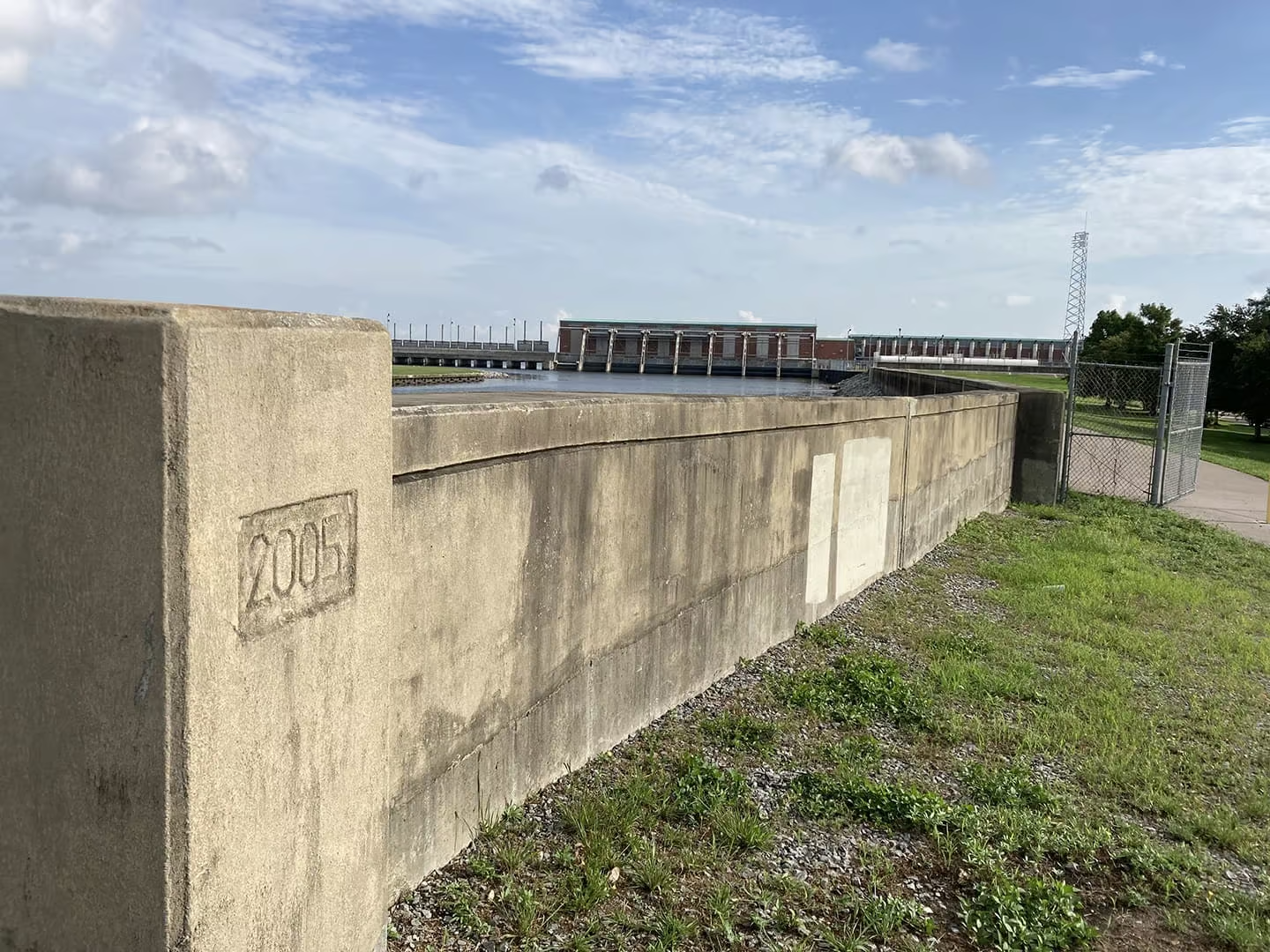
Good government advocates, meanwhile, say they’re mystified by Braud’s HB 633, which gives the governor control over the majority of board seats on the regional agency that oversees East Bank flood protection. The bill also removes a nominating committee that selects a pool of board candidates with relevant professional experience for the governor to choose from.
The bill doesn’t touch a twin agency overseeing the West Bank, where the nominating committee will continue choosing board candidates. Critics say the bill undoes post-Hurricane Katrina reforms to take politics out of flood protection, and that Gov. Jeff Landry — who asked Braud to carry the bill — hasn’t offered a rationale for the changes.
Guidry has said the nominating committee has become like “kingmakers” and the governor isn’t changing the makeup of the West Bank agency because it has “zero problems.” At least four board members of the East Bank agency resigned in protest of the governor and Guidry’s changes to that board.
Other bills
Other bills up for consideration include:
- Rep. Stephanie Hilferty’s House Bill 610 to increase short-term rental occupancy taxes
- Hilferty’s House Bill 611 to overhaul the composition of the Sewerage and Water Board
- Hilferty’s House Bill 29 and House Bill 31 on the New Orleans fire pension fund, which have been filed as placeholders but could make significant changes
- Knox’s House Bill 270 to minimize the City Council’s role in approving development incentives
- Rep. Delisha Boyd’s House Bill 215 to create exceptions for rape in the state’s abortion ban
- Willard’s House Bill 271 to increase the homestead tax exemption from $7,500 to $12,500
- State Sen. Jimmy Harris’s Senate Bill 202 to shift the University of New Orleans to the LSU system
- State Sen. Joseph Bouie’s Senate Bill 89 to require senate confirmation of Port of New Orleans board appointees
- State Sen. Royce Duplessis’s Senate Bill 222 requiring 20% insurance discount for participation fortified roofs program
- State Rep. Aimee Freeman’s House Bill 453 to require fortification of all new roofs in coastal zones
Staff writer Alex Lubben contributed to this story.
Fair Use Notice
This site occasionally reprints copyrighted material, the use of which has not always been specifically authorized by the copyright owner. We make such material available in our efforts to advance understanding of issues and to highlight the accomplishments of our affiliates. We believe this constitutes a “fair use” of any such copyrighted material as provided for in section 107 of the US Copyright Law. In accordance with Title 17 U.S.C. Section 107, the material on this site is available without profit. For more information go to: US CODE: Title 17,107. Limitations on exclusive rights: Fair use. If you wish to use copyrighted material from this site for purposes of your own that go beyond “fair use,” you must obtain permission from the copyright owner.