
The S&WB has a detailed plan for New Orleans water mains. It’s 23 years old.
By Ben Myers
Source: The Times-Picayune | NOLA.com
March 22, 2026
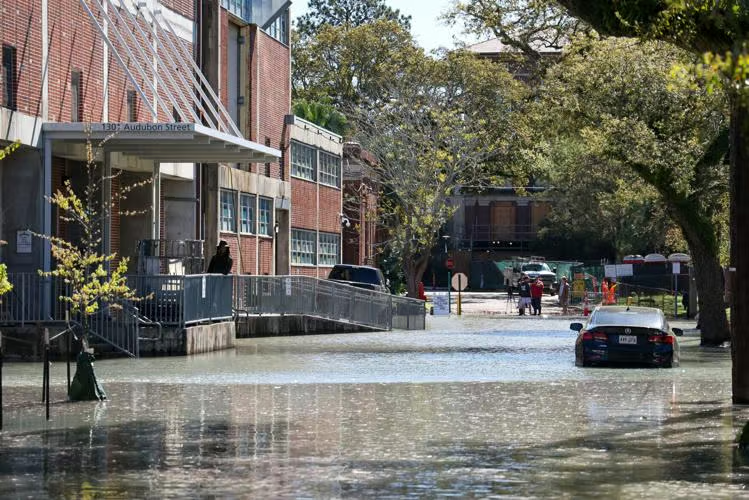
After four floods in six weeks caused by bursting water mains, New Orleans Mayor Helena Moreno and furious City Council members demanded a detailed plan to fix the problem. The criticism only grew louder when the Sewerage & Water Board responded with an outline and vague cost estimates.
In fact, the S&WB already has exactly the sort of plan elected officials want to see. The problem is that it’s two decades old.
In 2003, a consulting firm delivered a 565-page document with a soup-to-nuts assessment of the water system’s condition, along with a prioritized list of projects, timelines and cost estimates. The price tag: $2.8 billion over 20 years.
While the 2003 plan from consulting firm MWH is now well out of date, it offers a sense of how arduous, and costly, the challenge ahead is for the S&WB. Even then, large chunks of the system were at the end of their useful life and hundreds of miles of pipes needed to be replaced across the city’s neighborhoods. More than twenty years later, the S&WB is farther behind.
Steve Nelson, a former S&WB general superintendent who is now Moreno’s public works director, said the utility’s planning for the water system in recent years has focused on other pressing issues, like retrofitting treatment plants and installing two new water towers.
One reason that the S&WB has been slow to update plans for its pipes is that it lacks funding for the type of large-scale pipe replacement project that’s needed, he said.
“Even if you do have a plan, the age of the pipes and the conditions in which they lie, that’s been known,” Nelson said. “The root challenge remains: How do you get $2 billion in funding for this work?”
Planning after a century
The 2003 MWH plan came as parts of the tap water system reached 100 years old, which is generally considered the life expectancy. At the time, funding was limited and privatizing utility operations was floated. According to former Mayor Marc Morial, the S&WB was also focused on paying for a federally mandated $600 million sewer overhaul, and drainage was also top of mind — as it always is in New Orleans.
“In those days, I do think that the freshwater system took a bit of a backseat to the drainage and sewer system,” said Morial, who served from 1994 to 2002. “The sewer system was under a federal consent decree, and drainage was always considered to be such an acute risk because of flooding and hurricanes.”
MWH spent more than a year analyzing the city’s water distribution network, which is one of the three systems, along with drainage and sewerage, that the S&WB operates. The consulting firm built a geographic information system and hydraulic model with existing maps and databases, and studied the size, materials and structural condition of the mains and pipes. The firm concluded that a majority of the water mains were near the end of their useful life.
The capital improvement plan identified 31 projects to replace 929 miles of mains and pipes, or about 60% of the system, along with leakage management and other upgrades. The projects were sorted into priorities according to age of the water mains, break rates and impacts on residents.
The Central Business District and French Quarter would have seen the most extensive work under the plan, with 85 miles of pipe replacements starting in 2005. The large Uptown and South Claiborne Avenue mains that recently burst would have been replaced in 2007 and 2011.
Replacements around the lakeside end of City Park and in New Orleans East would have rounded out the work last year.
Hurricane Katrina struck two years after the MWH plan, causing untold damage to S&WB infrastructure that likely would have necessitated a new assessment before moving forward. And in the years that followed, other infrastructure issues garnered more attention.
There has been some work on water mains since Katrina, mostly through the $1.7 billion settlement with the Federal Emergency Management Agency that funded citywide road repairs and utility work.
But the FEMA roads money only paid for repairs to 7% of the tap water distribution network. Cedric Grant, who ran the S&WB under former Mayor Mitch Landrieu, said the FEMA program was never intended to be a comprehensive utility overhaul, but instead served as a template for fixing roads while making simultaneous repairs to water, sewer and drainage lines.
“That was to give you the foundation for ongoing work,” Grant said. “You could get ahead of the thing with a couple billion dollars getting started in doing comprehensive work, but you have to follow that in subsequent years with more, because everything needs to be done.”
Catastrophic flooding in 2017 from a series of August storms exposed major failures and historical neglect of the S&WB’s ancient pumps and turbines that are part of its drainage system. That eventually prompted the S&WB to construct a $350 million power complex meant to modernize electricity for those pumps, a project that is now in its final stages.
Meanwhile, planning for the water system has largely excluded water mains, apart from the handful of replacements covered by FEMA. Two new water towers built in 2019 have cut down on boil water advisories, and a forthcoming water quality master plan will focus on the water treatment plants on either side of the Mississippi River, which haven’t been upgraded in decades.
Everything has to be done
In interviews, S&WB officials said they recognized the need for an updated water distribution assessment last year, and began looking for ways to fund it. But the effort didn’t materialize before the rapid succession of water main breaks starting on Jan. 31.
“It was clear, as we started to have two or three breaks, that we did need that type of assessment,” said S&WB Executive Director Randy Hayman in an interview. “Going forward, I think we have to make sure we budget for assessments to be done at a regular pace.”
Other older cities are also struggling with dilapidated water systems, but New Orleans is an outlier. The S&WB says 80% of its water mains are more than 50 years old, while just one third have reached that age across the U.S. and Canada, according to a Utah State University survey.
Kaitlin Tymrak, the S&WB interim general superintendent, said industry standards call for replacing one to two percent of the distribution network each year.
“There’s a lot of things that have happened in the last 23 years,” Tymrak said. “Our team hasn’t been ignoring anything. Our team has been responding, doing what we can with the limited dollars we have.”
Decades of disinvestment
Fending off accusations of inaction, S&WB officials on March 16 released a phased outline for overhauling the water distribution network. It calls for more than $700 million in urgent repairs over two years, along with a new system assessment and 30-year capital improvement plan with an unknown cost. It cites the MWH plan as the most recent overall cost estimate.
The S&WB’s recent outline didn’t appease City Council critics, who sharpened their attacks last week. Council member Jason Hughes, who chairs the Public Works Committee, derided it as “concepts on paper.”
“A plan of action is just that. Here are the needs, here is the plan to execute. So I still have not seen a plan,” Hughes said.
As an example of what he expected, Hughes pointed to Jefferson Parish President Cynthia Lee-Sheng’s $2.3 billion water distribution capital plan, which the Parish Council adopted in 2021 along with gradually increasing water rates over 20 years to secure bonds to pay for it.
“She’s identified the total cost, and she’s identified how to pay for it,” Hughes said. “The Sewerage and Water Board has yet to even do that analysis. It will behoove them to do that analysis very quickly and stop telling us ‘to be determined.’”
Unlike Jefferson Parish, the S&WB cannot issue new bonds because its exclusive water revenue source — customer charges on water bills — is barely enough to cover day-to-day operations and maintenance. After factoring in depreciation, the S&WB is expecting the water system to operate with a $4.5 million deficit this year.
“I wish we could (issue bonds). When I was in other cities, we could do that,” said Hayman, who joined the S&WB in July after leading the Philadelphia water system for six years. “To do so we’d have to have a higher revenue stream.”
Water rates, which generate about $120 million annually, have not changed since 2020, following eight years of 10% increases. The water board in 2022 planned to ask the City Council for 3%-6% increases over five years, but the council, with Moreno serving as president at the time, said it wouldn’t consider a proposal.
Public outrage over wildly inaccurate bills was at a fever pitch, and council members said they couldn’t ask residents to pay more when the charges weren’t correct. The S&WB has since installed automatic smart meters, and the council appointed a third-party administrator to adjudicate billing disputes. Since then, billing disputes have plummeted.
Rebecca Mowbray, executive director of the Bureau of Governmental Research, the non-partisan good government group, said it’s time for the council to reconsider its stance on water rate increases.
“We have to accept the fact that the rates are not sufficient to support the system as we need it to be functioning,” Mowbray said. “We’re dealing with decades of disinvestment in all aspects of the system, and all of us who live here now are stuck with the dysfunction.”
At the same time, Mowbray said the S&WB must justify its requests with detailed plans, like the one completed in 2003.
“Public trust is very, very low, and so they need to be able to prove this is the plan, this is the need, this is what you’ll get,” she said.
Fair Use Notice
This site occasionally reprints copyrighted material, the use of which has not always been specifically authorized by the copyright owner. We make such material available in our efforts to advance understanding of issues and to highlight the accomplishments of our affiliates. We believe this constitutes a “fair use” of any such copyrighted material as provided for in section 107 of the US Copyright Law. In accordance with Title 17 U.S.C. Section 107, the material on this site is available without profit. For more information go to: US CODE: Title 17,107. Limitations on exclusive rights: Fair use. If you wish to use copyrighted material from this site for purposes of your own that go beyond “fair use,” you must obtain permission from the copyright owner.