
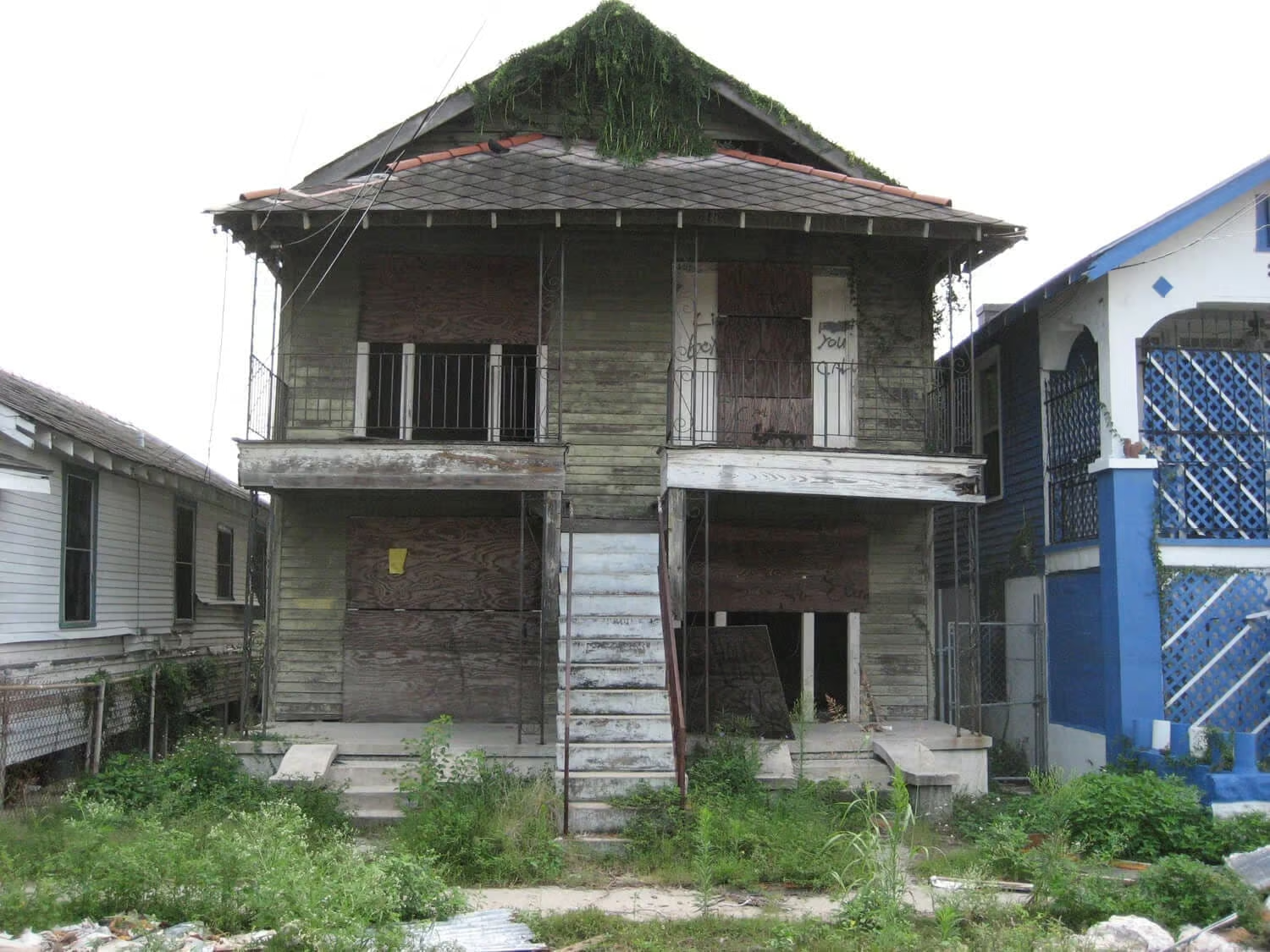
Blight fright: Why do buildings keep falling down in New Orleans?
By Sarah Ravits
Source: Gambit
November 8, 2024
Alex Robinson has amassed a large following on social media by sharing videos focusing on all the things everyone loves about New Orleans: the celebrations, live music, restaurants and festivals for every occasion.
But in September, the normally upbeat content creator’s life took an unexpected turn.
When she left a Central City networking event, she found herself in the middle of another kind of “only in New Orleans” scenario that would end up going viral for the wrong reasons. An abandoned building collapsed on her parked car, burying it underneath a pile of bricks and rubble.
First responders rushed to the area to re-route traffic and help secure the site. “It just happened so fast,” she told Gambit.
Robinson’s story isn’t exactly an anomaly. From derelict shotgun houses in Uptown to the Plaza Tower to abandoned strip malls in the East, New Orleans is facing a public health and safety crisis from blighted buildings.
And while the city may finally be taking steps to bring down some buildings, so far enforcement is uneven — and in cases like Robinson’s buried car, often too late.
The effects of blight can last well beyond the life of the crumbling building. For instance, while there were no physical injuries in the collapse that crushed Robinson’s car, she says it caused her to have a panic attack and left her with psychological trauma.
“I was on the sidewalk, crouched in a ball crying,” she told Gambit. “I was like, why do all these things keep happening to me? It felt like the straw that broke the camel’s back … I just felt like, it got really dark.”
New Orleans structures, especially historic ones, are subject to all sorts of problems that are difficult to assess and fix.
“Moisture is probably the biggest thing,” says local architect Michael Glenboski. “We get very hot, and very cold, and moisture can undermine things.”
He also cites termite damage and storms for compromising structural integrity. Plus, many of New Orleans’ historic properties have been renovated over the years, and some owners cut corners in stabilizing them.
“People buy them and modify them and take walls out,” he says. “It’s hard to find a house in its original configuration, and that happens sometimes without heavy structural intervention.”
But New Orleans has had several well-documented building collapses in recent years, that seem to stem largely from absentee landlords and outright neglect.
Just weeks after the abandoned building collapsed on Robinson’s car, for example, city workers rushed to begin an emergency demolition of a building at the busy intersection of Esplanade and Claiborne avenues.
That, too, had been racking up building code and maintenance violations.
But Glenboski says buildings don’t always crumble solely out of pure negligence or lack of wanting to fix them.
“A lot of housing in New Orleans is passed down and inherited, and it takes a lot to maintain 100-year-old housing stock,” he says. A lot of times, a “lack of maintenance is because people can’t afford to properly maintain them.”
The building that collapsed on Robinson’s car, located at 1410 Oretha Castle Haley Boulevard, was quickly declared an imminent danger — after it had collapsed. Only then did the city’s Code Enforcement take measures to demolish what remained of it.
But the collapse didn’t happen overnight. In fact, the 100-year-old building, which in the late ’90s was a gallery and community space, had sat vacant and neglected for years with roof damage by Hurricane Katrina and other elements.
The city had issued its absentee owner, whom Gambit was unable to track down for an interview, numerous citations, and the owner had paid fines to the city over the past 15 years.
Officials, including City Council Member Lesli Harris, were shocked by it.
“It wasn’t even on our radar,” says Harris, who chairs the Quality of Life Committee and has worked on blight remediation. “It did not appear it was in danger of collapse.”
That situation may have been exacerbated by a lack of staffing within Code Enforcement.
On Sept. 23, WDSU reported that nobody in the city really knew the rough condition of the building, in part due to the “unintended consequences of a departmental purge.” They found the property had been removed from the backlog of cases before a hearing inspection could be scheduled.
The city’s Code Enforcement office became a standalone department just 10 months ago, after the council created legislation to streamline it to handle permit violations, neglect and blight, among other issues.
The Code Enforcement office has also been using emergency demolition provisions under its new director Anthony Davis, who is overseeing a $10 million blight reduction program.
Part of the problem has been that nobody is entirely sure who even owns some of these long-neglected properties.
In an effort to get a handle on that, the city earmarked $2.5 million in American Rescue Plan Act (ARPA) funds to hire a contractor to do title research on the blighted properties in the city.
A spokesman for Mayor LaToya Cantrell, Terry Davis, became combative when asked whether the city had secured a contractor to do title searches and refused to comment on specifics. However, other city sources told Gambit a contract has been signed to do the work and that officials have been working to track down hundreds of property owners in blighted areas.
While city lawmakers have commended Code Enforcement’s Anthony Davis for tackling the issue, he inherited a massive backlog when he took his position. After all, some homes and other buildings have been in disrepair and abandoned since Hurricane Katrina or even longer.
“Council members generally believe he is knocking down more things than we’ve seen in a couple years,” says Council Member Joe Giarrusso. “But he’s got a hell of a backlog he’s got to deal with.”
Giarrusso acknowledges there’s an uphill battle for code enforcement officials, who are short-staffed and dealing with all kinds of hot-button issues, including monitoring short-term rentals.
“There are lots of things to clean up because they are spread so thin. I think it’s a big problem,” he says. “We always talk about it as a public safety issue.”
It’s also difficult to prioritize which buildings need to go. And owners have plenty of chances and deadline extensions to fix their properties, so the city is ultimately limited in what it can actually fix.
All that can make dealing with blighted properties not only time consuming and tedious, but very much a backburner issue for politicians.
In a city where the traffic lights at major intersections only occasionally work, roads are regularly destroying people’s cars and police have difficulty solving crimes, a slowly rotting building can quickly become just part of the background of life.
But about a year ago, Cantrell set her sights on the “Dirty Dozen,” a group of 12 high-profile buildings in notoriously decrepit conditions. Those range from the long-vacant Plaza Tower and Lindy Boggs Medical Center to housing complexes that have raked up violations and sparked public health concerns.
The city has made some progress on demolishing some of the worst offenders, like the Harlequin Theatre in Treme and the DeGaulle Manor, a housing complex owned by notorious slumlord Josh Bruno.
The city is also scheduling dozens of hearings for blight management every week, according to its OneStop website, which tracks data from various departments.
But because of the sheer numbers of blighted properties across the city, blight remediation can feel like a game of whack-a-mole.
Giarrusso’s chief of staff, Amanda Rizzo, says at best the city is perpetually in a state of triage, rather than curing the actual problem.
“We have to look at, [what is the] cost, what is the ability and if it’s a matter of neighborhood kids going in there and getting hurt,” Rizzo says. “A recurring thing is, ‘This has been this way since Katrina.’”
Council members say they regularly hear complaints from constituents about blighted properties in their districts, which can also be reported through the city’s 311 website.
But Giarrusso warns that it’s not supposed to be a tool to pit neighbors against each other.
“I’m not interested in pursuing a person who has one shingle missing,” he says. “You have to be careful with Code Enforcement because you don’t want neighbors weaponizing it. There has to be a delicate balance and an ecosystem between things that are clearly in need of being demolished versus a neighbor tattling on another neighbor.”
Another issue that can complicate blight remediation is the natural tension between the Code Enforcement office and the Historic District Landmarks Commission, the city’s regulatory agency for preserving historic landmarks and districts around the city.
“Anytime you have a historic city like New Orleans with blight, there’s going to be tension between tearing down houses that are blighted and tearing down houses that are historic, yet blighted,” Harris says. “We have to figure out a way to eradicate blight, but also preserve historic character in the city.”
There is also some pressure on the city from the Preservation Resource Center, the nonprofit that works to preserve historic architecture and help owners with renovating these properties.
Recently, the PRC blasted the city over a perceived lack of transparency and said officials should have dealt with three recently demolished buildings more cautiously.
“Blight is a major safety concern for residents, but when the blight removal process lacks transparency, it’s hard to know why demolition was the only option,” wrote MaryNell Nolan-Wheatley, advocacy coordinator and public policy research director of the PRC. “These buildings could have been sold to a responsible owner, renovated and turned back into housing.”
Nolan-Wheatley also noted that the Code Enforcement office had rebranded the acronym IDC, which used to stand for “imminent danger of collapse” but now is short for “imminent dangerous conditions.”
That, she argues, is “far more nebulous, potentially referring to a range of non-structural issues.”
Harris says one solution could be to get more involvement from the PRC in city decision-making and allow the organization to salvage historic architectural details before buildings are demolished. New laws could also help.
“We need to figure out how to get our hands on properties that have been long blighted and get them redeveloped,” she says. “That would take legislation, not just from the city but from the state.”
To that end, the state has created some newer policies that can help pressure property owners to remediate their blighted properties.
One amendment, passed in 2023, allows the city council to force nonprofits to pay taxes on problematic properties that have racked up three violations in a 12-month period.
That’s helpful for neighborhoods with heavy blight, like Central City.
Glenboski, the architect, says there are multiple properties owned by “ghost religious organizations” whose owners have out-of-state addresses and haven’t had to pay taxes on properties for decades.
Removing the tax-exempt status “is a tool to take these properties away from absentee landlords, or from churches and nonprofits,” says Harris.
There is also a criminal statute that was recently amended.
According to that, owners of blighted properties can be referred to the New Orleans Police Department, and defendants will need to appear in court. Criminal charges can also allow the city to seize properties and get them into the hands of people who will actually take care of them.
But when owners pay their fines and do the bare minimum to get something into compliance, there’s little else the city can do, due to state and federal private property laws.
“You can’t just go in and demolish a property without giving the owner the opportunity to remediate the blight,” says Harris. “There’s a clearing process.”
As New Orleanians know all too well, that can take years.
Meanwhile, officials and preservationists are working to find other ways to pressure and incentivize negligent owners to fix up their properties.
Of property owners, Giarrusso says, “We’re asking people to do a lot within a bureaucratic regime. We have to figure out when somebody needs grace.”
It’s also difficult to track down buildings with multiple owners, because everyone needs to have a say in the decision. Family arguments and absentee owners can also make it a frustrating process.
“If you have 16 co-owners, it’s hard to even figure out how to get notice to everybody,” Giarrusso says. “There are hoops people have to jump through.”
While the bureaucracy of blight remediation can be drawn out and frustrating, there’s a real human toll to this.
Robinson says she’s missed plenty of work opportunities and spent hours on the phone dealing with lawyers and insurance companies and emailing city officials trying to find answers and resources.
Reggie Parquet is a clinical associate professor at the Tulane School of Social Work and the associate dean for equity, diversity and inclusion and student experience. He studies the health impacts of blight, and says it is a significant source of stress to residents’ lives.
“If you’re living next to a piece of property that can potentially fall and cause you harm and damage, that can create quite a bit of anxiety for residents,” he says.
Blight, in general, also leads to poor health outcomes, crime and an overall feeling of being abandoned.
The Bureau of Government Research writes that blighted properties “destabilize neighborhoods, depress property values and subject neighbors to health and safety hazards.”
“For people who live in areas that are considered blighted, they undergo psychological and mental stress, and a lot of that stress is related to crime associated with these properties,” Parquet says.
For those reasons, Parquet believes the city should prioritize tackling blight.
“We have to be very diligent in making sure the city is taking an active position in trying to get remedies to this happening,” he says. “We have to be persistent and recognize that the longer these blighted properties exist, the more devastation they can potentially cause in terms of economic, physical and psychological harm.”
It has taken Alex Robinson several weeks to emotionally recover from the building collapse.
When it happened, her dog had just been diagnosed with cancer, and there were mounting stressors in her personal life that seemed to keep adding up, she says. The incident made her feel hopeless.
She sought therapy for her trauma, which helped. And she knows that in the end, she got relatively lucky. If she’d been in the car when the building collapsed five or ten minutes sooner, she could have been killed or seriously injured.
Robinson also got a strong sense of support from her friends and her social media followers, who expressed an outpouring of empathy over what happened. Some even shared their own experiences with New Orleans’ dysfunction.
“People were sharing stories about falling into holes in the sidewalks,” she says. “I got a lot of DMs.”
But it’s mostly been “crickets” from the city, she says.
Robinson also remains frustrated that there are buildings on the verge of collapse all over the city and says she pays more attention to it now.
While she says she doesn’t entirely blame the city for failing to secure the building ahead of its demise, she hopes that in the future, more measures will be taken to fix the ongoing problem of blight, like increasing accountability for property owners.
“I don’t want it to get brushed under the rug,” Robinson says. “This was very serious. I know it’s New Orleans, so it’s easy to be like, ‘That’s just the way things are.’ But I’m over being complacent.”
Fair Use Notice
This site occasionally reprints copyrighted material, the use of which has not always been specifically authorized by the copyright owner. We make such material available in our efforts to advance understanding of issues and to highlight the accomplishments of our affiliates. We believe this constitutes a “fair use” of any such copyrighted material as provided for in section 107 of the US Copyright Law. In accordance with Title 17 U.S.C. Section 107, the material on this site is available without profit. For more information go to: US CODE: Title 17,107. Limitations on exclusive rights: Fair use. If you wish to use copyrighted material from this site for purposes of your own that go beyond “fair use,” you must obtain permission from the copyright owner.