
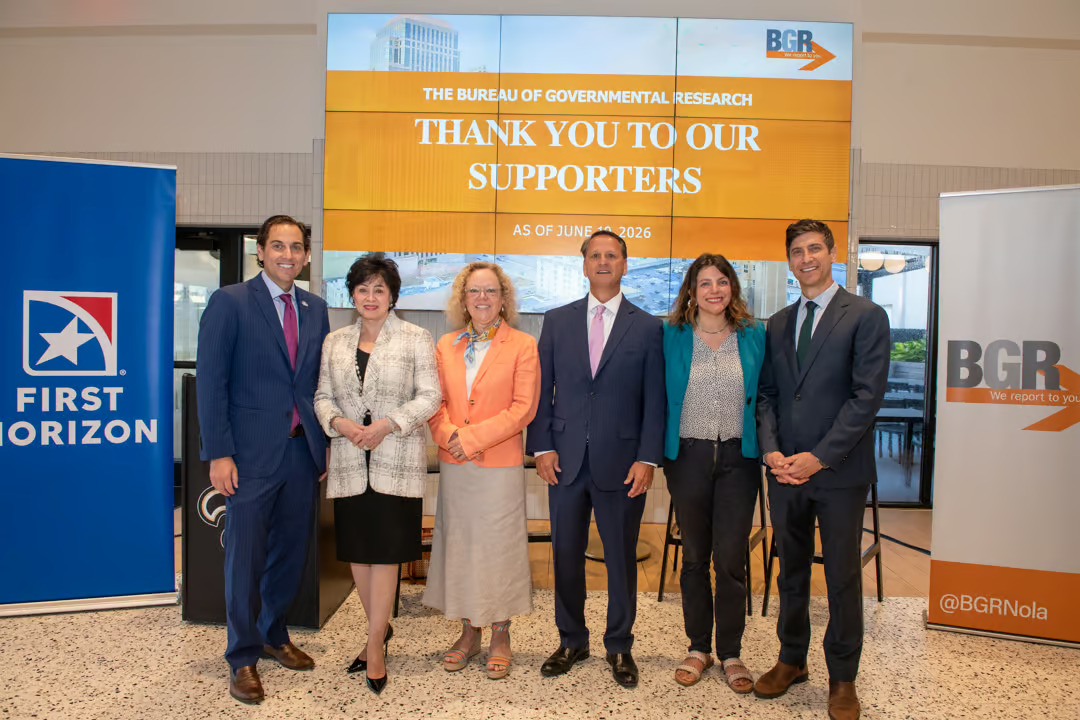
BGR Panel Maps Path to Regional Growth
By Kelly Hite
Source: Biz New Orleans
July 17, 2026
NEW ORLEANS – Attracting new businesses is only part of the equation for reversing population decline in the Greater New Orleans region, according to business and economic development leaders who gathered for the Bureau of Governmental Research (BGR) Breakfast Briefing on July 9. They said the region must also focus on growing existing companies, improving transportation and infrastructure, and creating the conditions that encourage people to live, work and build careers here. Orleans Parish lost about 7% of its population since 2019 while Jefferson Parish’s population has remained stable.
The BGR event featured Annalisa Kelly of the Jefferson Parish Economic Development Commission (JEDCO), Walt Leger of New Orleans & Company and Jeff Schwartz, deputy mayor for economic development for the City of New Orleans.
Leger said the region has built a strong entrepreneurial culture, but creating more long-term career opportunities will require helping existing businesses grow into larger employers.
“There is a lot of data that suggests that we’re a leading community in entrepreneurship and in non-employ-based business organizations like single-member LLCs and very small businesses,” Leger said. “This leads to business success for some but ultimately not employment opportunities and career growth opportunities for folks that are at mid-career.”
Leger said helping more companies scale would create additional career opportunities while making the region more competitive for talent.
BGR Panel: Building a Competitive Region
Kelly said economic development extends well beyond business recruitment and tax incentives. She said attracting and retaining residents also requires investments in education, beautification, resilience and other quality-of-life initiatives.
“It’s so important in economic development to take a holistic and overall view,” Kelly said. “We have to make sure the region is somewhere someone wants to be and so it can’t be focused just on tax incentives.”
Leger said improving regional transportation could expand economic opportunity across Greater New Orleans, with New Orleans East standing out as one area that could benefit from better connectivity.
“The South has struggled with public transportation for generations,” Leger said. “If we can crack some of that code, I think it sets us up for a dramatic movement in the right direction. If you think about New Orleans East and growing the economy there, real connectivity would transform that community.”
Supporting Long-Term Investment
Leger pointed to Mayor Helena Moreno’s July 8 announcement launching the New Orleans East Investment and Job Corridors initiative as an example of the type of long-term economic strategy the region should support.
“Yesterday Mayor Moreno announced a really exciting economic development initiative in New Orleans East, and I couldn’t help but notice on social media that there were nothing but negative comments from people in our region,” Leger said.
Leger said the initiative reflects a strategy of building on major economic assets, including the Louisiana International Terminal and NASA’s Michoud Assembly Facility, to create long-term jobs and investment in New Orleans East.
“We should rally around this plan. If it works, we should do more of it. If it doesn’t, we should come up with another strategy, but we shouldn’t ever fall into this cycle of negativity that feeds on itself. The way we communicate about ourselves really matters and the scorecard is population.”
Promoting the Region’s Strengths
Leger said Greater New Orleans also needs to do a better job highlighting the assets that distinguish the region when competing for businesses, investment and talent.
“We have to compete for talent,” Leger said. “We’ve got to highlight the great work that Shell does in helping to preserve and protect our culture with Jazz Fest every year. We’ve got to celebrate the fact that the Saints put us on an international stage every week of the football season in one of the most iconic stadiums in the world.”
“The Zurich Classic is here in Jefferson Parish because the leaders in Switzerland chose 25 years ago to invest here in our community because they believe so strongly that this was a special place,” Leger said.
Energy and Resilience
Kelly said Louisiana’s changing energy landscape presents new economic opportunities and that Louisiana can build on its traditional energy strengths while continuing to attract renewable energy companies and other emerging energy industries.
“We are an energy leader. Let’s attract ‘All of the Above,’” Kelly said. “We’ve seen such an incredible influx of renewable energy companies, we can take what could have been a threat to our economy and turn it into an opportunity.”
Kelly said she also plans to focus on encouraging more resilient design throughout the region’s built environment.
“I have charged myself over the next year or two with really looking at our built environment and how we can encourage more resilient design,” Kelly said.
Schwartz expanded on that idea, saying investments in infrastructure such as battery storage could transform resilience into an economic advantage.
“I see so much opportunity for our business community and our public sector to lead and turn what could be a liability into an asset,” Schwartz said.
Schwartz said the region’s future depends on embracing opportunities rather than becoming consumed by its challenges.
“We should not be paralyzed by where we are currently,” Schwartz said. “We don’t want to be managing decline. Managing decline leads to ‘wicked problems’ where you’re in a scarcity mindset. We have an embarrassment of riches in the city of New Orleans, in the region and in the state. I find no reason for despair where we currently are.”
About BGR
The Bureau of Governmental Research (BGR) is a nonprofit, independent research organization dedicated to informed public policy making and the effective use of public resources for the improvement of government in greater New Orleans.
Fair Use Notice
This site occasionally reprints copyrighted material, the use of which has not always been specifically authorized by the copyright owner. We make such material available in our efforts to advance understanding of issues and to highlight the accomplishments of our affiliates. We believe this constitutes a “fair use” of any such copyrighted material as provided for in section 107 of the US Copyright Law. In accordance with Title 17 U.S.C. Section 107, the material on this site is available without profit. For more information go to: US CODE: Title 17,107. Limitations on exclusive rights: Fair use. If you wish to use copyrighted material from this site for purposes of your own that go beyond “fair use,” you must obtain permission from the copyright owner.