

City Council committees advance sweeping changes to Sewerage & Water Board
By Maya Bell
Source: Verite News
July 30, 2026
The changes to the Sewerage & Water Board, which include increased oversight, will begin on August 1.
A joint New Orleans City Council committee on Thursday (July 30) voted to advance a series of measures that will make sweeping changes to the Sewerage & Water Board, including increased city oversight of the utility.
Councilmembers on the Climate Change and Sustainability and Public Works, Sanitation, and Environment committees also passed a resolution calling on the Louisiana Legislative Auditor to investigate the Sewerage & Water Board’s finances.
The council will take a final vote on the items at its regular meeting next Thursday.
The proposed changes to the Sewerage & Water Board come after the state legislature passed House Bill 1243, which gives the city control over the membership of the utility’s governing board and gives the City Council greater authority to regulate and override board decisions.
Any changes to the composition of the governing board will mean amending the city charter, which will require a citywide election. Andrew Tuozzolo, a top aide to Mayor Helena Moreno, said that the administration hopes to get something on the ballot within the next year, Gambit reported Thursday.
In the meantime, the new state law and the ordinance before the council will give Moreno the power to appoint a number of new members to the board, with council approval. The city is introducing potential new Sewerage & Water Board of Directors members in the council’s next Governmental Affairs Committee meeting on Aug. 5.
“Today we are taking on the challenge of reforming the Sewerage & Water Board,” Councilmember McCarron said at Thursday’s committee meeting. “Today this legislation creates the framework to create a better utility for the citizens of New Orleans.”
While City Council members were enthusiastic about overhauling the agency, some officials from the Sewerage & Water Board said they were skeptical.
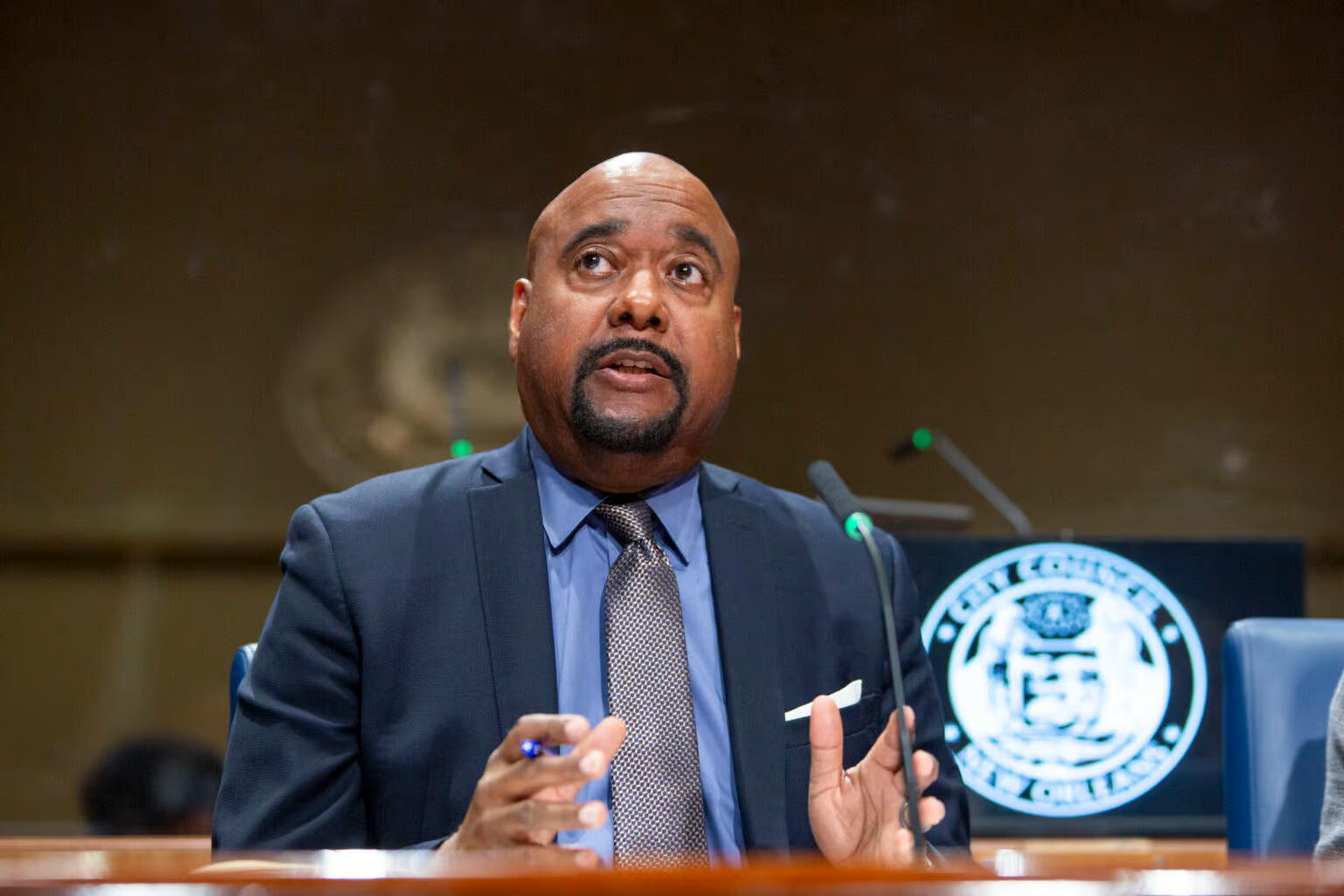
In a heated exchange, at-large Councilmember JP Morell and Sewerage & Water Board Executive Director Randy Hayman went back and forth on how the Sewerage & Water Board can make changes to leadership. Morrell has previously suggested that Hayman’s position may be redundant, floating the idea of combining it with the utility’s general superintendent, The Times-Picayune reported.
Hayman, who was hired into the role last year, argued the problems he faced during his tenure were in part due to long-neglected infrastructure and a lack of funding.
“No one can fix this system in just one year, and a lot of these issues came from the former superintendent. I did not bring up all of these issues. I did not make these pipes 100 years old. … I am here to do my job, and it’s hard to do it in 11 months,” Hayman said.
Morell pushed back, saying that the council’s issues with Sewerage & Water Board are institutional and that the changes are meant to build public trust.
“I do not blame you for the current state of the Sewerage & Water Board. I don’t think anyone here can blame any single person for an organization that is over 100 years old,” Morell said. “What is frustrating is that when we talk about the fundamental changes that have to happen at that organization, our impression of Sewerage and Water Board is ‘nothing to see, move along, we need more money’” Morell said.
What’s new
The proposed changes were presented by the Public Utility Modernization Process Subgroup (PUMPS), a group made up of city officials and experts who will monitor the transition.
According to the group’s presentation, a proposed ordinance before the committee on Thursday would give the city greater authority over the utility’s budget, rate and fee setting, and capital construction, as well as the power to remove members of the Sewerage & Water Board, including the executive director.
The ordinance would also require the Sewerage & Water Board to inform city officials of emergencies — such as boil water advisories or drainage pump failures — and coordinate emergency communications with the city Office of Coordination and Emergency Management, which runs the city’s NOLA Ready emergency communications service.
Tuozzolo said the new ordinance helps to give residents more information about the board’s work and to build trust.
“These are critical infrastructure operations. We don’t pump the city out of water, we don’t keep the water out of the pipes, we can’t have a city, so we need to have clear communications, clear authority,” Tuozzolo said.
Morell said the ordinance is good, but that he would take it a step further and remove bureaucratic roadblocks.
“We’re not talking about the guys who are literally drilling holes to fix pipes, we’re talking about looking throughout the system from the top to all the way to the bottom to we where there is duplication and we can take existing money for Sewerage and Water Board so we can repurpose it for Sewerage & Water Board, I think we need to go as far as possible to streamline it, ” Morell said.
Past issues
The changes come after years of criticism of the Sewerage & Water Board over frequent equipment failures and poor customer service. .
During a rainstorm earlier this month , drainage pumps serving Mid-City, Lakeview and Hollygrove failed causing flooding. The Sewerage & Water Board said some of those failures were caused by human error.
In addition, the utility has been repeatedly criticized for its handling of a nearly yearlong construction project in the French Quarter, which caused prolonged street closures and led to the closure of several businesses. Gov. Jeff Landry recently called for an audit of the Sewerage & Water Board’s monthslong construction project on Decatur Street.
Rebecca Mowbray, the president and CEO of the Bureau of Governmental Research, said that prior to the recent state legislation, city-led reform of the Sewerage & Water Board was all but impossible.
“It’s very hard to fix anything about the Sewerage & Water Board because, again, until the legislation that was passed this spring, the Sewerage & Water Board was set up in more than 80 laws in state law,” Mowbray said. “If you wanted to make any change, you had to go to Baton Rouge and convince lawmakers from around the state who had really no connection to New Orleans and would resent being asked about the Sewerage & Water Board because they looked at it as a fundamentally local issue.”
McCarron said the legislation is meant to build lost trust for residents.
“It’s a challenge, but I think we will have a clear understanding of what it looks like at Sewerage & Water Board and we’ll be able to be on the ground understanding the problems,” McCaron said.
Fair Use Notice
This site occasionally reprints copyrighted material, the use of which has not always been specifically authorized by the copyright owner. We make such material available in our efforts to advance understanding of issues and to highlight the accomplishments of our affiliates. We believe this constitutes a “fair use” of any such copyrighted material as provided for in section 107 of the US Copyright Law. In accordance with Title 17 U.S.C. Section 107, the material on this site is available without profit. For more information go to: US CODE: Title 17,107. Limitations on exclusive rights: Fair use. If you wish to use copyrighted material from this site for purposes of your own that go beyond “fair use,” you must obtain permission from the copyright owner.